
A French Word to Live By
How to Conjugate Imprégner in French
/ɛ̃.pʁe.ɲe/
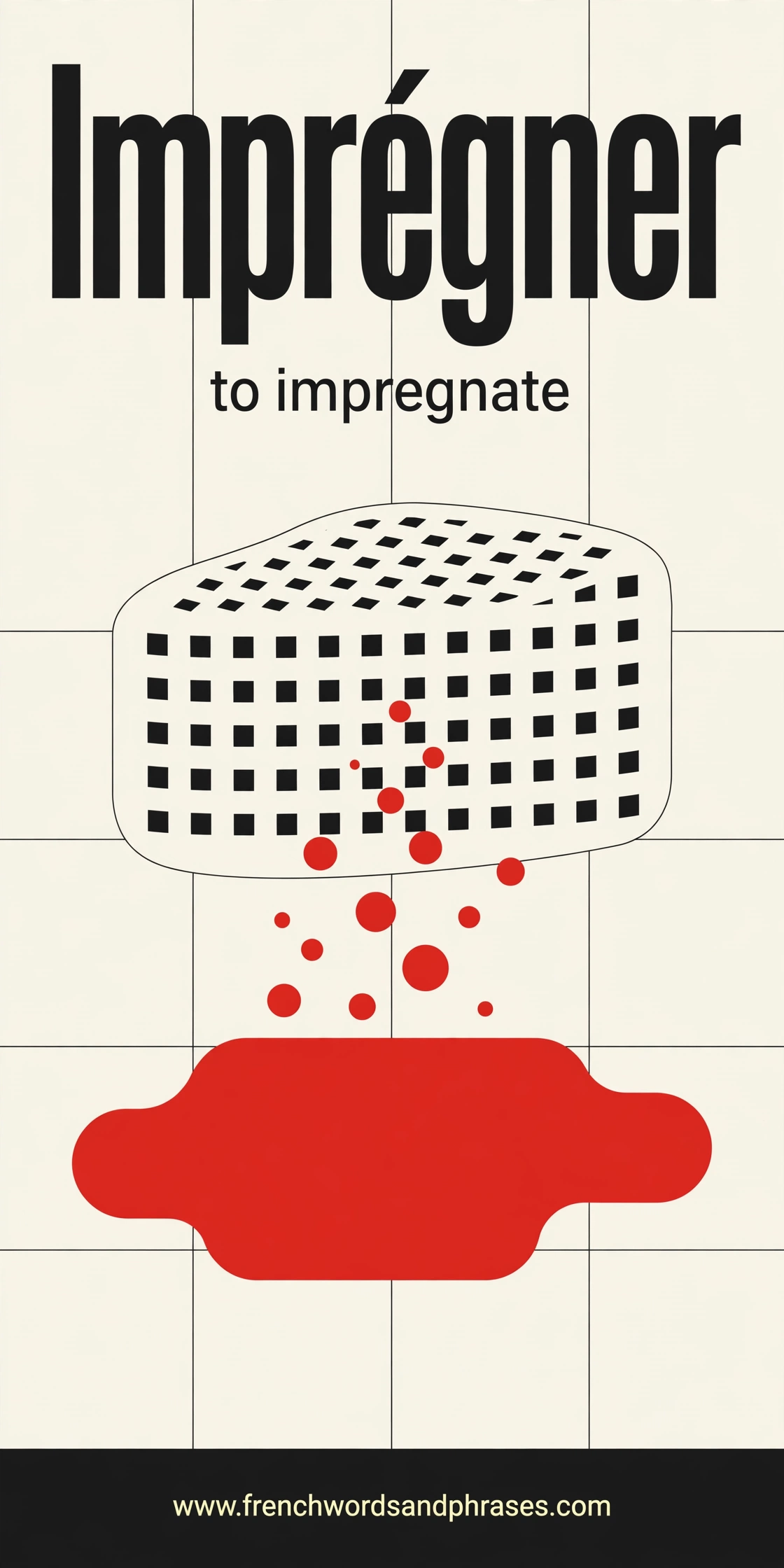
Imprégner means to impregnate, to permeate — to soak deep into something until the whole thing is filled with it: a smell into curtains, a culture into a mind.
Rain soaking into dry earth, the smell of woodsmoke living in an old jumper for years — imprégner is the verb of deep soaking: nothing stays on the surface, everything goes through and through.
In this guide, you’ll learn how to conjugate imprégner in all the major French tenses and moods. Explore complete conjugation tables, French examples, English translations, and practice quizzes.
Understanding the French Verb Imprégner
Imprégner is a regular French verb belonging to the first group of verbs, those ending in-er.
It means to impregnate, to permeate. Physically, liquids and smells imprègnent fabrics, wood and walls. Figuratively — and most often today — minds and works are imprégnés de something: un roman imprégné de mélancolie, une enfance imprégnée de musique. S’imprégner de is always deliberate and positive: you expose yourself to something until it becomes part of you.
Verb classification: First group (-er)
Auxiliary verb: Avoir
Past participle: imprégné
Present participle: imprégnant
English equivalents: To impregnate, to permeate, to soak into; imprégner un tissu d’huile — to impregnate a cloth with oil; une odeur qui imprègne la maison — a smell that permeates the house; s’imprégner de — to become imbued with, to soak up: s’imprégner de la culture locale — to soak up the local culture; imprégné de traditions — steeped in traditions.
One important detail: imprégner is an espérer-type verb — the é of the stem opens to è in the present singular and third plural, in the subjunctive singular and third plural, and in the tu imperative: j’imprègne, tu imprègnes, il imprègne, ils imprègnent. But the future and conditional keep é: j’imprégnerai, j’imprégnerais, and so do the sounded endings: nous imprégnons, vous imprégnez. The reflexive s’imprégner de is the traveller’s verb: to soak up an atmosphere, a language, a culture — il s’est imprégné de l’ambiance du village. Mind the gn: it is pronounced like the gn in montagne, one soft sound.
Experience the Word
Imprégner is the verb of the deep soak — what enters does not stop at the surface, it goes to the last fibre.
Imagine a fisherman’s cottage after forty winters of wood fires. The curtains, the beams, the old dog’s blanket — everything smells of smoke, doucement, pour toujours. La fumée a imprégné la maison entière, and no spring cleaning will ever quite wash it out.
The smell is not on the house, it is in it. The cottage has been permeated — imprégnée, soaked through, to the beams.
How to Conjugate Imprégner: Complete French Conjugation Guide
Let’s explore every major conjugation of imprégner, beginning with the indicative mood.
How to Conjugate Imprégner in the Indicative Mood
The indicative mood is used to express facts, observations, actions, and events.
How to Conjugate Imprégner in the Present Tense (Présent)
Used for actions happening now, habitual actions, and general truths.
| Subject | Conjugation |
|---|---|
| je | imprègne |
| tu | imprègnes |
| il / elle | imprègne |
| nous | imprégnons |
| vous | imprégnez |
| ils / elles | imprègnent |
Example
Cette odeur imprègne tous les vêtements de la maison.
This smell permeates all the clothes in the house.
Quick Quiz 1
Complete the sentence:
Nous ______ le bois avec de l’huile de lin.
Reveal the answer
imprégnons
Nous imprégnons le bois avec de l’huile de lin.
We impregnate the wood with linseed oil.
How to Conjugate Imprégner in the Passé Composé
Used for completed actions in the past. Imprégner takes the auxiliary verb avoir.
| Subject | Conjugation |
|---|---|
| j’ | ai imprégné |
| tu | as imprégné |
| il / elle | a imprégné |
| nous | avons imprégné |
| vous | avez imprégné |
| ils / elles | ont imprégné |
Example
La pluie a imprégné la terre sèche en une nuit.
The rain soaked into the dry earth in one night.
How to Conjugate Imprégner in the Imparfait (Imperfect Tense)
Used for habitual past actions, descriptions, and ongoing situations in the past.
| Subject | Conjugation |
|---|---|
| je | imprégnais |
| tu | imprégnais |
| il / elle | imprégnait |
| nous | imprégnions |
| vous | imprégniez |
| ils / elles | imprégnaient |
Example
Le parfum du jasmin imprégnait le jardin entier.
The scent of jasmine used to permeate the whole garden.
Quick Quiz 2
Choose the correct form:
The rain soaked into the dry earth.
La pluie ______ la terre sèche. (a imprégné / est imprégné)
Reveal the answer
a imprégné
La pluie a imprégné la terre sèche.
Imprégner takes avoir.
How to Conjugate Imprégner in the Plus-que-parfait
Used to describe an action that had already been completed before another past event.
| Subject | Conjugation |
|---|---|
| j’ | avais imprégné |
| tu | avais imprégné |
| il / elle | avait imprégné |
| nous | avions imprégné |
| vous | aviez imprégné |
| ils / elles | avaient imprégné |
Example
L’humidité avait imprégné les murs de la cave.
The damp had soaked into the cellar walls.
How to Conjugate Imprégner in the Passé Simple
Primarily used in formal writing, literature, and historical narratives. It is rarely used in everyday conversation.
| Subject | Conjugation |
|---|---|
| je | imprégnai |
| tu | imprégnas |
| il / elle | imprégna |
| nous | imprégnâmes |
| vous | imprégnâtes |
| ils / elles | imprégnèrent |
Example
Une tristesse douce imprégna tout le roman.
A gentle sadness permeated the whole novel.
How to Conjugate Imprégner in the Passé Antérieur
A literary tense used to express an action completed immediately before another past action, generally in the passé simple.
| Subject | Conjugation |
|---|---|
| j’ | eus imprégné |
| tu | eus imprégné |
| il / elle | eut imprégné |
| nous | eûmes imprégné |
| vous | eûtes imprégné |
| ils / elles | eurent imprégné |
Example
Quand la fumée eut imprégné les rideaux, on ouvrit les fenêtres.
When the smoke had soaked into the curtains, they opened the windows.
How to Conjugate Imprégner in the Future Tense (Futur Simple)
Used to describe actions that will take place in the future.
| Subject | Conjugation |
|---|---|
| je | imprégnerai |
| tu | imprégneras |
| il / elle | imprégnera |
| nous | imprégnerons |
| vous | imprégnerez |
| ils / elles | imprégneront |
Example
Ce voyage imprégnera son écriture pour toujours.
This journey will permeate his writing for ever.
How to Conjugate Imprégner in the Futur Antérieur (Future Perfect)
Used for an action that will have been completed before a particular point in the future.
| Subject | Conjugation |
|---|---|
| j’ | aurai imprégné |
| tu | auras imprégné |
| il / elle | aura imprégné |
| nous | aurons imprégné |
| vous | aurez imprégné |
| ils / elles | auront imprégné |
Example
À la fin de l’été, la mer aura imprégné tous ses souvenirs.
By the end of the summer, the sea will have soaked into all her memories.
How to Conjugate Imprégner in the Near Future (Futur Proche)
Used to describe something that is going to happen soon. Formed with aller + infinitive.
| Subject | Conjugation |
|---|---|
| je | vais imprégner |
| tu | vas imprégner |
| il / elle | va imprégner |
| nous | allons imprégner |
| vous | allez imprégner |
| ils / elles | vont imprégner |
Example
Attention, l’encre va imprégner le papier fin.
Careful, the ink is going to soak through the thin paper.
How to Conjugate Imprégner in the Conditional Mood
The conditional mood expresses what would happen under certain circumstances. It is also frequently used to make polite requests or express wishes.
How to Conjugate Imprégner in the Present Conditional
| Subject | Conjugation |
|---|---|
| je | imprégnerais |
| tu | imprégnerais |
| il / elle | imprégnerait |
| nous | imprégnerions |
| vous | imprégneriez |
| ils / elles | imprégneraient |
Example
Un séjour d’un an imprégnerait son accent de soleil.
A year’s stay would soak his accent in sunshine.
How to Conjugate Imprégner in the Past Conditional
| Subject | Conjugation |
|---|---|
| j’ | aurais imprégné |
| tu | aurais imprégné |
| il / elle | aurait imprégné |
| nous | aurions imprégné |
| vous | auriez imprégné |
| ils / elles | auraient imprégné |
Example
La pluie aurait imprégné nos manteaux sans l’abri.
The rain would have soaked our coats without the shelter.
Imprégner in the Literary Past Conditional Form
This less common literary form uses the imperfect subjunctive of avoir.
| Subject | Conjugation |
|---|---|
| j’ | eusse imprégné |
| tu | eusses imprégné |
| il / elle | eût imprégné |
| nous | eussions imprégné |
| vous | eussiez imprégné |
| ils / elles | eussent imprégné |
Example
La mélancolie eût imprégné le poème sans la dernière strophe.
Melancholy would have permeated the poem without the last stanza.
How to Conjugate Imprégner in the Subjunctive Mood
The subjunctive is used to express wishes, emotions, doubts, necessity, and uncertainty. It frequently follows expressions such as il faut que (it is necessary that) or bien que (although).
How to Conjugate Imprégner in the Present Subjunctive
| Subject | Conjugation |
|---|---|
| que je | imprègne |
| que tu | imprègnes |
| qu’il / qu’elle | imprègne |
| que nous | imprégnions |
| que vous | imprégniez |
| qu’ils / qu’elles | imprègnent |
Example
Il faut que l’huile imprègne bien le bois.
The oil must soak well into the wood.
Quick Quiz 3
Complete the sentence using the subjunctive:
Il faut que vous vous ______ de l’ambiance du festival.
Reveal the answer
imprégniez
Il faut que vous vous imprégniez de l’ambiance du festival.
You must soak up the atmosphere of the festival.
How to Conjugate Imprégner in the Imperfect Subjunctive
A literary tense, rarely encountered in modern spoken French.
| Subject | Conjugation |
|---|---|
| que je | imprégnasse |
| que tu | imprégnasses |
| qu’il / qu’elle | imprégnât |
| que nous | imprégnassions |
| que vous | imprégnassiez |
| qu’ils / qu’elles | imprégnassent |
Example
On craignait que l’odeur imprégnât toute la maison.
People feared the smell might permeate the whole house.
How to Conjugate Imprégner in the Pluperfect Subjunctive
A literary construction used to express an action completed before another past action.
| Subject | Conjugation |
|---|---|
| que j’ | eusse imprégné |
| que tu | eusses imprégné |
| qu’il / qu’elle | eût imprégné |
| que nous | eussions imprégné |
| que vous | eussiez imprégné |
| qu’ils / qu’elles | eussent imprégné |
Example
On racontait que la culture du pays eût imprégné son œuvre.
People said the country’s culture had permeated his work.
How to Conjugate Imprégner in the Past Subjunctive
| Subject | Conjugation |
|---|---|
| que j’ | aie imprégné |
| que tu | aies imprégné |
| qu’il / qu’elle | ait imprégné |
| que nous | ayons imprégné |
| que vous | ayez imprégné |
| qu’ils / qu’elles | aient imprégné |
Example
Je suis content que ce séjour ait imprégné son écriture.
I am glad this stay permeated her writing.
How to Conjugate Imprégner in the Imperative
The imperative is used to give commands, instructions, invitations, or suggestions. Subject pronouns are omitted.
How to Conjugate Imprégner in the Present Imperative
| Person | Conjugation |
|---|---|
| (tu) | imprègne |
| (nous) | imprégnons |
| (vous) | imprégnez |
Example
Imprègne-toi de l’ambiance avant de juger !
Soak up the atmosphere before judging!
Quick Quiz 4
How would you say Soak up the atmosphere (tu form)?
Reveal the answer
Imprègne-toi de l’ambiance !
French Participles of Imprégner
Participles are verb forms that can be used in compound tenses and other grammatical constructions.
Present Participle of Imprégner
imprégnant
En imprégnant le tissu, l’huile le rend imperméable.
By impregnating the cloth, the oil makes it waterproof.
Past Participle of Imprégner
imprégné
Imprégné de musique dès l’enfance, il est devenu chef d’orchestre.
Steeped in music from childhood, he became a conductor.
Imprégner in Everyday French: Real-Life Examples
Now that you know the conjugations, let’s see how imprégner appears in everyday French.
Example 1 — Present
Cette odeur imprègne tous les vêtements.
This smell permeates all the clothes.
Example 2 — Passé composé
La pluie a imprégné la terre sèche.
The rain soaked into the dry earth.
Example 3 — Imparfait
Le jasmin imprégnait le jardin.
The jasmine used to permeate the garden.
Example 4 — Future
Ce voyage imprégnera son écriture.
This journey will permeate his writing.
Example 5 — Conditional
Un long séjour imprégnerait son accent.
A long stay would soak into his accent.
Example 6 — Imperative
Imprègne-toi de la culture locale !
Soak up the local culture!
Beyond Translation: The Meaning of Imprégner
English impregnate has narrowed to laboratories and biology; French imprégner has kept the wide, poetic field — smells, rain, memories, whole cultures soaking into things.
Nothing merely touches; everything soaks through.
And its reflexive is the kindest travel advice in the language: imprègne-toi du pays — do not just visit the country, let it soak into you.
How to Remember the French Verb Imprégner
Remember it this way: Imprégner is about woodsmoke living in the cottage curtains for forty years.
- Espérer-type spelling: j’imprègne with è in the present, but j’imprégnerai with é in the future.
- The gn is one soft sound, as in montagne: imprégner, imprégné.
- S’imprégner de is the traveller’s verb: to soak up a culture, an atmosphere, a language.
The key idea is woodsmoke living in the cottage curtains for forty years.
Test Your Knowledge of Imprégner
Let’s see how much you’ve learned. Try answering these questions before revealing the answers.
Question 1
Why does je imprègne have a grave accent but je imprégnerai an acute one?
Reveal the answer
The espérer-type rule — é becomes è in the present and subjunctive stems, but the future and conditional keep é: j’imprégnerai.
Question 2
How do you say The rain soaked into the dry earth in French?
Reveal the answer
La pluie a imprégné la terre sèche.
Question 3
Translate: Soak up the local culture!
Reveal the answer
Imprègne-toi de la culture locale !
Question 4
What is the past participle of imprégner?
Reveal the answer
Imprégné.
Question 5
Complete the sentence:
Il faut que l’huile ______ bien le bois.
Reveal the answer
imprègne
Il faut que l’huile imprègne bien le bois.
The oil must soak well into the wood.
Your Final Challenge
Can You Use It?
How would you say this in French?
For a year, she soaked up the language and the songs of the village, and she never really left.
Reveal the answer
Pendant un an, elle s’est imprégnée de la langue et des chansons du village, et elle n’est jamais vraiment repartie.
For a year, she soaked up the language and the songs of the village, and she never really left.
A little French. A little curiosity. A richer everyday life.
LEARN FRENCH ONE WORD AT A TIME




