
A French Word to Live By
Translate Accotement stabilisé to English
/a.kɔt.mɑ̃ sta.bi.li.ze/
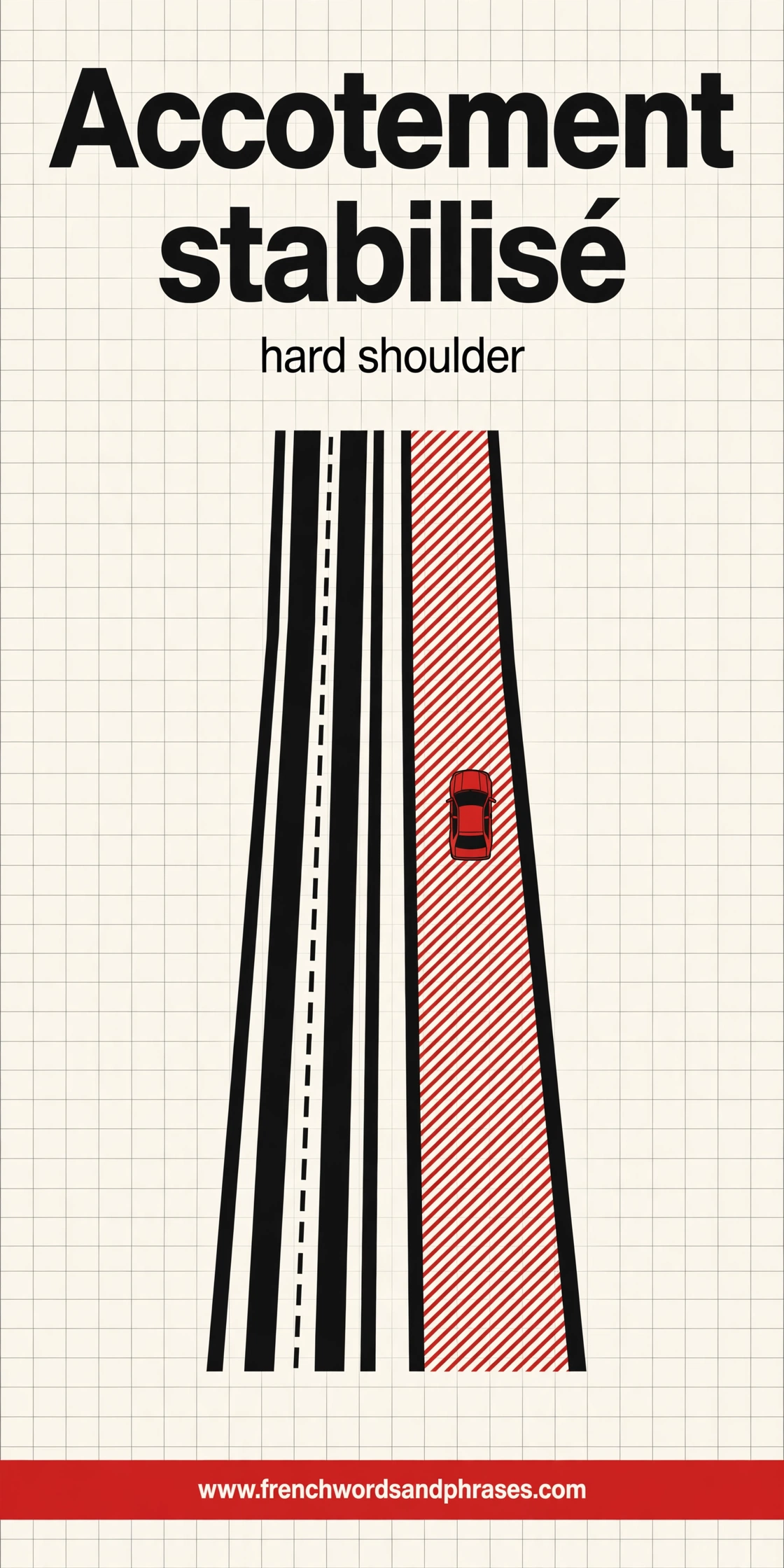
Accotement stabilisé means hard shoulder — the reinforced strip at the side of a motorway, for emergencies only.
Motorway, rain, a warning light blinking on the dashboard. The driver signals, slows, and rolls onto the firm strip at the road’s edge — l’accotement stabilisé, the hard shoulder, the one place on a motorway where stopping is allowed to save you.
Let’s explore how accotement stabilisé works in French, beginning with the whole phrase on one card.
Understanding the French Phrase Accotement stabilisé
Accotement stabilisé is a French road term built from accotement (the shoulder, the strip at the side of a road — a masculine noun) and stabilisé (stabilised, reinforced — the past participle of stabiliser). It names the difference between a verge that holds a car and a verge that swallows one: this shoulder has been built, packed and surfaced to bear weight.
It means the hard shoulder — the reinforced strip along a motorway or main road where a broken-down vehicle can stop safely. Its opposite is painted on French road signs everywhere: accotement non stabilisé, the soft verge, where a wheel sinks into gravel and grass. Learn the pair and you can read the edge of every French road: stabilisé, firm and safe; non stabilisé, keep your wheels on the tarmac.
Type: Road and driving term — noun phrase (accotement + stabilisé)
Answers the need: Naming the firm, reinforced shoulder at the side of a motorway
Register: Technical and official — road signs, driving tests, highway code
Strength: Safety-critical — it is the emergency strip, not a parking place
One important usage detail: on French motorways the emergency lane proper is la bande d’arrêt d’urgence — the marked lane for breakdowns. L’accotement stabilisé is the broader term for a reinforced shoulder on any road, and the sign accotement non stabilisé warns that the verge beside you is soft. Stopping on either, outside a real emergency, is forbidden — they are rescue strips, not picnic spots.
Experience the Word
Accotement stabilisé is the phrase of the driving test and the rainy breakdown — the strip of road that asks nothing and holds everything.
Imagine the family car coughing to a halt at midnight, hazard lights on, father rolling the car gently off the lane. The wheels find firm ground, everyone breathes: heureusement, l’accotement est stabilisé. On a soft verge, the same night ends in a ditch and a tow truck.
English calls it the hard shoulder — the shoulder that is hard. French explains instead of naming: accotement stabilisé, a shoulder that has been stabilised, engineered to hold you when the road lets you down.
How to Use Accotement stabilisé in French: Complete Guide
Let’s explore how accotement stabilisé works in French, beginning with the whole phrase on one card.
Accotement stabilisé at a Glance
The Whole Phrase on One Card
Real meaning, literal picture, English twin and register — accotement stabilisé in five lines.
| Point | Accotement stabilisé |
|---|---|
| What it really means | the hard shoulder — a reinforced verge that can bear a stopped vehicle |
| Word for word | a stabilised shoulder — accotement (roadside strip) + stabilisé (reinforced) |
| English equivalent | hard shoulder |
| Register | technical and official — signs, driving theory, road works |
| Use it for | breakdowns, road signs, driving-test questions |
Example
La voiture en panne est garée sur l’accotement stabilisé.
The broken-down car is parked on the hard shoulder.
Word by Word: Building the Hard Shoulder
Two pieces — the strip of road, and the engineering that makes it trustworthy.
| Word | Literal meaning | Its job in the phrase |
|---|---|---|
| accotement | the shoulder, the roadside strip | the ground at the road’s edge — a masculine noun: un accotement |
| stabilisé | stabilised, reinforced | the ground has been built and packed to bear weight |
| non stabilisé | not reinforced | the warning twin: soft ground, wheels beware |
Example
Attention, accotement non stabilisé après le pont.
Careful, soft verge after the bridge.
Quick Quiz 1
A sign reads accotement non stabilisé. What is it warning you about?
Reveal the answer
The verge is soft — not reinforced: a wheel that leaves the tarmac may sink or slip. Non stabilisé is the dangerous twin of stabilisé.
Accotement non stabilisé, restez sur la chaussée.
Soft verge, stay on the road surface.
When You Say It: The Roadside Moments
Accotement stabilisé appears at moments like these — breakdowns, roadworks and theory tests.
| Situation | Example |
|---|---|
| A breakdown | se garer sur l’accotement stabilisé — to pull over onto the hard shoulder |
| A road sign | accotement non stabilisé — soft verge (warning sign) |
| Roadworks | l’accotement stabilisé est en travaux — the hard shoulder is under repair |
| The driving test | question sur l’accotement stabilisé — a theory question on the hard shoulder |
| An accident report | le véhicule s’est arrêté sur l’accotement stabilisé — the vehicle stopped on the hard shoulder |
Example
En cas de panne, garez-vous sur l’accotement stabilisé et allumez vos feux de détresse.
In case of breakdown, pull onto the hard shoulder and switch on your hazard lights.
Make It Yours: The Shoulder and Its States
The noun stays fixed — the adjective after it carries the safety news.
| Form | French | In English |
|---|---|---|
| Reinforced | un accotement stabilisé | a hard shoulder |
| Not reinforced | un accotement non stabilisé | a soft verge |
| On the shoulder | sur l’accotement | on the shoulder |
| Off the road | en dehors de la chaussée | off the carriageway |
| The emergency lane | la bande d’arrêt d’urgence | the emergency lane (motorways) |
Example
Ne roulez jamais sur un accotement non stabilisé.
Never drive on a soft verge.
Quick Quiz 2
Complete it: En cas de panne, je me gare sur l’accotement ______. (hard, reinforced)
Reveal the answer
stabilisé — l’accotement stabilisé, the hard shoulder that can bear the car.
Je me gare sur l’accotement stabilisé, feux de détresse allumés.
I pull onto the hard shoulder, hazard lights on.
Everyday Expressions: Building on the Shoulder
Accotement stabilisé slots into these frames — each one ready to use as it stands.
| Frame | In English |
|---|---|
| se garer sur l’accotement | to pull over onto the shoulder |
| accotement non stabilisé | soft verge — the warning sign |
| la bande d’arrêt d’urgence | the emergency lane on a motorway |
| les feux de détresse | the hazard lights — switched on the moment you stop |
| le triangle de signalisation | the warning triangle — placed behind the car |
Example
Placez le triangle de signalisation derrière la voiture, sur l’accotement.
Place the warning triangle behind the car, on the shoulder.
Close Cousins: The Other Edge-of-Road Words
The road’s edge has a small vocabulary — accotement stabilisé is the engineered shoulder; its cousins name lanes, verges and ditches.
| Expression | The difference |
|---|---|
| accotement stabilisé | the hard shoulder — reinforced, bears a vehicle |
| bande d’arrêt d’urgence | the emergency lane — the marked motorway lane for breakdowns |
| accotement non stabilisé | the soft verge — unreinforced, a trap for wheels |
| bas-côté | the verge, the roadside — the everyday, older word |
| fossé | the ditch — where a soft verge likes to deliver you |
Example
Le bas-côté est mouillé, mais l’accotement stabilisé tient bon.
The verge is wet, but the hard shoulder holds firm.
Quick Quiz 3
On a motorway, what is the marked emergency lane called — l’accotement or la bande d’arrêt d’urgence?
Reveal the answer
La bande d’arrêt d’urgence — the emergency lane, the marked motorway lane. Accotement is the general word for the roadside strip.
Restez dans la bande d’arrêt d’urgence en cas de panne.
Stay in the emergency lane in case of breakdown.
Accotement stabilisé and Its Neighbours
The roadside shelf around the phrase — the lane, the lights and the triangle.
| French | In English |
|---|---|
| la chaussée | the road surface, the carriageway |
| une voie | a lane |
| les feux de détresse | the hazard lights |
| une panne | a breakdown |
| le code de la route | the highway code |
Example
Le code de la route interdit de s’arrêter sans raison sur l’accotement.
The highway code forbids stopping on the shoulder without a reason.
Watch Out: The Traps Around Accotement stabilisé
The traps: a shoulder that is not for parking, and a soft twin that punishes the unwary.
| Trap | The truth |
|---|---|
| stopping for a picnic or a nap | the shoulder is for emergencies only — stopping without a breakdown is an offence |
| confusing stabilisé and non stabilisé | one letter’s worth of sign, a ditch’s worth of difference: non stabilisé means soft ground |
| translating word for word | English says hard shoulder, never “stabilised shoulder” — the French term is the technical description |
| the gender of accotement | accotement is masculine: un accotement stabilisé, with stabilisé in the masculine too |
Example
Un accotement stabilisé n’est pas un parking : urgences seulement.
A hard shoulder is not a car park: emergencies only.
Quick Quiz 4
True or false: the hard shoulder is a good place for a picnic on a long drive.
Reveal the answer
False — l’accotement stabilisé is an emergency strip. Picnics belong on an aire de repos, a rest area.
Pour le pique-nique, arrêtez-vous à l’aire de repos.
For the picnic, stop at the rest area.
Accotement stabilisé in Everyday French: Real-Life Examples
Now that you know the word, let’s see how accotement stabilisé appears in everyday French.
Example 1 — The breakdown
Panne sur l’autoroute : il se gare sur l’accotement stabilisé, feux de détresse allumés.
Breakdown on the motorway: he pulls onto the hard shoulder, hazard lights on.
Example 2 — The road sign
Le panneau annonce : accotement non stabilisé sur deux kilomètres.
The sign announces: soft verge for two kilometres.
Example 3 — The driving test
À l’examen du code, une question porte sur l’accotement stabilisé.
In the theory exam, one question is about the hard shoulder.
Example 4 — Roadworks
Les ouvriers refont l’accotement stabilisé avant l’hiver.
The workers are resurfacing the hard shoulder before winter.
Example 5 — The near miss
La roue a mordu l’accotement non stabilisé, et la voiture a glissé vers le fossé.
The wheel bit into the soft verge, and the car slid towards the ditch.
Example 6 — Good advice
En cas de crevaison, rejoignez l’accotement stabilisé avant de changer la roue.
In case of a puncture, reach the hard shoulder before changing the wheel.
Beyond Translation: The Meaning of Accotement stabilisé
Road vocabulary is where a language shows its engineering. English gives the motorway a body — a shoulder, and the shoulder is hard. French gives it a report: accotement stabilisé, the strip has been examined, packed, stabilised, signed off. One language trusts the metaphor, the other trusts the paperwork.
To read accotement stabilisé on a sign is to read a promise: this ground has been prepared for your worst moment on the road.
And its warning twin, non stabilisé, is the same paperwork with the opposite verdict — together the pair teach the real lesson of French driving: the edge of the road is a place with rules, signs and consequences, like everything else in the code de la route.
How to Remember the French Phrase Accotement stabilisé
Remember it this way: Accotement stabilisé means hard shoulder — the reinforced roadside strip; its warning twin, accotement non stabilisé, is the soft verge.
- You learn the pair — stabilisé holds a car, non stabilisé swallows a wheel.
- You keep it for emergencies — the shoulder is a rescue strip, never a parking place or a picnic lawn.
- You know the motorway cousin — the marked emergency lane is la bande d’arrêt d’urgence.
The key idea is accotement stabilisé means hard shoulder — reinforced verge; non stabilisé = soft verge, emergencies only.
Test Your Knowledge of Accotement stabilisé
Let’s see how much you’ve learned. Try answering these questions before revealing the answers.
Question 1
What does accotement stabilisé mean?
Reveal the answer
Hard shoulder — the reinforced strip at the side of a motorway, for emergencies.
Question 2
What does accotement non stabilisé mean?
Reveal the answer
Soft verge — the unreinforced roadside, where a wheel can sink or slip.
Question 3
Translate: Pull onto the hard shoulder.
Reveal the answer
Garez-vous sur l’accotement stabilisé.
Question 4
What is the emergency lane on a motorway called?
Reveal the answer
La bande d’arrêt d’urgence — the marked lane reserved for breakdowns.
Question 5
Complete the sentence:
En cas de panne, je m’arrête sur l’______ stabilisé. (shoulder)
Reveal the answer
accotement
En cas de panne, je m’arrête sur l’accotement stabilisé.
In case of breakdown, I stop on the hard shoulder.
Your Final Challenge
Can You Use It?
How would you say this in French?
“In case of breakdown, pull onto the hard shoulder.”
Reveal the answer
En cas de panne, garez-vous sur l’accotement stabilisé.
In case of breakdown, pull onto the hard shoulder.
A little French. A little curiosity. A richer everyday life.
LEARN FRENCH ONE WORD AT A TIME




