A French Word to Live By
Translate Accordé to English
/a.kɔʁ.de/
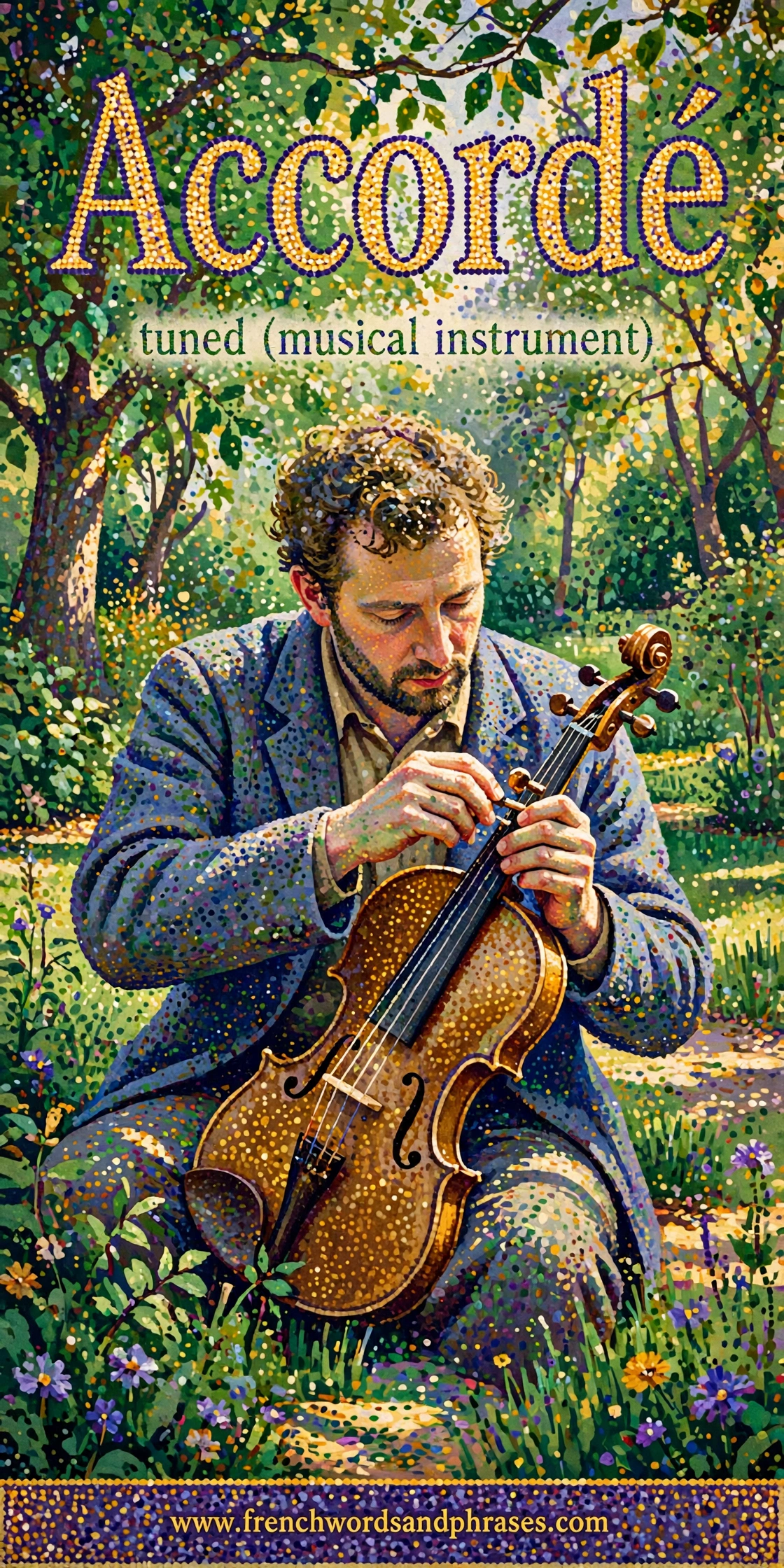
Accordé means tuned (musical instrument).
The piano tuner closes the lid, plays one slow chord, and nods like a doctor satisfied with a heartbeat. « Voilà, il est accordé. » After an hour of tiny turns and listening silences, the old piano sings true again. Accordé is the adjective of the instrument in tune: every string at its right pitch, ready for music.
In this guide, you’ll learn what accordé means in English for instruments, how its feminine accordée is formed, the dreaded opposite désaccordé, and the careful phrase piano bien accordé. Explore French examples, English translations, and practice quizzes.
Understanding the French Adjective Accordé
Accordé is a French adjective of quality — the adjective of the tuned instrument. It is the past participle of the verb accorder (to tune) working as an adjective: un piano accordé, une guitare accordée, des violons accordés. An instrument that is accordé has every string or pipe brought to the correct pitch; its unhappy opposite, désaccordé, is out of tune.
It means tuned — set to the correct pitch: un piano bien accordé, a well-tuned piano; une harpe accordée, a tuned harp. Musicians check it before every concert: les instruments sont-ils accordés ? The same verb accorder also means to grant (accorder un délai, to grant extra time), but this page is the musician’s accordé: pitch-perfect and ready to play.
Type: Adjective of quality — musical pitch; past participle of accorder
Answers the question: What is it like? — tuned, at the correct pitch
Changes form: Feminine adds -e — accordé / accordée; plurals accordés / accordées
English equivalents: Tuned; in tune; pitch-perfect.
One important usage detail: accordé follows the instrument’s name — un violon accordé, une flûte accordée — and bien or mal fine-tune the judgement: bien accordé, well tuned; mal accordé, badly tuned. For the complete opposite, French swaps the prefix: désaccordé, out of tune, the word every orchestra dreads.
Experience the Word
Accordé is the adjective of the first perfect chord — the moment the tuner steps back and the instrument, silent all morning, suddenly agrees with itself.
Imagine a village church organ, silent since Easter. The organ builder climbs inside among the pipes, and one by one the notes return, pure and steady. When the first hymn rises, accordé from bass to treble, the whole congregation smiles before a word is sung.
You have not just said an instrument works. You have named pitch in its right place — accordé, every string true, the music ready to begin.
How to Use Accordé in French: Complete Guide
Let’s explore how accordé works in French, beginning with the whole word on one card.
Accordé at a Glance
Before the details, here is the whole word on one card.
The Whole Word on One Card
Meaning, type, position and forms — accordé in four lines.
| Point | Accordé |
|---|---|
| Meaning | tuned — at the correct pitch |
| Type | adjective of quality — music (participle of accorder) |
| Usual position | after the instrument — un piano accordé |
| Form | accordé / accordée — accordés / accordées in the plural |
Example
Le piano est enfin accordé.
The piano is finally tuned.
The Four Forms of Accordé
Accordé follows the regular participle pattern: the feminine adds an e, the plurals add an s.
| Form | Accordé | Example |
|---|---|---|
| Masculine singular | accordé | un piano accordé — a tuned piano |
| Feminine singular | accordée | une guitare accordée — a tuned guitar |
| Masculine plural | accordés | des violons accordés — tuned violins |
| Feminine plural | accordées | des harpes accordées — tuned harps |
Example
Les harpes accordées attendent les musiciennes.
The tuned harps await the musicians.
Quick Quiz 1
What is the feminine of accordé?
Reveal the answer
accordée
Une guitare accordée — the feminine adds an e.
A tuned guitar.
The Feminine of Accordé: Accordée
Accordée is not a separate word to learn later — it is half of this word’s life, formed exactly like the feminine of arrivé or préparé.
| Situation | Example |
|---|---|
| Masculine | un violon accordé — a tuned violin |
| Feminine | une flûte accordée — identical but for the added e |
| Why | participle adjectives in -é form their feminine with -ée |
| The plural | add s — des flûtes accordées, tuned flutes |
Example
La flûte, accordée avec soin, sonne juste.
The flute, carefully tuned, sounds true.
Where Accordé Goes: After the Instrument
Accordé follows the noun it describes, or sits after être when the musician checks the pitch.
| Pattern | Example |
|---|---|
| After the noun | un orgue accordé — a tuned organ |
| After être | la guitare est accordée — the guitar is tuned |
| With an adverb | un piano bien accordé — a well-tuned piano |
| Before the noun | un accordé piano — not in everyday French |
Example
Les instruments accordés remplissent déjà la salle de murmures.
The tuned instruments already fill the hall with murmurs.
Quick Quiz 2
How do you say ‘the guitar is tuned’ — la guitare est accordé or la guitare est accordée?
Reveal the answer
la guitare est accordée
The adjective agrees with the instrument: guitare is feminine, so accordée.
The guitar is tuned.
More Accordé: Comparing with Accordé
Accordé compares through its adverbs — bien, mieux and parfaitement do the grading that pitch demands.
| Degree | Example |
|---|---|
| Well tuned | bien accordé — well tuned |
| Better tuned | mieux accordé — better tuned |
| Perfectly tuned | parfaitement accordé — perfectly tuned |
| The best tuned (masc.) | le mieux accordé — le mieux accordé des pianos |
| The best tuned (fem.) | la mieux accordée — la mieux accordée des guitares |
Example
De tous les pianos de l’école, c’est le mieux accordé.
Of all the school’s pianos, it is the best tuned.
Everyday Expressions with Accordé
Accordé appears in practice rooms and concert halls — wherever pitch is checked before the music starts.
| Expression | In English |
|---|---|
| un piano bien accordé | a well-tuned piano |
| une guitare accordée | a tuned guitar |
| des instruments accordés | tuned instruments |
| être accordé | to be in tune, to be tuned |
| désaccordé | out of tune — the dreaded opposite |
| l’accordeur | the tuner — the person who does it |
Example
Un piano bien accordé change toute la leçon.
A well-tuned piano changes the whole lesson.
Quick Quiz 3
What does désaccordé mean?
Reveal the answer
Out of tune
Désaccordé — the prefix dés- undoes the tuning: the instrument no longer sounds true.
Out of tune.
Accordé and Its Neighbours
Accordé stands in the family of musical agreement — its own root, accord, is the French word for a chord and for harmony itself.
| French | In English |
|---|---|
| accorder | to tune — the verb it comes from; also to grant |
| l’accord | the chord; agreement, harmony |
| juste | in tune, true — une note juste, a true note |
| désaccordé | out of tune — the opposite |
| l’accordeur | the piano tuner |
| le diapason | the tuning fork; the pitch standard |
Example
Sans diapason, l’accordeur accorde l’orgue à l’oreille, note par note.
Without a tuning fork, the tuner tunes the organ by ear, note by note.
Watch Out: The Traps Around Accordé
The traps here are a busy verb with other jobs, and an opposite hiding inside a prefix.
| Trap | The truth |
|---|---|
| The verb’s other life | accorder also means to grant — un délai accordé is extra time granted, not a tuned delay; context decides |
| Agreement | une harpe accordée, des harpes accordées — the participle agrees like any adjective |
| The opposite | désaccordé (out of tune) is one word with dés- — do not write accordé with a negative before it |
| The family | un accord is a chord: the tuned instrument is literally in chord with itself |
Example
Le délai accordé par le juge a sauvé le projet.
The extra time granted by the judge saved the project.
Quick Quiz 4
How do you say ‘tuned violins’?
Reveal the answer
des violons accordés
Accordé follows the noun and agrees: masculine plural accordés.
Tuned violins.
Accordé in Everyday French: Real-Life Examples
Now that you know the word, let’s see how accordé appears in everyday French.
Example 1 — A piano lesson
Le piano accordé rend la leçon plus belle.
The tuned piano makes the lesson more beautiful.
Example 2 — Before the concert
Tous les instruments sont accordés, on peut commencer.
All the instruments are tuned, we can begin.
Example 3 — A guitar
Elle joue sur une guitare parfaitement accordée.
She plays a perfectly tuned guitar.
Example 4 — The tuner
L’accordeur repart quand le piano est accordé.
The tuner leaves when the piano is tuned.
Example 5 — A problem
Attention, ce violon n’est pas accordé !
Careful, this violin is not tuned!
Example 6 — A church organ
L’orgue accordé remplit l’église de sons purs.
The tuned organ fills the church with pure sounds.
Beyond Translation: The Meaning of Accordé
English speakers can hear accordé’s family without trying: accord itself is this word’s noun — agreement, harmony, a chord. To tune, in French, is literally to bring an instrument into accord with itself, string agreeing with string.
Accordé is the adjective of pitch in agreement — the instrument at peace with its own notes, ready for the first chord.
Learn it beside désaccordé and the accordeur who earns his living between them, and the whole tuning world of French music opens in three words.
How to Remember the French Adjective Accordé
Remember it this way: Accordé is the tuned adjective — accordé for him, accordée for her, and one little prefix that ruins everything.
- You learn the pair together — un piano accordé, une guitare accordée.
- You hear the chord inside — un accordé est en accord avec lui-même.
- You fear the prefix — désaccordé, faux, le cauchemar de l’orchestre.
The key idea is accordé / accordée means tuned, in tune; désaccordé = out of tune; accorder also means to grant.
Test Your Knowledge of Accordé
Let’s see how much you’ve learned. Try answering these questions before revealing the answers.
Question 1
What does accordé mean (of an instrument)?
Reveal the answer
Tuned — set to the correct pitch.
Question 2
What is the feminine of accordé?
Reveal the answer
accordée — the feminine adds an e.
Question 3
Translate: a well-tuned piano.
Reveal the answer
Un piano bien accordé.
Question 4
Complete the sentence:
Les guitares ______ sonnent juste.
Reveal the answer
accordées
Les guitares accordées sonnent juste.
The tuned guitars sound true.
Question 5
How do you say ‘out of tune’?
Reveal the answer
désaccordé — the prefix dés- undoes the tuning.
Your Final Challenge
Can You Use It?
How would you say this in French?
“The piano is finally tuned.”
Reveal the answer
Le piano est enfin accordé.
The piano is finally tuned.
A little French. A little curiosity. A richer everyday life.
LEARN FRENCH ONE WORD AT A TIME