
A French Word to Live By
Translate Accident de décompression to English
/ak.si.dɑ̃ də de.kɔ̃.pʁɛ.sjɔ̃/
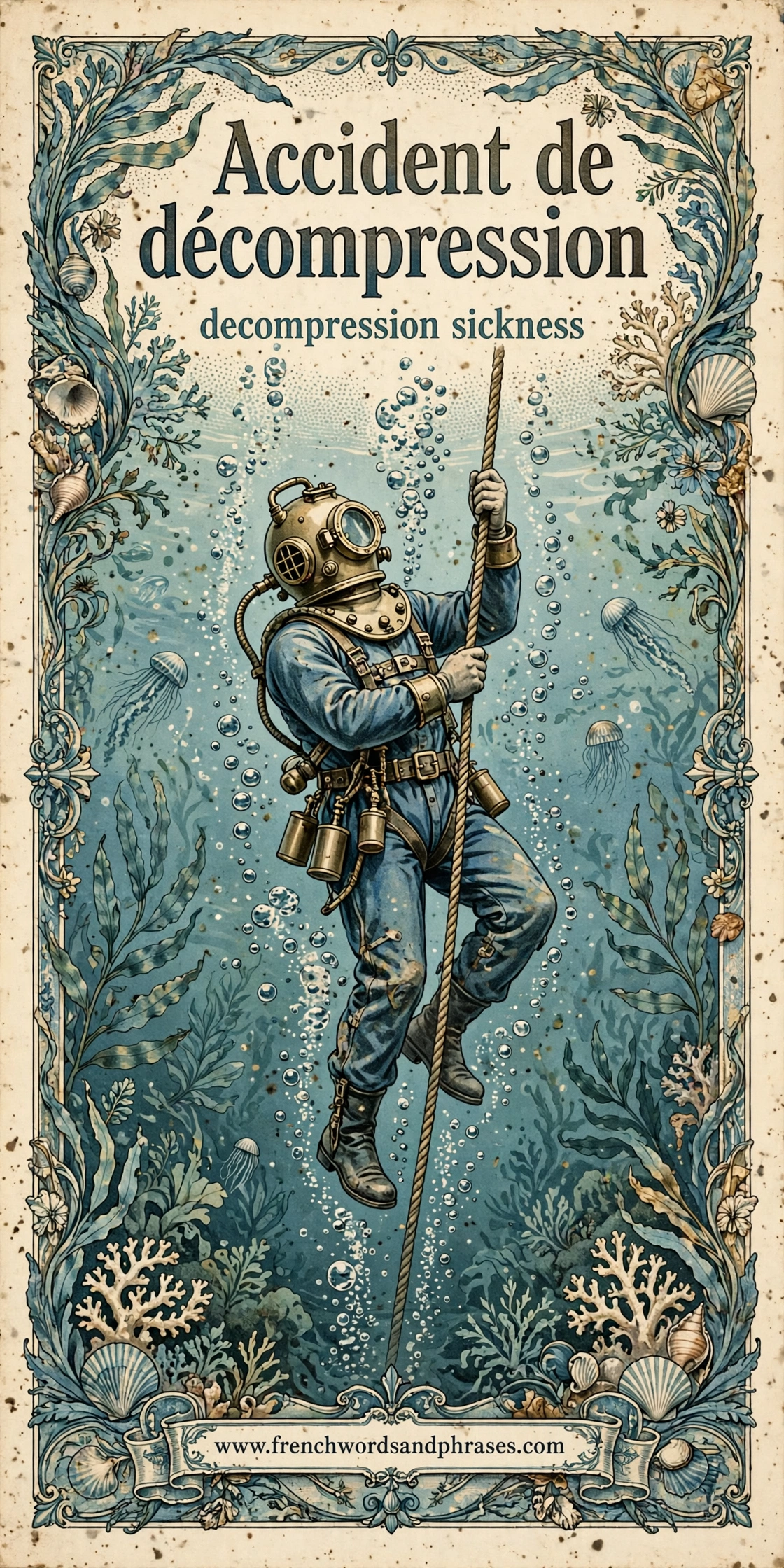
Accident de décompression means decompression sickness — the dangerous illness of divers who surface too fast.
The dive boat is quiet on the way back to port. The young diver who came up too fast, skipping his stops, is sitting very still, rubbing his shoulder, saying it feels strange. The instructor is already on the radio: « Un accident de décompression, préparez l’oxygène. »
Let’s explore how accident de décompression works in French, beginning with the whole term on one card.
Understanding the French Phrase Accident de décompression
Accident de décompression is a French medical and diving term built from accident (an accident — a masculine noun that has its own page on this site) and décompression (decompression — the fall of pressure, from compression with the undoing prefix dé-). Word for word: a decompression accident — the injury that pressure, released too quickly, writes into the body.
It means decompression sickness — the sometimes fatal condition in which nitrogen, dissolved in the blood and tissues under pressure, forms bubbles when the pressure drops too fast, as in a diver ascending too quickly. It brings severe pains in the joints and chest, itching skin, cramps, nausea and, in grave cases, paralysis. English divers nickname it the bends, for the way its victims double up with pain; French keeps the clinical name, and treats it as the emergency it is: oxygen, and a recompression chamber.
Type: Medical and diving term — a condition (accident + de + décompression)
Answers the need: Naming the emergency exactly — on the boat, at the hospital, in the report
Register: Technical — diving instruction, hyperbaric medicine, accident reports
Strength: Grave — this accident can kill; the term is never used lightly
One important usage detail: in French diving language, the prevention has its own fixed vocabulary — les paliers de décompression, the decompression stops a diver makes on the way up. To skip them is sauter les paliers, and that is how the accident happens. The same word accident serves all through French medicine for a sudden harmful event: this one is filed beside accident vasculaire cérébral, the stroke.
Experience the Word
Accident de décompression is a term nobody learns for pleasure — it belongs to briefings, checklists and the serious minute before a deep dive.
Imagine the classroom the night before the deep dive: the instructor draws the ascent curve on the board, marks the stops one by one, and underlines a single sentence — la remontée lente, ou l’accident de décompression. Nobody in the room checks their phone during that lesson.
English hides the danger inside a nickname, the bends. French names the mechanism itself: pressure, released too fast, becomes an accident.
How to Use Accident de décompression in French: Complete Guide
Let’s explore how accident de décompression works in French, beginning with the whole term on one card.
Accident de décompression at a Glance
The Whole Term on One Card
Real meaning, literal picture, English twin and register — accident de décompression in five lines.
| Point | Accident de décompression |
|---|---|
| What it really means | decompression sickness — nitrogen bubbles forming in the body after too fast a pressure drop |
| Word for word | decompression accident — the injury caused by decompression itself |
| English equivalent | decompression sickness — divers’ nickname: the bends |
| Register | technical — diving, hyperbaric medicine, emergency reports |
| Use it for | briefings, dive reports, hospital admissions, prevention |
Example
Après une remontée trop rapide, le plongeur a fait un accident de décompression.
After too fast an ascent, the diver suffered decompression sickness.
Word by Word: Building the Term
Two pieces — take them one by one and the mechanism stands revealed.
| Word | Literal meaning | Its job in the term |
|---|---|---|
| accident | accident, sudden harmful event | the injury itself — a masculine noun: un accident |
| décompression | decompression, release of pressure | the cause: pressure falling — with dé-, the undoing prefix |
Example
La décompression trop rapide est la cause de l’accident.
Too rapid decompression is the cause of the accident.
Quick Quiz 1
What actually injures the diver in an accident de décompression?
Reveal the answer
Nitrogen bubbles — gas dissolved in the blood under pressure forms bubbles when the pressure drops too fast, blocking and damaging tissues.
Les bulles d’azote se forment quand la pression chute trop vite.
Nitrogen bubbles form when the pressure falls too fast.
Where You Meet It: The Term in Its World
Accident de décompression turns up in moments like these — briefings, ascents and emergency rooms.
| Situation | Example |
|---|---|
| The cause | une remontée trop rapide — too fast an ascent |
| The skipped rule | sauter les paliers de décompression — to skip the decompression stops |
| The symptoms | des douleurs aux articulations — pains in the joints |
| The first aid | donner de l’oxygène — to give oxygen |
| The treatment | le caisson de recompression — the recompression chamber |
Example
Le plongeur a été placé en caisson de recompression.
The diver was placed in a recompression chamber.
Make It Yours: The Term in Sentences
The term is fixed — the verbs of medicine and diving move around it.
| Form | French | In English |
|---|---|---|
| The term | un accident de décompression | a case of decompression sickness |
| Suffering one | faire un accident de décompression | to suffer decompression sickness |
| Avoiding one | éviter l’accident de décompression | to avoid decompression sickness |
| Treating one | soigner un accident de décompression | to treat decompression sickness |
| Preventing one | respecter les paliers de décompression | to respect the decompression stops |
Example
Respecter les paliers, c’est éviter l’accident de décompression.
Respecting the stops means avoiding decompression sickness.
Quick Quiz 2
What are les paliers de décompression?
Reveal the answer
The decompression stops — the planned pauses a diver makes while ascending, letting nitrogen leave the body safely.
Il a fait tous ses paliers de décompression.
He made all his decompression stops.
Everyday Expressions: The Diving Frame
The term slots into these diving frames — each one ready to use as it stands.
| Frame | In English |
|---|---|
| une remontée trop rapide | too fast an ascent |
| les paliers de décompression | the decompression stops |
| un caisson de recompression | a recompression chamber |
| les bulles d’azote | the nitrogen bubbles |
| plonger en sécurité | to dive safely |
Example
Une remontée trop rapide, et les bulles d’azote se forment.
Too fast an ascent, and the nitrogen bubbles form.
Close Cousins: The Other Pressure Words
The diving shelf holds near neighbours — accident de décompression is the illness; its cousins are the physics and the cure.
| Expression | The difference |
|---|---|
| accident de décompression | decompression sickness — the illness itself |
| décompression | decompression — the fall of pressure, dangerous only when too fast |
| recompression | recompression — the treatment: pressure applied again in a chamber |
| les paliers | the stops — the prevention, pauses on the way up |
| le mal des caissons | caisson disease — the old name, from the bridge workers in pressurised caissons |
Example
Autrefois, on parlait du mal des caissons ; aujourd’hui, d’accident de décompression.
In the old days they spoke of caisson disease; today, of decompression sickness.
Quick Quiz 3
Which cousin is the treatment — décompression or recompression?
Reveal the answer
Recompression — the patient is put back under pressure in a chamber, then brought down very slowly. Décompression is the fall of pressure that caused the harm.
La recompression en caisson est le traitement principal.
Recompression in a chamber is the main treatment.
Accident de décompression and Its Neighbours
The diving shelf around the term — gas, pressure and depth.
| French | In English |
|---|---|
| l’azote | nitrogen |
| la pression | the pressure |
| un plongeur | a diver |
| la profondeur | the depth |
| l’oxygène | oxygen |
Example
Sous la pression, l’azote se dissout dans le sang du plongeur.
Under pressure, nitrogen dissolves in the diver’s blood.
Watch Out: The Traps Around Accident de décompression
The traps: a nickname that does not translate, and an accident that is a disease.
| Trap | The truth |
|---|---|
| translating “the bends” word for word | French has no such nickname in medical use — the clinical term is the everyday term too |
| picturing a crash | nothing collides: this accident is a sickness, bubbles in blood and tissues |
| confusing décompression and recompression | one causes, the other cures — the prefixes dé- and re- carry the whole story |
| thinking only divers are concerned | caisson workers and tunnel builders under pressure share the same risk |
Example
Pas de choc, pas de chute : l’accident de décompression est une maladie de la pression.
No crash, no fall: decompression sickness is an illness of pressure.
Quick Quiz 4
True or false: an accident de décompression can be fatal.
Reveal the answer
True — untreated, the bubbles can damage the brain, the spinal cord and the lungs. It is treated as an emergency: oxygen first, then the chamber.
Un accident de décompression grave est une urgence absolue.
A serious case of decompression sickness is an absolute emergency.
Accident de décompression in Everyday French: Real-Life Examples
Now that you know the word, let’s see how accident de décompression appears in everyday French.
Example 1 — The briefing
Le moniteur explique l’accident de décompression avant la plongée profonde.
The instructor explains decompression sickness before the deep dive.
Example 2 — The cause
Il est remonté trop vite et a fait un accident de décompression.
He came up too fast and suffered decompression sickness.
Example 3 — The symptoms
Des douleurs aux épaules peuvent annoncer un accident de décompression.
Pains in the shoulders can announce decompression sickness.
Example 4 — First aid
On lui a donné de l’oxygène dès le retour sur le bateau.
He was given oxygen as soon as he was back on the boat.
Example 5 — The treatment
L’accident de décompression se traite en caisson de recompression.
Decompression sickness is treated in a recompression chamber.
Example 6 — Prevention
Avec des paliers bien respectés, l’accident de décompression devient rare.
With the stops properly respected, decompression sickness becomes rare.
Beyond Translation: The Meaning of Accident de décompression
The body keeps its accounts in pressure: dive deep, and the blood quietly fills with dissolved nitrogen, like gas in a sealed bottle. Open the bottle slowly and the gas sighs out; tear the cap off, and it foams. Accident de décompression is the foaming, happening inside a person.
French names it with an engineer’s honesty: the accident is not the dive, nor the depth — it is the decompression, the way back up.
That is why the whole culture of diving is built around the return: tables, computers, paliers — a slow, patient staircase back to the surface, climbed so that this term never has to be used.
How to Remember the French Phrase Accident de décompression
Remember it this way: Accident de décompression means decompression sickness — nitrogen bubbles forming in the body when pressure drops too fast, as in a diver surfacing too quickly.
- You name the mechanism — décompression, pressure falling; too fast, and nitrogen foams into bubbles.
- You keep the prevention — les paliers de décompression, the stops on the way up, never skipped.
- You know the cure — oxygen, then the caisson de recompression, pressure given back slowly.
The key idea is accident de décompression = decompression sickness (the bends) — prevented by les paliers, treated by recompression.
Test Your Knowledge of Accident de décompression
Let’s see how much you’ve learned. Try answering these questions before revealing the answers.
Question 1
What does accident de décompression mean?
Reveal the answer
Decompression sickness — the illness caused by nitrogen bubbles forming after too fast a drop in pressure.
Question 2
What forms in the blood when it happens?
Reveal the answer
Nitrogen bubbles — gas that was dissolved under pressure comes out of solution too quickly.
Question 3
Translate: The diver came up too fast.
Reveal the answer
Le plongeur est remonté trop vite.
Question 4
How is decompression sickness prevented?
Reveal the answer
By ascending slowly and respecting les paliers de décompression — the decompression stops on the way up.
Question 5
Complete the sentence:
On traite l’accident de décompression en ______ de recompression. (chamber)
Reveal the answer
caisson
On traite l’accident de décompression en caisson de recompression.
Decompression sickness is treated in a recompression chamber.
Your Final Challenge
Can You Use It?
How would you say this in French?
“Respecting the stops means avoiding decompression sickness.”
Reveal the answer
Respecter les paliers, c’est éviter l’accident de décompression.
Respecting the stops means avoiding decompression sickness.
A little French. A little curiosity. A richer everyday life.
LEARN FRENCH ONE WORD AT A TIME




