A French Word to Live By
Translate Maïs to English
/ma.is/
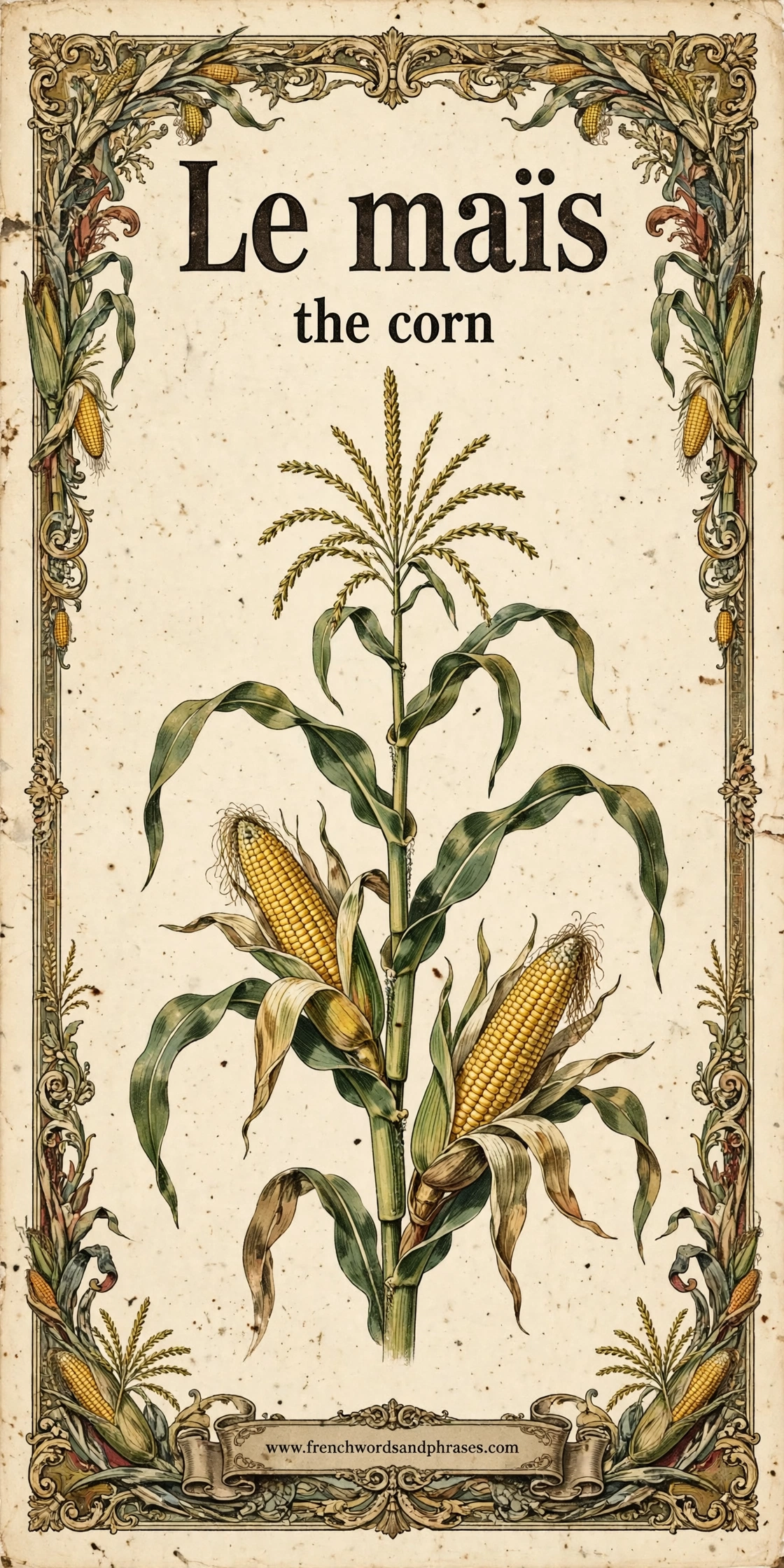
Le maïs means the corn.
Late summer, a field taller than a man, the leaves rustling dry in the heat — le maïs, the corn, gold in the ear and sweet on the cob.
In this guide, you’ll learn what maïs means in English, how to use it with its articles, how to form its plural, and how it appears in everyday French. Explore French examples, English translations, and practice quizzes.
Understanding the French Noun Maïs
Maïs is a masculine French noun, learned with its article: le maïs, du maïs. Its tréma is a working sign, not a decoration: ma-ïs, two full syllables — the ï keeps the a and the i apart, and it is why maïs (corn) never sounds like mais (but).
It means the corn — maize, the tall American grain with golden ears: un épi de maïs, a corn on the cob; le maïs doux, sweetcorn. In Québec the same plant is called le blé d’Inde, the wheat of India — a souvenir of the age when America was still « the Indies » on French maps.
Gender: Masculine — le maïs
Definite article: le — le maïs (the corn)
Indefinite article: un — un maïs (a corn plant)
Plural: les maïs — the spelling never changes
Spelling note: the tréma splits the word in two: ma-ïs — not mais (but)
The ear: un épi de maïs (a corn on the cob)
English equivalents: The corn, the maize.
Maïs is one of French’s invariable nouns: singular and plural are spelled exactly alike — le maïs, les maïs — only the article tells you how many. And at the table, watch the pair: fresh and sweet it is le maïs doux; burst and salted at the cinema it becomes le pop-corn.
Experience the Word
Maïs is the sound of late summer: dry leaves in the wind, cobs grilling, kernels popping in the pan.
Imagine the south-west of France in September, fields of maïs standing taller than the farmhouse windows, waiting for the harvest that will feed ducks, geese and half the region.
You have not just named a grain. You have met the American giant that crossed the ocean and took root — le maïs, two syllables and a field of gold.
How to Use Maïs in French: Complete Guide
Let’s explore how maïs works in French, beginning with its articles — le maïs, du maïs, les maïs.
Maïs with the Definite Article (Le, Les)
Used for a specific crop — the field behind the farm, this year’s corn.
| Form | French |
|---|---|
| Masculine singular | le maïs |
| Plural | les maïs |
Example
Le maïs est déjà plus haut que la clôture.
The corn is already taller than the fence.
Maïs with the Indefinite Article (Un, Des)
Used for a corn plant in general — one plant among thousands.
| Form | French |
|---|---|
| Masculine singular | un maïs |
| Plural | des maïs |
Example
Un maïs peut dépasser deux mètres de haut.
A corn plant can grow over two metres tall.
Maïs with the Partitive and Quantities (Du maïs…)
Corn is served by the spoonful and the tin — the partitive du does the serving.
| Quantity | French |
|---|---|
| some corn | du maïs |
| a corn on the cob | un épi de maïs |
| a tin of sweetcorn | une boîte de maïs |
| corn flour | de la farine de maïs |
| a field of corn | un champ de maïs |
Example
Elle ajoute du maïs doux à la salade.
She adds sweetcorn to the salad.
Quick Quiz 1
Complete the sentence:
Je mets ______ maïs dans la soupe. (some)
Reveal the answer
du
Je mets du maïs dans la soupe.
I am putting some corn in the soup — du, the partitive for an amount of corn.
The Plural of Maïs
Maïs never changes its spelling — les maïs looks exactly like le maïs; only the article changes.
| Number | French |
|---|---|
| Singular | le maïs |
| Plural | les maïs |
Example
Les maïs sèchent au soleil avant la récolte.
The corn plants are drying in the sun before the harvest.
Maïs with Possessive Adjectives (Mon, Ton, Son…)
Possessives agree with the noun: maïs is masculine, so mon, ton, son in the singular.
| Owner | French |
|---|---|
| my | mon maïs |
| your (tu) | ton maïs |
| his / her | son maïs |
| our | notre maïs |
| your (vous) | votre maïs |
| their | leur maïs |
Example
Le fermier surveille son maïs pendant la sécheresse.
The farmer watches over his corn during the drought.
Quick Quiz 2
Complete the sentence:
Ils récoltent ______ maïs en septembre. (their)
Reveal the answer
leur
Ils récoltent leur maïs en septembre.
They harvest their corn in September.
Maïs with Demonstrative Adjectives (Ce, Ces)
Used to point: ce maïs, this corn.
| Form | French |
|---|---|
| Masculine singular | ce maïs |
| Plural | ces maïs |
Example
Ce maïs est destiné aux animaux de la ferme.
This corn is meant for the farm animals.
Maïs with Adjectives
Adjectives agree with maïs — masculine singular: du maïs doux, un maïs doré.
| Adjective | With Maïs |
|---|---|
| doux (sweet) | le maïs doux |
| doré (golden) | un maïs doré |
| frais (fresh) | du maïs frais |
| soufflé (popped) | du maïs soufflé |
| en conserve (tinned) | du maïs en conserve |
Example
Le maïs doux se marie bien avec le thon.
Sweetcorn goes well with tuna.
Quick Quiz 3
Complete the sentence:
Elle achète du maïs ______ pour la salade. (sweet)
Reveal the answer
doux
Elle achète du maïs doux pour la salade.
She buys sweetcorn for the salad.
Everyday Expressions with Maïs
Cobs, popcorn and Canadian wheat — the maïs phrases of daily life.
| Expression | In English |
|---|---|
| un épi de maïs | a corn on the cob |
| le maïs doux | sweetcorn |
| le pop-corn | popcorn |
| un champ de maïs | a cornfield |
| le blé d’Inde | corn, maize (Québec name) |
| la farine de maïs | corn flour, cornmeal |
Example
Au cinéma, les enfants partagent un grand pop-corn.
At the cinema, the children share a big popcorn.
Words from the Same Family as Maïs
Ears, grains and harvests — the words that travel with maïs.
| French | In English |
|---|---|
| l’épi | the ear (of corn), the cob |
| le grain | the grain, the kernel |
| le champ | the field |
| la récolte | the harvest |
| le blé | the wheat — corn’s European cousin |
Example
Chaque épi de maïs porte des centaines de grains.
Each corn cob carries hundreds of kernels.
Quick Quiz 4
What does un épi de maïs mean?
Reveal the answer
A corn on the cob — the whole ear of corn, kernels and all.
Nous grillons des épis de maïs au barbecue.
We are grilling corn on the cob on the barbecue.
Maïs in Everyday French: Real-Life Examples
Now that you know the word, let’s see how maïs appears in everyday French.
Example 1 — In the field
Le maïs pousse vite sous le soleil de juillet.
The corn grows fast under the July sun.
Example 2 — At the market
Elle choisit trois épis de maïs bien dorés.
She chooses three nice golden corn cobs.
Example 3 — In the kitchen
Ajoute du maïs doux dans la salade composée.
Add sweetcorn to the mixed salad.
Example 4 — At the cinema
Le pop-corn est du maïs soufflé et salé.
Popcorn is popped, salted corn.
Example 5 — The harvest
Les maïs seront récoltés à la fin de l’été.
The corn will be harvested at the end of summer.
Example 6 — In Québec
Au Québec, on appelle le maïs le blé d’Inde.
In Québec, corn is called blé d’Inde.
Beyond Translation: The Meaning of Maïs
Maïs is a traveller: born in Mexico, carried to Europe after Columbus, and naturalised so completely that the south-west of France now measures its summers by it. Its tréma is the mark of the journey — the word came from the Taíno mahís through Spanish, and French split it into two honest syllables, ma-ïs, so it would never be confused with the little word mais, but.
To say maïs is to name the grain that crossed an ocean and became a French summer.
It evokes the cornfield taller than a man, the grilled cob, the popping pan — gold, in every form.
How to Remember the French Noun Maïs
Remember it this way: Maïs is the corn — masculine and invariable, with a tréma that splits it in two: le maïs, du maïs doux, un épi de maïs.
- Two syllables, always — ma-ïs : le tréma sépare le a et le i, unlike mais, but.
- Never changing — le maïs, les maïs : même orthographe au singulier et au pluriel.
- The cob — un épi de maïs, a corn on the cob ; doux, it is sweetcorn.
The key idea is le maïs — the corn, masculine and invariable; the tréma separates it from mais (but).
Test Your Knowledge of Maïs
Let’s see how much you’ve learned. Try answering these questions before revealing the answers.
Question 1
Is maïs masculine or feminine?
Reveal the answer
Masculine — le maïs, du maïs.
Question 2
What does the tréma do in maïs?
Reveal the answer
It splits the word into two syllables — ma-ïs — and separates it from mais, which means but.
Question 3
Translate: She adds sweetcorn to the salad.
Reveal the answer
Elle ajoute du maïs doux à la salade.
Question 4
Does the spelling of maïs change in the plural?
Reveal the answer
No — le maïs, les maïs: the noun is invariable.
Question 5
Complete the sentence:
Je voudrais un épi de ______. (corn)
Reveal the answer
maïs
Je voudrais un épi de maïs.
I would like a corn on the cob.
Your Final Challenge
Can You Use It?
How would you say this in French?
“She adds sweetcorn to the salad.”
Reveal the answer
Elle ajoute du maïs doux à la salade.
She adds sweetcorn to the salad.
A little French. A little curiosity. A richer everyday life.
LEARN FRENCH ONE WORD AT A TIME