A French Word to Live By
How to Conjugate Enligner in French
/ɑ̃.li.ɲe/
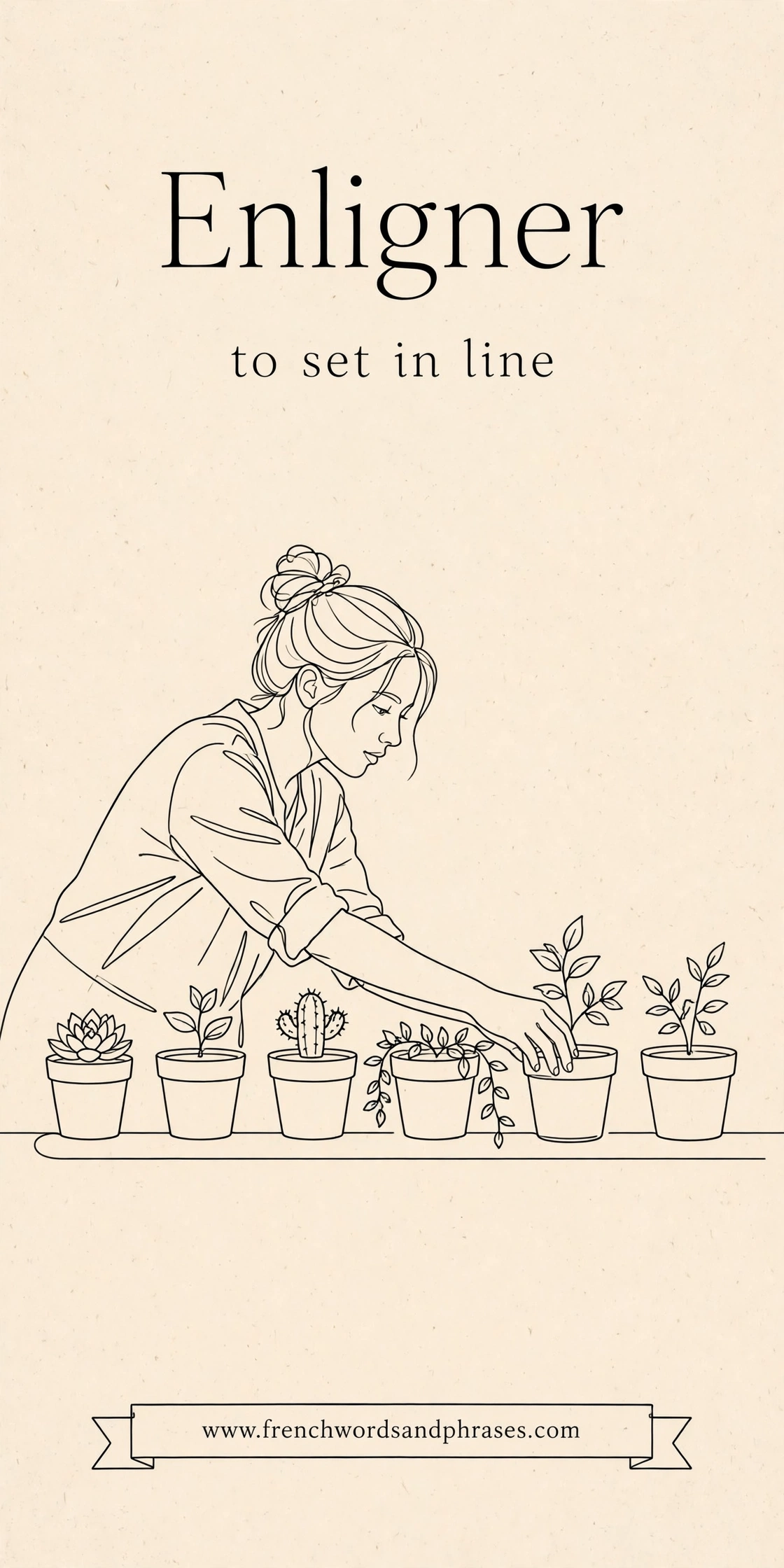
Enligner means to set in line — to place things one behind another in a straight, orderly row.
A teacher lining up chairs before the class arrives, a gardener setting out seedlings in a ruler-straight row, a printer aligning the letters of a headline — enligner is the quiet verb of putting things in line, one after another, exactly where they belong.
In this guide, you’ll learn how to conjugate enligner in all the major French tenses and moods. Explore complete conjugation tables, French examples, English translations, and practice quizzes.
Understanding the French Verb Enligner
Enligner is a regular French verb belonging to the first group of verbs, those ending in-er.
It means to set in line. It is a somewhat old-fashioned, regional-flavoured verb — you will meet it in older gardening, printing and schoolroom texts, and in parts of the French-speaking world where aligner has not quite pushed it out. The sense never stretches far: things, people or words placed in a straight line.
Verb classification: First group (-er)
Auxiliary verb: Avoir
Past participle: enligné
Present participle: enlignant
English equivalents: To set in line, to line up, to align; enligner des chaises — to set chairs in a row; enligner des plants — to set out seedlings in lines; enligner les mots — to line words up in a row; la ligne — the line.
One important detail: enligner is built on la ligne, the line, with the prefix en- doing its usual work of putting something into a state — to put into line. The gn is pronounced as one sound, like the gn in signal: je enligne sounds like ‘en-leen-ye’. Otherwise the verb is perfectly regular: je enligne, nous enlignons, ils enlignent, past participle enligné. Do not confuse it with aligner, its commoner twin — enligner is the older, rarer word for the same gesture.
Experience the Word
Enligner is the verb of the straight row — nothing scattered, nothing crooked, everything one behind the other.
Imagine a village schoolmaster in 1920, an hour before the rentrée. He walks the empty classroom with a ruler’s eye, enlignant each small chair, each inkwell, each copybook, until the room looks like a parade ground waiting for its soldiers.
Nothing is decorated or improved. It is simply set in line — enligné, chair after chair, in perfect order.
How to Conjugate Enligner: Complete French Conjugation Guide
Let’s explore every major conjugation of enligner, beginning with the indicative mood.
How to Conjugate Enligner in the Indicative Mood
The indicative mood is used to express facts, observations, actions, and events.
How to Conjugate Enligner in the Present Tense (Présent)
Used for actions happening now, habitual actions, and general truths.
| Subject | Conjugation |
|---|---|
| je | enligne |
| tu | enlignes |
| il / elle | enligne |
| nous | enlignons |
| vous | enlignez |
| ils / elles | enlignent |
Example
Le jardinier enligne les plants de tomates.
The gardener sets the tomato plants in line.
Quick Quiz 1
Complete the sentence:
Nous ______ les chaises le long du mur.
Reveal the answer
enlignons
Nous enlignons les chaises le long du mur.
We set the chairs in line along the wall.
How to Conjugate Enligner in the Passé Composé
Used for completed actions in the past. Enligner takes the auxiliary verb avoir.
| Subject | Conjugation |
|---|---|
| j’ | ai enligné |
| tu | as enligné |
| il / elle | a enligné |
| nous | avons enligné |
| vous | avez enligné |
| ils / elles | ont enligné |
Example
Elle a enligné les chaises le long du mur.
She set the chairs in a line along the wall.
How to Conjugate Enligner in the Imparfait (Imperfect Tense)
Used for habitual past actions, descriptions, and ongoing situations in the past.
| Subject | Conjugation |
|---|---|
| je | enlignais |
| tu | enlignais |
| il / elle | enlignait |
| nous | enlignions |
| vous | enligniez |
| ils / elles | enlignaient |
Example
Chaque matin, le maître enlignait les bancs avant la classe.
Every morning, the teacher lined up the benches before class.
Quick Quiz 2
Choose the correct form:
She set the glasses in line.
Elle ______ les verres. (a enligné / est enligné)
Reveal the answer
a enligné
Elle a enligné les verres.
Enligner takes avoir.
How to Conjugate Enligner in the Plus-que-parfait
Used to describe an action that had already been completed before another past event.
| Subject | Conjugation |
|---|---|
| j’ | avais enligné |
| tu | avais enligné |
| il / elle | avait enligné |
| nous | avions enligné |
| vous | aviez enligné |
| ils / elles | avaient enligné |
Example
Il avait enligné les bouteilles sur l’étagère.
He had set the bottles in line on the shelf.
How to Conjugate Enligner in the Passé Simple
Primarily used in formal writing, literature, and historical narratives. It is rarely used in everyday conversation.
| Subject | Conjugation |
|---|---|
| je | enlignai |
| tu | enlignas |
| il / elle | enligna |
| nous | enlignâmes |
| vous | enlignâtes |
| ils / elles | enlignèrent |
Example
Le sergent enligna les recrues dans la cour.
The sergeant lined up the recruits in the yard.
How to Conjugate Enligner in the Passé Antérieur
A literary tense used to express an action completed immediately before another past action, generally in the passé simple.
| Subject | Conjugation |
|---|---|
| j’ | eus enligné |
| tu | eus enligné |
| il / elle | eut enligné |
| nous | eûmes enligné |
| vous | eûtes enligné |
| ils / elles | eurent enligné |
Example
Quand elle eut enligné les verres, elle versa le vin.
When she had set the glasses in line, she poured the wine.
How to Conjugate Enligner in the Future Tense (Futur Simple)
Used to describe actions that will take place in the future.
| Subject | Conjugation |
|---|---|
| je | enlignerai |
| tu | enligneras |
| il / elle | enlignera |
| nous | enlignerons |
| vous | enlignerez |
| ils / elles | enligneront |
Example
Demain, nous enlignerons les pots sur la terrasse.
Tomorrow, we will set the pots in line on the terrace.
How to Conjugate Enligner in the Futur Antérieur (Future Perfect)
Used for an action that will have been completed before a particular point in the future.
| Subject | Conjugation |
|---|---|
| j’ | aurai enligné |
| tu | auras enligné |
| il / elle | aura enligné |
| nous | aurons enligné |
| vous | aurez enligné |
| ils / elles | auront enligné |
Example
À midi, il aura enligné toutes les caisses dans l’entrepôt.
By noon, he will have lined up all the crates in the warehouse.
How to Conjugate Enligner in the Near Future (Futur Proche)
Used to describe something that is going to happen soon. Formed with aller + infinitive.
| Subject | Conjugation |
|---|---|
| je | vais enligner |
| tu | vas enligner |
| il / elle | va enligner |
| nous | allons enligner |
| vous | allez enligner |
| ils / elles | vont enligner |
Example
Je vais enligner les livres par taille.
I am going to line up the books by size.
How to Conjugate Enligner in the Conditional Mood
The conditional mood expresses what would happen under certain circumstances. It is also frequently used to make polite requests or express wishes.
How to Conjugate Enligner in the Present Conditional
| Subject | Conjugation |
|---|---|
| je | enlignerais |
| tu | enlignerais |
| il / elle | enlignerait |
| nous | enlignerions |
| vous | enligneriez |
| ils / elles | enligneraient |
Example
Avec plus de place, elle enlignerait les tableaux au mur.
With more room, she would set the pictures in line on the wall.
How to Conjugate Enligner in the Past Conditional
| Subject | Conjugation |
|---|---|
| j’ | aurais enligné |
| tu | aurais enligné |
| il / elle | aurait enligné |
| nous | aurions enligné |
| vous | auriez enligné |
| ils / elles | auraient enligné |
Example
Il aurait enligné les outils si le banc avait été libre.
He would have lined up the tools if the bench had been free.
Enligner in the Literary Past Conditional Form
This less common literary form uses the imperfect subjunctive of avoir.
| Subject | Conjugation |
|---|---|
| j’ | eusse enligné |
| tu | eusses enligné |
| il / elle | eût enligné |
| nous | eussions enligné |
| vous | eussiez enligné |
| ils / elles | eussent enligné |
Example
Il eût enligné les soldats comme des quilles, sans l’ordre contraire.
He would have lined up the soldiers like skittles, without the counter-order.
How to Conjugate Enligner in the Subjunctive Mood
The subjunctive is used to express wishes, emotions, doubts, necessity, and uncertainty. It frequently follows expressions such as il faut que (it is necessary that) or bien que (although).
How to Conjugate Enligner in the Present Subjunctive
| Subject | Conjugation |
|---|---|
| que je | enligne |
| que tu | enlignes |
| qu’il / qu’elle | enligne |
| que nous | enlignions |
| que vous | enligniez |
| qu’ils / qu’elles | enlignent |
Example
Il faut que tu enlignes les assiettes sur la table.
You must set the plates in line on the table.
Quick Quiz 3
Complete the sentence using the subjunctive:
Il faut que tu ______ les assiettes sur la table.
Reveal the answer
enlignes
Il faut que tu enlignes les assiettes sur la table.
You must set the plates in line on the table.
How to Conjugate Enligner in the Imperfect Subjunctive
A literary tense, rarely encountered in modern spoken French.
| Subject | Conjugation |
|---|---|
| que je | enlignasse |
| que tu | enlignasses |
| qu’il / qu’elle | enlignât |
| que nous | enlignassions |
| que vous | enlignassiez |
| qu’ils / qu’elles | enlignassent |
Example
Le chef exigeait que l’on enlignât les caisses au cordeau.
The boss demanded that the crates be lined up with a string.
How to Conjugate Enligner in the Pluperfect Subjunctive
A literary construction used to express an action completed before another past action.
| Subject | Conjugation |
|---|---|
| que j’ | eusse enligné |
| que tu | eusses enligné |
| qu’il / qu’elle | eût enligné |
| que nous | eussions enligné |
| que vous | eussiez enligné |
| qu’ils / qu’elles | eussent enligné |
Example
On racontait qu’il eût enligné les pierres une à une.
People said he had set the stones in line one by one.
How to Conjugate Enligner in the Past Subjunctive
| Subject | Conjugation |
|---|---|
| que j’ | aie enligné |
| que tu | aies enligné |
| qu’il / qu’elle | ait enligné |
| que nous | ayons enligné |
| que vous | ayez enligné |
| qu’ils / qu’elles | aient enligné |
Example
Je suis content qu’elle ait enligné les chaises à temps.
I am glad she set the chairs in line in time.
How to Conjugate Enligner in the Imperative
The imperative is used to give commands, instructions, invitations, or suggestions. Subject pronouns are omitted.
How to Conjugate Enligner in the Present Imperative
| Person | Conjugation |
|---|---|
| (tu) | enligne |
| (nous) | enlignons |
| (vous) | enlignez |
Example
Enligne les verres sur le plateau !
Set the glasses in line on the tray!
Quick Quiz 4
How would you say Set the glasses in line (tu form)?
Reveal the answer
Enligne les verres !
French Participles of Enligner
Participles are verb forms that can be used in compound tenses and other grammatical constructions.
Present Participle of Enligner
enlignant
En enlignant les plants, le jardinier chante doucement.
While setting the plants in line, the gardener sings softly.
Past Participle of Enligner
enligné
Enlignées au cordeau, les laitues poussent droites.
Set in line with a string, the lettuces grow straight.
Enligner in Everyday French: Real-Life Examples
Now that you know the conjugations, let’s see how enligner appears in everyday French.
Example 1 — Present
Le jardinier enligne les plants.
The gardener sets the plants in line.
Example 2 — Passé composé
Elle a enligné les chaises le long du mur.
She set the chairs in line along the wall.
Example 3 — Imparfait
Le maître enlignait les bancs chaque matin.
The teacher lined up the benches every morning.
Example 4 — Future
Nous enlignerons les pots sur la terrasse.
We will set the pots in line on the terrace.
Example 5 — Conditional
Il enlignerait les outils avec plus de place.
He would line up the tools with more room.
Example 6 — Imperative
Enligne les verres sur le plateau !
Set the glasses in line on the tray!
Beyond Translation: The Meaning of Enligner
French loves its line words: la ligne gives aligner, en ligne (online!), and this older cousin enligner.
The prefix en- is the real worker here.
En- puts things into a place or a state — enfourner puts things into the oven, encadrer puts a picture into a frame, and enligner puts things into a line. Learn the prefix once and dozens of dictionary verbs unlock themselves.
How to Remember the French Verb Enligner
Remember it this way: Enligner is about chairs, seedlings and glasses — everything in a straight line.
- Built on la ligne: to enligner is simply to put things into a line.
- The gn sounds like the gn in signal — je enligne, nous enlignons.
- Regular -er throughout: je enligne, nous enlignons, past participle enligné.
The key idea is chairs, seedlings and glasses — everything in a straight line.
Test Your Knowledge of Enligner
Let’s see how much you’ve learned. Try answering these questions before revealing the answers.
Question 1
What noun is hidden inside enligner?
Reveal the answer
La ligne — the line: to enligner is to put things into a line.
Question 2
How do you say The gardener sets the plants in line in French?
Reveal the answer
Le jardinier enligne les plants.
Question 3
Translate: She set the chairs in line along the wall.
Reveal the answer
Elle a enligné les chaises le long du mur.
Question 4
What is the past participle of enligner?
Reveal the answer
Enligné.
Question 5
Complete the sentence:
Il faut que tu ______ les assiettes sur la table.
Reveal the answer
enlignes
Il faut que tu enlignes les assiettes sur la table.
You must set the plates in line on the table.
Your Final Challenge
Can You Use It?
How would you say this in French?
The gardener sets his plants in line with a string, and the vegetable garden becomes a neatly written page.
Reveal the answer
Le jardinier enligne ses plants au cordeau, et le potager devient une page bien écrite.
The gardener sets his plants in line with a string, and the vegetable garden becomes a neatly written page.
A little French. A little curiosity. A richer everyday life.
LEARN FRENCH ONE WORD AT A TIME