A French Word to Live By
How to Conjugate Enliser in French
/ɑ̃.li.ze/
Enliser means to sink, to engulf — to swallow something down into mud, sand or water until it can barely move.
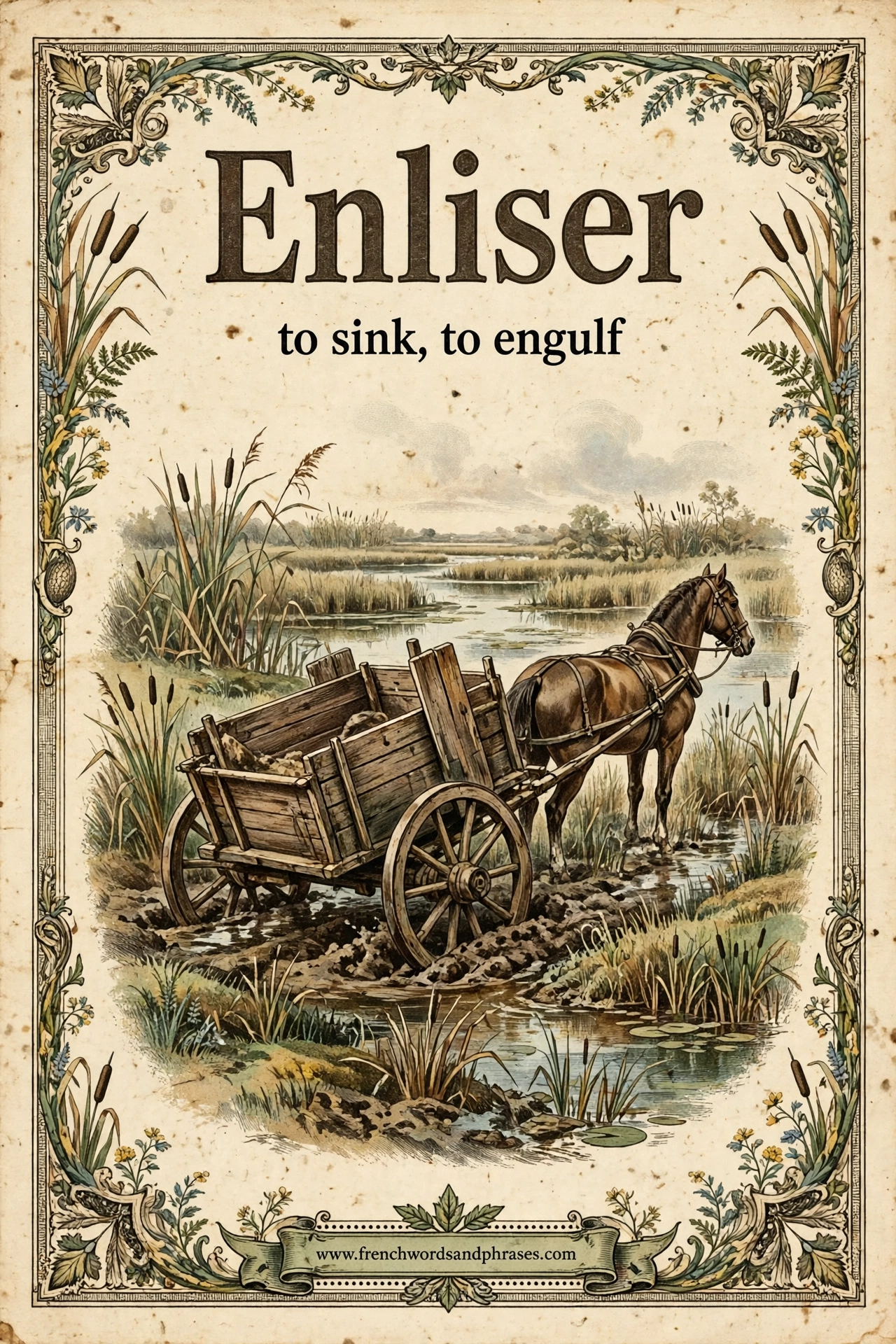
A cart sinking axle-deep into a flooded lane, a boat settling slowly into harbour mud, a boot disappearing into wet sand — enliser is the verb of things swallowed by soft ground: the mud takes hold, and what it takes, it keeps.
In this guide, you’ll learn how to conjugate enliser in all the major French tenses and moods. Explore complete conjugation tables, French examples, English translations, and practice quizzes.
Understanding the French Verb Enliser
Enliser is a regular French verb belonging to the first group of verbs, those ending in-er.
It means to sink, to engulf. It belongs to the world of mud, marshes, quicksand and soft riverbanks, and it is most often met in its passive or reflexive surroundings — things are enlisé, stuck fast, far more often than anyone actively enlise them. Figuratively it can describe anything swallowed up and immobilised by a soft, gripping medium.
Verb classification: First group (-er)
Auxiliary verb: Avoir
Past participle: enlisé
Present participle: enlisant
English equivalents: To sink, to engulf, to bog down; enliser une voiture — to bog a car down in the mud; enliser un bateau — to sink a boat in the mud; la vase enlise — the mud swallows up; les sables mouvants — quicksand.
One important detail: enliser is the active half of a pair — it is what the mud, the sand or the water does to its victim: la boue a enlisé la charrette, the mud sank the cart. The victim’s own verb is the reflexive s’enliser, to get bogged down. Keep the two apart and the sentences build themselves. The verb itself is a regular -er: j’enlise, nous enlisons, ils enlisent, past participle enlisé.
Experience the Word
Enliser is the verb of the grip from below — the ground stops being ground and starts swallowing.
Imagine a hay cart crossing a marsh lane after a week of rain. Halfway over, the wheels stop turning and start descending, slowly, silently, while the horse stamps and the carter watches the mud climb the spokes — la vase enlise la charrette, inch by inch.
The cart has not crashed or broken. It has been sunk — enlisée, swallowed by the mud itself.
How to Conjugate Enliser: Complete French Conjugation Guide
Let’s explore every major conjugation of enliser, beginning with the indicative mood.
How to Conjugate Enliser in the Indicative Mood
The indicative mood is used to express facts, observations, actions, and events.
How to Conjugate Enliser in the Present Tense (Présent)
Used for actions happening now, habitual actions, and general truths.
| Subject | Conjugation |
|---|---|
| je | enlise |
| tu | enlises |
| il / elle | enlise |
| nous | enlisons |
| vous | enlisez |
| ils / elles | enlisent |
Example
La boue enlise les roues de la charrette.
The mud sinks the wheels of the cart.
Quick Quiz 1
Complete the sentence:
La boue ______ les roues du camion.
Reveal the answer
enlise
La boue enlise les roues du camion.
The mud sinks the lorry’s wheels.
How to Conjugate Enliser in the Passé Composé
Used for completed actions in the past. Enliser takes the auxiliary verb avoir.
| Subject | Conjugation |
|---|---|
| j’ | ai enlisé |
| tu | as enlisé |
| il / elle | a enlisé |
| nous | avons enlisé |
| vous | avez enlisé |
| ils / elles | ont enlisé |
Example
Les sables mouvants ont enlisé le bateau.
The quicksands engulfed the boat.
How to Conjugate Enliser in the Imparfait (Imperfect Tense)
Used for habitual past actions, descriptions, and ongoing situations in the past.
| Subject | Conjugation |
|---|---|
| je | enlisais |
| tu | enlisais |
| il / elle | enlisait |
| nous | enlisions |
| vous | enlisiez |
| ils / elles | enlisaient |
Example
Chaque hiver, la vase enlisait les barques du port.
Every winter, the mud used to sink the harbour boats.
Quick Quiz 2
Choose the correct form:
The mud sank the cart.
La boue ______ la charrette. (a enlisé / est enlisé)
Reveal the answer
a enlisé
La boue a enlisé la charrette.
Enliser takes avoir.
How to Conjugate Enliser in the Plus-que-parfait
Used to describe an action that had already been completed before another past event.
| Subject | Conjugation |
|---|---|
| j’ | avais enlisé |
| tu | avais enlisé |
| il / elle | avait enlisé |
| nous | avions enlisé |
| vous | aviez enlisé |
| ils / elles | avaient enlisé |
Example
La marée avait enlisé l’épave dans le sable.
The tide had sunk the wreck in the sand.
How to Conjugate Enliser in the Passé Simple
Primarily used in formal writing, literature, and historical narratives. It is rarely used in everyday conversation.
| Subject | Conjugation |
|---|---|
| je | enlisai |
| tu | enlisas |
| il / elle | enlisa |
| nous | enlisâmes |
| vous | enlisâtes |
| ils / elles | enlisèrent |
Example
Le fleuve enlisa le tronc dans ses boues.
The river sank the log in its mud.
How to Conjugate Enliser in the Passé Antérieur
A literary tense used to express an action completed immediately before another past action, generally in the passé simple.
| Subject | Conjugation |
|---|---|
| j’ | eus enlisé |
| tu | eus enlisé |
| il / elle | eut enlisé |
| nous | eûmes enlisé |
| vous | eûtes enlisé |
| ils / elles | eurent enlisé |
Example
Quand la boue eut enlisé le camion, on appela le tracteur.
When the mud had bogged down the lorry, they called the tractor.
How to Conjugate Enliser in the Future Tense (Futur Simple)
Used to describe actions that will take place in the future.
| Subject | Conjugation |
|---|---|
| je | enliserai |
| tu | enliseras |
| il / elle | enlisera |
| nous | enliserons |
| vous | enliserez |
| ils / elles | enliseront |
Example
Si la pluie continue, le chemin enlisera les voitures.
If the rain keeps up, the lane will bog down the cars.
How to Conjugate Enliser in the Futur Antérieur (Future Perfect)
Used for an action that will have been completed before a particular point in the future.
| Subject | Conjugation |
|---|---|
| j’ | aurai enlisé |
| tu | auras enlisé |
| il / elle | aura enlisé |
| nous | aurons enlisé |
| vous | aurez enlisé |
| ils / elles | auront enlisé |
Example
À marée basse, la vase aura enlisé l’ancre.
By low tide, the mud will have sunk the anchor.
How to Conjugate Enliser in the Near Future (Futur Proche)
Used to describe something that is going to happen soon. Formed with aller + infinitive.
| Subject | Conjugation |
|---|---|
| je | vais enliser |
| tu | vas enliser |
| il / elle | va enliser |
| nous | allons enliser |
| vous | allez enliser |
| ils / elles | vont enliser |
Example
Attention, ce sable mou va enliser tes bottes.
Careful, this soft sand is going to swallow your boots.
How to Conjugate Enliser in the Conditional Mood
The conditional mood expresses what would happen under certain circumstances. It is also frequently used to make polite requests or express wishes.
How to Conjugate Enliser in the Present Conditional
| Subject | Conjugation |
|---|---|
| je | enliserais |
| tu | enliserais |
| il / elle | enliserait |
| nous | enliserions |
| vous | enliseriez |
| ils / elles | enliseraient |
Example
Sans la digue, la marée enliserait le village.
Without the dyke, the tide would engulf the village.
How to Conjugate Enliser in the Past Conditional
| Subject | Conjugation |
|---|---|
| j’ | aurais enlisé |
| tu | aurais enlisé |
| il / elle | aurait enlisé |
| nous | aurions enlisé |
| vous | auriez enlisé |
| ils / elles | auraient enlisé |
Example
La boue aurait enlisé le tracteur sans les planches.
The mud would have bogged down the tractor without the planks.
Enliser in the Literary Past Conditional Form
This less common literary form uses the imperfect subjunctive of avoir.
| Subject | Conjugation |
|---|---|
| j’ | eusse enlisé |
| tu | eusses enlisé |
| il / elle | eût enlisé |
| nous | eussions enlisé |
| vous | eussiez enlisé |
| ils / elles | eussent enlisé |
Example
Le marais eût enlisé l’armée entière, sans les guides.
The marsh would have engulfed the whole army, without the guides.
How to Conjugate Enliser in the Subjunctive Mood
The subjunctive is used to express wishes, emotions, doubts, necessity, and uncertainty. It frequently follows expressions such as il faut que (it is necessary that) or bien que (although).
How to Conjugate Enliser in the Present Subjunctive
| Subject | Conjugation |
|---|---|
| que je | enlise |
| que tu | enlises |
| qu’il / qu’elle | enlise |
| que nous | enlisions |
| que vous | enlisiez |
| qu’ils / qu’elles | enlisent |
Example
Je crains que le sable enlise la quille du bateau.
I fear the sand may sink the boat’s keel.
Quick Quiz 3
Complete the sentence using the subjunctive:
Je crains que le sable ______ la barque.
Reveal the answer
enlise
Je crains que le sable enlise la barque.
I fear the sand may sink the boat.
How to Conjugate Enliser in the Imperfect Subjunctive
A literary tense, rarely encountered in modern spoken French.
| Subject | Conjugation |
|---|---|
| que je | enlisasse |
| que tu | enlisasses |
| qu’il / qu’elle | enlisât |
| que nous | enlisassions |
| que vous | enlisassiez |
| qu’ils / qu’elles | enlisassent |
Example
On redoutait que la vase enlisât les barques pendant l’hiver.
They feared the mud might sink the boats during the winter.
How to Conjugate Enliser in the Pluperfect Subjunctive
A literary construction used to express an action completed before another past action.
| Subject | Conjugation |
|---|---|
| que j’ | eusse enlisé |
| que tu | eusses enlisé |
| qu’il / qu’elle | eût enlisé |
| que nous | eussions enlisé |
| que vous | eussiez enlisé |
| qu’ils / qu’elles | eussent enlisé |
Example
Les anciens disaient que le fleuve eût enlisé des navires entiers.
The old folk said the river had engulfed whole ships.
How to Conjugate Enliser in the Past Subjunctive
| Subject | Conjugation |
|---|---|
| que j’ | aie enlisé |
| que tu | aies enlisé |
| qu’il / qu’elle | ait enlisé |
| que nous | ayons enlisé |
| que vous | ayez enlisé |
| qu’ils / qu’elles | aient enlisé |
Example
Il est possible que la boue ait enlisé la roue arrière.
It is possible the mud bogged down the rear wheel.
How to Conjugate Enliser in the Imperative
The imperative is used to give commands, instructions, invitations, or suggestions. Subject pronouns are omitted.
How to Conjugate Enliser in the Present Imperative
| Person | Conjugation |
|---|---|
| (tu) | enlise |
| (nous) | enlisons |
| (vous) | enlisez |
Example
N’enlise pas la voiture dans ce chemin creux !
Do not bog the car down in this sunken lane!
Quick Quiz 4
How would you say Do not bog the car down (tu form)?
Reveal the answer
N’enlise pas la voiture !
French Participles of Enliser
Participles are verb forms that can be used in compound tenses and other grammatical constructions.
Present Participle of Enliser
enlisant
En enlisant les barques, la vase les protège parfois des tempêtes.
By sinking the boats, the mud sometimes protects them from storms.
Past Participle of Enliser
enlisé
Enlisée dans la vase, l’épave attend la grande marée.
Sunk in the mud, the wreck waits for the spring tide.
Enliser in Everyday French: Real-Life Examples
Now that you know the conjugations, let’s see how enliser appears in everyday French.
Example 1 — Present
La boue enlise les roues de la charrette.
The mud sinks the wheels of the cart.
Example 2 — Passé composé
Les sables mouvants ont enlisé le bateau.
The quicksands engulfed the boat.
Example 3 — Imparfait
La vase enlisait les barques du port.
The mud used to sink the harbour boats.
Example 4 — Future
Le chemin enlisera les voitures si la pluie continue.
The lane will bog down the cars if the rain keeps up.
Example 5 — Conditional
La marée enliserait le village sans la digue.
The tide would engulf the village without the dyke.
Example 6 — Imperative
N’enlise pas la voiture dans ce chemin !
Do not bog the car down in this lane!
Beyond Translation: The Meaning of Enliser
English speakers know this verb’s world from one word: quicksand — in French, les sables mouvants, and the verb for what they do is enliser.
Its heart is the soft grip.
Nothing breaks and nothing burns with enliser; things simply descend, slowly and silently, into mud, silt or sand. The noun un enlisement names the sinking itself — and, in modern figurative use, any situation that grips harder the more you struggle.
How to Remember the French Verb Enliser
Remember it this way: Enliser is about the mud climbing the cart wheels, swallowing them slowly.
- Enliser is what the mud does: la boue enlise la charrette — the victim’s verb is s’enliser.
- Think quicksand: les sables mouvants enlisent — they swallow and hold.
- Regular -er: j’enlise, nous enlisons, past participle enlisé.
The key idea is the mud climbing the cart wheels, swallowing them slowly.
Test Your Knowledge of Enliser
Let’s see how much you’ve learned. Try answering these questions before revealing the answers.
Question 1
Who or what does the sinking in a sentence with enliser?
Reveal the answer
The mud, sand or water — la boue enlise la charrette; the victim uses s’enliser.
Question 2
How do you say The mud sinks the wheels in French?
Reveal the answer
La boue enlise les roues.
Question 3
Translate: The quicksands engulfed the boat.
Reveal the answer
Les sables mouvants ont enlisé le bateau.
Question 4
What is the past participle of enliser?
Reveal the answer
Enlisé.
Question 5
Complete the sentence:
Je crains que le sable ______ le bateau.
Reveal the answer
enlise
Je crains que le sable enlise le bateau.
I fear the sand may sink the boat.
Your Final Challenge
Can You Use It?
How would you say this in French?
The mud slowly engulfs the wreck, and the harbour forgets one more boat.
Reveal the answer
La vase enlise lentement l’épave, et le port oublie un bateau de plus.
The mud slowly engulfs the wreck, and the harbour forgets one more boat.
A little French. A little curiosity. A richer everyday life.
LEARN FRENCH ONE WORD AT A TIME