A French Word to Live By
How to Conjugate Engrosser in French
/ɑ̃.ɡʁo.se/
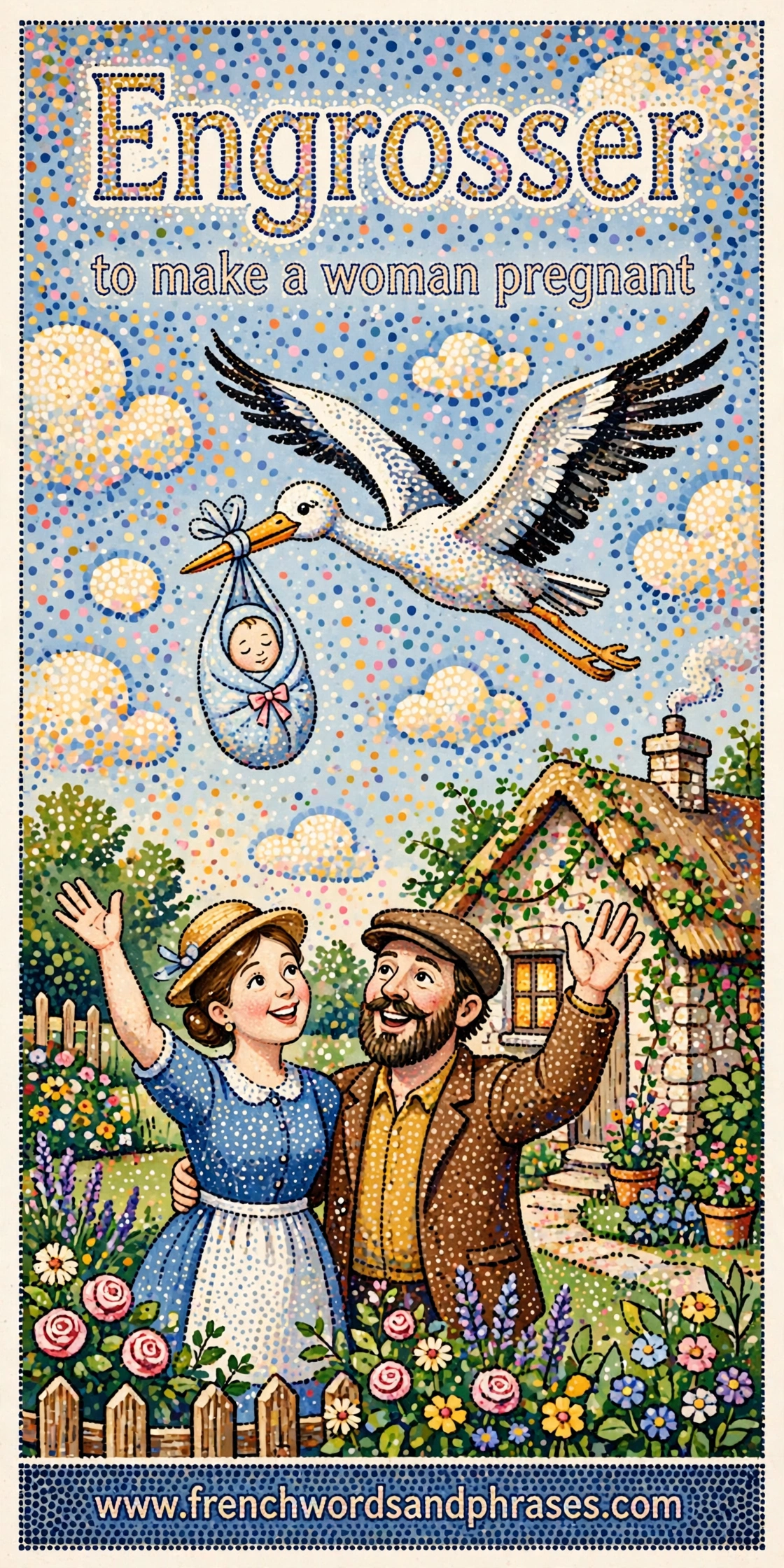
Engrosser means to make a woman pregnant — a blunt, dated word that modern French keeps for crude talk, old novels and history rather than for polite conversation.
You will meet this verb in nineteenth-century novels, in court records and in coarse speech — rarely in a modern drawing room. Engrosser is the blunt old word for making a woman pregnant, and learning it honestly means learning its register too.
In this guide, you’ll learn how to conjugate engrosser in all the major French tenses and moods. Explore complete conjugation tables, French examples, English translations, and practice quizzes.
Understanding the French Verb Engrosser
Engrosser is a regular French verb belonging to the first group of verbs, those ending in-er.
It means to make a woman pregnant. Today the verb survives in literature, historical writing and deliberately coarse or comic speech; in journalism and everyday life it has been almost entirely replaced by mettre enceinte. You need it to read older French without a blush — and to know exactly why a modern speaker would choose a different word.
Verb classification: First group (-er)
Auxiliary verb: Avoir
Past participle: engrossé
Present participle: engrossant
English equivalents: To make pregnant, to get with child (dated and blunt); engrosser une femme — to make a woman pregnant; the neutral modern equivalents: mettre enceinte, rendre enceinte — to make pregnant; tomber enceinte — to become pregnant; être enceinte — to be pregnant.
Register first: engrosser is familier and crude in modern French — the blunt word of old novels, soldiers and scandal. In neutral, polite French one says mettre enceinte or rendre enceinte, and the woman herself est enceinte or tombe enceinte. The word comes from gros: in older French une femme grosse meant a pregnant woman, and the verb kept the period bluntness. Its grammar, at least, is perfectly regular: j’engrosse, nous engrossons, past participle engrossé.
Experience the Word
Engrosser is a word with its century stamped on it — to use it today is to quote the past, warts and all.
Imagine a village chronicle of 1880, written in a careful hand: the miller’s son, the servant girl, a hasty wedding in October. The chronicler chooses the blunt verb of his time — il l’a engrossée — and the whole scandal of the parish fits inside that one dated word.
A modern writer would soften it. The chronicle keeps it — engrossée, in the plain speech of another century.
How to Conjugate Engrosser: Complete French Conjugation Guide
Let’s explore every major conjugation of engrosser, beginning with the indicative mood.
How to Conjugate Engrosser in the Indicative Mood
The indicative mood is used to express facts, observations, actions, and events.
How to Conjugate Engrosser in the Present Tense (Présent)
Used for actions happening now, habitual actions, and general truths.
| Subject | Conjugation |
|---|---|
| je | engrosse |
| tu | engrosses |
| il / elle | engrosse |
| nous | engrossons |
| vous | engrossez |
| ils / elles | engrossent |
Example
Dans le roman, le séducteur engrosse la servante puis disparaît.
In the novel, the seducer gets the servant girl pregnant and then disappears.
Quick Quiz 1
Complete the sentence:
Dans le roman, il ______ la servante au troisième chapitre.
Reveal the answer
engrosse
Dans le roman, il engrosse la servante au troisième chapitre.
In the novel, he gets the servant girl pregnant in the third chapter.
How to Conjugate Engrosser in the Passé Composé
Used for completed actions in the past. Engrosser takes the auxiliary verb avoir.
| Subject | Conjugation |
|---|---|
| j’ | ai engrossé |
| tu | as engrossé |
| il / elle | a engrossé |
| nous | avons engrossé |
| vous | avez engrossé |
| ils / elles | ont engrossé |
Example
Il l’a engrossée et a refusé de l’épouser.
He got her pregnant and refused to marry her.
How to Conjugate Engrosser in the Imparfait (Imperfect Tense)
Used for habitual past actions, descriptions, and ongoing situations in the past.
| Subject | Conjugation |
|---|---|
| je | engrossais |
| tu | engrossais |
| il / elle | engrossait |
| nous | engrossions |
| vous | engrossiez |
| ils / elles | engrossaient |
Example
Dans les romans du siècle dernier, le séducteur engrossait la servante au troisième chapitre.
In last century’s novels, the seducer got the servant girl pregnant in the third chapter.
Quick Quiz 2
Choose the correct form:
He got her pregnant before the war.
Il ______ avant la guerre. (l’a engrossée / l’est engrossée)
Reveal the answer
l’a engrossée
Il l’a engrossée avant la guerre.
Engrosser takes avoir.
How to Conjugate Engrosser in the Plus-que-parfait
Used to describe an action that had already been completed before another past event.
| Subject | Conjugation |
|---|---|
| j’ | avais engrossé |
| tu | avais engrossé |
| il / elle | avait engrossé |
| nous | avions engrossé |
| vous | aviez engrossé |
| ils / elles | avaient engrossé |
Example
Il l’avait engrossée avant de partir à la guerre.
He had got her pregnant before leaving for the war.
How to Conjugate Engrosser in the Passé Simple
Primarily used in formal writing, literature, and historical narratives. It is rarely used in everyday conversation.
| Subject | Conjugation |
|---|---|
| je | engrossai |
| tu | engrossas |
| il / elle | engrossa |
| nous | engrossâmes |
| vous | engrossâtes |
| ils / elles | engrossèrent |
Example
Le roman raconte comment il l’engrossa puis l’abandonna.
The novel tells how he got her pregnant and then abandoned her.
How to Conjugate Engrosser in the Passé Antérieur
A literary tense used to express an action completed immediately before another past action, generally in the passé simple.
| Subject | Conjugation |
|---|---|
| j’ | eus engrossé |
| tu | eus engrossé |
| il / elle | eut engrossé |
| nous | eûmes engrossé |
| vous | eûtes engrossé |
| ils / elles | eurent engrossé |
Example
Quand il l’eut engrossée, il quitta le village pour toujours.
When he had got her pregnant, he left the village for good.
How to Conjugate Engrosser in the Future Tense (Futur Simple)
Used to describe actions that will take place in the future.
| Subject | Conjugation |
|---|---|
| je | engrosserai |
| tu | engrosseras |
| il / elle | engrossera |
| nous | engrosserons |
| vous | engrosserez |
| ils / elles | engrosseront |
Example
Dans la suite du feuilleton, le comte engrossera la nouvelle servante.
In the next instalment of the serial, the count will get the new servant girl pregnant.
How to Conjugate Engrosser in the Futur Antérieur (Future Perfect)
Used for an action that will have been completed before a particular point in the future.
| Subject | Conjugation |
|---|---|
| j’ | aurai engrossé |
| tu | auras engrossé |
| il / elle | aura engrossé |
| nous | aurons engrossé |
| vous | aurez engrossé |
| ils / elles | auront engrossé |
Example
À la fin du chapitre, il l’aura engrossée et abandonnée.
By the end of the chapter, he will have got her pregnant and abandoned her.
How to Conjugate Engrosser in the Near Future (Futur Proche)
Used to describe something that is going to happen soon. Formed with aller + infinitive.
| Subject | Conjugation |
|---|---|
| je | vais engrosser |
| tu | vas engrosser |
| il / elle | va engrosser |
| nous | allons engrosser |
| vous | allez engrosser |
| ils / elles | vont engrosser |
Example
Le feuilleton laisse entendre qu’il va l’engrosser.
The serial hints that he is going to get her pregnant.
How to Conjugate Engrosser in the Conditional Mood
The conditional mood expresses what would happen under certain circumstances. It is also frequently used to make polite requests or express wishes.
How to Conjugate Engrosser in the Present Conditional
| Subject | Conjugation |
|---|---|
| je | engrosserais |
| tu | engrosserais |
| il / elle | engrosserait |
| nous | engrosserions |
| vous | engrosseriez |
| ils / elles | engrosseraient |
Example
Un homme honnête n’engrosserait pas une femme pour l’abandonner ensuite.
An honest man would not get a woman pregnant only to abandon her afterwards.
How to Conjugate Engrosser in the Past Conditional
| Subject | Conjugation |
|---|---|
| j’ | aurais engrossé |
| tu | aurais engrossé |
| il / elle | aurait engrossé |
| nous | aurions engrossé |
| vous | auriez engrossé |
| ils / elles | auraient engrossé |
Example
Il ne l’aurait jamais engrossée s’il avait été un homme responsable.
He would never have got her pregnant if he had been a responsible man.
Engrosser in the Literary Past Conditional Form
This less common literary form uses the imperfect subjunctive of avoir.
| Subject | Conjugation |
|---|---|
| j’ | eusse engrossé |
| tu | eusses engrossé |
| il / elle | eût engrossé |
| nous | eussions engrossé |
| vous | eussiez engrossé |
| ils / elles | eussent engrossé |
Example
Il l’eût engrossée sans remords, dit le chroniqueur.
He would have got her pregnant without remorse, says the chronicler.
How to Conjugate Engrosser in the Subjunctive Mood
The subjunctive is used to express wishes, emotions, doubts, necessity, and uncertainty. It frequently follows expressions such as il faut que (it is necessary that) or bien que (although).
How to Conjugate Engrosser in the Present Subjunctive
| Subject | Conjugation |
|---|---|
| que je | engrosse |
| que tu | engrosses |
| qu’il / qu’elle | engrosse |
| que nous | engrossions |
| que vous | engrossiez |
| qu’ils / qu’elles | engrossent |
Example
Il est honteux qu’un homme engrosse une femme et disparaisse.
It is shameful for a man to get a woman pregnant and disappear.
Quick Quiz 3
Complete the sentence using the subjunctive:
Il est honteux qu’un homme ______ une femme et disparaisse.
Reveal the answer
engrosse
Il est honteux qu’un homme engrosse une femme et disparaisse.
It is shameful for a man to get a woman pregnant and disappear.
How to Conjugate Engrosser in the Imperfect Subjunctive
A literary tense, rarely encountered in modern spoken French.
| Subject | Conjugation |
|---|---|
| que je | engrossasse |
| que tu | engrossasses |
| qu’il / qu’elle | engrossât |
| que nous | engrossassions |
| que vous | engrossassiez |
| qu’ils / qu’elles | engrossassent |
Example
La famille craignait qu’il n’engrossât la fille aînée.
The family feared he might get the eldest daughter pregnant.
How to Conjugate Engrosser in the Pluperfect Subjunctive
A literary construction used to express an action completed before another past action.
| Subject | Conjugation |
|---|---|
| que j’ | eusse engrossé |
| que tu | eusses engrossé |
| qu’il / qu’elle | eût engrossé |
| que nous | eussions engrossé |
| que vous | eussiez engrossé |
| qu’ils / qu’elles | eussent engrossé |
Example
On murmurait qu’il l’eût engrossée avant le mariage.
People whispered that he had got her pregnant before the wedding.
How to Conjugate Engrosser in the Past Subjunctive
| Subject | Conjugation |
|---|---|
| que j’ | aie engrossé |
| que tu | aies engrossé |
| qu’il / qu’elle | ait engrossé |
| que nous | ayons engrossé |
| que vous | ayez engrossé |
| qu’ils / qu’elles | aient engrossé |
Example
Je suis scandalisé qu’il l’ait engrossée puis abandonnée.
I am scandalised that he got her pregnant and then abandoned her.
How to Conjugate Engrosser in the Imperative
The imperative is used to give commands, instructions, invitations, or suggestions. Subject pronouns are omitted.
How to Conjugate Engrosser in the Present Imperative
| Person | Conjugation |
|---|---|
| (tu) | engrosse |
| (nous) | engrossons |
| (vous) | engrossez |
Example
N’engrosse jamais une femme pour l’abandonner !
Never get a woman pregnant only to abandon her!
Quick Quiz 4
How would you say Never get a woman pregnant only to abandon her (tu form)?
Reveal the answer
N’engrosse jamais une femme pour l’abandonner !
French Participles of Engrosser
Participles are verb forms that can be used in compound tenses and other grammatical constructions.
Present Participle of Engrosser
engrossant
En l’engrossant puis en l’abandonnant, il a ruiné deux vies.
By getting her pregnant and then abandoning her, he ruined two lives.
Past Participle of Engrosser
engrossé
Engrossée puis abandonnée, elle a élevé l’enfant seule.
Got pregnant and then abandoned, she raised the child alone.
Engrosser in Everyday French: Real-Life Examples
Now that you know the conjugations, let’s see how engrosser appears in everyday French.
Example 1 — Present
Dans le roman, il engrosse la servante.
In the novel, he gets the servant girl pregnant.
Example 2 — Passé composé
Il l’a engrossée avant la guerre.
He got her pregnant before the war.
Example 3 — Imparfait
Le chroniqueur racontait qu’il l’engrossait puis fuyait le village.
The chronicler told how he would get her pregnant and then flee the village.
Example 4 — Future
Le feuilleton suggère qu’il l’engrossera.
The serial suggests he will get her pregnant.
Example 5 — Conditional
Un homme honnête n’engrosserait pas une femme pour l’abandonner.
An honest man would not get a woman pregnant only to abandon her.
Example 6 — Imperative
N’engrosse jamais une femme pour l’abandonner !
Never get a woman pregnant only to abandon her!
Beyond Translation: The Meaning of Engrosser
The history of the word is written in its root: gros, big. Older French said une femme grosse where modern French says une femme enceinte, and engrosser is the verb that age produced.
Language moved on; the verb stayed behind.
That is precisely its value to a reader: meet it in Balzac or in a village chronicle and it tells you, before anything else in the sentence, exactly how bluntly that world could speak about women, honour and scandal.
How to Remember the French Verb Engrosser
Remember it this way: Engrosser is about the blunt old word the novels keep.
- Register first: engrosser is blunt and dated — in polite modern French, say mettre enceinte or rendre enceinte.
- From gros: une femme grosse was the old way to say a pregnant woman, and the verb kept the bluntness.
- Regular -er forms: j’engrosse, nous engrossons, past participle engrossé — it is the tone, not the grammar, that is rough.
The key idea is the blunt old word the novels keep.
Test Your Knowledge of Engrosser
Let’s see how much you’ve learned. Try answering these questions before revealing the answers.
Question 1
What should you say instead of engrosser in polite modern French?
Reveal the answer
Mettre enceinte or rendre enceinte — engrosser is blunt, dated and familier.
Question 2
How do you say, as an old novel would, He got her pregnant in French?
Reveal the answer
Il l’a engrossée.
Question 3
Translate: She raised the child alone.
Reveal the answer
Elle a élevé l’enfant seule.
Question 4
What is the past participle of engrosser?
Reveal the answer
Engrossé.
Question 5
Complete the sentence:
Il est honteux qu’un homme ______ une femme et disparaisse.
Reveal the answer
engrosse
Il est honteux qu’un homme engrosse une femme et disparaisse.
It is shameful for a man to get a woman pregnant and disappear.
Your Final Challenge
Can You Use It?
How would you say this in French?
He got her pregnant, says the novel, with the coldness of another century.
Reveal the answer
Il l’a engrossée, dit le roman, avec la froideur d’un autre siècle.
He got her pregnant, says the novel, with the coldness of another century.
A little French. A little curiosity. A richer everyday life.
LEARN FRENCH ONE WORD AT A TIME