A French Word to Live By
How to Conjugate Engorger in French
/ɑ̃.ɡɔʁ.ʒe/
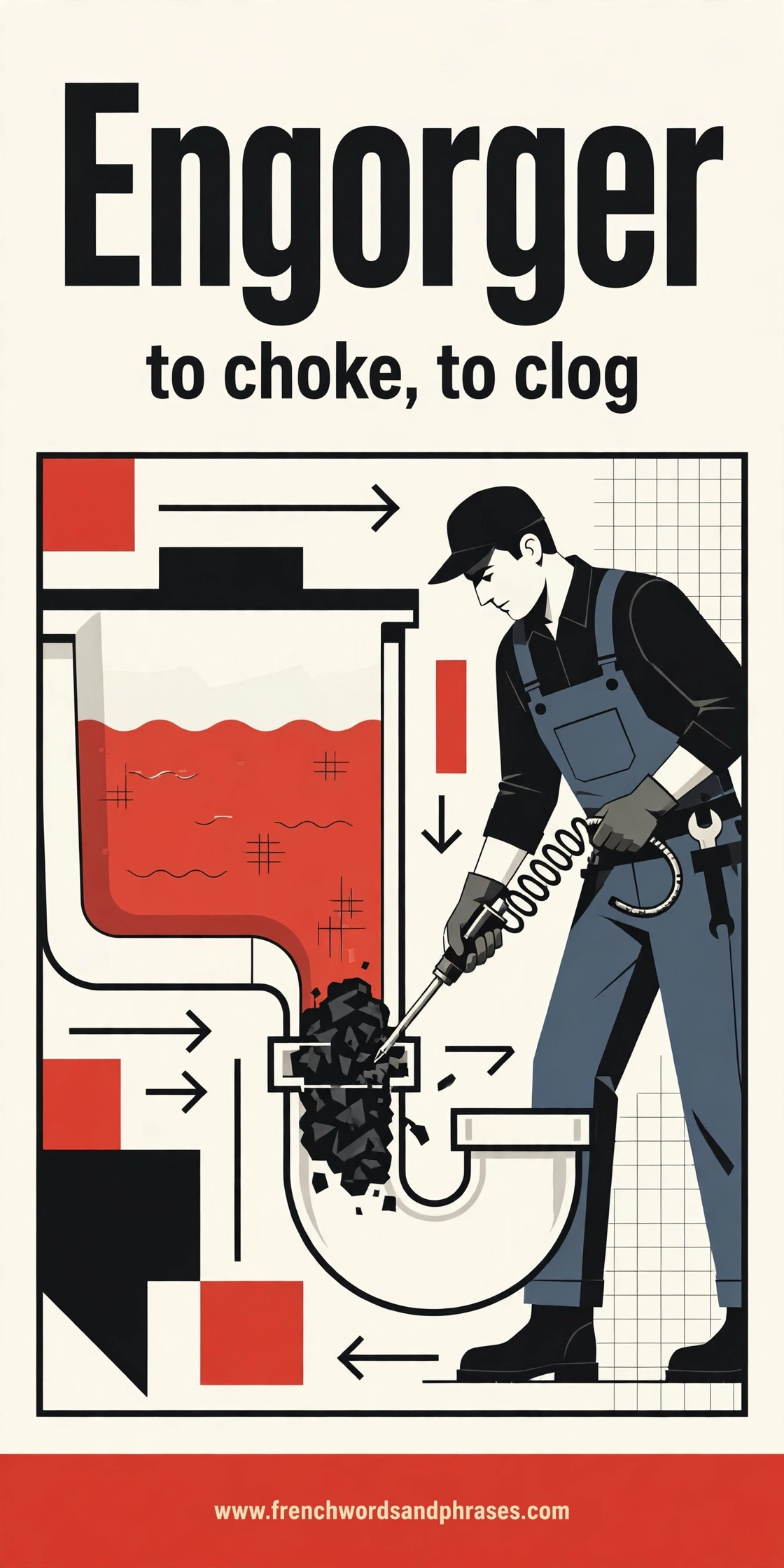
Engorger means to choke, to clog — to block a pipe, a throat, a street or a market by filling it fuller than it can bear.
Dead leaves in a gutter, fat in a kitchen drain, cars in a city centre on Friday evening, unsold goods in a warehouse — engorger is the verb of the blockage: whatever fills a passage until nothing can flow is engorgé, choked and clogged.
In this guide, you’ll learn how to conjugate engorger in all the major French tenses and moods. Explore complete conjugation tables, French examples, English translations, and practice quizzes.
Understanding the French Verb Engorger
Engorger is a regular French verb belonging to the first group of verbs, those ending in-er.
It means to choke, to clog. It is commonly used of drains, gutters, canals and throats blocked by matter, of streets and stations clogged with people and traffic, of hospital services overwhelmed, and of markets glutted with goods nobody buys. Wherever French needs a picture of too much in too narrow a passage, engorger is the word.
Verb classification: First group (-er)
Auxiliary verb: Avoir
Past participle: engorgé
Present participle: engorgeant
English equivalents: To choke, to clog, to block up; engorger un tuyau — to clog a pipe; les feuilles engorgent la gouttière — the leaves are blocking the gutter; engorger le centre-ville — to clog up the town centre; un marché engorgé — a glutted market; les urgences sont engorgées — casualty is overwhelmed.
One important detail: engorger is a -ger verb, so a silent e slips in after the g before a and o to keep the g soft: nous engorgeons, j’engorgeais, en engorgeant — but never before e or i: j’engorge, ils engorgent, que nous engorgions. The noun at its heart is la gorge, the throat: a pipe, a street or a hospital service is engorgé exactly the way a throat is choked. The reflexive s’engorger — to become clogged — has its own page.
Experience the Word
Engorger is the verb of the full passage — the drain, the street and the throat all fail in exactly the same way.
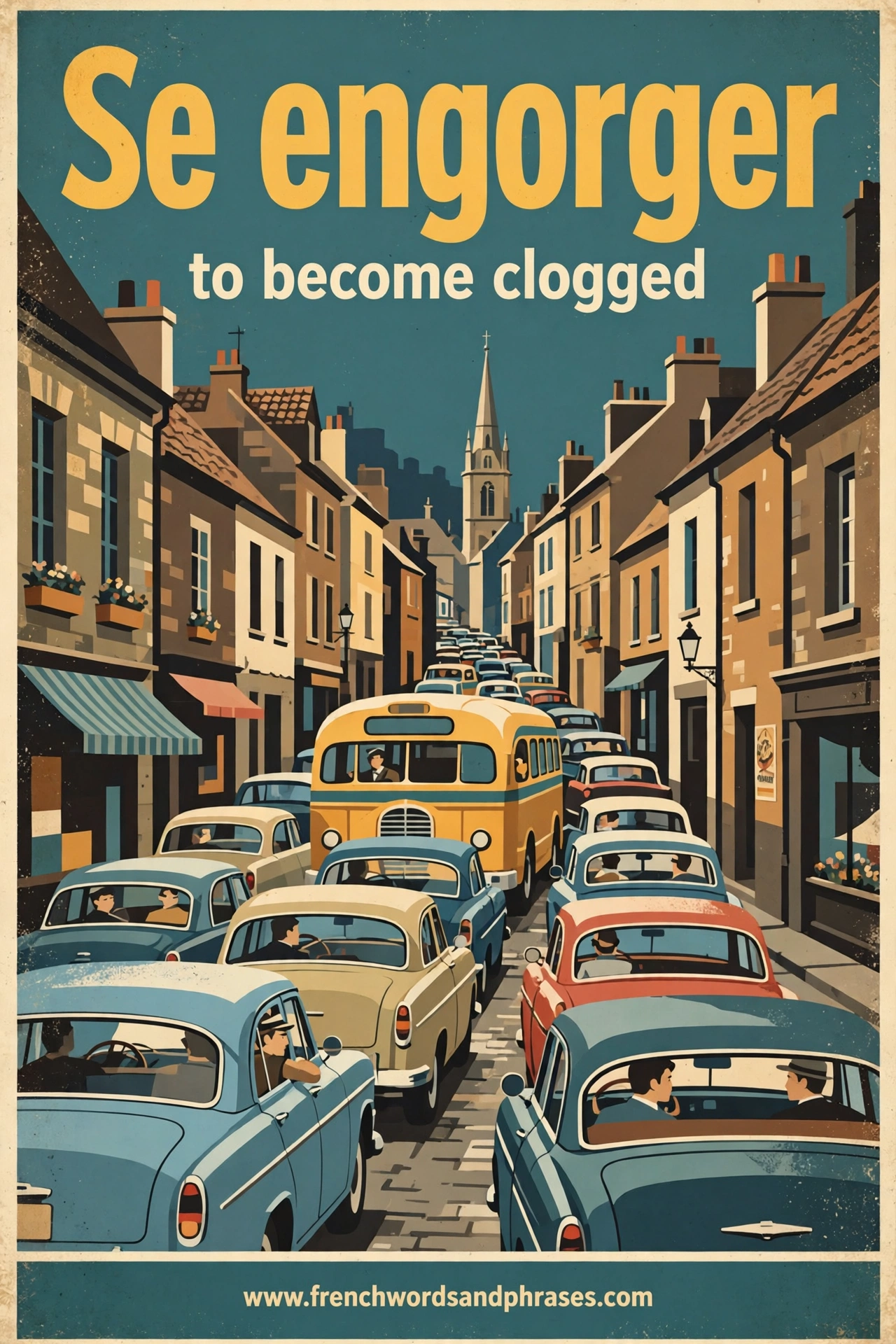
Imagine the Friday before a holiday. Every road out of the city fills at once, the ring road slows to walking pace, then stops; the radio announces that the whole network is engorgé. Ten thousand cars are doing to the motorway what dead leaves do to a gutter.
Nothing is broken; everything is full. The road is choked — engorgée — and nothing can flow.
How to Conjugate Engorger: Complete French Conjugation Guide
Let’s explore every major conjugation of engorger, beginning with the indicative mood.
How to Conjugate Engorger in the Indicative Mood
The indicative mood is used to express facts, observations, actions, and events.
How to Conjugate Engorger in the Present Tense (Présent)
Used for actions happening now, habitual actions, and general truths.
| Subject | Conjugation |
|---|---|
| je | engorge |
| tu | engorges |
| il / elle | engorge |
| nous | engorgeons |
| vous | engorgez |
| ils / elles | engorgent |
Example
Les feuilles mortes engorgent la gouttière.
The dead leaves are clogging the gutter.
Quick Quiz 1
Complete the sentence:
Nous ______ le tuyau si nous versons la graisse dans l’évier.
Reveal the answer
engorgerons
Nous engorgerons le tuyau si nous versons la graisse dans l’évier.
We will clog the pipe if we pour grease into the sink.
How to Conjugate Engorger in the Passé Composé
Used for completed actions in the past. Engorger takes the auxiliary verb avoir.
| Subject | Conjugation |
|---|---|
| j’ | ai engorgé |
| tu | as engorgé |
| il / elle | a engorgé |
| nous | avons engorgé |
| vous | avez engorgé |
| ils / elles | ont engorgé |
Example
La graisse a engorgé le tuyau de l’évier.
The grease has clogged the sink pipe.
How to Conjugate Engorger in the Imparfait (Imperfect Tense)
Used for habitual past actions, descriptions, and ongoing situations in the past.
| Subject | Conjugation |
|---|---|
| je | engorgeais |
| tu | engorgeais |
| il / elle | engorgeait |
| nous | engorgions |
| vous | engorgiez |
| ils / elles | engorgeaient |
Example
Les voitures engorgeaient le centre-ville chaque vendredi.
Cars used to clog the town centre every Friday.
Quick Quiz 2
Choose the correct form:
The grease has clogged the sink pipe.
La graisse ______ le tuyau de l’évier. (a engorgé / est engorgée)
Reveal the answer
a engorgé
La graisse a engorgé le tuyau de l’évier.
Engorger takes avoir.
How to Conjugate Engorger in the Plus-que-parfait
Used to describe an action that had already been completed before another past event.
| Subject | Conjugation |
|---|---|
| j’ | avais engorgé |
| tu | avais engorgé |
| il / elle | avait engorgé |
| nous | avions engorgé |
| vous | aviez engorgé |
| ils / elles | avaient engorgé |
Example
La boue avait engorgé le fossé le long de la route.
The mud had blocked the ditch along the road.
How to Conjugate Engorger in the Passé Simple
Primarily used in formal writing, literature, and historical narratives. It is rarely used in everyday conversation.
| Subject | Conjugation |
|---|---|
| je | engorgeai |
| tu | engorgeas |
| il / elle | engorgea |
| nous | engorgeâmes |
| vous | engorgeâtes |
| ils / elles | engorgeèrent |
Example
La foule engorgea la place en quelques minutes.
The crowd clogged the square within minutes.
How to Conjugate Engorger in the Passé Antérieur
A literary tense used to express an action completed immediately before another past action, generally in the passé simple.
| Subject | Conjugation |
|---|---|
| j’ | eus engorgé |
| tu | eus engorgé |
| il / elle | eut engorgé |
| nous | eûmes engorgé |
| vous | eûtes engorgé |
| ils / elles | eurent engorgé |
Example
Quand les déchets eurent engorgé le canal, l’eau déborda.
When the rubbish had choked the canal, the water overflowed.
How to Conjugate Engorger in the Future Tense (Futur Simple)
Used to describe actions that will take place in the future.
| Subject | Conjugation |
|---|---|
| je | engorgerai |
| tu | engorgeras |
| il / elle | engorgera |
| nous | engorgerons |
| vous | engorgerez |
| ils / elles | engorgeront |
Example
Les travaux engorgeront la rue pendant un mois.
The roadworks will clog the street for a month.
How to Conjugate Engorger in the Futur Antérieur (Future Perfect)
Used for an action that will have been completed before a particular point in the future.
| Subject | Conjugation |
|---|---|
| j’ | aurai engorgé |
| tu | auras engorgé |
| il / elle | aura engorgé |
| nous | aurons engorgé |
| vous | aurez engorgé |
| ils / elles | auront engorgé |
Example
À Noël, les commandes auront engorgé tous les entrepôts.
By Christmas, orders will have clogged every warehouse.
How to Conjugate Engorger in the Near Future (Futur Proche)
Used to describe something that is going to happen soon. Formed with aller + infinitive.
| Subject | Conjugation |
|---|---|
| je | vais engorger |
| tu | vas engorger |
| il / elle | va engorger |
| nous | allons engorger |
| vous | allez engorger |
| ils / elles | vont engorger |
Example
Ce calcaire va engorger les tuyaux si on ne le traite pas.
This limescale is going to clog the pipes if it is not treated.
How to Conjugate Engorger in the Conditional Mood
The conditional mood expresses what would happen under certain circumstances. It is also frequently used to make polite requests or express wishes.
How to Conjugate Engorger in the Present Conditional
| Subject | Conjugation |
|---|---|
| je | engorgerais |
| tu | engorgerais |
| il / elle | engorgerait |
| nous | engorgerions |
| vous | engorgeriez |
| ils / elles | engorgeraient |
Example
Sans entretien, la vase engorgerait le port en deux ans.
Without maintenance, the silt would choke the harbour in two years.
How to Conjugate Engorger in the Past Conditional
| Subject | Conjugation |
|---|---|
| j’ | aurais engorgé |
| tu | aurais engorgé |
| il / elle | aurait engorgé |
| nous | aurions engorgé |
| vous | auriez engorgé |
| ils / elles | auraient engorgé |
Example
Le sable aurait engorgé le moteur sans le filtre.
The sand would have clogged the engine without the filter.
Engorger in the Literary Past Conditional Form
This less common literary form uses the imperfect subjunctive of avoir.
| Subject | Conjugation |
|---|---|
| j’ | eusse engorgé |
| tu | eusses engorgé |
| il / elle | eût engorgé |
| nous | eussions engorgé |
| vous | eussiez engorgé |
| ils / elles | eussent engorgé |
Example
La neige eût engorgé les cols sans les chasse-neige.
The snow would have blocked the passes without the snowploughs.
How to Conjugate Engorger in the Subjunctive Mood
The subjunctive is used to express wishes, emotions, doubts, necessity, and uncertainty. It frequently follows expressions such as il faut que (it is necessary that) or bien que (although).
How to Conjugate Engorger in the Present Subjunctive
| Subject | Conjugation |
|---|---|
| que je | engorge |
| que tu | engorges |
| qu’il / qu’elle | engorge |
| que nous | engorgions |
| que vous | engorgiez |
| qu’ils / qu’elles | engorgent |
Example
Il faut éviter que la graisse engorge les canalisations.
We must stop grease clogging the drains.
Quick Quiz 3
Complete the sentence using the subjunctive:
Il faut éviter que les feuilles ______ la gouttière.
Reveal the answer
engorgent
Il faut éviter que les feuilles engorgent la gouttière.
We must stop the leaves clogging the gutter.
How to Conjugate Engorger in the Imperfect Subjunctive
A literary tense, rarely encountered in modern spoken French.
| Subject | Conjugation |
|---|---|
| que je | engorgasse |
| que tu | engorgasses |
| qu’il / qu’elle | engorgât |
| que nous | engorgassions |
| que vous | engorgassiez |
| qu’ils / qu’elles | engorgassent |
Example
On craignait que les visiteurs engorgeassent les petites rues du village.
People feared the visitors might clog the village’s little streets.
How to Conjugate Engorger in the Pluperfect Subjunctive
A literary construction used to express an action completed before another past action.
| Subject | Conjugation |
|---|---|
| que j’ | eusse engorgé |
| que tu | eusses engorgé |
| qu’il / qu’elle | eût engorgé |
| que nous | eussions engorgé |
| que vous | eussiez engorgé |
| qu’ils / qu’elles | eussent engorgé |
Example
On racontait que les sables eussent engorgé l’ancien port.
People said the sands had choked the old harbour.
How to Conjugate Engorger in the Past Subjunctive
| Subject | Conjugation |
|---|---|
| que j’ | aie engorgé |
| que tu | aies engorgé |
| qu’il / qu’elle | ait engorgé |
| que nous | ayons engorgé |
| que vous | ayez engorgé |
| qu’ils / qu’elles | aient engorgé |
Example
Je suis étonné que la boue ait engorgé le tuyau si vite.
I am amazed the mud clogged the pipe so quickly.
How to Conjugate Engorger in the Imperative
The imperative is used to give commands, instructions, invitations, or suggestions. Subject pronouns are omitted.
How to Conjugate Engorger in the Present Imperative
| Person | Conjugation |
|---|---|
| (tu) | engorge |
| (nous) | engorgeons |
| (vous) | engorgez |
Example
N’engorgez pas les trottoirs avec vos cartons !
Do not block the pavements with your boxes!
Quick Quiz 4
How would you say Do not block the pavement (tu form)?
Reveal the answer
N’engorge pas le trottoir !
French Participles of Engorger
Participles are verb forms that can be used in compound tenses and other grammatical constructions.
Present Participle of Engorger
engorgeant
En engorgeant les artères, le trafic paralyse la ville.
By clogging the arteries, the traffic paralyses the city.
Past Participle of Engorger
engorgé
Engorgé par les algues, le canal ne laisse plus passer les bateaux.
Choked with algae, the canal no longer lets the boats through.
Engorger in Everyday French: Real-Life Examples
Now that you know the conjugations, let’s see how engorger appears in everyday French.
Example 1 — Present
Les feuilles mortes engorgent la gouttière.
The dead leaves are clogging the gutter.
Example 2 — Passé composé
La graisse a engorgé le tuyau de l’évier.
The grease has clogged the sink pipe.
Example 3 — Imparfait
Les voitures engorgeaient le centre-ville.
Cars used to clog the town centre.
Example 4 — Future
Les travaux engorgeront la rue pendant un mois.
The roadworks will clog the street for a month.
Example 5 — Conditional
La vase engorgerait le port sans entretien.
The silt would choke the harbour without maintenance.
Example 6 — Imperative
N’engorgez pas les trottoirs !
Do not block the pavements!
Beyond Translation: The Meaning of Engorger
English clog and choke split the work between them; French engorger unites both in one picture — la gorge, the throat, stuffed too full to swallow.
Its favourite modern stage is the hospital.
Every winter the news reports that les urgences sont engorgées — casualty is choked with patients — and every driver stuck on the ring road understands the metaphor in his bones.
How to Remember the French Verb Engorger
Remember it this way: Engorger is about dead leaves in the gutter, cars on the ring road — a throat too full to swallow.
- Built on la gorge, the throat: engorger is to choke a passage — pipe, street or hospital — by overfilling it.
- A -ger verb: keep the g soft with a silent e — nous engorgeons, j’engorgeais, en engorgeant.
- Regular endings otherwise: j’engorge, ils engorgent, past participle engorgé.
The key idea is dead leaves in the gutter, cars on the ring road — a throat too full to swallow.
Test Your Knowledge of Engorger
Let’s see how much you’ve learned. Try answering these questions before revealing the answers.
Question 1
Why does nous engorgeons have an extra e?
Reveal the answer
Because engorger is a -ger verb — the silent e keeps the g soft before o: engorgeons, engorgeais, engorgeant.
Question 2
How do you say The grease has clogged the sink pipe in French?
Reveal the answer
La graisse a engorgé le tuyau de l’évier.
Question 3
Translate: The dead leaves are clogging the gutter.
Reveal the answer
Les feuilles mortes engorgent la gouttière.
Question 4
What is the past participle of engorger?
Reveal the answer
Engorgé.
Question 5
Complete the sentence:
Il faut éviter que la graisse ______ les canalisations.
Reveal the answer
engorge
Il faut éviter que la graisse engorge les canalisations.
We must stop grease clogging the drains.
Your Final Challenge
Can You Use It?
How would you say this in French?
The leaves have clogged the gutter, the cars the street, and worries, for their part, clog people’s minds.
Reveal the answer
Les feuilles ont engorgé la gouttière, les voitures la rue, et les soucis, eux, engorgent les esprits.
The leaves have clogged the gutter, the cars the street, and worries, for their part, clog people’s minds.
A little French. A little curiosity. A richer everyday life.
LEARN FRENCH ONE WORD AT A TIME