A French Word to Live By
How to Conjugate Engoncer in French
/ɑ̃.ɡɔ̃.se/
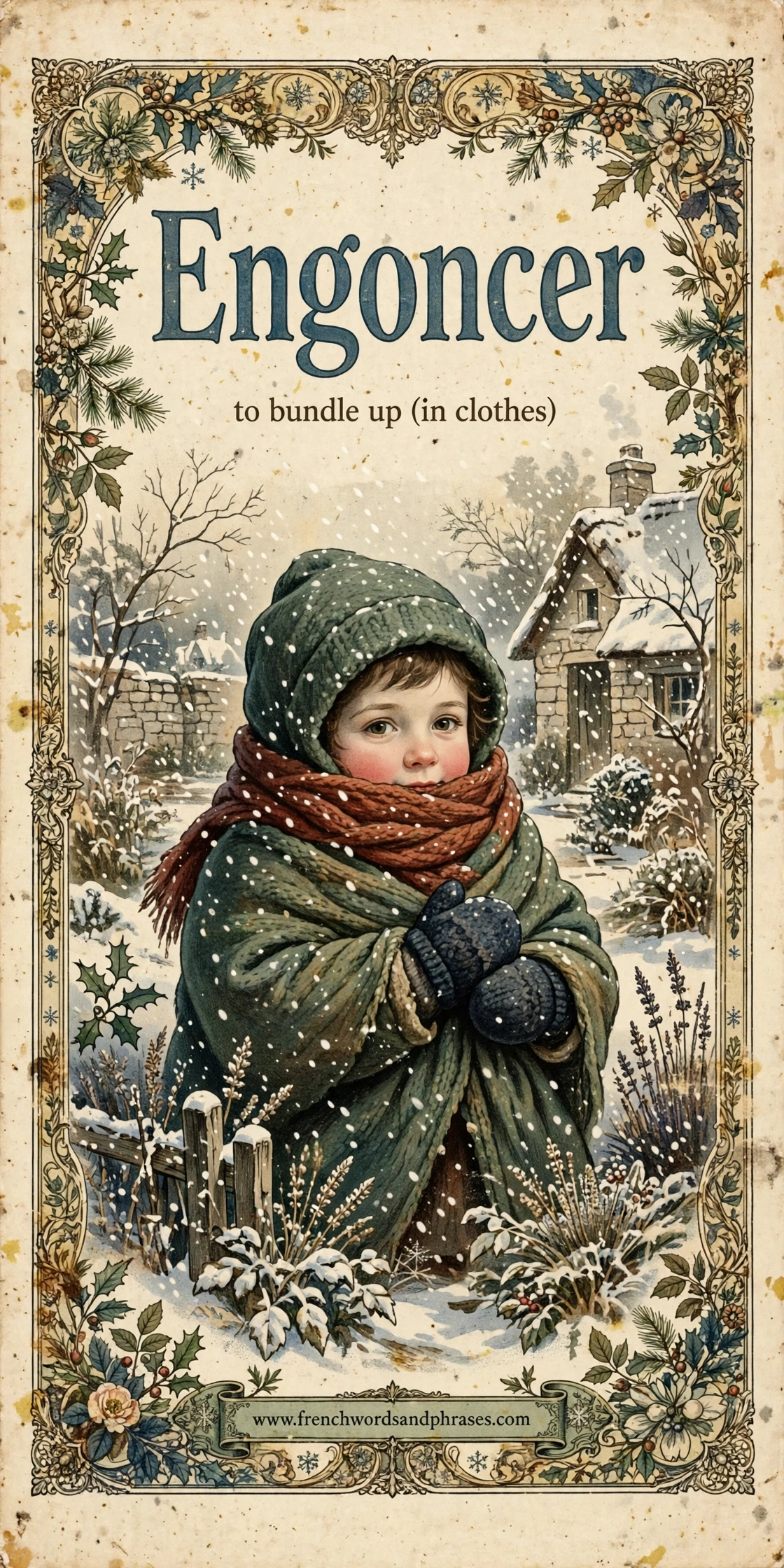
Engoncer means to bundle up (in clothes) — to wrap someone so tightly in layers of clothing that they can barely move, head sunk between their shoulders.
A toddler in January, wrapped in a snowsuit, scarf, hat and mittens until only his eyes show; a man squeezed into a coat two sizes too small — engoncer is the verb of the over-wrapped: to bundle someone up in clothes until the clothes are wearing them.
In this guide, you’ll learn how to conjugate engoncer in all the major French tenses and moods. Explore complete conjugation tables, French examples, English translations, and practice quizzes.
Understanding the French Verb Engoncer
Engoncer is a regular French verb belonging to the first group of verbs, those ending in-er.
It means to bundle up (in clothes). It is commonly used of children bundled into winter clothes, of anyone squeezed into tight or ill-fitting garments, and of the head-and-shoulders posture of someone muffled up against the cold. It always suggests discomfort or comedy — nobody is elegantly engoncé.
Verb classification: First group (-er)
Auxiliary verb: Avoir
Past participle: engoncé
Present participle: engonçant
English equivalents: To bundle up, to muffle up (in clothes); engoncer un enfant dans son manteau — to bundle a child up in his coat; être engoncé dans un manteau trop petit — to be squeezed into a too-small coat; engoncer sa tête entre ses épaules — to sink one’s head between one’s shoulders.
One important detail: engoncer is a -cer verb, so the c becomes ç before a and o to keep its soft s sound: nous engonçons, j’engonçais, en engonçant, and in the passé simple elle engonça — but the c stays hard and plain before e and i: j’engonce, ils engoncent, que nous engoncions. The picture to keep is of someone wrapped so tight that the neck disappears: être engoncé dans un vêtement, squeezed and sunk into a garment. A collar or a coat that is too tight can itself engoncer the wearer — ce col m’engonce.
Experience the Word
Engoncer is the verb of too many layers — the moment the scarf goes over the hat, the person inside stops moving like a person.
Imagine a grandmother preparing her grandson for a walk in the snow. Coat, then scarf, then the second scarf, then mittens on a string. She engonce the little boy so thoroughly that when he falls over in the snow, he cannot get up, and lies there waving his arms like a small, cheerful tortoise.
The child is warm, safe and completely helpless. He has been bundled up — engoncé — beyond all movement.
How to Conjugate Engoncer: Complete French Conjugation Guide
Let’s explore every major conjugation of engoncer, beginning with the indicative mood.
How to Conjugate Engoncer in the Indicative Mood
The indicative mood is used to express facts, observations, actions, and events.
How to Conjugate Engoncer in the Present Tense (Présent)
Used for actions happening now, habitual actions, and general truths.
| Subject | Conjugation |
|---|---|
| je | engonce |
| tu | engonces |
| il / elle | engonce |
| nous | engonçons |
| vous | engoncez |
| ils / elles | engoncent |
Example
Ce manteau trop petit l’engonce et l’empêche de bouger.
This too-small coat squeezes him in and stops him moving.
Quick Quiz 1
Complete the sentence:
Nous ______ les enfants dans leurs manteaux d’hiver.
Reveal the answer
engonçons
Nous engonçons les enfants dans leurs manteaux d’hiver.
We bundle the children up in their winter coats — note the cedilla in engonçons.
How to Conjugate Engoncer in the Passé Composé
Used for completed actions in the past. Engoncer takes the auxiliary verb avoir.
| Subject | Conjugation |
|---|---|
| j’ | ai engoncé |
| tu | as engoncé |
| il / elle | a engoncé |
| nous | avons engoncé |
| vous | avez engoncé |
| ils / elles | ont engoncé |
Example
Maman a engoncé le petit dans son manteau d’hiver.
Mum bundled the little one up in his winter coat.
How to Conjugate Engoncer in the Imparfait (Imperfect Tense)
Used for habitual past actions, descriptions, and ongoing situations in the past.
| Subject | Conjugation |
|---|---|
| je | engonçais |
| tu | engonçais |
| il / elle | engonçait |
| nous | engoncions |
| vous | engonciez |
| ils / elles | engonçaient |
Example
Chaque hiver, elle engonçait ses enfants dans des écharpes énormes.
Every winter, she used to bundle her children up in enormous scarves.
Quick Quiz 2
Choose the correct form:
Mum bundled the little one up in his coat.
Maman ______ le petit dans son manteau. (a engoncé / est engoncée)
Reveal the answer
a engoncé
Maman a engoncé le petit dans son manteau.
Engoncer takes avoir.
How to Conjugate Engoncer in the Plus-que-parfait
Used to describe an action that had already been completed before another past event.
| Subject | Conjugation |
|---|---|
| j’ | avais engoncé |
| tu | avais engoncé |
| il / elle | avait engoncé |
| nous | avions engoncé |
| vous | aviez engoncé |
| ils / elles | avaient engoncé |
Example
Il avait engoncé l’enfant dans tant de laine qu’il ne pouvait plus lever les bras.
He had bundled the child up in so much wool that he could no longer lift his arms.
How to Conjugate Engoncer in the Passé Simple
Primarily used in formal writing, literature, and historical narratives. It is rarely used in everyday conversation.
| Subject | Conjugation |
|---|---|
| je | engonçai |
| tu | engonças |
| il / elle | engonça |
| nous | engonçâmes |
| vous | engonçâtes |
| ils / elles | engonçèrent |
Example
Elle engonça le bébé dans la couverture avant de sortir.
She bundled the baby up in the blanket before going out.
How to Conjugate Engoncer in the Passé Antérieur
A literary tense used to express an action completed immediately before another past action, generally in the passé simple.
| Subject | Conjugation |
|---|---|
| j’ | eus engoncé |
| tu | eus engoncé |
| il / elle | eut engoncé |
| nous | eûmes engoncé |
| vous | eûtes engoncé |
| ils / elles | eurent engoncé |
Example
Quand elle eut engoncé l’enfant, elle ouvrit la porte au froid.
When she had bundled the child up, she opened the door to the cold.
How to Conjugate Engoncer in the Future Tense (Futur Simple)
Used to describe actions that will take place in the future.
| Subject | Conjugation |
|---|---|
| je | engoncerai |
| tu | engonceras |
| il / elle | engoncera |
| nous | engoncerons |
| vous | engoncerez |
| ils / elles | engonceront |
Example
Tu engonceras le petit dans sa combinaison de ski.
You will bundle the little one up in his ski suit.
How to Conjugate Engoncer in the Futur Antérieur (Future Perfect)
Used for an action that will have been completed before a particular point in the future.
| Subject | Conjugation |
|---|---|
| j’ | aurai engoncé |
| tu | auras engoncé |
| il / elle | aura engoncé |
| nous | aurons engoncé |
| vous | aurez engoncé |
| ils / elles | auront engoncé |
Example
À huit heures, elle aura engoncé les deux enfants pour l’école.
By eight o’clock, she will have bundled up both children for school.
How to Conjugate Engoncer in the Near Future (Futur Proche)
Used to describe something that is going to happen soon. Formed with aller + infinitive.
| Subject | Conjugation |
|---|---|
| je | vais engoncer |
| tu | vas engoncer |
| il / elle | va engoncer |
| nous | allons engoncer |
| vous | allez engoncer |
| ils / elles | vont engoncer |
Example
Elle va engoncer le bébé dans son manteau.
She is going to bundle the baby up in his coat.
How to Conjugate Engoncer in the Conditional Mood
The conditional mood expresses what would happen under certain circumstances. It is also frequently used to make polite requests or express wishes.
How to Conjugate Engoncer in the Present Conditional
| Subject | Conjugation |
|---|---|
| je | engoncerais |
| tu | engoncerais |
| il / elle | engoncerait |
| nous | engoncerions |
| vous | engonceriez |
| ils / elles | engonceraient |
Example
Sans ce vent glacial, on n’engoncerait pas les enfants à ce point.
Without this icy wind, we would not bundle the children up to this extent.
How to Conjugate Engoncer in the Past Conditional
| Subject | Conjugation |
|---|---|
| j’ | aurais engoncé |
| tu | aurais engoncé |
| il / elle | aurait engoncé |
| nous | aurions engoncé |
| vous | auriez engoncé |
| ils / elles | auraient engoncé |
Example
Nous aurions engoncé le petit davantage si nous avions su qu’il neigeait.
We would have bundled the little one up more if we had known it was snowing.
Engoncer in the Literary Past Conditional Form
This less common literary form uses the imperfect subjunctive of avoir.
| Subject | Conjugation |
|---|---|
| j’ | eusse engoncé |
| tu | eusses engoncé |
| il / elle | eût engoncé |
| nous | eussions engoncé |
| vous | eussiez engoncé |
| ils / elles | eussent engoncé |
Example
Elle eût engoncé l’enfant dans toutes les laines de la maison.
She would have bundled the child up in every wool in the house.
How to Conjugate Engoncer in the Subjunctive Mood
The subjunctive is used to express wishes, emotions, doubts, necessity, and uncertainty. It frequently follows expressions such as il faut que (it is necessary that) or bien que (although).
How to Conjugate Engoncer in the Present Subjunctive
| Subject | Conjugation |
|---|---|
| que je | engonce |
| que tu | engonces |
| qu’il / qu’elle | engonce |
| que nous | engoncions |
| que vous | engonciez |
| qu’ils / qu’elles | engoncent |
Example
Je ne veux pas que ce col m’engonce.
I do not want this collar to squeeze me in.
Quick Quiz 3
Complete the sentence using the subjunctive:
Je ne veux pas que ce col te ______.
Reveal the answer
engonce
Je ne veux pas que ce col t’engonce.
I do not want this collar to squeeze you in.
How to Conjugate Engoncer in the Imperfect Subjunctive
A literary tense, rarely encountered in modern spoken French.
| Subject | Conjugation |
|---|---|
| que je | engoncasse |
| que tu | engoncasses |
| qu’il / qu’elle | engoncât |
| que nous | engoncassions |
| que vous | engoncassiez |
| qu’ils / qu’elles | engoncassent |
Example
Il fallait qu’elle engonçât le bébé avant la promenade.
She had to bundle the baby up before the walk.
How to Conjugate Engoncer in the Pluperfect Subjunctive
A literary construction used to express an action completed before another past action.
| Subject | Conjugation |
|---|---|
| que j’ | eusse engoncé |
| que tu | eusses engoncé |
| qu’il / qu’elle | eût engoncé |
| que nous | eussions engoncé |
| que vous | eussiez engoncé |
| qu’ils / qu’elles | eussent engoncé |
Example
On riait à l’idée qu’elle eût engoncé le chien dans un pull.
People laughed at the thought that she had bundled the dog up in a jumper.
How to Conjugate Engoncer in the Past Subjunctive
| Subject | Conjugation |
|---|---|
| que j’ | aie engoncé |
| que tu | aies engoncé |
| qu’il / qu’elle | ait engoncé |
| que nous | ayons engoncé |
| que vous | ayez engoncé |
| qu’ils / qu’elles | aient engoncé |
Example
Je suis amusé qu’elle ait engoncé le petit dans trois écharpes.
I am amused that she bundled the little one up in three scarves.
How to Conjugate Engoncer in the Imperative
The imperative is used to give commands, instructions, invitations, or suggestions. Subject pronouns are omitted.
How to Conjugate Engoncer in the Present Imperative
| Person | Conjugation |
|---|---|
| (tu) | engonce |
| (nous) | engonçons |
| (vous) | engoncez |
Example
N’engonce pas l’enfant, il étouffe déjà !
Do not bundle the child up, he is already suffocating!
Quick Quiz 4
How would you say Do not bundle the child up (tu form)?
Reveal the answer
N’engonce pas l’enfant !
French Participles of Engoncer
Participles are verb forms that can be used in compound tenses and other grammatical constructions.
Present Participle of Engoncer
engonçant
En engonçant son fils dans le manteau, elle riait de le voir si rond.
While bundling her son up in the coat, she laughed to see him so round.
Past Participle of Engoncer
engoncé
Engoncé dans son manteau, l’enfant ressemblait à un petit ours.
Bundled up in his coat, the child looked like a little bear.
Engoncer in Everyday French: Real-Life Examples
Now that you know the conjugations, let’s see how engoncer appears in everyday French.
Example 1 — Present
Ce manteau trop petit l’engonce.
This too-small coat squeezes him in.
Example 2 — Passé composé
Maman a engoncé le petit dans son manteau.
Mum bundled the little one up in his coat.
Example 3 — Imparfait
Elle engonçait ses enfants dans des écharpes énormes.
She used to bundle her children up in enormous scarves.
Example 4 — Future
Tu engonceras le petit dans sa combinaison de ski.
You will bundle the little one up in his ski suit.
Example 5 — Conditional
On n’engoncerait pas les enfants sans ce vent glacial.
We would not bundle the children up without this icy wind.
Example 6 — Imperative
N’engonce pas l’enfant, il étouffe !
Do not bundle the child up, he is suffocating!
Beyond Translation: The Meaning of Engoncer
English bundle up needs its particle; French engoncer does it in one word, and adds a nuance English misses — the head sinking between the shoulders inside too many clothes.
It is the verb of the disappearing neck.
From grandmothers with scarves to waiters squeezed into tight waistcoats, anyone swallowed by their own outfit is engoncé — warm, ridiculous, and barely able to turn their head.
How to Remember the French Verb Engoncer
Remember it this way: Engoncer is about the child in three scarves, head sunk, arms stuck out like a little bear.
- Picture the toddler in the snowsuit who cannot move: engoncer is to bundle up in clothes until the clothes win.
- A -cer verb: c becomes ç before a and o — nous engonçons, j’engonçais, elle engonça.
- Regular endings otherwise: j’engonce, ils engoncent, past participle engoncé.
The key idea is the child in three scarves, head sunk, arms stuck out like a little bear.
Test Your Knowledge of Engoncer
Let’s see how much you’ve learned. Try answering these questions before revealing the answers.
Question 1
Why does nous engonçons have a cedilla?
Reveal the answer
Because engoncer is a -cer verb — c becomes ç before a and o to keep the soft s sound: engonçons, engonçais.
Question 2
How do you say Mum bundled the little one up in his coat in French?
Reveal the answer
Maman a engoncé le petit dans son manteau.
Question 3
Translate: Bundled up in his coat, the child looked like a little bear.
Reveal the answer
Engoncé dans son manteau, l’enfant ressemblait à un petit ours.
Question 4
What is the past participle of engoncer?
Reveal the answer
Engoncé.
Question 5
Complete the sentence:
Je ne veux pas que ce col ______.
Reveal the answer
m’engonce
Je ne veux pas que ce col m’engonce.
I do not want this collar to squeeze me in.
Your Final Challenge
Can You Use It?
How would you say this in French?
Bundled up in three scarves, the little one crossed the yard like a heroic teddy bear.
Reveal the answer
Engoncé dans trois écharpes, le petit a traversé la cour comme un ours en peluche héroïque.
Bundled up in three scarves, the little one crossed the yard like a heroic teddy bear.
A little French. A little curiosity. A richer everyday life.
LEARN FRENCH ONE WORD AT A TIME