A French Word to Live By
How to Conjugate Engainer in French
/ɑ̃.ɡɛ.ne/
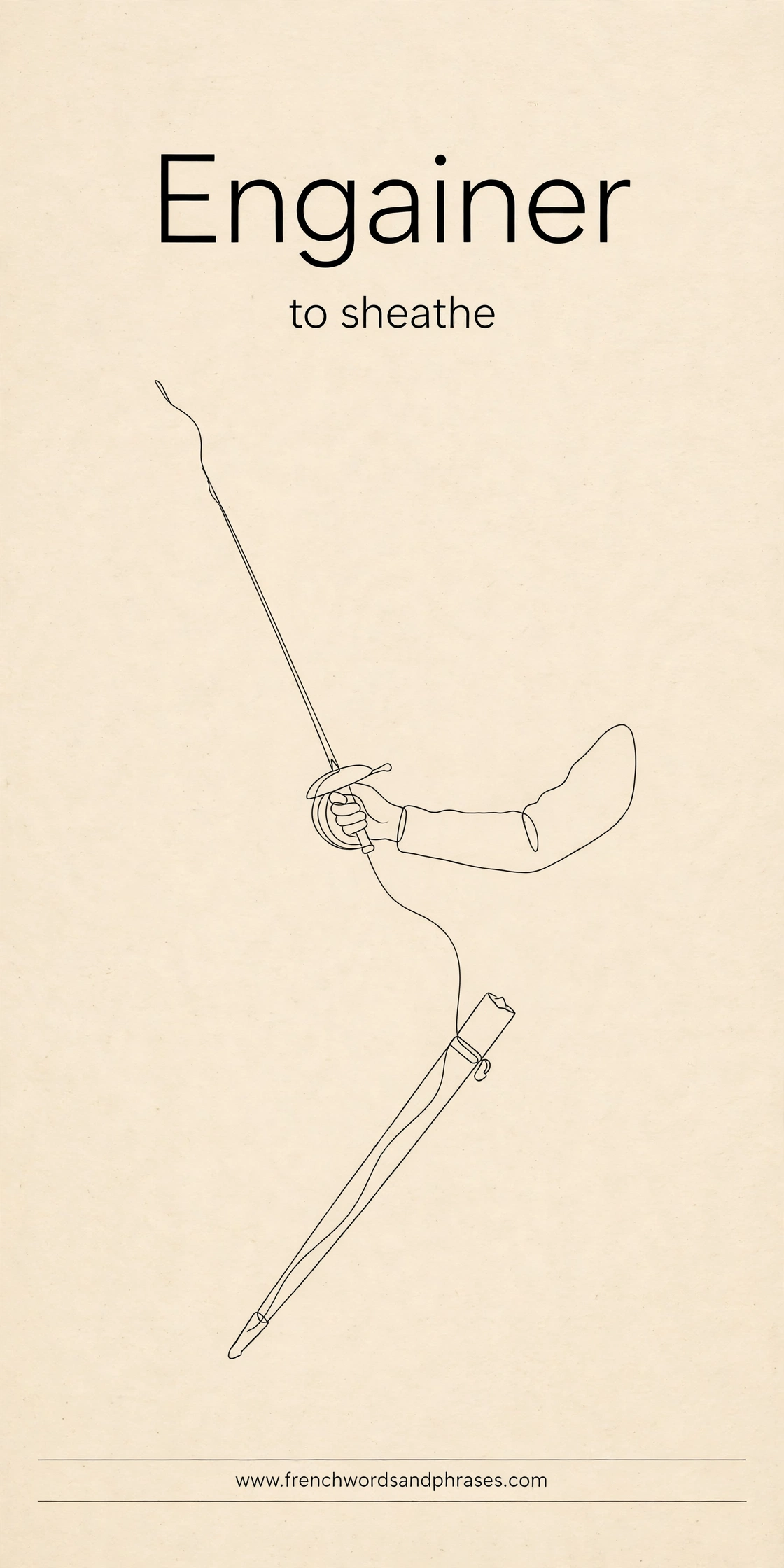
Engainer means to sheathe — to slide a blade back into its scabbard, or a cable into its protective sleeve.
A musketeer returning his sword to its scabbard after the duel, an electrician feeding a wire into its plastic conduit — engainer is the verb of putting a dangerous or delicate thing safely away inside its sheath.
In this guide, you’ll learn how to conjugate engainer in all the major French tenses and moods. Explore complete conjugation tables, French examples, English translations, and practice quizzes.
Understanding the French Verb Engainer
Engainer is a regular French verb belonging to the first group of verbs, those ending in-er.
It means to sheathe. It belongs to fencers, soldiers and electricians: swords, sabres and foils are engainés in their fourreaux, and in modern building work, cables and wires are engainés — run inside protective sheaths and conduits before the walls are closed.
Verb classification: First group (-er)
Auxiliary verb: Avoir
Past participle: engainé
Present participle: engainant
English equivalents: To sheathe, to put into a sheath or sleeve; engainer une épée — to sheathe a sword; engainer un câble — to sleeve a cable; une gaine — a sheath, a sleeve, a conduit; rengainer — to sheathe again, to put away (also figurative).
One important detail: engainer is built on une gaine — a sheath, a scabbard, a sleeve, even a girdle — and it is perfectly regular (j’engaine, nous engainons, participle engainé). Its everyday partner is its twin with a prefix, rengainer: you rengainez your sword after a fight, and figuratively you rengainez your insults, your anger, your ambitions — il a rengainé ses critiques, he swallowed his criticisms. Engainer alone is the plainer, more technical word.
Experience the Word
Engainer is the verb of the fight put away — the blade disappears, and everyone can breathe again.
Imagine two musketeers in a courtyard at dawn, swords out, honour at stake. A friend steps between them, words are spoken, and slowly, with great dignity, each man engaina son épée — slides the steel home into the scabbard — and bows. The duel is over; the sheathing was the peace treaty.
No blow was struck at the end. The swords are sheathed — engainées — and honour is satisfied.
How to Conjugate Engainer: Complete French Conjugation Guide
Let’s explore every major conjugation of engainer, beginning with the indicative mood.
How to Conjugate Engainer in the Indicative Mood
The indicative mood is used to express facts, observations, actions, and events.
How to Conjugate Engainer in the Present Tense (Présent)
Used for actions happening now, habitual actions, and general truths.
| Subject | Conjugation |
|---|---|
| je | engaine |
| tu | engaines |
| il / elle | engaine |
| nous | engainons |
| vous | engainez |
| ils / elles | engainent |
Example
Le mousquetaire engaine son épée après le duel.
The musketeer sheathes his sword after the duel.
Quick Quiz 1
Complete the sentence:
Nous ______ les câbles avant de fermer le mur.
Reveal the answer
engainons
Nous engainons les câbles avant de fermer le mur.
We sleeve the cables before closing the wall.
How to Conjugate Engainer in the Passé Composé
Used for completed actions in the past. Engainer takes the auxiliary verb avoir.
| Subject | Conjugation |
|---|---|
| j’ | ai engainé |
| tu | as engainé |
| il / elle | a engainé |
| nous | avons engainé |
| vous | avez engainé |
| ils / elles | ont engainé |
Example
Elle a engainé le câble dans une gaine isolante.
She sleeved the cable in an insulating sheath.
How to Conjugate Engainer in the Imparfait (Imperfect Tense)
Used for habitual past actions, descriptions, and ongoing situations in the past.
| Subject | Conjugation |
|---|---|
| je | engainais |
| tu | engainais |
| il / elle | engainait |
| nous | engainions |
| vous | engainiez |
| ils / elles | engainaient |
Example
Après chaque combat, il engainait son sabre lentement.
After every fight, he used to sheathe his sabre slowly.
Quick Quiz 2
Choose the correct form:
The knight sheathed his sword.
Le chevalier ______ son épée. (a engainé / est engainé)
Reveal the answer
a engainé
Le chevalier a engainé son épée.
Engainer takes avoir.
How to Conjugate Engainer in the Plus-que-parfait
Used to describe an action that had already been completed before another past event.
| Subject | Conjugation |
|---|---|
| j’ | avais engainé |
| tu | avais engainé |
| il / elle | avait engainé |
| nous | avions engainé |
| vous | aviez engainé |
| ils / elles | avaient engainé |
Example
Le soldat avait engainé sa baïonnette avant la marche.
The soldier had sheathed his bayonet before the march.
How to Conjugate Engainer in the Passé Simple
Primarily used in formal writing, literature, and historical narratives. It is rarely used in everyday conversation.
| Subject | Conjugation |
|---|---|
| je | engainai |
| tu | engainas |
| il / elle | engaina |
| nous | engainâmes |
| vous | engainâtes |
| ils / elles | engainèrent |
Example
Le chevalier engaina son épée et s’inclina.
The knight sheathed his sword and bowed.
How to Conjugate Engainer in the Passé Antérieur
A literary tense used to express an action completed immediately before another past action, generally in the passé simple.
| Subject | Conjugation |
|---|---|
| j’ | eus engainé |
| tu | eus engainé |
| il / elle | eut engainé |
| nous | eûmes engainé |
| vous | eûtes engainé |
| ils / elles | eurent engainé |
Example
Quand il eut engainé son arme, le silence revint.
When he had sheathed his weapon, silence returned.
How to Conjugate Engainer in the Future Tense (Futur Simple)
Used to describe actions that will take place in the future.
| Subject | Conjugation |
|---|---|
| je | engainerai |
| tu | engaineras |
| il / elle | engainera |
| nous | engainerons |
| vous | engainerez |
| ils / elles | engaineront |
Example
Tu engaineras les fils avant de refermer le boîtier.
You will sleeve the wires before closing the box.
How to Conjugate Engainer in the Futur Antérieur (Future Perfect)
Used for an action that will have been completed before a particular point in the future.
| Subject | Conjugation |
|---|---|
| j’ | aurai engainé |
| tu | auras engainé |
| il / elle | aura engainé |
| nous | aurons engainé |
| vous | aurez engainé |
| ils / elles | auront engainé |
Example
À la fin du chantier, l’électricien aura engainé tous les câbles.
By the end of the job, the electrician will have sleeved all the cables.
How to Conjugate Engainer in the Near Future (Futur Proche)
Used to describe something that is going to happen soon. Formed with aller + infinitive.
| Subject | Conjugation |
|---|---|
| je | vais engainer |
| tu | vas engainer |
| il / elle | va engainer |
| nous | allons engainer |
| vous | allez engainer |
| ils / elles | vont engainer |
Example
L’escrimeur va engainer son fleuret.
The fencer is going to sheathe his foil.
How to Conjugate Engainer in the Conditional Mood
The conditional mood expresses what would happen under certain circumstances. It is also frequently used to make polite requests or express wishes.
How to Conjugate Engainer in the Present Conditional
| Subject | Conjugation |
|---|---|
| je | engainerais |
| tu | engainerais |
| il / elle | engainerait |
| nous | engainerions |
| vous | engaineriez |
| ils / elles | engaineraient |
Example
Avec un fourreau plus large, tu engainerais l’épée facilement.
With a wider scabbard, you would sheathe the sword easily.
How to Conjugate Engainer in the Past Conditional
| Subject | Conjugation |
|---|---|
| j’ | aurais engainé |
| tu | aurais engainé |
| il / elle | aurait engainé |
| nous | aurions engainé |
| vous | auriez engainé |
| ils / elles | auraient engainé |
Example
Il aurait engainé son couteau si on le lui avait demandé.
He would have sheathed his knife if he had been asked.
Engainer in the Literary Past Conditional Form
This less common literary form uses the imperfect subjunctive of avoir.
| Subject | Conjugation |
|---|---|
| j’ | eusse engainé |
| tu | eusses engainé |
| il / elle | eût engainé |
| nous | eussions engainé |
| vous | eussiez engainé |
| ils / elles | eussent engainé |
Example
Le duelliste eût engainé son épée sans un regard.
The duellist would have sheathed his sword without a glance.
How to Conjugate Engainer in the Subjunctive Mood
The subjunctive is used to express wishes, emotions, doubts, necessity, and uncertainty. It frequently follows expressions such as il faut que (it is necessary that) or bien que (although).
How to Conjugate Engainer in the Present Subjunctive
| Subject | Conjugation |
|---|---|
| que je | engaine |
| que tu | engaines |
| qu’il / qu’elle | engaine |
| que nous | engainions |
| que vous | engainiez |
| qu’ils / qu’elles | engainent |
Example
Il faut que tu engaines ton épée avant d’entrer.
You must sheathe your sword before coming in.
Quick Quiz 3
Complete the sentence using the subjunctive:
Il faut que vous ______ vos épées avant d’entrer.
Reveal the answer
engainiez
Il faut que vous engainiez vos épées avant d’entrer.
You must sheathe your swords before coming in.
How to Conjugate Engainer in the Imperfect Subjunctive
A literary tense, rarely encountered in modern spoken French.
| Subject | Conjugation |
|---|---|
| que je | engainasse |
| que tu | engainasses |
| qu’il / qu’elle | engainât |
| que nous | engainassions |
| que vous | engainassiez |
| qu’ils / qu’elles | engainassent |
Example
Le capitaine ordonna que l’on engainât les sabres.
The captain ordered the sabres to be sheathed.
How to Conjugate Engainer in the Pluperfect Subjunctive
A literary construction used to express an action completed before another past action.
| Subject | Conjugation |
|---|---|
| que j’ | eusse engainé |
| que tu | eusses engainé |
| qu’il / qu’elle | eût engainé |
| que nous | eussions engainé |
| que vous | eussiez engainé |
| qu’ils / qu’elles | eussent engainé |
Example
On racontait qu’il eût engainé l’épée du roi lui-même.
People said he had sheathed the king’s own sword.
How to Conjugate Engainer in the Past Subjunctive
| Subject | Conjugation |
|---|---|
| que j’ | aie engainé |
| que tu | aies engainé |
| qu’il / qu’elle | ait engainé |
| que nous | ayons engainé |
| que vous | ayez engainé |
| qu’ils / qu’elles | aient engainé |
Example
Je suis content qu’elle ait engainé les câbles correctement.
I am glad she sleeved the cables properly.
How to Conjugate Engainer in the Imperative
The imperative is used to give commands, instructions, invitations, or suggestions. Subject pronouns are omitted.
How to Conjugate Engainer in the Present Imperative
| Person | Conjugation |
|---|---|
| (tu) | engaine |
| (nous) | engainons |
| (vous) | engainez |
Example
Engaine ton épée, le combat est terminé !
Sheathe your sword, the fight is over!
Quick Quiz 4
How would you say Sheathe your sword, the fight is over (tu form)?
Reveal the answer
Engaine ton épée, le combat est terminé !
French Participles of Engainer
Participles are verb forms that can be used in compound tenses and other grammatical constructions.
Present Participle of Engainer
engainant
En engainant son fleuret, elle salua son adversaire.
As she sheathed her foil, she saluted her opponent.
Past Participle of Engainer
engainé
Engainée dans le cuir, la lame attendra des années.
Sheathed in leather, the blade will wait for years.
Engainer in Everyday French: Real-Life Examples
Now that you know the conjugations, let’s see how engainer appears in everyday French.
Example 1 — Present
Le mousquetaire engaine son épée après le duel.
The musketeer sheathes his sword after the duel.
Example 2 — Passé composé
Elle a engainé le câble dans une gaine isolante.
She sleeved the cable in an insulating sheath.
Example 3 — Imparfait
Il engainait son sabre lentement après chaque combat.
He used to sheathe his sabre slowly after every fight.
Example 4 — Future
Tu engaineras les fils avant de refermer le boîtier.
You will sleeve the wires before closing the box.
Example 5 — Conditional
Tu engainerais l’épée facilement avec un fourreau plus large.
You would sheathe the sword easily with a wider scabbard.
Example 6 — Imperative
Engaine ton épée, le combat est terminé !
Sheathe your sword, the fight is over!
Beyond Translation: The Meaning of Engainer
English sheathe is a bookish word; French engainer hides in plain sight inside a word every learner knows — une gaine gives us the shapewear gaine and the electrician’s conduit alike.
Its twin rengainer runs modern speech.
Rengainer is what you do with a sword, but also with a retort you decide not to fire: il a rengainé sa remarque — he swallowed his remark. Learn engainer, and the whole family of putting things away — blades, wires, and sharp words — is yours.
How to Remember the French Verb Engainer
Remember it this way: Engainer is about the musketeer’s sword sliding home into the scabbard — peace restored.
- Une gaine is a sheath or sleeve; engainer is sliding the blade — or the cable — into it.
- Its famous twin is rengainer: rengainer son épée, and figuratively rengainer ses critiques.
- Regular -er: j’engaine, nous engainons, past participle engainé.
The key idea is the musketeer’s sword sliding home into the scabbard — peace restored.
Test Your Knowledge of Engainer
Let’s see how much you’ve learned. Try answering these questions before revealing the answers.
Question 1
What noun is engainer built on, and what does it mean?
Reveal the answer
Une gaine — a sheath, a scabbard, a sleeve or conduit.
Question 2
How do you say The musketeer sheathes his sword after the duel in French?
Reveal the answer
Le mousquetaire engaine son épée après le duel.
Question 3
Translate: She sleeved the cable in an insulating sheath.
Reveal the answer
Elle a engainé le câble dans une gaine isolante.
Question 4
What is the past participle of engainer?
Reveal the answer
Engainé.
Question 5
Complete the sentence:
Il faut que tu ______ ton épée avant d’entrer.
Reveal the answer
engaines
Il faut que tu engaines ton épée avant d’entrer.
You must sheathe your sword before coming in.
Your Final Challenge
Can You Use It?
How would you say this in French?
The musketeer sheathes his sword, bows, and both men’s honour is safe.
Reveal the answer
Le mousquetaire engaine son épée, s’incline, et l’honneur des deux hommes est sauf.
The musketeer sheathes his sword, bows, and both men’s honour is safe.
A little French. A little curiosity. A richer everyday life.
LEARN FRENCH ONE WORD AT A TIME