A French Word to Live By
How to Conjugate Engaver in French
/ɑ̃.ɡa.ve/
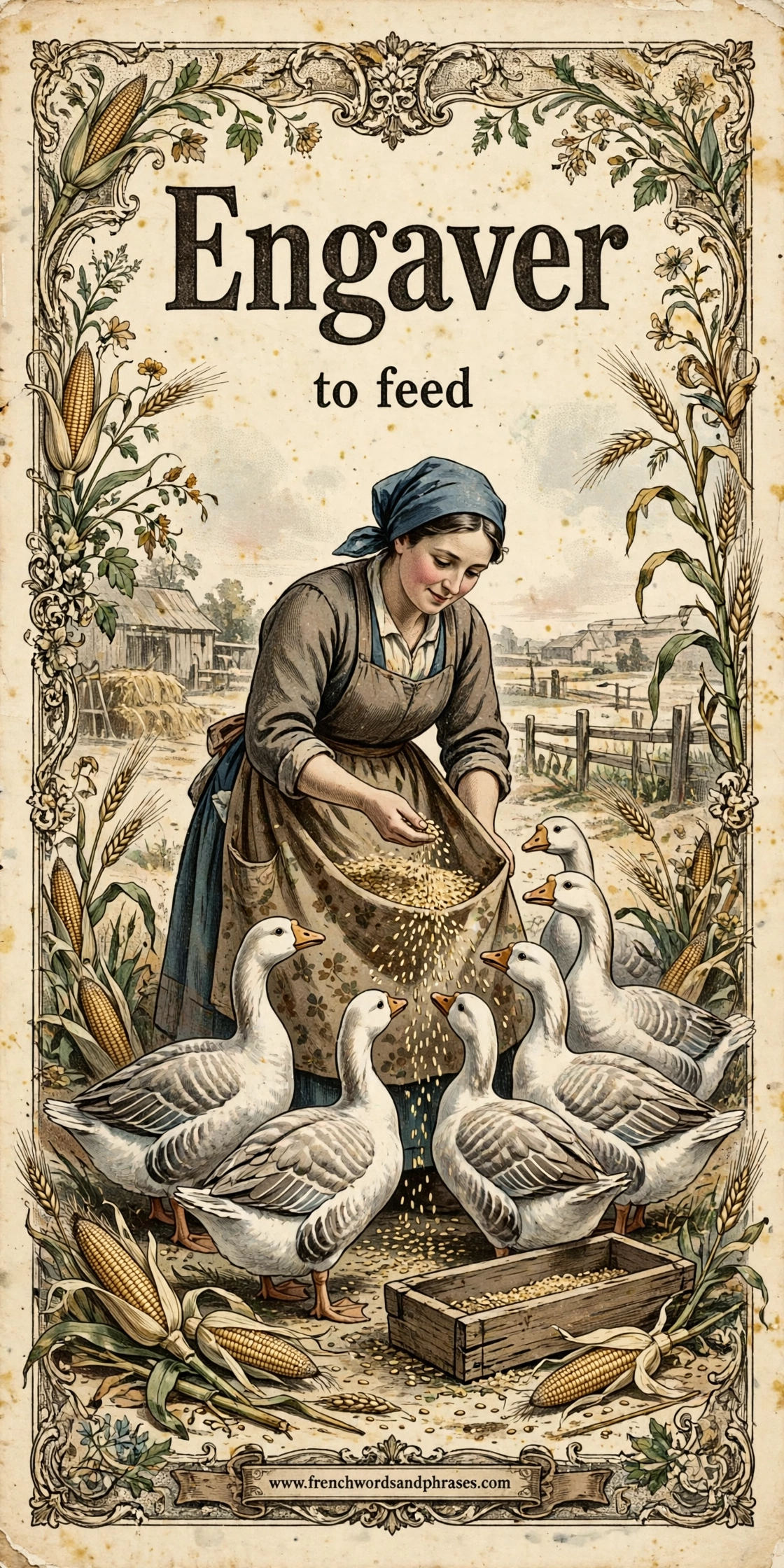
Engaver means to feed — to feed animals generously, filling them up so they grow fat and ready.
Geese in a farmyard in the Périgord opening their beaks for corn, ducks and turkeys being readied for the Christmas table — engaver is the farmer’s verb of feeding to fatten: meals given not just to nourish, but to fill and to finish an animal well.
In this guide, you’ll learn how to conjugate engaver in all the major French tenses and moods. Explore complete conjugation tables, French examples, English translations, and practice quizzes.
Understanding the French Verb Engaver
Engaver is a regular French verb belonging to the first group of verbs, those ending in-er.
It means to feed. It belongs to traditional farming, above all in the goose and duck country of south-west France, where birds are fed on maize to prepare them for the table. You will meet it in agricultural and regional writing rather than in town conversation, where nourrir and donner à manger do the everyday work.
Verb classification: First group (-er)
Auxiliary verb: Avoir
Past participle: engavé
Present participle: engavant
English equivalents: To feed, to fatten up by feeding; engaver les oies — to feed the geese; engaver les canards — to fatten the ducks; engaver le cochon — to feed up the pig; le gavage — force-feeding (the intensive method); gaver — to force-feed, to stuff.
One important detail: engaver is the farmyard cousin of gaver — both come from an old word for the throat and crop of a bird. It is perfectly regular (j’engave, nous engavons, participle engavé), and its objects are farm animals being fed up: les oies, les canards, le cochon, les volailles. Where gaver insists on the force-feeding funnel of foie gras production (le gavage), engaver is the broader, older farm word for feeding generously so that animals thrive and fatten.
Experience the Word
Engaver is the verb of the generous farmyard meal — the scoop of maize, the open beak, the animal growing rounder by the week.
Imagine a farm in the Dordogne in October. Twice a day the farmer’s wife walks the yard with her bucket, and the geese come waddling from every corner, necks stretched, clamouring. Elle engave ses oies — scoop after scoop of golden maize — because Christmas is coming and the farm’s reputation rides on those birds.
The geese are not just fed. They are fed up — engavées — round, calm and ready.
How to Conjugate Engaver: Complete French Conjugation Guide
Let’s explore every major conjugation of engaver, beginning with the indicative mood.
How to Conjugate Engaver in the Indicative Mood
The indicative mood is used to express facts, observations, actions, and events.
How to Conjugate Engaver in the Present Tense (Présent)
Used for actions happening now, habitual actions, and general truths.
| Subject | Conjugation |
|---|---|
| je | engave |
| tu | engaves |
| il / elle | engave |
| nous | engavons |
| vous | engavez |
| ils / elles | engavent |
Example
Le fermier engave ses oies deux fois par jour.
The farmer feeds his geese twice a day.
Quick Quiz 1
Complete the sentence:
Nous ______ les dindes dès septembre.
Reveal the answer
engaverons
Nous engaverons les dindes dès septembre.
We will feed up the turkeys from September.
How to Conjugate Engaver in the Passé Composé
Used for completed actions in the past. Engaver takes the auxiliary verb avoir.
| Subject | Conjugation |
|---|---|
| j’ | ai engavé |
| tu | as engavé |
| il / elle | a engavé |
| nous | avons engavé |
| vous | avez engavé |
| ils / elles | ont engavé |
Example
Elle a engavé les poules avant l’hiver.
She fed up the hens before winter.
How to Conjugate Engaver in the Imparfait (Imperfect Tense)
Used for habitual past actions, descriptions, and ongoing situations in the past.
| Subject | Conjugation |
|---|---|
| je | engavais |
| tu | engavais |
| il / elle | engavait |
| nous | engavions |
| vous | engaviez |
| ils / elles | engavaient |
Example
Chaque matin, on engavait les canards dans la basse-cour.
Every morning, the ducks were fed in the farmyard.
Quick Quiz 2
Choose the correct form:
She fed up the hens before winter.
Elle ______ les poules avant l’hiver. (a engavé / est engavée)
Reveal the answer
a engavé
Elle a engavé les poules avant l’hiver.
Engaver takes avoir.
How to Conjugate Engaver in the Plus-que-parfait
Used to describe an action that had already been completed before another past event.
| Subject | Conjugation |
|---|---|
| j’ | avais engavé |
| tu | avais engavé |
| il / elle | avait engavé |
| nous | avions engavé |
| vous | aviez engavé |
| ils / elles | avaient engavé |
Example
Ils avaient engavé le cochon pendant des mois.
They had been feeding up the pig for months.
How to Conjugate Engaver in the Passé Simple
Primarily used in formal writing, literature, and historical narratives. It is rarely used in everyday conversation.
| Subject | Conjugation |
|---|---|
| je | engavai |
| tu | engavas |
| il / elle | engava |
| nous | engavâmes |
| vous | engavâtes |
| ils / elles | engavèrent |
Example
Le paysan engava ses bêtes avant la foire.
The farmer fed up his animals before the fair.
How to Conjugate Engaver in the Passé Antérieur
A literary tense used to express an action completed immediately before another past action, generally in the passé simple.
| Subject | Conjugation |
|---|---|
| j’ | eus engavé |
| tu | eus engavé |
| il / elle | eut engavé |
| nous | eûmes engavé |
| vous | eûtes engavé |
| ils / elles | eurent engavé |
Example
Quand elle eut engavé les oies, elle ferma l’enclos.
When she had fed the geese, she closed the pen.
How to Conjugate Engaver in the Future Tense (Futur Simple)
Used to describe actions that will take place in the future.
| Subject | Conjugation |
|---|---|
| je | engaverai |
| tu | engaveras |
| il / elle | engavera |
| nous | engaverons |
| vous | engaverez |
| ils / elles | engaveront |
Example
Nous engaverons les dindes dès septembre.
We will start feeding up the turkeys in September.
How to Conjugate Engaver in the Futur Antérieur (Future Perfect)
Used for an action that will have been completed before a particular point in the future.
| Subject | Conjugation |
|---|---|
| j’ | aurai engavé |
| tu | auras engavé |
| il / elle | aura engavé |
| nous | aurons engavé |
| vous | aurez engavé |
| ils / elles | auront engavé |
Example
À Noël, le fermier aura engavé toutes ses volailles.
By Christmas, the farmer will have fed up all his poultry.
How to Conjugate Engaver in the Near Future (Futur Proche)
Used to describe something that is going to happen soon. Formed with aller + infinitive.
| Subject | Conjugation |
|---|---|
| je | vais engaver |
| tu | vas engaver |
| il / elle | va engaver |
| nous | allons engaver |
| vous | allez engaver |
| ils / elles | vont engaver |
Example
Viens, on va engaver les poules.
Come on, let’s go and feed the hens.
How to Conjugate Engaver in the Conditional Mood
The conditional mood expresses what would happen under certain circumstances. It is also frequently used to make polite requests or express wishes.
How to Conjugate Engaver in the Present Conditional
| Subject | Conjugation |
|---|---|
| je | engaverais |
| tu | engaverais |
| il / elle | engaverait |
| nous | engaverions |
| vous | engaveriez |
| ils / elles | engaveraient |
Example
Avec ce maïs, on engaverait les canards en un mois.
With this maize, we would fatten the ducks in a month.
How to Conjugate Engaver in the Past Conditional
| Subject | Conjugation |
|---|---|
| j’ | aurais engavé |
| tu | aurais engavé |
| il / elle | aurait engavé |
| nous | aurions engavé |
| vous | auriez engavé |
| ils / elles | auraient engavé |
Example
Il aurait engavé le cochon plus longtemps sans la maladie.
He would have fed the pig longer without the illness.
Engaver in the Literary Past Conditional Form
This less common literary form uses the imperfect subjunctive of avoir.
| Subject | Conjugation |
|---|---|
| j’ | eusse engavé |
| tu | eusses engavé |
| il / elle | eût engavé |
| nous | eussions engavé |
| vous | eussiez engavé |
| ils / elles | eussent engavé |
Example
Elle eût engavé ses oies comme autrefois, à la main.
She would have fed her geese by hand, as in the old days.
How to Conjugate Engaver in the Subjunctive Mood
The subjunctive is used to express wishes, emotions, doubts, necessity, and uncertainty. It frequently follows expressions such as il faut que (it is necessary that) or bien que (although).
How to Conjugate Engaver in the Present Subjunctive
| Subject | Conjugation |
|---|---|
| que je | engave |
| que tu | engaves |
| qu’il / qu’elle | engave |
| que nous | engavions |
| que vous | engaviez |
| qu’ils / qu’elles | engavent |
Example
Il faut que tu engaves les oies régulièrement.
You must feed the geese regularly.
Quick Quiz 3
Complete the sentence using the subjunctive:
Il faut que vous ______ les oies régulièrement.
Reveal the answer
engaviez
Il faut que vous engaviez les oies régulièrement.
You must feed the geese regularly.
How to Conjugate Engaver in the Imperfect Subjunctive
A literary tense, rarely encountered in modern spoken French.
| Subject | Conjugation |
|---|---|
| que je | engavasse |
| que tu | engavasses |
| qu’il / qu’elle | engavât |
| que nous | engavassions |
| que vous | engavassiez |
| qu’ils / qu’elles | engavassent |
Example
Le fermier voulait que l’on engavât les canards dès l’automne.
The farmer wanted the ducks fed from autumn onwards.
How to Conjugate Engaver in the Pluperfect Subjunctive
A literary construction used to express an action completed before another past action.
| Subject | Conjugation |
|---|---|
| que j’ | eusse engavé |
| que tu | eusses engavé |
| qu’il / qu’elle | eût engavé |
| que nous | eussions engavé |
| que vous | eussiez engavé |
| qu’ils / qu’elles | eussent engavé |
Example
On disait qu’il eût engavé le plus beau cochon du village.
People said he had fed up the finest pig in the village.
How to Conjugate Engaver in the Past Subjunctive
| Subject | Conjugation |
|---|---|
| que j’ | aie engavé |
| que tu | aies engavé |
| qu’il / qu’elle | ait engavé |
| que nous | ayons engavé |
| que vous | ayez engavé |
| qu’ils / qu’elles | aient engavé |
Example
Je doute qu’il ait engavé les bêtes ce matin.
I doubt he fed the animals this morning.
How to Conjugate Engaver in the Imperative
The imperative is used to give commands, instructions, invitations, or suggestions. Subject pronouns are omitted.
How to Conjugate Engaver in the Present Imperative
| Person | Conjugation |
|---|---|
| (tu) | engave |
| (nous) | engavons |
| (vous) | engavez |
Example
Engave les oies, c’est l’heure !
Feed the geese, it is time!
Quick Quiz 4
How would you say Feed the geese, it is time (tu form)?
Reveal the answer
Engave les oies, c’est l’heure !
French Participles of Engaver
Participles are verb forms that can be used in compound tenses and other grammatical constructions.
Present Participle of Engaver
engavant
En engavant ses canards, il prépare le foie gras.
By feeding up his ducks, he is preparing the foie gras.
Past Participle of Engaver
engavé
Engavées au maïs, les oies grandissent vite.
Fed on maize, the geese grow quickly.
Engaver in Everyday French: Real-Life Examples
Now that you know the conjugations, let’s see how engaver appears in everyday French.
Example 1 — Present
Le fermier engave ses oies deux fois par jour.
The farmer feeds his geese twice a day.
Example 2 — Passé composé
Elle a engavé les poules avant l’hiver.
She fed up the hens before winter.
Example 3 — Imparfait
On engavait les canards dans la basse-cour.
The ducks used to be fed in the farmyard.
Example 4 — Future
Nous engaverons les dindes dès septembre.
We will feed up the turkeys from September.
Example 5 — Conditional
On engaverait les canards en un mois avec ce maïs.
We would fatten the ducks in a month with this maize.
Example 6 — Imperative
Engave les oies, c’est l’heure !
Feed the geese, it is time!
Beyond Translation: The Meaning of Engaver
English feed is plain and daily; French engaver belongs to a richer farmyard family — gaver, to force-feed, gives modern slang its ça me gave !, ‘that really gets on my nerves’, literally ‘that force-feeds me’.
Behind the verb stands the whole foie gras tradition.
The maize, the farmyard, the Christmas table: engaver is a small verb that opens the door on one of France’s oldest and most debated food crafts — handle the word, and you can talk about all of it.
How to Remember the French Verb Engaver
Remember it this way: Engaver is about the farmer’s wife with her bucket of maize, and the geese waddling in from every corner.
- Farm animals only, and fed generously: engaver les oies, les canards, le cochon.
- Its famous cousin is gaver (to force-feed) — source of the slang ça me gave, ‘that annoys me’.
- Regular -er: j’engave, nous engavons, past participle engavé.
The key idea is the farmer’s wife with her bucket of maize, and the geese waddling in from every corner.
Test Your Knowledge of Engaver
Let’s see how much you’ve learned. Try answering these questions before revealing the answers.
Question 1
What kinds of creatures get engavés, and why?
Reveal the answer
Farm animals — geese, ducks, pigs, poultry — fed generously so they grow fat and ready for the table.
Question 2
How do you say The farmer feeds his geese twice a day in French?
Reveal the answer
Le fermier engave ses oies deux fois par jour.
Question 3
Translate: We will start feeding up the turkeys in September.
Reveal the answer
Nous engaverons les dindes dès septembre.
Question 4
What is the past participle of engaver?
Reveal the answer
Engavé.
Question 5
Complete the sentence:
Il faut que tu ______ les oies régulièrement.
Reveal the answer
engaves
Il faut que tu engaves les oies régulièrement.
You must feed the geese regularly.
Your Final Challenge
Can You Use It?
How would you say this in French?
Twice a day, the farmer’s wife feeds her geese on golden maize, and the whole farmyard follows her with its eyes.
Reveal the answer
Deux fois par jour, la fermière engave ses oies au maïs doré, et la basse-cour entière la suit des yeux.
Twice a day, the farmer’s wife feeds her geese on golden maize, and the whole farmyard follows her with its eyes.
A little French. A little curiosity. A richer everyday life.
LEARN FRENCH ONE WORD AT A TIME