A French Word to Live By
How to Conjugate Enfourcher in French
/ɑ̃.fuʁ.ʃe/
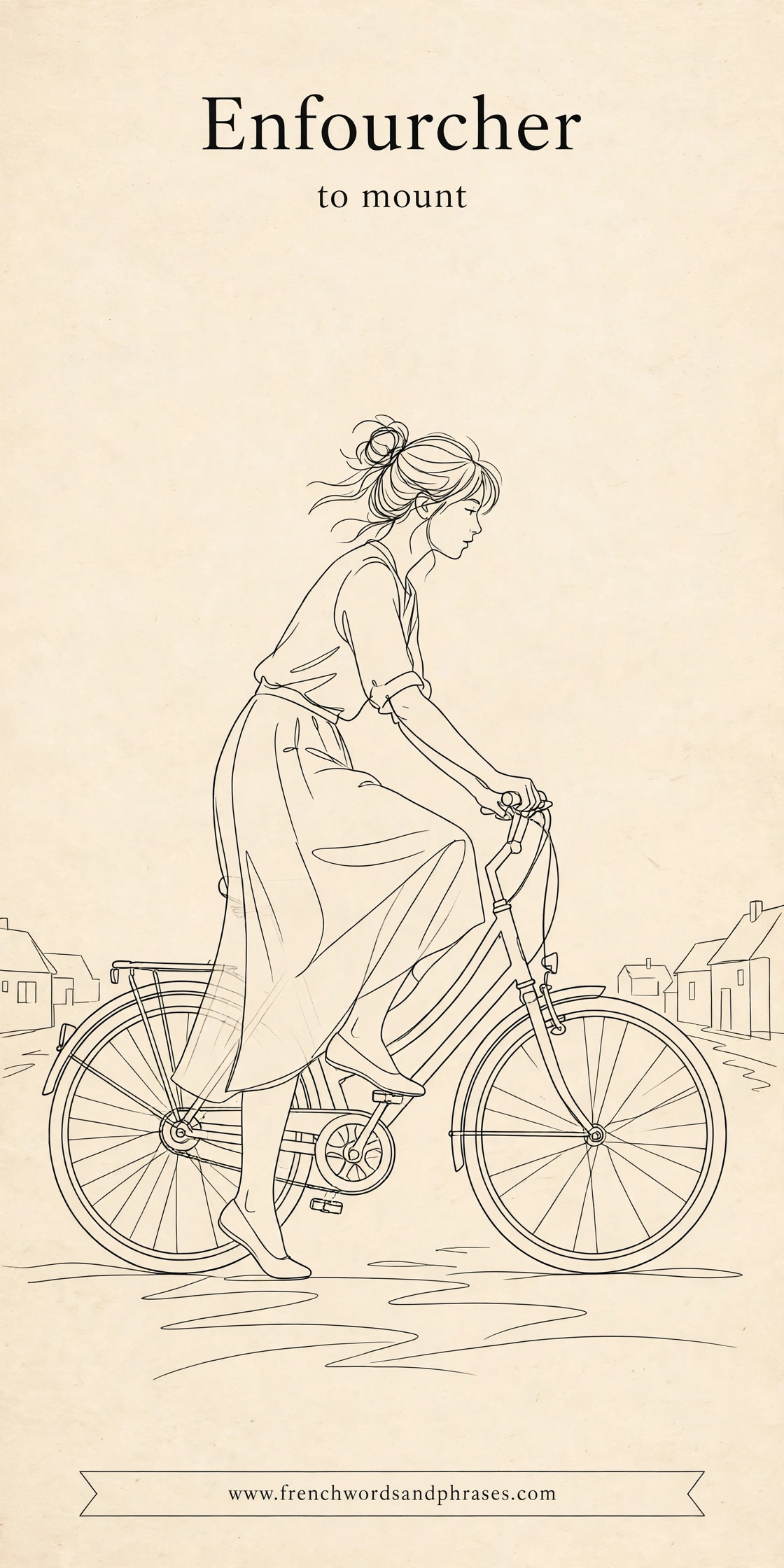
Enfourcher means to mount — to swing a leg over a horse, a bicycle or a motorbike and settle astride it.
A cowboy swinging into the saddle, a teenager hopping onto her bike outside school, a courier straddling his motorbike in Paris traffic — enfourcher is the verb of getting astride: one leg over, and you are mounted.
In this guide, you’ll learn how to conjugate enfourcher in all the major French tenses and moods. Explore complete conjugation tables, French examples, English translations, and practice quizzes.
Understanding the French Verb Enfourcher
Enfourcher is a regular French verb belonging to the first group of verbs, those ending in-er.
It means to mount. It is the everyday verb for mounting bicycles and motorbikes (far more common than monter sur for getting on), the classic verb for horses in novels and westerns, and it survives figuratively in enfourcher son dada — to get on one’s hobby horse, to ride one’s favourite topic.
Verb classification: First group (-er)
Auxiliary verb: Avoir
Past participle: enfourché
Present participle: enfourchant
English equivalents: To mount, to get on, to straddle; enfourcher un cheval — to mount a horse; enfourcher son vélo — to hop on one’s bike; enfourcher une moto — to get on a motorbike; une fourche — a fork (the shape your legs make).
One important detail: enfourcher is built on une fourche, a fork — astride a horse or a bike, your two legs form the fork’s prongs. It is a perfectly regular -er verb (j’enfourche, nous enfourchons, participle enfourché), and it always implies the leg-over movement: you do not enfourcher a car or a train, only things you sit astride — un cheval, un vélo, une moto, un âne.
Experience the Word
Enfourcher is the verb of the swing of the leg — half a second of balance, and the rider and the machine are one.
Imagine a Paris courier at a red light, one foot on the ground, engine humming. The light turns green: il enfourche sa moto — no, he is already astride it — and threads into the traffic like a needle. Every delivery in the city begins with that one movement.
No climbing, no sitting down politely. He has mounted — enfourché — and he is gone.
How to Conjugate Enfourcher: Complete French Conjugation Guide
Let’s explore every major conjugation of enfourcher, beginning with the indicative mood.
How to Conjugate Enfourcher in the Indicative Mood
The indicative mood is used to express facts, observations, actions, and events.
How to Conjugate Enfourcher in the Present Tense (Présent)
Used for actions happening now, habitual actions, and general truths.
| Subject | Conjugation |
|---|---|
| je | enfourche |
| tu | enfourches |
| il / elle | enfourche |
| nous | enfourchons |
| vous | enfourchez |
| ils / elles | enfourchent |
Example
Le cavalier enfourche sa monture d’un bond.
The rider mounts his horse with one leap.
Quick Quiz 1
Complete the sentence:
Nous ______ nos motos à huit heures.
Reveal the answer
enfourcherons
Nous enfourcherons nos motos à huit heures.
We will get on our motorbikes at eight o’clock.
How to Conjugate Enfourcher in the Passé Composé
Used for completed actions in the past. Enfourcher takes the auxiliary verb avoir.
| Subject | Conjugation |
|---|---|
| j’ | ai enfourché |
| tu | as enfourché |
| il / elle | a enfourché |
| nous | avons enfourché |
| vous | avez enfourché |
| ils / elles | ont enfourché |
Example
Elle a enfourché son vélo et elle est partie.
She got on her bike and rode off.
How to Conjugate Enfourcher in the Imparfait (Imperfect Tense)
Used for habitual past actions, descriptions, and ongoing situations in the past.
| Subject | Conjugation |
|---|---|
| je | enfourchais |
| tu | enfourchais |
| il / elle | enfourchait |
| nous | enfourchions |
| vous | enfourchiez |
| ils / elles | enfourchaient |
Example
Chaque matin, il enfourchait sa vieille bicyclette.
Every morning, he would get on his old bicycle.
Quick Quiz 2
Choose the correct form:
She got on her bike.
Elle ______ son vélo. (a enfourché / est enfourchée)
Reveal the answer
a enfourché
Elle a enfourché son vélo.
Enfourcher takes avoir.
How to Conjugate Enfourcher in the Plus-que-parfait
Used to describe an action that had already been completed before another past event.
| Subject | Conjugation |
|---|---|
| j’ | avais enfourché |
| tu | avais enfourché |
| il / elle | avait enfourché |
| nous | avions enfourché |
| vous | aviez enfourché |
| ils / elles | avaient enfourché |
Example
Ils avaient enfourché leurs motos avant l’aube.
They had mounted their motorbikes before dawn.
How to Conjugate Enfourcher in the Passé Simple
Primarily used in formal writing, literature, and historical narratives. It is rarely used in everyday conversation.
| Subject | Conjugation |
|---|---|
| je | enfourchai |
| tu | enfourchas |
| il / elle | enfourcha |
| nous | enfourchâmes |
| vous | enfourchâtes |
| ils / elles | enfourchèrent |
Example
Le messager enfourcha son cheval et galopa vers la ville.
The messenger mounted his horse and galloped towards the town.
How to Conjugate Enfourcher in the Passé Antérieur
A literary tense used to express an action completed immediately before another past action, generally in the passé simple.
| Subject | Conjugation |
|---|---|
| j’ | eus enfourché |
| tu | eus enfourché |
| il / elle | eut enfourché |
| nous | eûmes enfourché |
| vous | eûtes enfourché |
| ils / elles | eurent enfourché |
Example
Dès qu’il eut enfourché sa monture, il partit au galop.
As soon as he had mounted his horse, he set off at a gallop.
How to Conjugate Enfourcher in the Future Tense (Futur Simple)
Used to describe actions that will take place in the future.
| Subject | Conjugation |
|---|---|
| je | enfourcherai |
| tu | enfourcheras |
| il / elle | enfourchera |
| nous | enfourcherons |
| vous | enfourcherez |
| ils / elles | enfourcheront |
Example
Demain, nous enfourcherons nos vélos à l’aube.
Tomorrow, we will get on our bikes at dawn.
How to Conjugate Enfourcher in the Futur Antérieur (Future Perfect)
Used for an action that will have been completed before a particular point in the future.
| Subject | Conjugation |
|---|---|
| j’ | aurai enfourché |
| tu | auras enfourché |
| il / elle | aura enfourché |
| nous | aurons enfourché |
| vous | aurez enfourché |
| ils / elles | auront enfourché |
Example
À huit heures, tout le groupe aura enfourché ses motos.
By eight o’clock, the whole group will have mounted their motorbikes.
How to Conjugate Enfourcher in the Near Future (Futur Proche)
Used to describe something that is going to happen soon. Formed with aller + infinitive.
| Subject | Conjugation |
|---|---|
| je | vais enfourcher |
| tu | vas enfourcher |
| il / elle | va enfourcher |
| nous | allons enfourcher |
| vous | allez enfourcher |
| ils / elles | vont enfourcher |
Example
Attends-moi, je vais enfourcher mon vélo.
Wait for me, I am going to get on my bike.
How to Conjugate Enfourcher in the Conditional Mood
The conditional mood expresses what would happen under certain circumstances. It is also frequently used to make polite requests or express wishes.
How to Conjugate Enfourcher in the Present Conditional
| Subject | Conjugation |
|---|---|
| je | enfourcherais |
| tu | enfourcherais |
| il / elle | enfourcherait |
| nous | enfourcherions |
| vous | enfourcheriez |
| ils / elles | enfourcheraient |
Example
Sans selle, tu enfourcherais difficilement ce cheval.
Without a saddle, you would have trouble mounting this horse.
How to Conjugate Enfourcher in the Past Conditional
| Subject | Conjugation |
|---|---|
| j’ | aurais enfourché |
| tu | aurais enfourché |
| il / elle | aurait enfourché |
| nous | aurions enfourché |
| vous | auriez enfourché |
| ils / elles | auraient enfourché |
Example
Elle aurait enfourché sa moto s’il n’avait pas plu.
She would have got on her motorbike if it had not rained.
Enfourcher in the Literary Past Conditional Form
This less common literary form uses the imperfect subjunctive of avoir.
| Subject | Conjugation |
|---|---|
| j’ | eusse enfourché |
| tu | eusses enfourché |
| il / elle | eût enfourché |
| nous | eussions enfourché |
| vous | eussiez enfourché |
| ils / elles | eussent enfourché |
Example
Il eût enfourché le plus fougueux des chevaux.
He would have mounted the most spirited of horses.
How to Conjugate Enfourcher in the Subjunctive Mood
The subjunctive is used to express wishes, emotions, doubts, necessity, and uncertainty. It frequently follows expressions such as il faut que (it is necessary that) or bien que (although).
How to Conjugate Enfourcher in the Present Subjunctive
| Subject | Conjugation |
|---|---|
| que je | enfourche |
| que tu | enfourches |
| qu’il / qu’elle | enfourche |
| que nous | enfourchions |
| que vous | enfourchiez |
| qu’ils / qu’elles | enfourchent |
Example
Il faut que tu enfourches ton vélo sans aide.
You must get on your bike without help.
Quick Quiz 3
Complete the sentence using the subjunctive:
Il faut que vous ______ vos vélos sans aide.
Reveal the answer
enfourchiez
Il faut que vous enfourchiez vos vélos sans aide.
You must get on your bikes without help.
How to Conjugate Enfourcher in the Imperfect Subjunctive
A literary tense, rarely encountered in modern spoken French.
| Subject | Conjugation |
|---|---|
| que je | enfourchasse |
| que tu | enfourchasses |
| qu’il / qu’elle | enfourchât |
| que nous | enfourchassions |
| que vous | enfourchassiez |
| qu’ils / qu’elles | enfourchassent |
Example
Le roi ordonna que le messager enfourchât son cheval sur-le-champ.
The king ordered the messenger to mount his horse at once.
How to Conjugate Enfourcher in the Pluperfect Subjunctive
A literary construction used to express an action completed before another past action.
| Subject | Conjugation |
|---|---|
| que j’ | eusse enfourché |
| que tu | eusses enfourché |
| qu’il / qu’elle | eût enfourché |
| que nous | eussions enfourché |
| que vous | eussiez enfourché |
| qu’ils / qu’elles | eussent enfourché |
Example
On disait qu’il eût enfourché un dragon sans hésiter.
People said he would have mounted a dragon without hesitating.
How to Conjugate Enfourcher in the Past Subjunctive
| Subject | Conjugation |
|---|---|
| que j’ | aie enfourché |
| que tu | aies enfourché |
| qu’il / qu’elle | ait enfourché |
| que nous | ayons enfourché |
| que vous | ayez enfourché |
| qu’ils / qu’elles | aient enfourché |
Example
Je suis ravi qu’elle ait enfourché son premier poney.
I am delighted she got on her first pony.
How to Conjugate Enfourcher in the Imperative
The imperative is used to give commands, instructions, invitations, or suggestions. Subject pronouns are omitted.
How to Conjugate Enfourcher in the Present Imperative
| Person | Conjugation |
|---|---|
| (tu) | enfourche |
| (nous) | enfourchons |
| (vous) | enfourchez |
Example
Enfourche ton vélo, on part !
Get on your bike, we’re off!
Quick Quiz 4
How would you say Get on your bike, we’re off (tu form)?
Reveal the answer
Enfourche ton vélo, on part !
French Participles of Enfourcher
Participles are verb forms that can be used in compound tenses and other grammatical constructions.
Present Participle of Enfourcher
enfourchant
En enfourchant sa moto, il renversa son café.
As he got on his motorbike, he knocked over his coffee.
Past Participle of Enfourcher
enfourché
Le cheval à peine enfourché, le cavalier sentit l’animal trembler.
Hardly had the horse been mounted than the rider felt the animal tremble.
Enfourcher in Everyday French: Real-Life Examples
Now that you know the conjugations, let’s see how enfourcher appears in everyday French.
Example 1 — Present
Le cavalier enfourche sa monture d’un bond.
The rider mounts his horse with one leap.
Example 2 — Passé composé
Elle a enfourché son vélo et elle est partie.
She got on her bike and rode off.
Example 3 — Imparfait
Il enfourchait sa bicyclette chaque matin.
He used to get on his bicycle every morning.
Example 4 — Future
Nous enfourcherons nos vélos à l’aube.
We will get on our bikes at dawn.
Example 5 — Conditional
Tu enfourcherais ce cheval sans selle ?
Would you mount this horse without a saddle?
Example 6 — Imperative
Enfourche ton vélo, on part !
Get on your bike, we’re off!
Beyond Translation: The Meaning of Enfourcher
English mount is formal — horses and ceremonies; French enfourcher is what you do to a bicycle ten times a day.
Your legs are the fork.
The word carries its picture inside it: une fourche, a fork, two prongs either side of the saddle. And the figurative prize is enfourcher son dada — to climb onto your hobby horse and ride your favourite subject into the ground.
How to Remember the French Verb Enfourcher
Remember it this way: Enfourcher is about the leg swinging over the saddle — your legs make the fork.
- Picture a fork: your two legs are the prongs, one on each side of the saddle.
- Only for things you sit astride: un cheval, un vélo, une moto — never a car.
- Regular -er: j’enfourche, nous enfourchons, past participle enfourché.
The key idea is the leg swinging over the saddle — your legs make the fork.
Test Your Knowledge of Enfourcher
Let’s see how much you’ve learned. Try answering these questions before revealing the answers.
Question 1
Why is a bicycle something you enfourches, but not a car?
Reveal the answer
Enfourcher means to sit astride, with a leg on each side — true of bikes, motorbikes and horses, not of cars.
Question 2
How do you say She got on her bike and rode off in French?
Reveal the answer
Elle a enfourché son vélo et elle est partie.
Question 3
Translate: Tomorrow, we will get on our bikes at dawn.
Reveal the answer
Demain, nous enfourcherons nos vélos à l’aube.
Question 4
What is the past participle of enfourcher?
Reveal the answer
Enfourché.
Question 5
Complete the sentence:
Il faut que tu ______ ton vélo sans aide.
Reveal the answer
enfourches
Il faut que tu enfourches ton vélo sans aide.
You must get on your bike without help.
Your Final Challenge
Can You Use It?
How would you say this in French?
He gets on his bike at dawn, and the sleeping city belongs to him.
Reveal the answer
Il enfourche son vélo à l’aube, et la ville endormie lui appartient.
He gets on his bike at dawn, and the sleeping city belongs to him.
A little French. A little curiosity. A richer everyday life.
LEARN FRENCH ONE WORD AT A TIME