A French Word to Live By
Translate Faites-le maintenant to English
/fɛt lə mɛ̃t.nɑ̃/
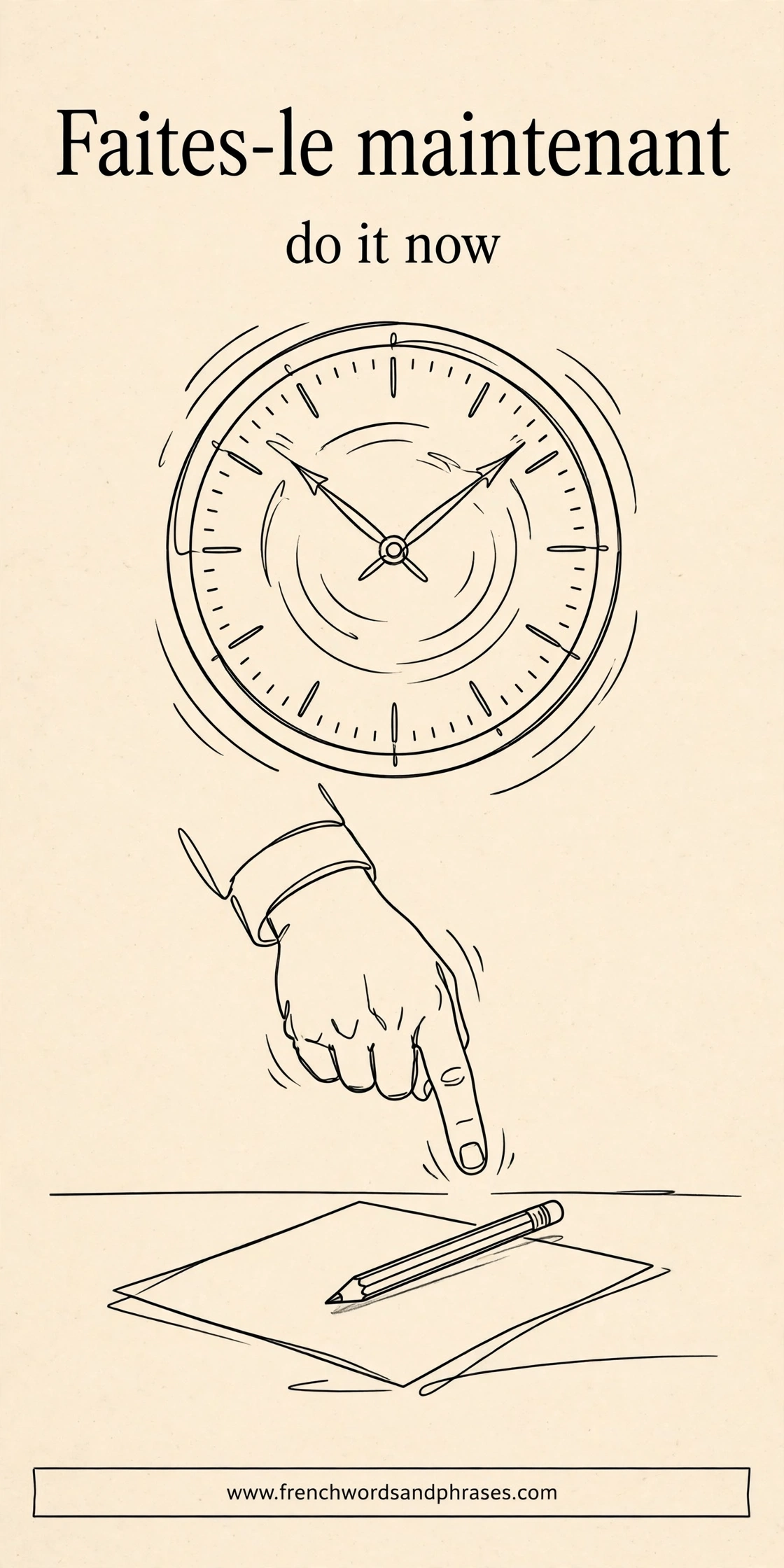
Faites-le maintenant means do it now — a polite or plural order with the pronoun attached.
The removal men are standing in the doorway, the van is double-parked, and the landlady points at the last sofa with the calm of a general: « Faites-le maintenant, avant que la rue se remplisse. » — Do it now, before the street fills up.
Let’s explore how faites-le maintenant works in French, beginning with the whole phrase on one card.
Understanding the French Phrase Faites-le maintenant
Faites-le maintenant is a French imperative phrase built from faites (do! — the vous imperative of faire), -le (it — the direct-object pronoun, attached with a hyphen) and maintenant (now — an adverb that has its own page on this site). It is a whole grammar lesson in three words: how French gives an order, where the pronoun goes when the order is positive, and how urgency is added with maintenant.
It means do it now. The vous form makes it polite, plural, or official — a teacher to a class, a manager to a team, a sign to the public. Nothing is vague: the thing to do is already known (that is what le carries), the people are addressed directly, and maintenant removes all discussion about when.
Type: Imperative phrase — order (faites + -le + maintenant)
Answers the need: Telling vous — one person formally, or several — to do a known thing immediately
Register: Polite, official or plural — the tu twin is fais-le maintenant
Strength: Firm — an order, softened only by the politeness of vous
One important usage detail: in a positive order, the pronoun jumps behind the verb and attaches with a hyphen — faites-le, fais-le, faisons-le. But the moment the order turns negative, the pronoun jumps back in front and the hyphens vanish: ne le faites pas maintenant, do not do it now. The same phrase wears two completely different shapes, and the hyphen is the tell-tale sign of the positive one.
Experience the Word
Faites-le maintenant is the phrase of departure boards, instruction leaflets and decisive grandmothers — the moment when discussion ends and doing begins.
Imagine the station loudspeaker crackling over the platform: « Faites-le maintenant » would be too personal for a loudspeaker, but every teacher who ever faced a sleepy Monday class has said it with exactly that energy — books out, exercise three, and no, not in five minutes: maintenant.
English do it now bolts its words together plainly. French welds its pronoun to the verb with a hyphen — faites-le — as if the order and the thing were riveted into a single tool.
How to Use Faites-le maintenant in French: Complete Guide
Let’s explore how faites-le maintenant works in French, beginning with the whole phrase on one card.
Faites-le maintenant at a Glance
The Whole Phrase on One Card
Real meaning, literal picture, English twin and register — faites-le maintenant in five lines.
| Point | Faites-le maintenant |
|---|---|
| What it really means | do it now — an immediate order to vous |
| Word for word | do-it now — faites (imperative) + le (it) + maintenant (now) |
| English equivalent | do it now / do it right away |
| Register | polite, official or plural — the vous imperative |
| Use it for | instructions, classrooms, teams, signs and deadlines |
Example
Le rapport est urgent : faites-le maintenant.
The report is urgent: do it now.
Word by Word: Building the Order
Three small pieces — take them one by one and the order assembles itself.
| Word | Literal meaning | Its job in the phrase |
|---|---|---|
| faites | do! make! | the vous imperative of faire — one formal person, or several |
| -le | it | the direct-object pronoun: the known thing to do — masculine, attached by a hyphen |
| maintenant | now | the adverb of urgency — it closes the discussion about when |
Example
Vous connaissez le plan : faites-le maintenant.
You know the plan: do it now.
Quick Quiz 1
Why is there a hyphen in faites-le?
Reveal the answer
Because in a positive order, the pronoun attaches behind the verb — and French welds it on with a hyphen: faites-le, donne-le, prends-le.
Le formulaire est prêt : remplissez-le maintenant.
The form is ready: fill it in now.
When You Say It: The Order Moments
Faites-le maintenant fires at moments like these — wherever a known task can no longer wait.
| Situation | Example |
|---|---|
| In class | ouvrez vos livres et faites-le maintenant — open your books and do it now |
| At work | le client attend : faites-le maintenant — the client is waiting: do it now |
| An instruction | appuyez sur le bouton et faites-le maintenant — press the button and do it now |
| At home (to the family) | rangez vos affaires, faites-le maintenant — tidy your things, do it now |
| An official notice | présentez vos billets, faites-le maintenant — show your tickets, do it now |
Example
Le train part dans cinq minutes : faites-le maintenant.
The train leaves in five minutes: do it now.
Make It Yours: Fais-le, Faites-le, Faisons-le
The order changes its verb with the audience — the pronoun stays welded behind, and the hyphens stay in place.
| Form | French | In English |
|---|---|---|
| To one tu | fais-le maintenant | do it now (friend, child, family) |
| To vous / a group | faites-le maintenant | do it now (formal or plural) |
| Together | faisons-le maintenant | let’s do it now |
| A feminine thing | faites-la maintenant | do it now — la for a feminine noun (la lettre) |
| The negative | ne le faites pas maintenant | do not do it now — pronoun back in front, hyphens gone |
Example
La lettre est écrite ? Alors envoyez-la maintenant.
Is the letter written? Then send it now.
Quick Quiz 2
Say “do not do it now” to a group: where does le go?
Reveal the answer
Back in front of the verb — ne le faites pas maintenant. Negative orders put the pronoun before the verb, and the hyphen disappears.
Ne le faites pas maintenant, attendez le signal.
Do not do it now, wait for the signal.
Everyday Expressions: Building on the Order
Faites-le maintenant slots into these everyday frames — each one ready to use as it stands.
| Frame | In English |
|---|---|
| fais-le maintenant | do it now — the tu form, for family and friends |
| faisons-le maintenant | let’s do it now — the order that includes the speaker |
| faites-le tout de suite | do it right away — maintenant’s more urgent twin |
| ne le faites pas | do not do it — the negative, pronoun in front |
| faites-le moi savoir | let me know — literally make-it me know (formal letters) |
Example
Faisons-le maintenant, pendant qu’il fait jour.
Let’s do it now, while it is daylight.
Close Cousins: The Other Ways to Say Now
French has a whole shelf of urgency — maintenant is the standard; its cousins press harder or soften the blow.
| Expression | The difference |
|---|---|
| maintenant | now — the standard word, firm and clear |
| tout de suite | right away, immediately — a notch more urgent |
| immédiatement | immediately — formal, written, official |
| d’abord | first — the softener: faites d’abord ceci, do this first |
| plus tard | later — the opposite, the order postponed |
Example
Pas plus tard : faites-le tout de suite.
Not later: do it right away.
Quick Quiz 3
Which cousin is more urgent than maintenant — plus tard or tout de suite?
Reveal the answer
Tout de suite — right away. Plus tard is the opposite direction entirely: later.
Faites-le tout de suite, s’il vous plaît.
Do it right away, please.
Faites-le maintenant and Its Neighbours
The urgency shelf around the phrase — the orders, the clock and the waiting.
| French | In English |
|---|---|
| un ordre | an order, a command |
| une consigne | an instruction (official) |
| vite | quickly |
| attendre | to wait |
| se dépêcher | to hurry |
Example
Pas le temps d’attendre : faites-le maintenant, vite.
No time to wait: do it now, quickly.
Watch Out: The Traps Around Faites-le maintenant
The traps: the wandering pronoun, the missing hyphen, and le used for a feminine thing.
| Trap | The truth |
|---|---|
| « faites le maintenant » (pronoun loose) | in a positive order the pronoun welds to the verb: faites-le |
| « le faites maintenant » as an order | that order of words is a statement (vous le faites), not a command — the command is faites-le |
| « faites-le » for la lettre | a feminine thing takes -la: faites-la, envoyez-la |
| keeping the hyphen in the negative | ne le faites pas — negative orders drop the hyphen and move the pronoun in front |
Example
Ne le faites pas demain : faites-le maintenant.
Do not do it tomorrow: do it now.
Quick Quiz 4
True or false: fais-le maintenant is the form for a close friend.
Reveal the answer
True — fais is the tu imperative; faites-le maintenant is for vous, formal or plural.
Allez, fais-le maintenant, on t’attend.
Come on, do it now, we are waiting for you.
Faites-le maintenant in Everyday French: Real-Life Examples
Now that you know the word, let’s see how faites-le maintenant appears in everyday French.
Example 1 — In class
Ouvrez vos cahiers et faites l’exercice — faites-le maintenant.
Open your notebooks and do the exercise — do it now.
Example 2 — At work
Le directeur attend le dossier : faites-le maintenant.
The manager is waiting for the file: do it now.
Example 3 — At home
Fais-le maintenant, pas après le dîner.
Do it now, not after dinner.
Example 4 — Together
Faisons-le maintenant, tant que nous sommes tous là.
Let’s do it now, while we are all here.
Example 5 — A feminine thing
La soupe est prête ? Servez-la maintenant.
Is the soup ready? Serve it now.
Example 6 — The negative
Ne le faites pas maintenant, le sol est encore mouillé.
Do not do it now, the floor is still wet.
Beyond Translation: The Meaning of Faites-le maintenant
English gives its orders in separate blocks — do, it, now — three words standing in a row like soldiers. French rivets two of them together: faites-le, the verb and its object fused by a hyphen into a single instrument, and then maintenant arrives like a hand on the shoulder: not later, not soon — now.
To say faites-le maintenant is to leave the listener exactly one freedom: to begin.
And hidden inside the firmness is a courtesy — vous, not tu. French can order a person politely, formally, almost ceremonially, and this phrase is the proof.
How to Remember the French Phrase Faites-le maintenant
Remember it this way: Faites-le maintenant means do it now — a positive order welds its pronoun behind the verb with a hyphen, and the negative unwelds it.
- You weld the pronoun on — faites-le, fais-le, faisons-le, hyphen and all.
- You match the audience — faites for vous and groups, fais for tu.
- You unweld to say no — ne le faites pas maintenant, pronoun back in front.
The key idea is faites-le maintenant means do it now — positive orders: pronoun behind with a hyphen; negative: ne le faites pas.
Test Your Knowledge of Faites-le maintenant
Let’s see how much you’ve learned. Try answering these questions before revealing the answers.
Question 1
What does faites-le maintenant mean?
Reveal the answer
Do it now — a vous order, with the pronoun le attached to the verb.
Question 2
How do you say do it now to a close friend?
Reveal the answer
Fais-le maintenant — the tu imperative of faire, same welded pronoun.
Question 3
Translate: Do not do it now. (to a group)
Reveal the answer
Ne le faites pas maintenant.
Question 4
The thing to do is la lettre, feminine. What replaces -le?
Reveal the answer
-la — faites-la, écrivez-la: the pronoun matches the noun’s gender.
Question 5
Complete the sentence:
Le rapport est urgent : ______-le maintenant. (do — vous form)
Reveal the answer
faites
Faites-le maintenant.
Do it now — the pronoun welded on with its hyphen.
Your Final Challenge
Can You Use It?
How would you say this in French?
“Do it now, please.”
Reveal the answer
Faites-le maintenant, s’il vous plaît.
Do it now, please.
A little French. A little curiosity. A richer everyday life.
LEARN FRENCH ONE WORD AT A TIME