A French Word to Live By
Translate Fais attention to English
/fɛ a.tɑ̃.sjɔ̃/
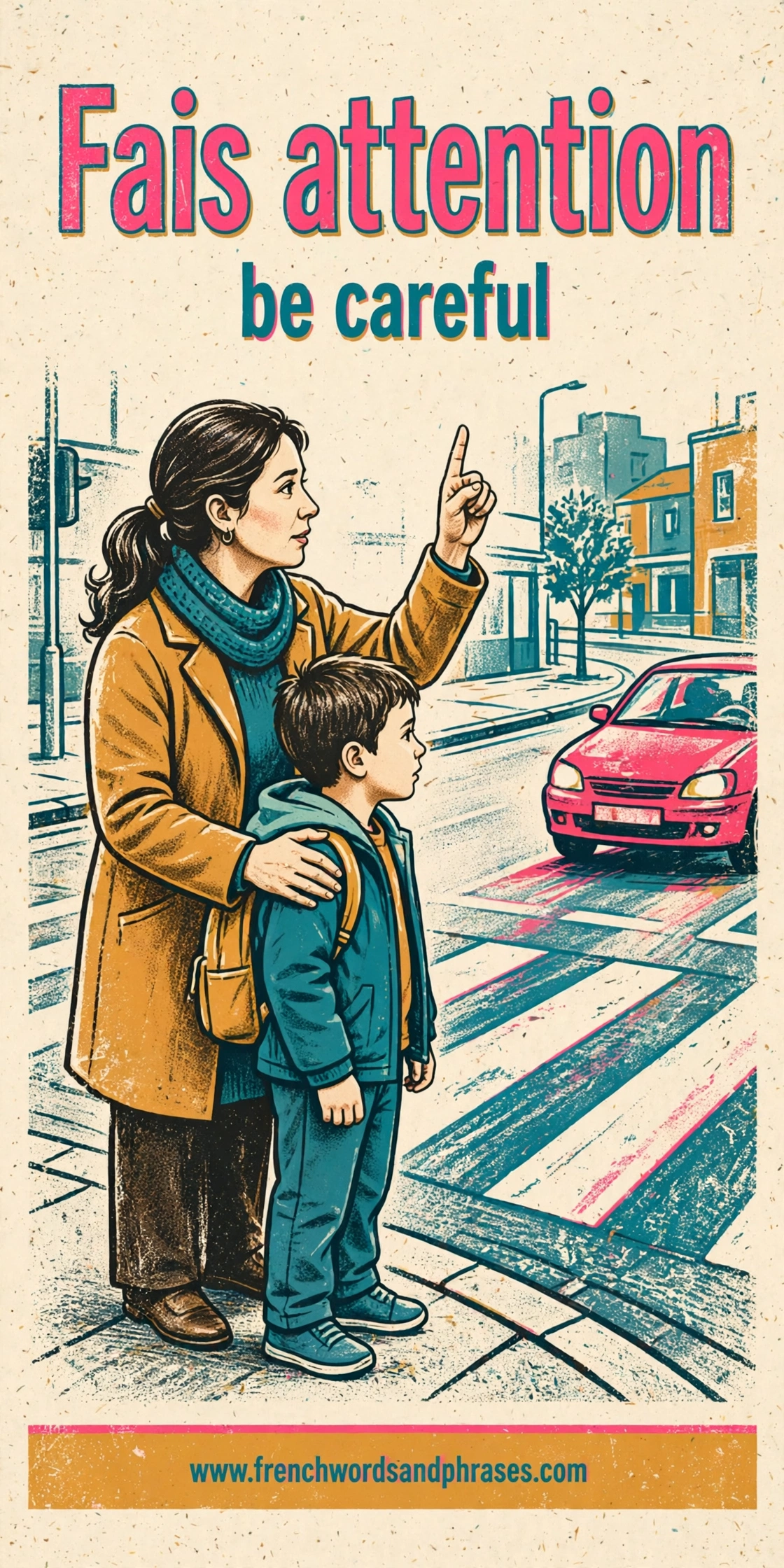
Fais attention means be careful — watch out, the everyday warning.
The toddler reaches, wobbling, for the cup at the edge of the table. Every adult in the room says it at once, gently but fast: « Fais attention ! » — Be careful! It is probably the first warning every French child ever hears.
Let’s explore how fais attention works in French, beginning with the whole phrase on one card.
Understanding the French Phrase Fais attention
Fais attention is a French imperative phrase built from fais (do, make — the tu imperative of faire) and attention (attention, care — a feminine noun that has its own page on this site). The full expression is faire attention, to pay attention, to take care; pointed at one person as an order, it becomes the universal French warning: fais attention.
It means be careful, watch out, mind out. Fais attention, la marche est haute — be careful, the step is high. Fais attention à ne pas tomber — be careful not to fall. Nobody is giving a lecture: the phrase is a hand stretched out at the exact moment of danger, two words that arrive before the accident does.
Type: Imperative phrase — warning (fais, imperative of faire + attention)
Answers the need: Warning someone, kindly and instantly, of a danger or a mistake
Register: Neutral — the tu form; formal and plural: faites attention
Strength: Urgent but kind — from a whispered warning to a shouted one
One important usage detail: the person inside the imperative must match your listener — fais attention to one person you call tu, faites attention to vous, to several people, or in any formal setting. And when the danger is named, it follows à: fais attention à la marche (mind the step), fais attention aux voitures (watch out for the cars — à + les contracts to aux).
Experience the Word
Fais attention is the soundtrack of French childhood — said at curbs, at stairs, at the edges of swimming pools, ten thousand times before the age of ten.
Imagine the grandmother at the top of the cellar stairs, one hand on the rail, calling down into the dark with the tenderness of long practice: « Fais attention, ça glisse. » Be careful, it is slippery. The warning is a form of love, and everyone in the house knows it.
English be careful asks for a state of mind. French asks for an action — fais, do — do attention, make it, the way you would make a barrier or a shield.
How to Use Fais attention in French: Complete Guide
Let’s explore how fais attention works in French, beginning with the whole phrase on one card.
Fais attention at a Glance
The Whole Phrase on One Card
Real meaning, literal picture, English twin and register — fais attention in five lines.
| Point | Fais attention |
|---|---|
| What it really means | be careful — watch out, take care |
| Word for word | do attention — fais (imperative of faire) + attention |
| English equivalent | be careful / watch out / mind out |
| Register | neutral — the tu form; faites attention for vous and groups |
| Use it for | warnings at steps, roads, hot pans and slippery floors |
Example
Fais attention, le sol est mouillé.
Be careful, the floor is wet.
Word by Word: Building the Warning
Two small pieces — take them one by one and the warning assembles itself.
| Word | Literal meaning | Its job in the phrase |
|---|---|---|
| fais | do! make! | the tu imperative of faire — with its final s, unlike most -er imperatives |
| attention | attention, care | a feminine noun: l’attention — what you must switch on |
| à | to, at | the pointer that names the danger: attention à la marche |
Example
Fais attention à la marche en sortant.
Mind the step on your way out.
Quick Quiz 1
Which verb hides inside fais?
Reveal the answer
Faire — to do, to make. Fais is its tu imperative: fais attention, do attention, be careful.
Fais attention, c’est chaud.
Be careful, it is hot.
When You Say It: The Warning Moments
Fais attention fires at moments like these — wherever a danger is half a second away.
| Situation | Example |
|---|---|
| At the road | fais attention en traversant — be careful crossing |
| In the kitchen | fais attention, la poêle est chaude — careful, the pan is hot |
| On the stairs | fais attention à la marche — mind the step |
| With glass | fais attention, ça casse — careful, it breaks (it is fragile) |
| A general caution | fais attention à toi — take care of yourself |
Example
Fais attention aux voitures en traversant la rue.
Watch out for the cars when you cross the street.
Make It Yours: Fais or Faites, the Person Decides
The warning changes its verb ending with the listener — fais for tu, faites for vous and for groups.
| Form | French | In English |
|---|---|---|
| To one tu | fais attention | be careful |
| To vous / a group | faites attention | be careful (all of you) |
| Naming the danger | fais attention à la marche | mind the step |
| A negative warning | fais attention à ne pas tomber | be careful not to fall |
| As a statement | il fait attention | he is careful, he pays attention |
Example
Faites attention, les enfants, la route est glissante.
Be careful, children, the road is slippery.
Quick Quiz 2
You are warning a whole class of schoolchildren. Fais or faites attention?
Reveal the answer
Faites attention — a group takes the vous imperative. Fais is for one person you call tu.
Faites attention, on traverse.
Be careful, we are crossing.
Everyday Expressions: Building on the Warning
Fais attention slots into these everyday frames — each one ready to use as it stands.
| Frame | In English |
|---|---|
| fais attention à toi | take care of yourself — a warm goodbye |
| faire attention à quelqu’un | to pay attention to someone, to look after them |
| ne pas faire attention | to not notice, to pay no attention — il n’a pas fait attention, he did not notice |
| attention ! | watch out! / attention! — the one-word shout |
| faire attention à ce qu’on dit | to watch what one says |
Example
Il n’a pas fait attention et il a manqué la sortie.
He was not paying attention and he missed the exit.
Close Cousins: The Other Ways to Warn
French has a whole shelf of warnings — fais attention is the kind everyday one; its cousins sharpen or soften it.
| Expression | The difference |
|---|---|
| fais attention | be careful — the standard warning, kind and instant |
| attention ! | watch out! — one word, for immediate danger |
| prends garde | beware, take care — a little older, a little sterner |
| sois prudent | be careful, be cautious — advice about character, not a sudden danger |
| méfie-toi | watch out, be wary — when something smells like a trap |
Example
Attention ! Une voiture arrive.
Watch out! A car is coming.
Quick Quiz 3
A cyclist is about to hit a pedestrian. Which do you shout — sois prudent or attention?
Reveal the answer
Attention ! — one word, instant. Sois prudent is calm advice for later, not a shout for now.
Attention, le vélo !
Watch out, the bike!
Fais attention and Its Neighbours
The safety shelf around the phrase — the dangers and the care that answers them.
| French | In English |
|---|---|
| le danger | the danger |
| prudent | careful, cautious |
| doucement | gently, slowly |
| une marche | a step (of stairs) |
| glissant | slippery |
Example
Doucement, et fais attention : c’est glissant.
Gently, and be careful: it is slippery.
Watch Out: The Traps Around Fais attention
The traps: the wrong person ending, a missing à, and the calque of English pay attention in the wrong place.
| Trap | The truth |
|---|---|
| « faites attention » to your little brother | family takes tu: fais attention. Faites is for vous and groups |
| « fais attention la marche » (à forgotten) | the danger is named with à: fais attention à la marche |
| « fais attention de tomber » | for the negative purpose, à ne pas: fais attention à ne pas tomber |
| attention confused with English intention | attention means care and notice — a plan is une intention, never une attention |
Example
Fais attention à ne pas glisser sur la glace.
Be careful not to slip on the ice.
Quick Quiz 4
True or false: fais attention à toi is a warning about a danger.
Reveal the answer
False — it is a warm goodbye: take care of yourself. The danger version names the danger with à: fais attention à la marche.
Bon voyage, et fais attention à toi.
Have a good trip, and take care of yourself.
Fais attention in Everyday French: Real-Life Examples
Now that you know the word, let’s see how fais attention appears in everyday French.
Example 1 — In the kitchen
Fais attention, le four est très chaud.
Be careful, the oven is very hot.
Example 2 — At the road
Fais attention en traversant, regarde des deux côtés.
Be careful crossing, look both ways.
Example 3 — On the stairs
Faites attention à la marche, elle est haute.
Mind the step, it is high.
Example 4 — A goodbye
Bonne route, et fais attention à toi.
Safe journey, and take care of yourself.
Example 5 — In class
Faites attention, les enfants, j’explique la règle.
Pay attention, children, I am explaining the rule.
Example 6 — Winter
Fais attention à ne pas tomber sur le verglas.
Be careful not to fall on the ice.
Beyond Translation: The Meaning of Fais attention
English be careful describes a state — be full of care, the way a cup is full of water. French refuses the metaphor and issues an instruction instead: fais attention, do attention, make it now, with your hands if necessary.
To say fais attention is to treat care as something you do, not something you are.
Perhaps that is why the phrase scales so gracefully — from a whisper over a hot pan to the shout that stops a child at the curb, it is always the same small act: attention, made on purpose, in time.
How to Remember the French Phrase Fais attention
Remember it this way: Fais attention means be careful — the tu imperative of faire attention, with faites for vous and groups, and the danger named after à.
- You match the listener — fais attention for tu, faites attention for vous and groups.
- You name the danger with à — fais attention à la marche, aux voitures.
- You soften it into love — fais attention à toi, take care of yourself, the goodbye version.
The key idea is fais attention means be careful — faites attention for vous/groups; danger follows à (à la marche, aux voitures).
Test Your Knowledge of Fais attention
Let’s see how much you’ve learned. Try answering these questions before revealing the answers.
Question 1
What does fais attention mean?
Reveal the answer
Be careful, watch out — literally, do attention.
Question 2
How do you say be careful to a group?
Reveal the answer
Faites attention — the vous imperative of faire.
Question 3
Translate: Mind the step.
Reveal the answer
Fais attention à la marche.
Question 4
What does fais attention à toi mean as a goodbye?
Reveal the answer
Take care of yourself — the warm farewell version of the warning.
Question 5
Complete the sentence:
______ attention à ne pas tomber. (Be careful not to fall — to a friend)
Reveal the answer
Fais
Fais attention à ne pas tomber.
Be careful not to fall.
Your Final Challenge
Can You Use It?
How would you say this in French?
“Be careful, the floor is wet.”
Reveal the answer
Fais attention, le sol est mouillé.
Be careful, the floor is wet.
A little French. A little curiosity. A richer everyday life.
LEARN FRENCH ONE WORD AT A TIME