A French Word to Live By
How to Conjugate Mâcher in French
/ma.ʃe/
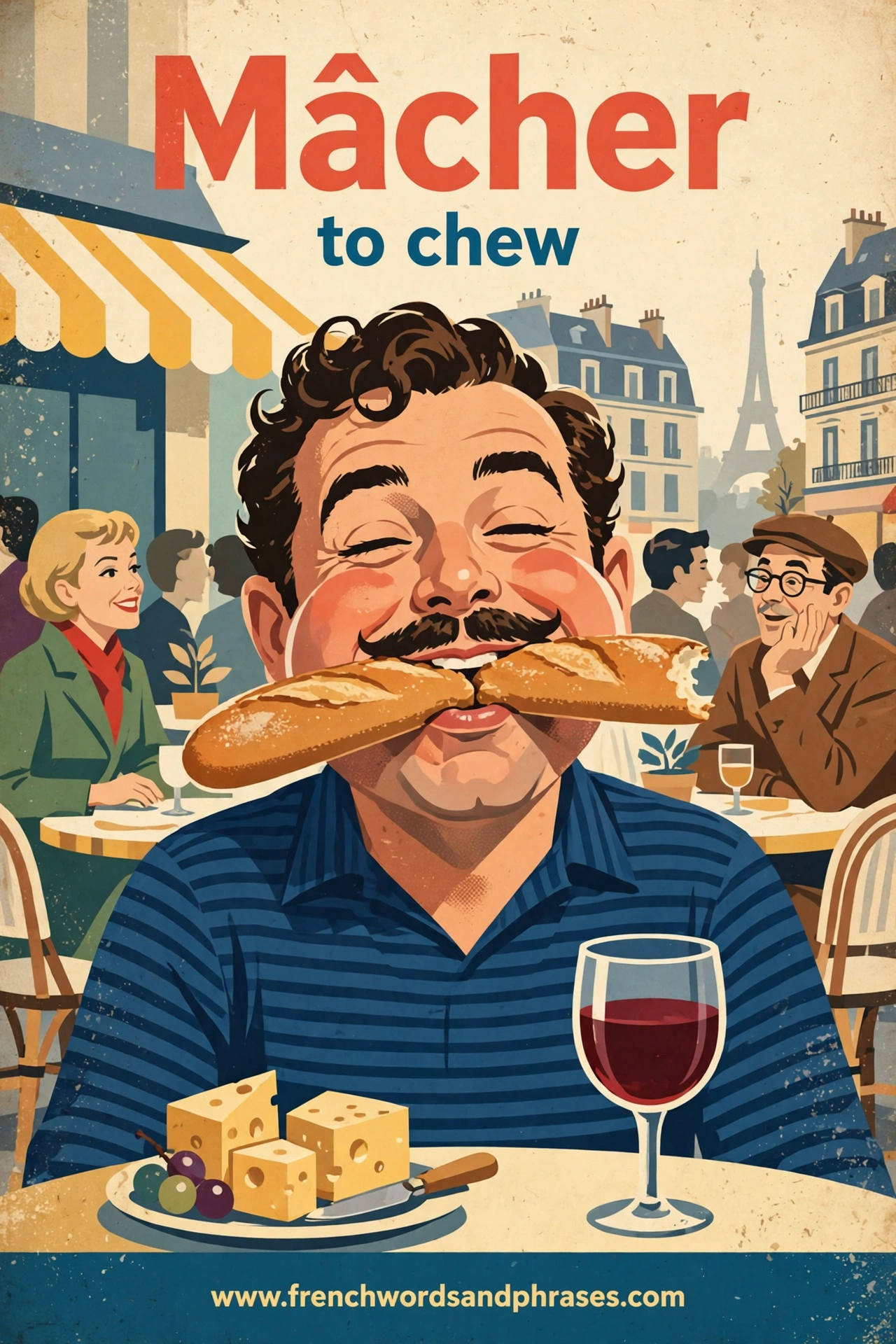
Mâcher means to chew — to work food between your teeth before swallowing, whether that is quiet, polite chewing or the loud, open-mouthed kind that drives everyone at the table mad.
A steak that fights back, a piece of baguette gone leathery, a toddler working through his first crust: mâcher is the everyday verb for chewing. And when someone chews noisily at the cinema or over a bowl of soup, mâcher is also the verb of that small, maddening noise.
In this guide, you’ll learn how to conjugate mâcher in all the major French tenses and moods. Explore complete conjugation tables, French examples, English translations, and practice quizzes.
Understanding the French Verb Mâcher
Mâcher is a regular French verb belonging to the first group of verbs, those ending in-er.
It means to chew. Beyond the dinner table, mâcher has a famous figurative life: ne pas mâcher ses mots means to not mince your words — to say exactly what you think. The image is perfect: softening your words would mean chewing them first, and this speaker refuses to.
Verb classification: First group (-er)
Auxiliary verb: Avoir
Past participle: mâché
Present participle: mâchant
English equivalents: To chew, to munch; mâcher lentement — to chew slowly; mâcher bruyamment — to chew noisily; ne pas mâcher ses mots — to not mince one’s words; mâcher le travail à quelqu’un — to chew someone’s work for them, to spoon-feed them; un chewing-gum à mâcher — a piece of chewing gum.
One important detail: the circumflex in mâcher is a souvenir of an old s that fell silent (compare maître and English master); it changes nothing in the conjugation. The stem mâch- never changes: je mâche, nous mâchons, je mâchais, mâché. Wherever you see the ch, it sounds like the sh of English shoe.
Experience the Word
Mâcher is the verb of jaws at work — the first thing a baby learns to do with solid food, and the last thing a good cook asks of you: take your time.
Imagine a long Sunday lunch in the country. The bread is thick-crusted, the cheese is firm, and nobody is in a hurry: everyone mâche slowly, talks between mouthfuls, and lets the meal last until the light changes.
Good food asks for it. Chew — mâchez — and the flavour has time to arrive.
How to Conjugate Mâcher: Complete French Conjugation Guide
Let’s explore every major conjugation of mâcher, beginning with the indicative mood.
How to Conjugate Mâcher in the Indicative Mood
The indicative mood is used to express facts, observations, actions, and events.
How to Conjugate Mâcher in the Present Tense (Présent)
Used for actions happening now, habitual actions, and general truths.
| Subject | Conjugation |
|---|---|
| je | mâche |
| tu | mâches |
| il / elle | mâche |
| nous | mâchons |
| vous | mâchez |
| ils / elles | mâchent |
Example
Le bébé mâche son premier morceau de pain avec sérieux.
The baby chews his first piece of bread very seriously.
Quick Quiz 1
Complete the sentence:
Nous ______ chaque bouchée avec soin.
Reveal the answer
mâchons
Nous mâchons chaque bouchée avec soin.
We chew every mouthful carefully.
How to Conjugate Mâcher in the Passé Composé
Used for completed actions in the past. Mâcher takes the auxiliary verb avoir.
| Subject | Conjugation |
|---|---|
| j’ | ai mâché |
| tu | as mâché |
| il / elle | a mâché |
| nous | avons mâché |
| vous | avez mâché |
| ils / elles | ont mâché |
Example
Elle a mâché son chewing-gum pendant tout le trajet.
She chewed her gum for the whole journey.
How to Conjugate Mâcher in the Imparfait (Imperfect Tense)
Used for habitual past actions, descriptions, and ongoing situations in the past.
| Subject | Conjugation |
|---|---|
| je | mâchais |
| tu | mâchais |
| il / elle | mâchait |
| nous | mâchions |
| vous | mâchiez |
| ils / elles | mâchaient |
Example
Grand-père mâchait lentement, comme il faisait tout.
Grandfather used to chew slowly, as he did everything.
Quick Quiz 2
Choose the correct form:
He always used to chew very noisily.
Il ______ toujours très bruyamment. (mâchait / mâcherait)
Reveal the answer
mâchait
Il mâchait toujours très bruyamment.
A repeated habit in the past takes the imperfect.
How to Conjugate Mâcher in the Plus-que-parfait
Used to describe an action that had already been completed before another past event.
| Subject | Conjugation |
|---|---|
| j’ | avais mâché |
| tu | avais mâché |
| il / elle | avait mâché |
| nous | avions mâché |
| vous | aviez mâché |
| ils / elles | avaient mâché |
Example
Le chien avait mâché la laisse avant notre retour.
The dog had chewed through the leash before we got back.
How to Conjugate Mâcher in the Passé Simple
Primarily used in formal writing, literature, and historical narratives. It is rarely used in everyday conversation.
| Subject | Conjugation |
|---|---|
| je | mâchai |
| tu | mâchas |
| il / elle | mâcha |
| nous | mâchâmes |
| vous | mâchâtes |
| ils / elles | mâchèrent |
Example
Il mâcha sa bouchée en silence, puis il sourit.
He chewed his mouthful in silence, then he smiled.
How to Conjugate Mâcher in the Passé Antérieur
A literary tense used to express an action completed immediately before another past action, generally in the passé simple.
| Subject | Conjugation |
|---|---|
| j’ | eus mâché |
| tu | eus mâché |
| il / elle | eut mâché |
| nous | eûmes mâché |
| vous | eûtes mâché |
| ils / elles | eurent mâché |
Example
Quand il eut mâché la dernière bouchée, il posa sa fourchette.
When he had chewed the last mouthful, he put down his fork.
How to Conjugate Mâcher in the Future Tense (Futur Simple)
Used to describe actions that will take place in the future.
| Subject | Conjugation |
|---|---|
| je | mâcherai |
| tu | mâcheras |
| il / elle | mâchera |
| nous | mâcherons |
| vous | mâcherez |
| ils / elles | mâcheront |
Example
Avec son nouvel appareil dentaire, il mâchera sans douleur.
With his new dental appliance, he will chew without pain.
How to Conjugate Mâcher in the Futur Antérieur (Future Perfect)
Used for an action that will have been completed before a particular point in the future.
| Subject | Conjugation |
|---|---|
| j’ | aurai mâché |
| tu | auras mâché |
| il / elle | aura mâché |
| nous | aurons mâché |
| vous | aurez mâché |
| ils / elles | auront mâché |
Example
Quand tu auras mâché vingt fois, tu pourras avaler.
When you have chewed twenty times, you may swallow.
How to Conjugate Mâcher in the Near Future (Futur Proche)
Used to describe something that is going to happen soon. Formed with aller + infinitive.
| Subject | Conjugation |
|---|---|
| je | vais mâcher |
| tu | vas mâcher |
| il / elle | va mâcher |
| nous | allons mâcher |
| vous | allez mâcher |
| ils / elles | vont mâcher |
Example
Attention, le petit va mâcher le coin du livre !
Careful, the little one is going to chew the corner of the book!
How to Conjugate Mâcher in the Conditional Mood
The conditional mood expresses what would happen under certain circumstances. It is also frequently used to make polite requests or express wishes.
How to Conjugate Mâcher in the Present Conditional
| Subject | Conjugation |
|---|---|
| je | mâcherais |
| tu | mâcherais |
| il / elle | mâcherait |
| nous | mâcherions |
| vous | mâcheriez |
| ils / elles | mâcheraient |
Example
Tu mâcherais plus facilement avec de meilleures dents.
You would chew more easily with better teeth.
How to Conjugate Mâcher in the Past Conditional
| Subject | Conjugation |
|---|---|
| j’ | aurais mâché |
| tu | aurais mâché |
| il / elle | aurait mâché |
| nous | aurions mâché |
| vous | auriez mâché |
| ils / elles | auraient mâché |
Example
Elle aurait mâché plus lentement si on le lui avait demandé poliment.
She would have chewed more slowly if she had been asked politely.
Mâcher in the Literary Past Conditional Form
This less common literary form uses the imperfect subjunctive of avoir.
| Subject | Conjugation |
|---|---|
| j’ | eusse mâché |
| tu | eusses mâché |
| il / elle | eût mâché |
| nous | eussions mâché |
| vous | eussiez mâché |
| ils / elles | eussent mâché |
Example
Sans ce bruit de fond, il eût mâché en paix.
Without that background noise, he would have chewed in peace.
How to Conjugate Mâcher in the Subjunctive Mood
The subjunctive is used to express wishes, emotions, doubts, necessity, and uncertainty. It frequently follows expressions such as il faut que (it is necessary that) or bien que (although).
How to Conjugate Mâcher in the Present Subjunctive
| Subject | Conjugation |
|---|---|
| que je | mâche |
| que tu | mâches |
| qu’il / qu’elle | mâche |
| que nous | mâchions |
| que vous | mâchiez |
| qu’ils / qu’elles | mâchent |
Example
Le médecin veut que vous mâchiez chaque bouchée lentement.
The doctor wants you to chew every mouthful slowly.
Quick Quiz 3
Complete the sentence using the subjunctive:
Il faut que tu ______ la bouche fermée.
Reveal the answer
mâches
Il faut que tu mâches la bouche fermée.
You must chew with your mouth closed.
How to Conjugate Mâcher in the Imperfect Subjunctive
A literary tense, rarely encountered in modern spoken French.
| Subject | Conjugation |
|---|---|
| que je | mâchasse |
| que tu | mâchasses |
| qu’il / qu’elle | mâchât |
| que nous | mâchassions |
| que vous | mâchassiez |
| qu’ils / qu’elles | mâchassent |
Example
Sa mère exigeait qu’il mâchât la bouche fermée.
His mother insisted that he chew with his mouth closed.
How to Conjugate Mâcher in the Pluperfect Subjunctive
A literary construction used to express an action completed before another past action.
| Subject | Conjugation |
|---|---|
| que j’ | eusse mâché |
| que tu | eusses mâché |
| qu’il / qu’elle | eût mâché |
| que nous | eussions mâché |
| que vous | eussiez mâché |
| qu’ils / qu’elles | eussent mâché |
Example
On riait à l’idée que le critique eût mâché ses mots devant le chef.
People laughed at the idea that the critic had minced his words in front of the chef.
How to Conjugate Mâcher in the Past Subjunctive
| Subject | Conjugation |
|---|---|
| que j’ | aie mâché |
| que tu | aies mâché |
| qu’il / qu’elle | ait mâché |
| que nous | ayons mâché |
| que vous | ayez mâché |
| qu’ils / qu’elles | aient mâché |
Example
Je suis content que tu aies mâché doucement après ton opération.
I am glad you chewed gently after your operation.
How to Conjugate Mâcher in the Imperative
The imperative is used to give commands, instructions, invitations, or suggestions. Subject pronouns are omitted.
How to Conjugate Mâcher in the Present Imperative
| Person | Conjugation |
|---|---|
| (tu) | mâche |
| (nous) | mâchons |
| (vous) | mâchez |
Example
Mâchez bien avant d’avaler !
Chew well before swallowing!
Quick Quiz 4
How would you say Chew well before swallowing (vous form)?
Reveal the answer
Mâchez bien avant d’avaler !
French Participles of Mâcher
Participles are verb forms that can be used in compound tenses and other grammatical constructions.
Present Participle of Mâcher
mâchant
En mâchant lentement, on découvre le vrai goût du pain.
By chewing slowly, you discover the real taste of the bread.
Past Participle of Mâcher
mâché
Bien mâché, ce pain de campagne se digère sans effort.
Well chewed, this country bread digests effortlessly.
Mâcher in Everyday French: Real-Life Examples
Now that you know the conjugations, let’s see how mâcher appears in everyday French.
Example 1 — Present
Elle mâche un chewing-gum en travaillant.
She chews gum while working.
Example 2 — Passé composé
Le chien a mâché mes pantoufles.
The dog chewed my slippers.
Example 3 — Imparfait
Il mâchait toujours très bruyamment.
He always used to chew very noisily.
Example 4 — Future
Tu mâcheras plus facilement demain.
You will chew more easily tomorrow.
Example 5 — Conditional
Sans bruit, il mâcherait en paix.
Without the noise, he would chew in peace.
Example 6 — Imperative
Mâche lentement, il n’y a pas de feu !
Chew slowly, there’s no rush!
Beyond Translation: The Meaning of Mâcher
The circumflex on the â is a small gravestone: Old French had mascher, from Latin masticare — the same root as English masticate. When the s fell silent, the â stayed behind to mark the spot.
And the idiom turns the mouth into a kitchen.
Ne pas mâcher ses mots — to not chew your words before serving them — is what every honest critic, blunt friend and fed-up grandmother does. French also says mâcher le travail à quelqu’un: to chew someone’s work for them, the way a mother bird feeds a chick — in English, to spoon-feed them.
How to Remember the French Verb Mâcher
Remember it this way: Mâcher is about a toddler chewing his first crust of bread with total concentration.
- The â changes nothing: the stem mâch- stays the same in every form — je mâche, nous mâchons, mâché.
- Ne pas mâcher ses mots = to not mince your words; both languages picture the same un-chewed sentence.
- Regular -er endings throughout: je mâche, nous mâchons, past participle mâché.
The key idea is a toddler chewing his first crust of bread with total concentration.
Test Your Knowledge of Mâcher
Let’s see how much you’ve learned. Try answering these questions before revealing the answers.
Question 1
What does ne pas mâcher ses mots mean?
Reveal the answer
To not mince one’s words — to say exactly what you think, without chewing your words soft first.
Question 2
How do you say The dog chewed my slippers in French?
Reveal the answer
Le chien a mâché mes pantoufles.
Question 3
Translate: Chew slowly, there’s no rush!
Reveal the answer
Mâche lentement, il n’y a pas de feu !
Question 4
What is the past participle of mâcher?
Reveal the answer
Mâché.
Question 5
Complete the sentence:
Le médecin veut que vous ______ chaque bouchée lentement.
Reveal the answer
mâchiez
Le médecin veut que vous mâchiez chaque bouchée lentement.
The doctor wants you to chew every mouthful slowly.
Your Final Challenge
Can You Use It?
How would you say this in French?
He never minces his words, but he chews his bread like a poet: slowly.
Reveal the answer
Il ne mâche jamais ses mots, mais il mâche son pain comme un poète : lentement.
He never minces his words, but he chews his bread like a poet: slowly.
A little French. A little curiosity. A richer everyday life.
LEARN FRENCH ONE WORD AT A TIME