How to Conjugate Patenter in French
/pa.tɑ̃.te/
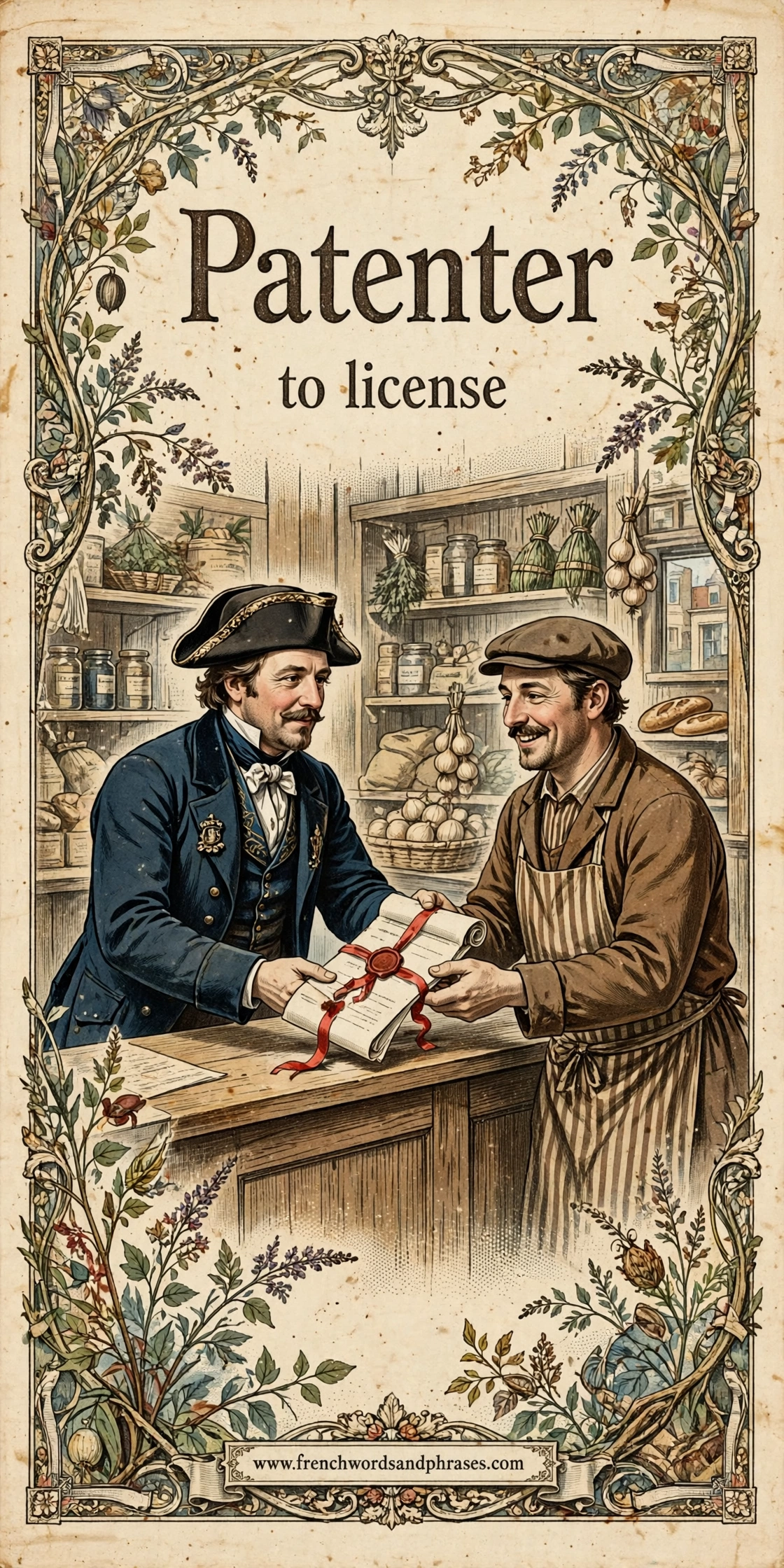
Patenter means to license — to grant, or to obtain, the official patente that authorises a trade or an activity.
At the town hall window, a market trader pays his fee and receives the stamped paper that lets him sell in the square all year. Patenter is the verb of that paper: to license a business, a pedlar or a profession — the administration’s stamp turned into a word.
In this guide, you’ll learn how to conjugate patenter in all the major French tenses and moods. Explore complete conjugation tables, French examples, English translations, and practice quizzes.
Understanding the French Verb Patenter
Patenter is a regular French verb belonging to the first group of verbs, those ending in -er.
It means to license. The word smells of the nineteenth-century high street: la patente was abolished and replaced in modern French business tax, but patenter and patenté survive for licences of all kinds — and in Belgium and Switzerland the patente still names real permits, so the verb stays fully alive there.
Verb classification: First group (-er)
Auxiliary verb: Avoir
Past participle: patenté
Present participle: patentant
English equivalents: To license, to grant a licence; patenter un commerçant — to license a trader; se faire patenter — to get oneself licensed; un marchand patenté — a licensed trader; la patente — the licence, the trading tax; patenter une invention — to patent an invention (older use).
One important detail: patenter turns on the noun la patente, the old trading licence — the tax every shopkeeper, pedlar and cabaret keeper once paid for the right to open his doors. The verb works both ways: the town patente the trader, and the trader se fait patenter, gets himself licensed. Its adjective is a badge of respectability in old novels: un marchand patenté, a licensed — that is, legitimate — dealer. The verb is a regular -er: je patente, nous patentons, ils patentent, past participle patenté. Do not confuse it with the English patent for inventions: modern French protects those with un brevet, though older texts use patenter for that too.
Experience the Word
Patenter is the verb of official permission — the stamp that turns a seller into a licensed trader.
Imagine a pedlar arriving in a mountain village in 1890 with his pack of ribbons and needles. Before he opens a single parcel, he walks to the mairie: on le patente, the paper is stamped, and only then does he cry his wares in the square — a trader in law, not a vagabond.
The ribbons have not changed. He has been licensed — patenté — and the whole village may buy in peace.
How to Conjugate Patenter: Complete French Conjugation Guide
Let’s explore every major conjugation of patenter, beginning with the indicative mood.
How to Conjugate Patenter in the Indicative Mood
The indicative mood is used to express facts, observations, actions, and events.
How to Conjugate Patenter in the Present Tense (Présent)
Used for actions happening now, habitual actions, and general truths.
| Subject | Conjugation |
|---|---|
| je | patente |
| tu | patentes |
| il / elle | patente |
| nous | patentons |
| vous | patentez |
| ils / elles | patentent |
La mairie patente les commerçants du marché.
The town hall licenses the market traders.
Complete the sentence:
Nous ______ les commerçants du marché.
Reveal the answer
patentons
Nous patentons les commerçants du marché.
We license the market traders.
How to Conjugate Patenter in the Passé Composé
Used for completed actions in the past. Patenter takes the auxiliary verb avoir.
| Subject | Conjugation |
|---|---|
| j’ | ai patenté |
| tu | as patenté |
| il / elle | a patenté |
| nous | avons patenté |
| vous | avez patenté |
| ils / elles | ont patenté |
Il s’est fait patenter avant d’ouvrir sa boutique.
He got himself licensed before opening his shop.
How to Conjugate Patenter in the Imparfait (Imperfect Tense)
Used for habitual past actions, descriptions, and ongoing situations in the past.
| Subject | Conjugation |
|---|---|
| je | patentais |
| tu | patentais |
| il / elle | patentait |
| nous | patentions |
| vous | patentiez |
| ils / elles | patentaient |
Autrefois, on patentait les colporteurs dans chaque village.
In the old days, pedlars were licensed in every village.
Choose the correct form:
She licensed her business.
Elle ______ son commerce. (a patenté / est patentée)
Reveal the answer
a patenté
Elle a patenté son commerce.
Patenter takes avoir.
How to Conjugate Patenter in the Plus-que-parfait
Used to describe an action that had already been completed before another past event.
| Subject | Conjugation |
|---|---|
| j’ | avais patenté |
| tu | avais patenté |
| il / elle | avait patenté |
| nous | avions patenté |
| vous | aviez patenté |
| ils / elles | avaient patenté |
Elle avait patenté son commerce dès le mois de janvier.
She had licensed her business as early as January.
How to Conjugate Patenter in the Passé Simple
Primarily used in formal writing, literature, and historical narratives. It is rarely used in everyday conversation.
| Subject | Conjugation |
|---|---|
| je | patentai |
| tu | patentas |
| il / elle | patenta |
| nous | patentâmes |
| vous | patentâtes |
| ils / elles | patentèrent |
Le maire patenta les marchands avant la foire.
The mayor licensed the traders before the fair.
How to Conjugate Patenter in the Passé Antérieur
A literary tense used to express an action completed immediately before another past action, generally in the passé simple.
| Subject | Conjugation |
|---|---|
| j’ | eus patenté |
| tu | eus patenté |
| il / elle | eut patenté |
| nous | eûmes patenté |
| vous | eûtes patenté |
| ils / elles | eurent patenté |
Quand il eut patenté son étal, il déballa ses marchandises.
When he had licensed his stall, he unpacked his goods.
How to Conjugate Patenter in the Future Tense (Futur Simple)
Used to describe actions that will take place in the future.
| Subject | Conjugation |
|---|---|
| je | patenterai |
| tu | patenteras |
| il / elle | patentera |
| nous | patenterons |
| vous | patenterez |
| ils / elles | patenteront |
Nous patenterons le café au printemps.
We will license the café in the spring.
How to Conjugate Patenter in the Futur Antérieur (Future Perfect)
Used for an action that will have been completed before a particular point in the future.
| Subject | Conjugation |
|---|---|
| j’ | aurai patenté |
| tu | auras patenté |
| il / elle | aura patenté |
| nous | aurons patenté |
| vous | aurez patenté |
| ils / elles | auront patenté |
À l’ouverture, ils auront patenté tous les exposants.
By the opening, they will have licensed all the exhibitors.
How to Conjugate Patenter in the Near Future (Futur Proche)
Used to describe something that is going to happen soon. Formed with aller + infinitive.
| Subject | Conjugation |
|---|---|
| je | vais patenter |
| tu | vas patenter |
| il / elle | va patenter |
| nous | allons patenter |
| vous | allez patenter |
| ils / elles | vont patenter |
Tu vas te faire patenter quand, pour ton commerce ?
When are you going to get licensed for your business?
How to Conjugate Patenter in the Conditional Mood
The conditional mood expresses what would happen under certain circumstances. It is also frequently used to make polite requests or express wishes.
How to Conjugate Patenter in the Present Conditional
| Subject | Conjugation |
|---|---|
| je | patenterais |
| tu | patenterais |
| il / elle | patenterait |
| nous | patenterions |
| vous | patenteriez |
| ils / elles | patenteraient |
Ce règlement patenterait même les plus petits vendeurs.
This regulation would license even the smallest sellers.
How to Conjugate Patenter in the Past Conditional
| Subject | Conjugation |
|---|---|
| j’ | aurais patenté |
| tu | aurais patenté |
| il / elle | aurait patenté |
| nous | aurions patenté |
| vous | auriez patenté |
| ils / elles | auraient patenté |
Elle aurait patenté sa boutique si les frais avaient été moindres.
She would have licensed her shop if the fees had been lower.
Patenter in the Literary Past Conditional Form
This less common literary form uses the imperfect subjunctive of avoir.
| Subject | Conjugation |
|---|---|
| j’ | eusse patenté |
| tu | eusses patenté |
| il / elle | eût patenté |
| nous | eussions patenté |
| vous | eussiez patenté |
| ils / elles | eussent patenté |
Le préfet eût patenté les marchands avant l’aube de la foire.
The prefect would have licensed the traders before the fair’s dawn.
How to Conjugate Patenter in the Subjunctive Mood
The subjunctive is used to express wishes, emotions, doubts, necessity, and uncertainty. It frequently follows expressions such as il faut que (it is necessary that) or bien que (although).
How to Conjugate Patenter in the Present Subjunctive
| Subject | Conjugation |
|---|---|
| que je | patente |
| que tu | patentes |
| qu’il / qu’elle | patente |
| que nous | patentions |
| que vous | patentiez |
| qu’ils / qu’elles | patentent |
Il faut que chaque vendeur se fasse patenter.
Every seller must get himself licensed.
Complete the sentence using the subjunctive:
L’administration exige que vous ______ les cabarets.
Reveal the answer
patentiez
L’administration exige que vous patentiez les cabarets.
The administration requires you to license the cabarets.
How to Conjugate Patenter in the Imperfect Subjunctive
A literary tense, rarely encountered in modern spoken French.
| Subject | Conjugation |
|---|---|
| que je | patentasse |
| que tu | patentasses |
| qu’il / qu’elle | patentât |
| que nous | patentassions |
| que vous | patentassiez |
| qu’ils / qu’elles | patentassent |
L’administration exigeait que l’on patentât les cabarets.
The administration required cabarets to be licensed.
How to Conjugate Patenter in the Pluperfect Subjunctive
A literary construction used to express an action completed before another past action.
| Subject | Conjugation |
|---|---|
| que j’ | eusse patenté |
| que tu | eusses patenté |
| qu’il / qu’elle | eût patenté |
| que nous | eussions patenté |
| que vous | eussiez patenté |
| qu’ils / qu’elles | eussent patenté |
On vérifia qu’il eût patenté son commerce en règle.
They checked that he had duly licensed his business.
How to Conjugate Patenter in the Past Subjunctive
| Subject | Conjugation |
|---|---|
| que j’ | aie patenté |
| que tu | aies patenté |
| qu’il / qu’elle | ait patenté |
| que nous | ayons patenté |
| que vous | ayez patenté |
| qu’ils / qu’elles | aient patenté |
Je suis content qu’elle ait patenté son étal à temps.
I am glad she licensed her stall in time.
How to Conjugate Patenter in the Imperative
The imperative is used to give commands, instructions, invitations, or suggestions. Subject pronouns are omitted.
How to Conjugate Patenter in the Present Imperative
| Person | Conjugation |
|---|---|
| (tu) | patente |
| (nous) | patentons |
| (vous) | patentez |
Patentez votre commerce avant la foire !
License your business before the fair!
How would you say License your business (tu form)?
Reveal the answer
Patente ton commerce !
French Participles of Patenter
Participles are verb forms that can be used in compound tenses and other grammatical constructions.
Present Participle of Patenter
patentant
En patentant les marchands, la ville remplit ses caisses.
By licensing the traders, the town fills its coffers.
Past Participle of Patenter
patenté
Patenté par la mairie, le marchand ouvrit son étal.
Licensed by the town hall, the trader opened his stall.
Patenter in Everyday French: Real-Life Examples
Now that you know the conjugations, let’s see how patenter appears in everyday French.
La mairie patente les commerçants du marché.
The town hall licenses the market traders.
Il s’est fait patenter avant d’ouvrir sa boutique.
He got himself licensed before opening his shop.
On patentait les colporteurs dans chaque village.
Pedlars were licensed in every village.
Nous patenterons le café au printemps.
We will license the café in the spring.
Ce règlement patenterait même les petits vendeurs.
This regulation would license even the small sellers.
Patente ton commerce avant la foire !
License your business before the fair!
Beyond Translation: The Meaning of Patenter
La patente descends from Latin patens, open, laid bare — the licence was a public, open declaration that your trade was legal.
For two centuries it was the small trader’s annual rite.
Balzac’s France runs on it: every shop, workshop and cabaret in his novels is patenté, and the unlicensed seller is halfway to a smuggler. The tax has gone, but the verb kept the smell of the stamped paper — and in Belgium, the patente on alcohol and terraces is still very real.
How to Remember the French Verb Patenter
Remember it this way: Patenter is about the pedlar at the mairie window, waiting for the stamp.
- La patente is the licence itself; patenter is granting it — or, with se faire, getting it: se faire patenter.
- Un marchand patenté is a respectable, legitimate trader — the adjective is the badge.
- Regular -er: je patente, nous patentons, past participle patenté.
The key idea is the pedlar at the mairie window, waiting for the stamp.
Test Your Knowledge of Patenter
Let’s see how much you’ve learned. Try answering these questions before revealing the answers.
What is la patente?
Reveal the answer
The trading licence — the official permit (and old tax) that authorised a business; patenter is to grant or obtain it.
How do you say He got himself licensed in French?
Reveal the answer
Il s’est fait patenter.
Translate: The town hall licenses the market traders.
Reveal the answer
La mairie patente les commerçants du marché.
What is the past participle of patenter?
Reveal the answer
Patenté.
Complete the sentence:
Il faut que chaque vendeur se fasse ______.
Reveal the answer
patenter
Il faut que chaque vendeur se fasse patenter.
Every seller must get himself licensed.
Can You Use It?
How would you say this in French?
The pedlar gets himself licensed at the town hall, then opens his pack of ribbons on the village square.
Reveal the answer
Le colporteur se fait patenter à la mairie, puis il ouvre sa balle de rubans sur la place du village.
The pedlar gets himself licensed at the town hall, then opens his pack of ribbons on the village square.
LEARN FRENCH ONE WORD AT A TIME