How to Conjugate Parqueter in French
/paʁ.kə.te/
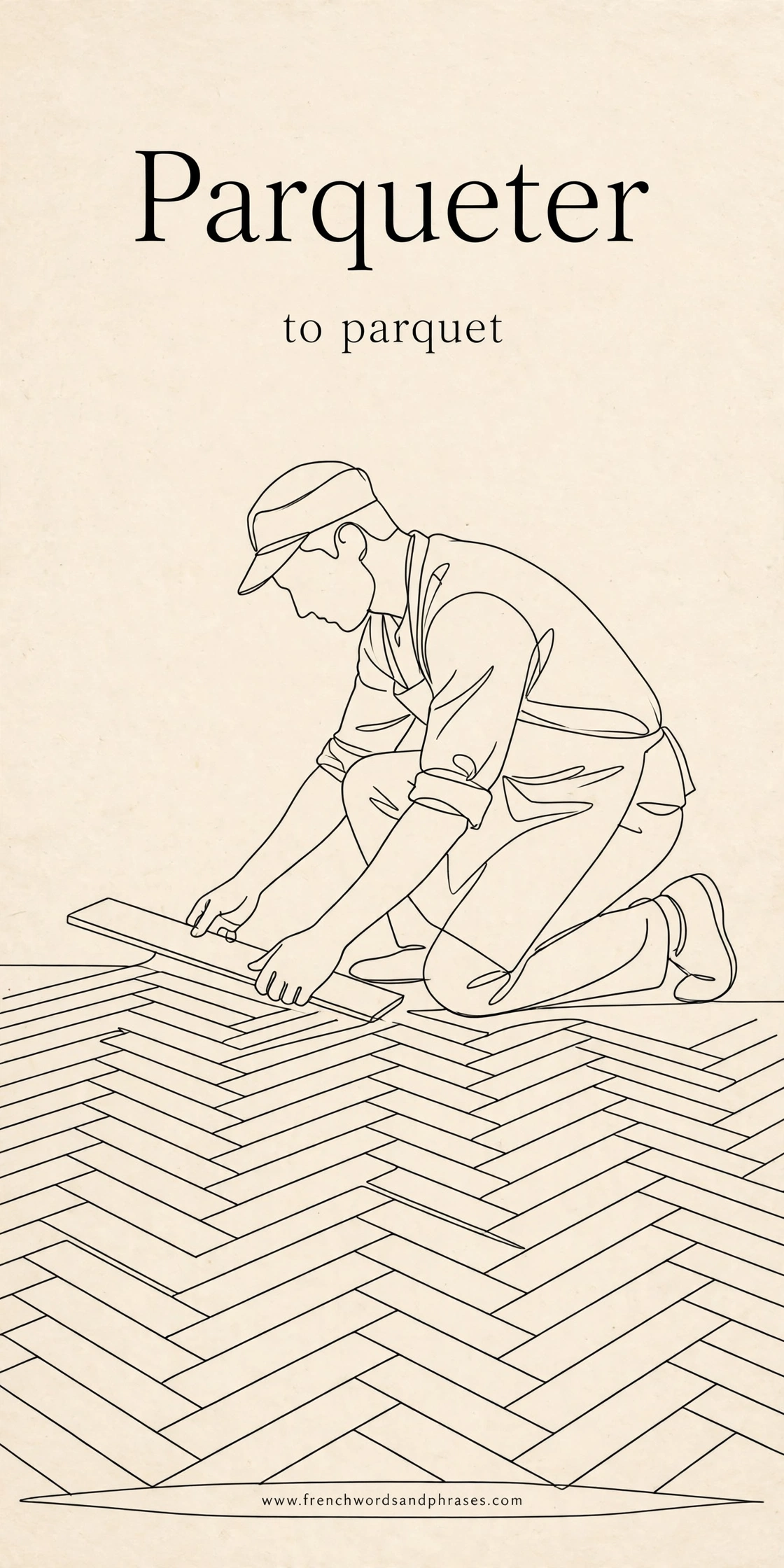
Parqueter means to parquet — to lay a wooden parquet floor, strip by strip and square by square, until the room glows.
A craftsman on his knees with a basket of oak strips, fitting each small rectangle against the last in herringbone and chevron — parqueter is the verb of the parquet floor, the slow carpentry that turns bare boards into the warm geometry under a Parisian apartment.
In this guide, you’ll learn how to conjugate parqueter in all the major French tenses and moods. Explore complete conjugation tables, French examples, English translations, and practice quizzes.
Understanding the French Verb Parqueter
Parqueter is a regular French verb belonging to the first group of verbs, those ending in -er.
It means to parquet. It is a tradesman’s verb — used by floor layers, builders and proud owners of old apartments — and almost always with the room or the floor as its object: parqueter un salon, parqueter tout l’appartement. The finished surface, un parquet, is so much a part of French interiors that the verb is the natural way to say a room got its wooden floor.
Verb classification: First group (-er)
Auxiliary verb: Avoir
Past participle: parqueté
Present participle: parquetant
English equivalents: To parquet, to lay parquet flooring; parqueter une pièce — to parquet a room; parqueter en point de Hongrie — to lay in herringbone; un parquet — a parquet floor (and, by another life of the word, the public prosecutor’s office); le parqueteur — the parquet layer.
One important detail: parqueter behaves like jeter — the t doubles wherever the next syllable is mute: je parquette, tu parquettes, il parquette, ils parquettent, and all through the future and conditional: je parquetterai, je parquetterais. The single t survives wherever the ending is sounded: nous parquetons, vous parquetez, je parquetais, en parquetant, and in the infinitive and the participle, parqueter, parqueté. The subjunctive splits the same way: que je parquette, but que nous parquetions.
Experience the Word
Parqueter is carpentry at the scale of the hand — hundreds of small pieces, one glowing surface.
Imagine an empty Paris flat in June, windows open, the old boards stripped away. The parqueteur arrives with bundles of oak, kneels in the corner and begins: strip, tap, strip, tap. By Friday the herringbone has crossed the room like a wheat field — il a parqueté le salon — and the whole flat smells of wood and wax.
Bare boards went in; a floor came out. Parqueté — laid, fitted and polished, one small rectangle at a time.
How to Conjugate Parqueter: Complete French Conjugation Guide
Let’s explore every major conjugation of parqueter, beginning with the indicative mood.
How to Conjugate Parqueter in the Indicative Mood
The indicative mood is used to express facts, observations, actions, and events.
How to Conjugate Parqueter in the Present Tense (Présent)
Used for actions happening now, habitual actions, and general truths.
| Subject | Conjugation |
|---|---|
| je | parquette |
| tu | parquettes |
| il / elle | parquette |
| nous | parquetons |
| vous | parquetez |
| ils / elles | parquettent |
L’artisan parquette le salon avec du chêne clair.
The craftsman is laying parquet in the living room with pale oak.
Complete the sentence:
Nous ______ le couloir en chêne.
Reveal the answer
parquetons
Nous parquetons le couloir en chêne.
We are parqueting the corridor in oak.
How to Conjugate Parqueter in the Passé Composé
Used for completed actions in the past. Parqueter takes the auxiliary verb avoir.
| Subject | Conjugation |
|---|---|
| j’ | ai parqueté |
| tu | as parqueté |
| il / elle | a parqueté |
| nous | avons parqueté |
| vous | avez parqueté |
| ils / elles | ont parqueté |
Ils ont parqueté toute la maison en un mois.
They parqueted the whole house in a month.
How to Conjugate Parqueter in the Imparfait (Imperfect Tense)
Used for habitual past actions, descriptions, and ongoing situations in the past.
| Subject | Conjugation |
|---|---|
| je | parquetais |
| tu | parquetais |
| il / elle | parquetait |
| nous | parquetions |
| vous | parquetiez |
| ils / elles | parquetaient |
Autrefois, on parquetait les chambres des maisons bourgeoises.
In the old days, the bedrooms of bourgeois houses were parqueted.
Choose the correct form:
The craftsman is parqueting the living room.
L’artisan ______ le salon. (parquette / parquet)
Reveal the answer
parquette
L’artisan parquette le salon.
The t doubles before the mute ending.
How to Conjugate Parqueter in the Plus-que-parfait
Used to describe an action that had already been completed before another past event.
| Subject | Conjugation |
|---|---|
| j’ | avais parqueté |
| tu | avais parqueté |
| il / elle | avait parqueté |
| nous | avions parqueté |
| vous | aviez parqueté |
| ils / elles | avaient parqueté |
Elle avait parqueté le bureau avant l’hiver.
She had parqueted the study before winter.
How to Conjugate Parqueter in the Passé Simple
Primarily used in formal writing, literature, and historical narratives. It is rarely used in everyday conversation.
| Subject | Conjugation |
|---|---|
| je | parquetai |
| tu | parquetas |
| il / elle | parqueta |
| nous | parquetâmes |
| vous | parquetâtes |
| ils / elles | parquetèrent |
Les ouvriers parquetèrent la grande salle en huit jours.
The workmen parqueted the great hall in eight days.
How to Conjugate Parqueter in the Passé Antérieur
A literary tense used to express an action completed immediately before another past action, generally in the passé simple.
| Subject | Conjugation |
|---|---|
| j’ | eus parqueté |
| tu | eus parqueté |
| il / elle | eut parqueté |
| nous | eûmes parqueté |
| vous | eûtes parqueté |
| ils / elles | eurent parqueté |
Quand il eut parqueté l’entrée, il posa les plinthes.
When he had parqueted the hall, he fitted the skirting boards.
How to Conjugate Parqueter in the Future Tense (Futur Simple)
Used to describe actions that will take place in the future.
| Subject | Conjugation |
|---|---|
| je | parquetterai |
| tu | parquetteras |
| il / elle | parquettera |
| nous | parquetterons |
| vous | parquetterez |
| ils / elles | parquetteront |
Demain, je parquetterai la chambre des enfants.
Tomorrow, I will parquet the children’s bedroom.
How to Conjugate Parqueter in the Futur Antérieur (Future Perfect)
Used for an action that will have been completed before a particular point in the future.
| Subject | Conjugation |
|---|---|
| j’ | aurai parqueté |
| tu | auras parqueté |
| il / elle | aura parqueté |
| nous | aurons parqueté |
| vous | aurez parqueté |
| ils / elles | auront parqueté |
À la fin du chantier, nous aurons parqueté trois pièces.
By the end of the job, we will have parqueted three rooms.
How to Conjugate Parqueter in the Near Future (Futur Proche)
Used to describe something that is going to happen soon. Formed with aller + infinitive.
| Subject | Conjugation |
|---|---|
| je | vais parqueter |
| tu | vas parqueter |
| il / elle | va parqueter |
| nous | allons parqueter |
| vous | allez parqueter |
| ils / elles | vont parqueter |
Le menuisier va parqueter le couloir demain.
The carpenter is going to parquet the corridor tomorrow.
How to Conjugate Parqueter in the Conditional Mood
The conditional mood expresses what would happen under certain circumstances. It is also frequently used to make polite requests or express wishes.
How to Conjugate Parqueter in the Present Conditional
| Subject | Conjugation |
|---|---|
| je | parquetterais |
| tu | parquetterais |
| il / elle | parquetterait |
| nous | parquetterions |
| vous | parquetteriez |
| ils / elles | parquetteraient |
Avec plus de temps, tu parquetterais aussi la cuisine.
With more time, you would parquet the kitchen too.
How to Conjugate Parqueter in the Past Conditional
| Subject | Conjugation |
|---|---|
| j’ | aurais parqueté |
| tu | aurais parqueté |
| il / elle | aurait parqueté |
| nous | aurions parqueté |
| vous | auriez parqueté |
| ils / elles | auraient parqueté |
Ils auraient parqueté le grenier si le bois avait suffi.
They would have parqueted the attic if there had been enough wood.
Parqueter in the Literary Past Conditional Form
This less common literary form uses the imperfect subjunctive of avoir.
| Subject | Conjugation |
|---|---|
| j’ | eusse parqueté |
| tu | eusses parqueté |
| il / elle | eût parqueté |
| nous | eussions parqueté |
| vous | eussiez parqueté |
| ils / elles | eussent parqueté |
Sans la guerre, on eût parqueté tout le château.
Without the war, the whole castle would have been parqueted.
How to Conjugate Parqueter in the Subjunctive Mood
The subjunctive is used to express wishes, emotions, doubts, necessity, and uncertainty. It frequently follows expressions such as il faut que (it is necessary that) or bien que (although).
How to Conjugate Parqueter in the Present Subjunctive
| Subject | Conjugation |
|---|---|
| que je | parquette |
| que tu | parquettes |
| qu’il / qu’elle | parquette |
| que nous | parquetions |
| que vous | parquetiez |
| qu’ils / qu’elles | parquettent |
Il faut que tu parquettes le salon avant Noël.
You must parquet the living room before Christmas.
Complete the sentence using the subjunctive:
Il faut que vous ______ la chambre avant l’hiver.
Reveal the answer
parquetiez
Il faut que vous parquetiez la chambre avant l’hiver.
You must parquet the bedroom before winter.
How to Conjugate Parqueter in the Imperfect Subjunctive
A literary tense, rarely encountered in modern spoken French.
| Subject | Conjugation |
|---|---|
| que je | parquetasse |
| que tu | parquetasses |
| qu’il / qu’elle | parquetât |
| que nous | parquetassions |
| que vous | parquetassiez |
| qu’ils / qu’elles | parquetassent |
Le roi voulait que l’on parquetât ses appartements.
The king wanted his apartments to be parqueted.
How to Conjugate Parqueter in the Pluperfect Subjunctive
A literary construction used to express an action completed before another past action.
| Subject | Conjugation |
|---|---|
| que j’ | eusse parqueté |
| que tu | eusses parqueté |
| qu’il / qu’elle | eût parqueté |
| que nous | eussions parqueté |
| que vous | eussiez parqueté |
| qu’ils / elles | eussent parqueté |
On admirait qu’ils eussent parqueté la salle en si peu de temps.
People admired that they had parqueted the hall in so little time.
How to Conjugate Parqueter in the Past Subjunctive
| Subject | Conjugation |
|---|---|
| que j’ | aie parqueté |
| que tu | aies parqueté |
| qu’il / qu’elle | ait parqueté |
| que nous | ayons parqueté |
| que vous | ayez parqueté |
| qu’ils / elles | aient parqueté |
Je suis heureux que vous ayez parqueté la chambre.
I am happy you parqueted the bedroom.
How to Conjugate Parqueter in the Imperative
The imperative is used to give commands, instructions, invitations, or suggestions. Subject pronouns are omitted.
How to Conjugate Parqueter in the Present Imperative
| Person | Conjugation |
|---|---|
| (tu) | parquette |
| (nous) | parquetons |
| (vous) | parquetez |
Parquette d’abord la pièce la plus froide !
Parquet the coldest room first!
How would you say Parquet the coldest room first (tu form)?
Reveal the answer
Parquette d’abord la pièce la plus froide !
French Participles of Parqueter
Participles are verb forms that can be used in compound tenses and other grammatical constructions.
Present Participle of Parqueter
parquetant
En parquetant le salon, il a trouvé une trappe ancienne.
While parqueting the living room, he found an old trapdoor.
Past Participle of Parqueter
parqueté
Parquetée en chêne massif, la pièce sentait le bois neuf.
Parqueted in solid oak, the room smelled of new wood.
Parqueter in Everyday French: Real-Life Examples
Now that you know the conjugations, let’s see how parqueter appears in everyday French.
L’artisan parquette le salon.
The craftsman is parqueting the living room.
Ils ont parqueté toute la maison.
They parqueted the whole house.
On parquetait les chambres autrefois.
Bedrooms used to be parqueted in the old days.
Je parquetterai la chambre demain.
I will parquet the bedroom tomorrow.
Tu parquetterais aussi la cuisine avec plus de bois.
You would parquet the kitchen too with more wood.
Parquette d’abord la pièce la plus froide !
Parquet the coldest room first!
Beyond Translation: The Meaning of Parqueter
The word parquet began as a little parc — a small enclosed space — and the floor of small fitted pieces took the name of the pattern it made.
Then the floor lent its name to the law.
In French courts, le parquet is also the public prosecutor’s office, named for the small railed enclosure where its officers once stood. So parqueter belongs to the carpenter, while le parquet, in a courtroom, belongs to the state — one word, two kinds of standing room.
How to Remember the French Verb Parqueter
Remember it this way: Parqueter is about the craftsman on his knees, tapping oak strips into herringbone.
- Jeter-type doubling: je parquette with two t’s, but nous parquetons with one.
- The double t runs through the future and conditional too: je parquetterai, je parquetterais.
- Infinitive and participle keep the single t: parqueter, parqueté.
The key idea is the craftsman on his knees, tapping oak strips into herringbone.
Test Your Knowledge of Parqueter
Let’s see how much you’ve learned. Try answering these questions before revealing the answers.
Why does je parquette have two t’s but nous parquetons only one?
Reveal the answer
The jeter rule — the consonant doubles before a mute syllable (je parquette) and stays single where the ending is sounded (nous parquetons).
How do you say They parqueted the whole house in French?
Reveal the answer
Ils ont parqueté toute la maison.
Translate: Tomorrow, I will parquet the children’s bedroom.
Reveal the answer
Demain, je parquetterai la chambre des enfants.
What is the past participle of parqueter?
Reveal the answer
Parqueté — with a single t.
Complete the sentence:
Il faut que tu ______ le salon avant Noël.
Reveal the answer
parquettes
Il faut que tu parquettes le salon avant Noël.
You must parquet the living room before Christmas.
Can You Use It?
How would you say this in French?
He is parqueting the living room in pale oak, and the evening light dances on the new wood.
Reveal the answer
Il parquette le salon en chêne clair, et la lumière du soir danse sur le bois neuf.
He is parqueting the living room in pale oak, and the evening light dances on the new wood.
LEARN FRENCH ONE WORD AT A TIME