How to Conjugate Parquer in French
/paʁ.ke/
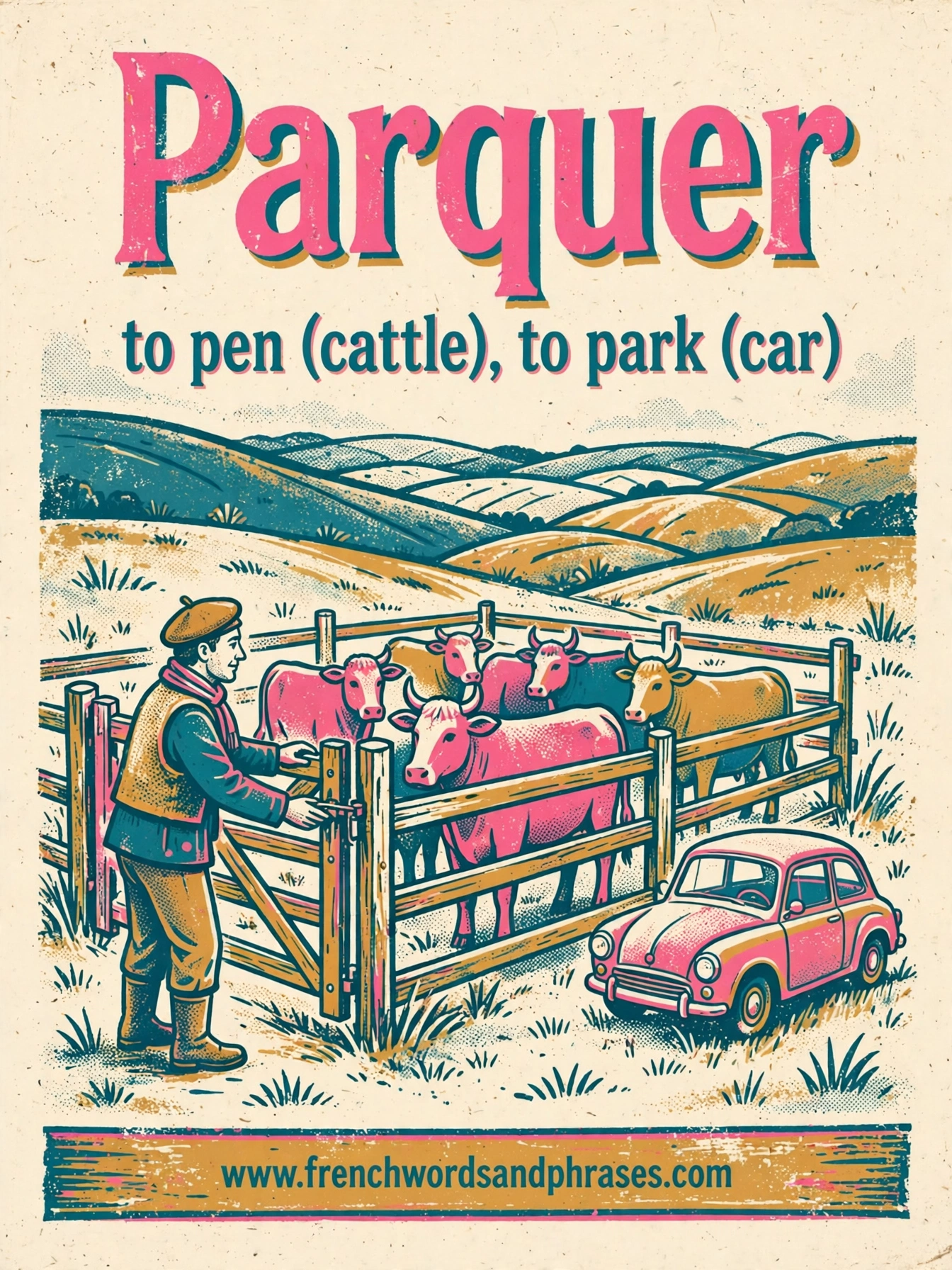
Parquer means to pen (cattle), to park (car) — to put animals inside an enclosure or a vehicle into its allotted place.
Evening on the farm: the cattle are counted into the pen before dark. Evening in the city: a driver circles the block hunting for two metres of kerb. Parquer covers both worlds — it is the verb of putting living or metal stock neatly away inside a bounded space.
In this guide, you’ll learn how to conjugate parquer in all the major French tenses and moods. Explore complete conjugation tables, French examples, English translations, and practice quizzes.
Understanding the French Verb Parquer
Parquer is a regular French verb belonging to the first group of verbs, those ending in -er.
It means to pen (cattle), to park (car). Its home ground is the farm — parquer les moutons, les vaches, les chevaux — and by extension any group penned into a space, which gives the verb a slightly cold edge when used of people: parquer des réfugiés dans un stade, to pen refugees in a stadium, is a criticism, not a description.
Verb classification: First group (-er)
Auxiliary verb: Avoir
Past participle: parqué
Present participle: parquant
English equivalents: To pen, to fold (sheep), to park; parquer les vaches — to pen the cows; parquer un troupeau — to fold a flock; parquer sa voiture — to park one’s car; un parc — a park, an enclosure; un parking — a car park.
One important detail: parquer keeps its qu in every form — je parque, nous parquons, je parquais, parqué — the u is written but the sound is simply /k/, exactly as in marquer. Note too the division of labour in modern French: you parquez a car or a herd, but for parking yourself and your own car in everyday speech, most people reach for se garer: je me suis garé devant la gare. Parquer les voitures is the language of attendants, farmers and official signs.
Experience the Word
Parquer is the verb of the enclosure — whatever goes in, beast or vehicle, is counted, bounded and shut in for the night.
Imagine a shepherd above a Pyrenean village at dusk. One by one the sheep stream through the gate he holds open, bells clinking, until the last ewe is in; he drops the bar across the entrance — il a parqué le troupeau — and the mountain night can begin.
Two hundred sheep, one wooden bar. They are penned — parquées — safe from the dark and the dogs.
How to Conjugate Parquer: Complete French Conjugation Guide
Let’s explore every major conjugation of parquer, beginning with the indicative mood.
How to Conjugate Parquer in the Indicative Mood
The indicative mood is used to express facts, observations, actions, and events.
How to Conjugate Parquer in the Present Tense (Présent)
Used for actions happening now, habitual actions, and general truths.
| Subject | Conjugation |
|---|---|
| je | parque |
| tu | parques |
| il / elle | parque |
| nous | parquons |
| vous | parquez |
| ils / elles | parquent |
Le fermier parque ses vaches dans le pré du bas.
The farmer pens his cows in the lower meadow.
Complete the sentence:
Nous ______ les moutons dans l’enclos.
Reveal the answer
parquons
Nous parquons les moutons dans l’enclos.
We pen the sheep in the enclosure.
How to Conjugate Parquer in the Passé Composé
Used for completed actions in the past. Parquer takes the auxiliary verb avoir.
| Subject | Conjugation |
|---|---|
| j’ | ai parqué |
| tu | as parqué |
| il / elle | a parqué |
| nous | avons parqué |
| vous | avez parqué |
| ils / elles | ont parqué |
J’ai parqué la voiture près de la gare.
I parked the car near the station.
How to Conjugate Parquer in the Imparfait (Imperfect Tense)
Used for habitual past actions, descriptions, and ongoing situations in the past.
| Subject | Conjugation |
|---|---|
| je | parquais |
| tu | parquais |
| il / elle | parquait |
| nous | parquions |
| vous | parquiez |
| ils / elles | parquaient |
On parquait les troupeaux près de la rivière.
They used to pen the flocks near the river.
Choose the correct form:
I parked the car near the station.
J’______ la voiture près de la gare. (ai parqué / suis parqué)
Reveal the answer
ai parqué
J’ai parqué la voiture près de la gare.
Parquer takes avoir.
How to Conjugate Parquer in the Plus-que-parfait
Used to describe an action that had already been completed before another past event.
| Subject | Conjugation |
|---|---|
| j’ | avais parqué |
| tu | avais parqué |
| il / elle | avait parqué |
| nous | avions parqué |
| vous | aviez parqué |
| ils / elles | avaient parqué |
Elle avait parqué son vélo contre le mur.
She had parked her bike against the wall.
How to Conjugate Parquer in the Passé Simple
Primarily used in formal writing, literature, and historical narratives. It is rarely used in everyday conversation.
| Subject | Conjugation |
|---|---|
| je | parquai |
| tu | parquas |
| il / elle | parqua |
| nous | parquâmes |
| vous | parquâtes |
| ils / elles | parquèrent |
Les soldats parquèrent les chevaux derrière l’auberge.
The soldiers penned the horses behind the inn.
How to Conjugate Parquer in the Passé Antérieur
A literary tense used to express an action completed immediately before another past action, generally in the passé simple.
| Subject | Conjugation |
|---|---|
| j’ | eus parqué |
| tu | eus parqué |
| il / elle | eut parqué |
| nous | eûmes parqué |
| vous | eûtes parqué |
| ils / elles | eurent parqué |
Quand il eut parqué le troupeau, il ferma la barrière.
When he had penned the flock, he closed the gate.
How to Conjugate Parquer in the Future Tense (Futur Simple)
Used to describe actions that will take place in the future.
| Subject | Conjugation |
|---|---|
| je | parquerai |
| tu | parqueras |
| il / elle | parquera |
| nous | parquerons |
| vous | parquerez |
| ils / elles | parqueront |
Nous parquerons les moutons dans l’enclos ce soir.
We will pen the sheep in the enclosure this evening.
How to Conjugate Parquer in the Futur Antérieur (Future Perfect)
Used for an action that will have been completed before a particular point in the future.
| Subject | Conjugation |
|---|---|
| j’ | aurai parqué |
| tu | auras parqué |
| il / elle | aura parqué |
| nous | aurons parqué |
| vous | aurez parqué |
| ils / elles | auront parqué |
À la tombée de la nuit, le berger aura parqué toutes les bêtes.
By nightfall, the shepherd will have penned all the animals.
How to Conjugate Parquer in the Near Future (Futur Proche)
Used to describe something that is going to happen soon. Formed with aller + infinitive.
| Subject | Conjugation |
|---|---|
| je | vais parquer |
| tu | vas parquer |
| il / elle | va parquer |
| nous | allons parquer |
| vous | allez parquer |
| ils / elles | vont parquer |
Je vais parquer la camionnette derrière la grange.
I am going to park the van behind the barn.
How to Conjugate Parquer in the Conditional Mood
The conditional mood expresses what would happen under certain circumstances. It is also frequently used to make polite requests or express wishes.
How to Conjugate Parquer in the Present Conditional
| Subject | Conjugation |
|---|---|
| je | parquerais |
| tu | parquerais |
| il / elle | parquerait |
| nous | parquerions |
| vous | parqueriez |
| ils / elles | parqueraient |
Sans la clôture, on parquerait les chèvres dans le jardin.
Without the fence, we would pen the goats in the garden.
How to Conjugate Parquer in the Past Conditional
| Subject | Conjugation |
|---|---|
| j’ | aurais parqué |
| tu | aurais parqué |
| il / elle | aurait parqué |
| nous | aurions parqué |
| vous | auriez parqué |
| ils / elles | auraient parqué |
Tu aurais parqué la voiture plus près si tu étais venu tôt.
You would have parked the car closer if you had come early.
Parquer in the Literary Past Conditional Form
This less common literary form uses the imperfect subjunctive of avoir.
| Subject | Conjugation |
|---|---|
| j’ | eusse parqué |
| tu | eusses parqué |
| il / elle | eût parqué |
| nous | eussions parqué |
| vous | eussiez parqué |
| ils / elles | eussent parqué |
Le régiment eût parqué ses canons près du village.
The regiment would have parked its cannons near the village.
How to Conjugate Parquer in the Subjunctive Mood
The subjunctive is used to express wishes, emotions, doubts, necessity, and uncertainty. It frequently follows expressions such as il faut que (it is necessary that) or bien que (although).
How to Conjugate Parquer in the Present Subjunctive
| Subject | Conjugation |
|---|---|
| que je | parque |
| que tu | parques |
| qu’il / qu’elle | parque |
| que nous | parquions |
| que vous | parquiez |
| qu’ils / qu’elles | parquent |
Il faut que vous parquiez les voitures sur le terrain vague.
You must park the cars on the waste ground.
Complete the sentence using the subjunctive:
Il faut que tu ______ la voiture à l’ombre.
Reveal the answer
parques
Il faut que tu parques la voiture à l’ombre.
You must park the car in the shade.
How to Conjugate Parquer in the Imperfect Subjunctive
A literary tense, rarely encountered in modern spoken French.
| Subject | Conjugation |
|---|---|
| que je | parquasse |
| que tu | parquasses |
| qu’il / qu’elle | parquât |
| que nous | parquassions |
| que vous | parquassiez |
| qu’ils / qu’elles | parquassent |
On exigea que le fermier parquât ses bêtes loin de la route.
It was required that the farmer pen his animals far from the road.
How to Conjugate Parquer in the Pluperfect Subjunctive
A literary construction used to express an action completed before another past action.
| Subject | Conjugation |
|---|---|
| que j’ | eusse parqué |
| que tu | eusses parqué |
| qu’il / qu’elle | eût parqué |
| que nous | eussions parqué |
| que vous | eussiez parqué |
| qu’ils / elles | eussent parqué |
On doutait qu’ils eussent parqué le troupeau avant l’orage.
People doubted they had penned the flock before the storm.
How to Conjugate Parquer in the Past Subjunctive
| Subject | Conjugation |
|---|---|
| que j’ | aie parqué |
| que tu | aies parqué |
| qu’il / qu’elle | ait parqué |
| que nous | ayons parqué |
| que vous | ayez parqué |
| qu’ils / elles | aient parqué |
Je suis content que tu aies parqué la voiture à l’ombre.
I am glad you parked the car in the shade.
How to Conjugate Parquer in the Imperative
The imperative is used to give commands, instructions, invitations, or suggestions. Subject pronouns are omitted.
How to Conjugate Parquer in the Present Imperative
| Person | Conjugation |
|---|---|
| (tu) | parque |
| (nous) | parquons |
| (vous) | parquez |
Parque les vaches dans le grand pré !
Pen the cows in the big meadow!
How would you say Pen the cows in the big meadow (tu form)?
Reveal the answer
Parque les vaches dans le grand pré !
French Participles of Parquer
Participles are verb forms that can be used in compound tenses and other grammatical constructions.
Present Participle of Parquer
parquant
En parquant les voitures trop près, on bloque le passage.
By parking the cars too close, people block the way through.
Past Participle of Parquer
parqué
Parquées pour la nuit, les vaches dormaient dans l’enclos.
Penned for the night, the cows were sleeping in the enclosure.
Parquer in Everyday French: Real-Life Examples
Now that you know the conjugations, let’s see how parquer appears in everyday French.
Le fermier parque ses vaches.
The farmer pens his cows.
J’ai parqué la voiture près de la gare.
I parked the car near the station.
On parquait les troupeaux près de la rivière.
They used to pen the flocks near the river.
Nous parquerons les moutons ce soir.
We will pen the sheep this evening.
Tu parquerais la voiture plus près avec une petite auto.
You would park the car closer with a small car.
Parque les vaches dans le grand pré !
Pen the cows in the big meadow!
Beyond Translation: The Meaning of Parquer
English park is this verb’s own child — Old French parc was an enclosure for animals long before it was a garden or a place for cars, and English borrowed both the fence and the word.
From sheep pen to car park, the idea never changed.
A parc is still any bounded ground — un parc naturel, un parc d’attractions, un parc automobile (a country’s whole fleet of vehicles) — and parquer is still the act of putting things inside the fence, whatever the things are made of.
How to Remember the French Verb Parquer
Remember it this way: Parquer is about the shepherd dropping the bar across the gate at dusk.
- Un parc is an enclosure first: parquer = to put inside the fence — cattle in a pen, cars in a car park.
- The qu never changes: je parque, nous parquons, parqué — and it sounds like a plain k.
- For parking your own car in conversation, se garer is the everyday rival: je me suis garé.
The key idea is the shepherd dropping the bar across the gate at dusk.
Test Your Knowledge of Parquer
Let’s see how much you’ve learned. Try answering these questions before revealing the answers.
What two worlds does parquer cover?
Reveal the answer
The farm and the street — to pen cattle in an enclosure, and to park a car in its place.
How do you say The farmer pens his cows in French?
Reveal the answer
Le fermier parque ses vaches.
Translate: I parked the car near the station.
Reveal the answer
J’ai parqué la voiture près de la gare.
What is the past participle of parquer?
Reveal the answer
Parqué.
Complete the sentence:
Il faut que vous ______ les voitures sur le terrain vague.
Reveal the answer
parquiez
Il faut que vous parquiez les voitures sur le terrain vague.
You must park the cars on the waste ground.
Can You Use It?
How would you say this in French?
The shepherd pens his flock, closes the gate, and the mountain keeps its silence.
Reveal the answer
Le berger parque son troupeau, ferme la barrière, et la montagne garde le silence.
The shepherd pens his flock, closes the gate, and the mountain keeps its silence.
LEARN FRENCH ONE WORD AT A TIME