How to Conjugate Parodier in French
/pa.ʁɔ.dje/
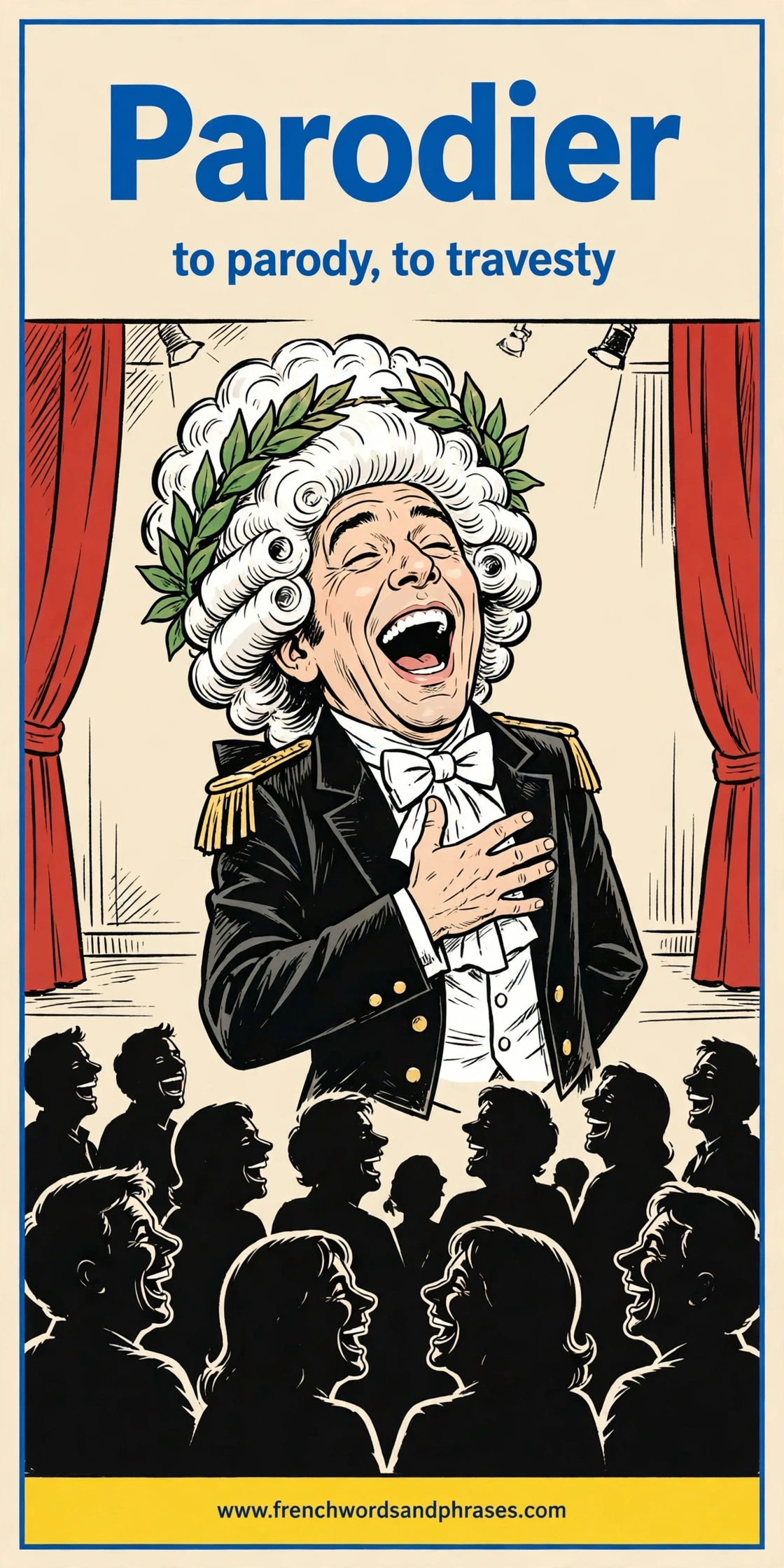
Parodier means to parody, to travesty — to imitate a work, a style or a famous voice with comic exaggeration until everyone laughs.
A student troupe performing Molière in motorcycle helmets, a radio comedian borrowing the president’s voice to discuss the weather — parodier is the art of the loving copy: take something solemn, tilt it a few degrees, and watch the whole room recognise it and roar.
In this guide, you’ll learn how to conjugate parodier in all the major French tenses and moods. Explore complete conjugation tables, French examples, English translations, and practice quizzes.
Understanding the French Verb Parodier
Parodier is a regular French verb belonging to the first group of verbs, those ending in -er.
It means to parody, to travesty. It ranges from affectionate imitation — a comedian parodying a singer — to something sharper: une parodie de procès, a travesty of a trial, where the copy is an accusation. In schools and theatres it is a compliment; in politics, a weapon; in both cases it only works if the audience knows the original well.
Verb classification: First group (-er)
Auxiliary verb: Avoir
Past participle: parodié
Present participle: parodiant
English equivalents: To parody, to travesty, to spoof; parodier un discours — to parody a speech; parodier un chanteur — to do a send-up of a singer; une parodie de justice — a travesty of justice; parodier les manières de quelqu’un — to mimic someone’s mannerisms.
One important detail: parodier is an -ier verb, and -ier verbs double the i wherever the stem meets an ending that begins with i: nous parodiions, vous parodiiez, in both the imperfect and the subjunctive — two i’s in a row, both written and both pronounced. Everywhere else the verb is a model regular: je parodie, nous parodions (present), past participle parodié.
Experience the Word
Parodier is imitation with the volume turned up — faithful enough to recognise, twisted enough to laugh at.
Imagine the end-of-year school show. The head boy climbs the stage in a borrowed suit two sizes too big, folds his hands exactly like the headmaster, clears his throat exactly like the headmaster — and the hall dissolves. He has changed almost nothing; he has simply parodié, and precision has done all the work.
The headmaster is laughing loudest of all. That is the secret of a good parody — parodier well is a form of attention, almost of love.
How to Conjugate Parodier: Complete French Conjugation Guide
Let’s explore every major conjugation of parodier, beginning with the indicative mood.
How to Conjugate Parodier in the Indicative Mood
The indicative mood is used to express facts, observations, actions, and events.
How to Conjugate Parodier in the Present Tense (Présent)
Used for actions happening now, habitual actions, and general truths.
| Subject | Conjugation |
|---|---|
| je | parodie |
| tu | parodies |
| il / elle | parodie |
| nous | parodions |
| vous | parodiez |
| ils / elles | parodient |
Ce comédien parodie les hommes politiques à la perfection.
This comedian parodies politicians to perfection.
Complete the sentence:
Nous ______ les voix des professeurs.
Reveal the answer
parodions
Nous parodions les voix des professeurs.
We parody the teachers’ voices.
How to Conjugate Parodier in the Passé Composé
Used for completed actions in the past. Parodier takes the auxiliary verb avoir.
| Subject | Conjugation |
|---|---|
| j’ | ai parodié |
| tu | as parodié |
| il / elle | a parodié |
| nous | avons parodié |
| vous | avez parodié |
| ils / elles | ont parodié |
Les étudiants ont parodié la pièce de Molière.
The students parodied Molière’s play.
How to Conjugate Parodier in the Imparfait (Imperfect Tense)
Used for habitual past actions, descriptions, and ongoing situations in the past.
| Subject | Conjugation |
|---|---|
| je | parodiais |
| tu | parodiais |
| il / elle | parodiait |
| nous | parodiions |
| vous | parodiiez |
| ils / elles | parodiaient |
Chaque semaine, l’émission parodiait l’actualité.
Every week, the programme parodied the news.
Choose the correct form:
The students parodied the play.
Les étudiants ______ la pièce. (ont parodié / sont parodiés)
Reveal the answer
ont parodié
Les étudiants ont parodié la pièce.
Parodier takes avoir.
How to Conjugate Parodier in the Plus-que-parfait
Used to describe an action that had already been completed before another past event.
| Subject | Conjugation |
|---|---|
| j’ | avais parodié |
| tu | avais parodié |
| il / elle | avait parodié |
| nous | avions parodié |
| vous | aviez parodié |
| ils / elles | avaient parodié |
Ils avaient déjà parodié ce discours l’an dernier.
They had already parodied this speech last year.
How to Conjugate Parodier in the Passé Simple
Primarily used in formal writing, literature, and historical narratives. It is rarely used in everyday conversation.
| Subject | Conjugation |
|---|---|
| je | parodiai |
| tu | parodias |
| il / elle | parodia |
| nous | parodiâmes |
| vous | parodiâtes |
| ils / elles | parodièrent |
Le journal parodia le discours du ministre dès le lendemain.
The newspaper parodied the minister’s speech the very next day.
How to Conjugate Parodier in the Passé Antérieur
A literary tense used to express an action completed immediately before another past action, generally in the passé simple.
| Subject | Conjugation |
|---|---|
| j’ | eus parodié |
| tu | eus parodié |
| il / elle | eut parodié |
| nous | eûmes parodié |
| vous | eûtes parodié |
| ils / elles | eurent parodié |
Quand il eut parodié le président, la salle éclata de rire.
When he had parodied the president, the room burst out laughing.
How to Conjugate Parodier in the Future Tense (Futur Simple)
Used to describe actions that will take place in the future.
| Subject | Conjugation |
|---|---|
| je | parodierai |
| tu | parodieras |
| il / elle | parodiera |
| nous | parodierons |
| vous | parodierez |
| ils / elles | parodieront |
Demain, les humoristes parodieront le débat.
Tomorrow, the comedians will parody the debate.
How to Conjugate Parodier in the Futur Antérieur (Future Perfect)
Used for an action that will have been completed before a particular point in the future.
| Subject | Conjugation |
|---|---|
| j’ | aurai parodié |
| tu | auras parodié |
| il / elle | aura parodié |
| nous | aurons parodié |
| vous | aurez parodié |
| ils / elles | auront parodié |
À la fin de la saison, elle aura parodié tous les candidats.
By the end of the season, she will have parodied all the candidates.
How to Conjugate Parodier in the Near Future (Futur Proche)
Used to describe something that is going to happen soon. Formed with aller + infinitive.
| Subject | Conjugation |
|---|---|
| je | vais parodier |
| tu | vas parodier |
| il / elle | va parodier |
| nous | allons parodier |
| vous | allez parodier |
| ils / elles | vont parodier |
Attention, il va encore parodier le professeur !
Careful, he is going to parody the teacher again!
How to Conjugate Parodier in the Conditional Mood
The conditional mood expresses what would happen under certain circumstances. It is also frequently used to make polite requests or express wishes.
How to Conjugate Parodier in the Present Conditional
| Subject | Conjugation |
|---|---|
| je | parodierais |
| tu | parodierais |
| il / elle | parodierait |
| nous | parodierions |
| vous | parodieriez |
| ils / elles | parodieraient |
Un bon imitateur parodierait ce chanteur sans effort.
A good impersonator would parody this singer effortlessly.
How to Conjugate Parodier in the Past Conditional
| Subject | Conjugation |
|---|---|
| j’ | aurais parodié |
| tu | aurais parodié |
| il / elle | aurait parodié |
| nous | aurions parodié |
| vous | auriez parodié |
| ils / elles | auraient parodié |
Ils auraient parodié la chanson si elle avait été connue.
They would have parodied the song if it had been well known.
Parodier in the Literary Past Conditional Form
This less common literary form uses the imperfect subjunctive of avoir.
| Subject | Conjugation |
|---|---|
| j’ | eusse parodié |
| tu | eusses parodié |
| il / elle | eût parodié |
| nous | eussions parodié |
| vous | eussiez parodié |
| ils / elles | eussent parodié |
Le poète eût parodié les héros de son temps.
The poet would have parodied the heroes of his time.
How to Conjugate Parodier in the Subjunctive Mood
The subjunctive is used to express wishes, emotions, doubts, necessity, and uncertainty. It frequently follows expressions such as il faut que (it is necessary that) or bien que (although).
How to Conjugate Parodier in the Present Subjunctive
| Subject | Conjugation |
|---|---|
| que je | parodie |
| que tu | parodies |
| qu’il / qu’elle | parodie |
| que nous | parodiions |
| que vous | parodiiez |
| qu’ils / qu’elles | parodient |
Il faut que tu parodies sans méchanceté.
You must parody without malice.
Complete the sentence using the subjunctive:
Il faut que vous ______ cette scène sans cruauté.
Reveal the answer
parodiiez
Il faut que vous parodiiez cette scène sans cruauté.
You must parody this scene without cruelty.
How to Conjugate Parodier in the Imperfect Subjunctive
A literary tense, rarely encountered in modern spoken French.
| Subject | Conjugation |
|---|---|
| que je | parodiasse |
| que tu | parodiasses |
| qu’il / qu’elle | parodiât |
| que nous | parodiassions |
| que vous | parodiassiez |
| qu’ils / qu’elles | parodiassent |
On ne s’attendait pas qu’il parodiât le roi lui-même.
No one expected him to parody the king himself.
How to Conjugate Parodier in the Pluperfect Subjunctive
A literary construction used to express an action completed before another past action.
| Subject | Conjugation |
|---|---|
| que j’ | eusse parodié |
| que tu | eusses parodié |
| qu’il / qu’elle | eût parodié |
| que nous | eussions parodié |
| que vous | eussiez parodié |
| qu’ils / elles | eussent parodié |
On racontait qu’ils eussent parodié la cérémonie entière.
People said they had parodied the entire ceremony.
How to Conjugate Parodier in the Past Subjunctive
| Subject | Conjugation |
|---|---|
| que j’ | aie parodié |
| que tu | aies parodié |
| qu’il / qu’elle | ait parodié |
| que nous | ayons parodié |
| que vous | ayez parodié |
| qu’ils / qu’elles | aient parodié |
Je suis content que vous ayez parodié cette scène.
I am glad you parodied this scene.
How to Conjugate Parodier in the Imperative
The imperative is used to give commands, instructions, invitations, or suggestions. Subject pronouns are omitted.
How to Conjugate Parodier in the Present Imperative
| Person | Conjugation |
|---|---|
| (tu) | parodie |
| (nous) | parodions |
| (vous) | parodiez |
Parodiez ce discours, mais avec élégance !
Parody this speech, but with elegance!
How would you say Parody the teacher, for a laugh (tu form)?
Reveal the answer
Parodie le professeur, pour rire !
French Participles of Parodier
Participles are verb forms that can be used in compound tenses and other grammatical constructions.
Present Participle of Parodier
parodiant
En parodiant les accents, il fait rire toute la classe.
By parodying accents, he makes the whole class laugh.
Past Participle of Parodier
parodié
Parodiée par les étudiants, la pièce a connu une seconde vie.
Parodied by the students, the play enjoyed a second life.
Parodier in Everyday French: Real-Life Examples
Now that you know the conjugations, let’s see how parodier appears in everyday French.
Ce comédien parodie le président.
This comedian parodies the president.
Les étudiants ont parodié la pièce.
The students parodied the play.
L’émission parodiait l’actualité.
The programme used to parody the news.
Les humoristes parodieront le débat.
The comedians will parody the debate.
Elle parodierait ce chanteur sans effort.
She would parody this singer effortlessly.
Parodie le professeur, pour rire !
Parody the teacher, for a laugh!
Beyond Translation: The Meaning of Parodier
English parody and French parodier share the Greek parōidia — a song sung beside another song, the counter-song.
The copy that judges the original.
French keeps the darker edge of the word too: une parodie de justice is a travesty of justice, a trial that imitates justice the way a bad actor imitates a king. To parodier well, in laughter or in anger, you must first have understood perfectly.
How to Remember the French Verb Parodier
Remember it this way: Parodier is about the student in the too-big suit, clearing his throat exactly like the headmaster.
- -ier verb: watch the double i — nous parodiions (imperfect), que vous parodiiez (subjunctive).
- A parody must be recognisable: parodier works only when the audience knows the original.
- Regular endings elsewhere: je parodie, nous parodions, past participle parodié.
The key idea is the student in the too-big suit, clearing his throat exactly like the headmaster.
Test Your Knowledge of Parodier
Let’s see how much you’ve learned. Try answering these questions before revealing the answers.
Why does nous parodiions have two i’s?
Reveal the answer
Because parodier is an -ier verb — the stem parodi- meets the ending -ions, and both i’s are written: nous parodiions, vous parodiiez.
How do you say The students parodied the play in French?
Reveal the answer
Les étudiants ont parodié la pièce.
Translate: This comedian parodies politicians.
Reveal the answer
Ce comédien parodie les hommes politiques.
What is the past participle of parodier?
Reveal the answer
Parodié.
Complete the sentence:
Il faut que tu ______ sans méchanceté.
Reveal the answer
parodies
Il faut que tu parodies sans méchanceté.
You must parody without malice.
Can You Use It?
How would you say this in French?
He parodies the mayor so well that even the mayor, sitting in the audience, is crying with laughter.
Reveal the answer
Il parodie si bien le maire que même le maire, dans la salle, rit aux larmes.
He parodies the mayor so well that even the mayor, sitting in the audience, is crying with laughter.
LEARN FRENCH ONE WORD AT A TIME