How to Conjugate Parloter in French
/paʁ.lɔ.te/
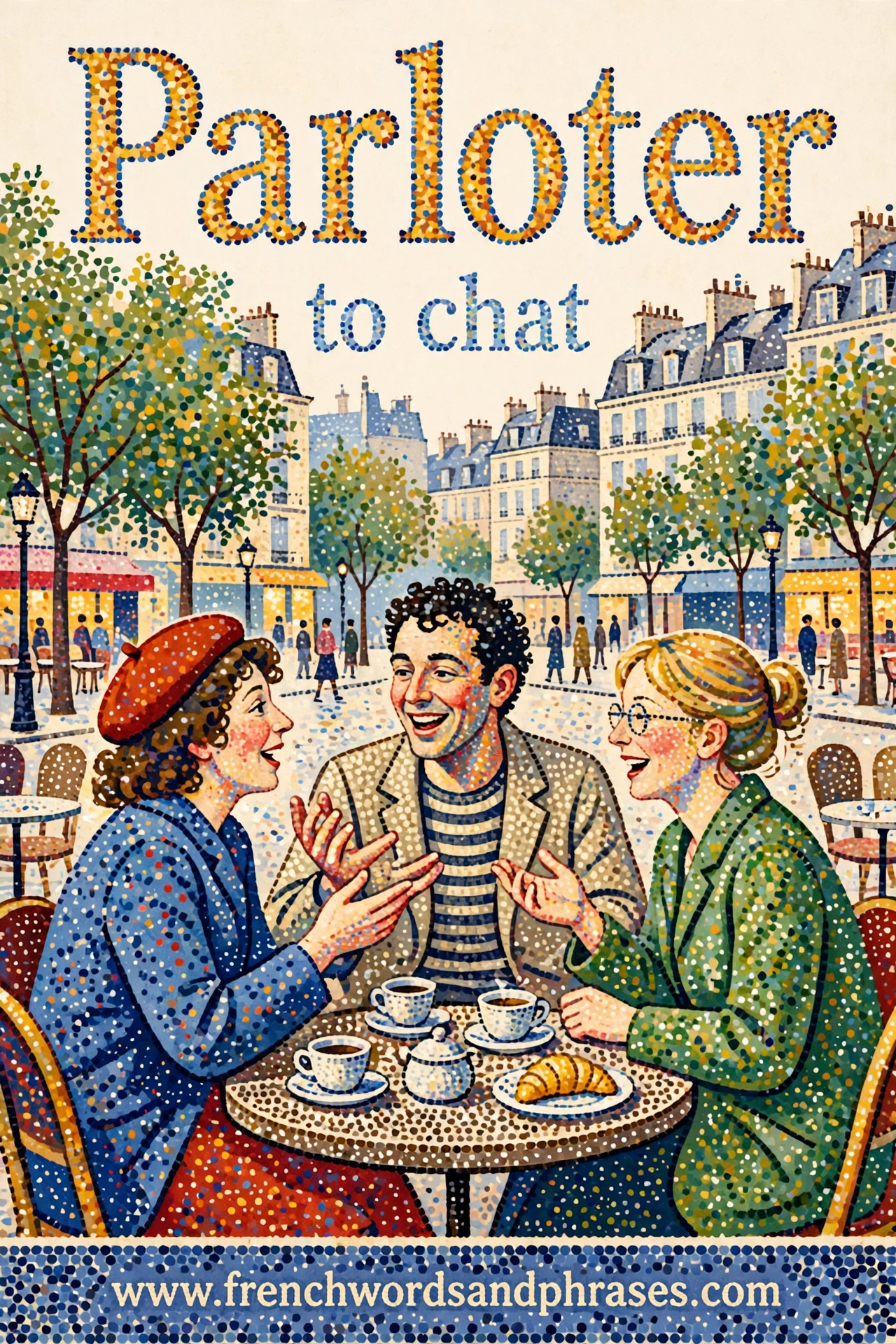
Parloter means to chat — to talk lightly and at length about nothing very serious, the way neighbours do over a fence.
Two women on a doorstep with shopping bags growing heavy, schoolchildren whispering at the back of the church, old friends who have said everything a hundred times and say it again — parloter is small talk in its natural state: cheerful, endless and gloriously unimportant.
In this guide, you’ll learn how to conjugate parloter in all the major French tenses and moods. Explore complete conjugation tables, French examples, English translations, and practice quizzes.
Understanding the French Verb Parloter
Parloter is a regular French verb belonging to the first group of verbs, those ending in -er.
It means to chat. It is the verb of doorsteps, café terraces and the backs of classrooms — talk for the pleasure of company rather than for information. Said of children it can mean whispering when they should be silent; said of adults it is usually affectionate, with at most a hint of teasing about how long the chatting lasts.
Verb classification: First group (-er)
Auxiliary verb: Avoir
Past participle: parloté
Present participle: parlotant
English equivalents: To chat, to natter, to chatter away; parloter entre voisins — to chat among neighbours; parloter à voix basse — to whisper and chat quietly; parloter de tout et de rien — to chat about everything and nothing; register: familier, affectionate or slightly teasing.
One important detail: parloter is parler with its sleeves rolled down — a familier (informal) derivative of parler with the diminutive suffix -oter, the same ending that suggests doing something lightly and repeatedly. It is a perfectly regular -er verb — je parlote, nous parlotons, ils parlotent, past participle parloté — but keep it for friendly company: in a job interview or an essay, plain parler is the safer choice.
Experience the Word
Parloter is talking as a pastime — the words matter less than the company.
Imagine a village doorstep at six in the evening. Madame Fabre has met Madame Roux on her way back from the bakery; the baguettes are tucked under their arms, the dogs sit down in the road, and the two of them parlotent — the mayor, the rain, somebody’s tomatoes — while dinner waits, unhurried, in both houses.
Nothing has been decided or announced. They have chatted — parloté — and the village is somehow in better order for it.
How to Conjugate Parloter: Complete French Conjugation Guide
Let’s explore every major conjugation of parloter, beginning with the indicative mood.
How to Conjugate Parloter in the Indicative Mood
The indicative mood is used to express facts, observations, actions, and events.
How to Conjugate Parloter in the Present Tense (Présent)
Used for actions happening now, habitual actions, and general truths.
| Subject | Conjugation |
|---|---|
| je | parlote |
| tu | parlotes |
| il / elle | parlote |
| nous | parlotons |
| vous | parlotez |
| ils / elles | parlotent |
Les commères parlotent sur le pas de la porte.
The gossips chat on the doorstep.
Complete the sentence:
Les enfants ______ au fond de la classe.
Reveal the answer
parlotent
Les enfants parlotent au fond de la classe.
The children are chatting at the back of the class.
How to Conjugate Parloter in the Passé Composé
Used for completed actions in the past. Parloter takes the auxiliary verb avoir.
| Subject | Conjugation |
|---|---|
| j’ | ai parloté |
| tu | as parloté |
| il / elle | a parloté |
| nous | avons parloté |
| vous | avez parloté |
| ils / elles | ont parloté |
Ils ont parloté toute la soirée au café.
They chatted all evening at the café.
How to Conjugate Parloter in the Imparfait (Imperfect Tense)
Used for habitual past actions, descriptions, and ongoing situations in the past.
| Subject | Conjugation |
|---|---|
| je | parlotais |
| tu | parlotais |
| il / elle | parlotait |
| nous | parlotions |
| vous | parlotiez |
| ils / elles | parlotaient |
Pendant la messe, les enfants parlotaient au fond de l’église.
During mass, the children were chatting at the back of the church.
Choose the correct form:
We chatted all evening.
Nous ______ toute la soirée. (avons parloté / sommes parlotés)
Reveal the answer
avons parloté
Nous avons parloté toute la soirée.
Parloter takes avoir.
How to Conjugate Parloter in the Plus-que-parfait
Used to describe an action that had already been completed before another past event.
| Subject | Conjugation |
|---|---|
| j’ | avais parloté |
| tu | avais parloté |
| il / elle | avait parloté |
| nous | avions parloté |
| vous | aviez parloté |
| ils / elles | avaient parloté |
Nous avions parloté des heures avant de nous décider.
We had chatted for hours before making up our minds.
How to Conjugate Parloter in the Passé Simple
Primarily used in formal writing, literature, and historical narratives. It is rarely used in everyday conversation.
| Subject | Conjugation |
|---|---|
| je | parlotai |
| tu | parlotas |
| il / elle | parlota |
| nous | parlotâmes |
| vous | parlotâtes |
| ils / elles | parlotèrent |
Ils parlotèrent à voix basse jusqu’à minuit.
They chatted in low voices until midnight.
How to Conjugate Parloter in the Passé Antérieur
A literary tense used to express an action completed immediately before another past action, generally in the passé simple.
| Subject | Conjugation |
|---|---|
| j’ | eus parloté |
| tu | eus parloté |
| il / elle | eut parloté |
| nous | eûmes parloté |
| vous | eûtes parloté |
| ils / elles | eurent parloté |
Quand ils eurent parloté assez longtemps, le maire prit la parole.
When they had chatted long enough, the mayor began to speak.
How to Conjugate Parloter in the Future Tense (Futur Simple)
Used to describe actions that will take place in the future.
| Subject | Conjugation |
|---|---|
| je | parloterai |
| tu | parloteras |
| il / elle | parlotera |
| nous | parloterons |
| vous | parloterez |
| ils / elles | parloteront |
Elles parloteront encore pendant tout le trajet.
They will chat again for the whole journey.
How to Conjugate Parloter in the Futur Antérieur (Future Perfect)
Used for an action that will have been completed before a particular point in the future.
| Subject | Conjugation |
|---|---|
| j’ | aurai parloté |
| tu | auras parloté |
| il / elle | aura parloté |
| nous | aurons parloté |
| vous | aurez parloté |
| ils / elles | auront parloté |
À la fin du voyage, ils auront parloté de tout et de rien.
By the end of the trip, they will have chatted about everything and nothing.
How to Conjugate Parloter in the Near Future (Futur Proche)
Used to describe something that is going to happen soon. Formed with aller + infinitive.
| Subject | Conjugation |
|---|---|
| je | vais parloter |
| tu | vas parloter |
| il / elle | va parloter |
| nous | allons parloter |
| vous | allez parloter |
| ils / elles | vont parloter |
Viens, on va parloter cinq minutes sur le banc.
Come on, let’s chat for five minutes on the bench.
How to Conjugate Parloter in the Conditional Mood
The conditional mood expresses what would happen under certain circumstances. It is also frequently used to make polite requests or express wishes.
How to Conjugate Parloter in the Present Conditional
| Subject | Conjugation |
|---|---|
| je | parloterais |
| tu | parloterais |
| il / elle | parloterait |
| nous | parloterions |
| vous | parloteriez |
| ils / elles | parloteraient |
Sans le bruit du train, nous parloterions tranquillement.
Without the noise of the train, we would chat in peace.
How to Conjugate Parloter in the Past Conditional
| Subject | Conjugation |
|---|---|
| j’ | aurais parloté |
| tu | aurais parloté |
| il / elle | aurait parloté |
| nous | aurions parloté |
| vous | auriez parloté |
| ils / elles | auraient parloté |
Ils auraient parloté plus longtemps sans la sonnette.
They would have chatted longer if the bell had not rung.
Parloter in the Literary Past Conditional Form
This less common literary form uses the imperfect subjunctive of avoir.
| Subject | Conjugation |
|---|---|
| j’ | eusse parloté |
| tu | eusses parloté |
| il / elle | eût parloté |
| nous | eussions parloté |
| vous | eussiez parloté |
| ils / elles | eussent parloté |
Elles eussent parloté jusqu’à l’aube si on les avait laissées faire.
They would have chatted until dawn if they had been left to it.
How to Conjugate Parloter in the Subjunctive Mood
The subjunctive is used to express wishes, emotions, doubts, necessity, and uncertainty. It frequently follows expressions such as il faut que (it is necessary that) or bien que (although).
How to Conjugate Parloter in the Present Subjunctive
| Subject | Conjugation |
|---|---|
| que je | parlote |
| que tu | parlotes |
| qu’il / qu’elle | parlote |
| que nous | parlotions |
| que vous | parlotiez |
| qu’ils / qu’elles | parlotent |
Je ne crois pas qu’ils parlotent de choses sérieuses.
I do not think they are chatting about serious things.
Complete the sentence using the subjunctive:
Il est possible qu’elles ______ dans notre dos.
Reveal the answer
aient parloté
Il est possible qu’elles aient parloté dans notre dos.
It is possible they chatted behind our backs.
How to Conjugate Parloter in the Imperfect Subjunctive
A literary tense, rarely encountered in modern spoken French.
| Subject | Conjugation |
|---|---|
| que je | parlotasse |
| que tu | parlotasses |
| qu’il / qu’elle | parlotât |
| que nous | parlotassions |
| que vous | parlotassiez |
| qu’ils / qu’elles | parlotassent |
Il semblait que les deux voisines parlotassent sans fin.
It seemed the two neighbours were chatting endlessly.
How to Conjugate Parloter in the Pluperfect Subjunctive
A literary construction used to express an action completed before another past action.
| Subject | Conjugation |
|---|---|
| que j’ | eusse parloté |
| que tu | eusses parloté |
| qu’il / qu’elle | eût parloté |
| que nous | eussions parloté |
| que vous | eussiez parloté |
| qu’ils / elles | eussent parloté |
On craignait qu’ils eussent parloté trop fort près du berceau.
People feared they had chatted too loudly near the cradle.
How to Conjugate Parloter in the Past Subjunctive
| Subject | Conjugation |
|---|---|
| que j’ | aie parloté |
| que tu | aies parloté |
| qu’il / qu’elle | ait parloté |
| que nous | ayons parloté |
| que vous | ayez parloté |
| qu’ils / qu’elles | aient parloté |
Il est possible qu’ils aient parloté dans notre dos.
It is possible they chatted behind our backs.
How to Conjugate Parloter in the Imperative
The imperative is used to give commands, instructions, invitations, or suggestions. Subject pronouns are omitted.
How to Conjugate Parloter in the Present Imperative
| Person | Conjugation |
|---|---|
| (tu) | parlote |
| (nous) | parlotons |
| (vous) | parlotez |
Parlote moins et écoute un peu !
Chat less and listen a little!
How would you say Chat less and listen (tu form)?
Reveal the answer
Parlote moins et écoute un peu !
French Participles of Parloter
Participles are verb forms that can be used in compound tenses and other grammatical constructions.
Present Participle of Parloter
parlotant
En parlotant à voix basse, ils ont réveillé le bébé.
By chatting in low voices, they woke the baby.
Past Participle of Parloter
parloté
Après avoir parloté pendant une heure, les voisines sont rentrées chez elles.
After chatting for an hour, the neighbours went back home.
Parloter in Everyday French: Real-Life Examples
Now that you know the conjugations, let’s see how parloter appears in everyday French.
Les voisines parlotent sur le pas de la porte.
The neighbours chat on the doorstep.
Nous avons parloté toute la soirée.
We chatted all evening.
Les enfants parlotaient au fond de la classe.
The children were chatting at the back of the class.
Elles parloteront pendant le trajet.
They will chat during the journey.
On parloterait bien encore un peu.
We could happily chat a little longer.
Parlote moins, écoute un peu !
Chat less, listen a little!
Beyond Translation: The Meaning of Parloter
French builds its small-talk verbs with the suffix -oter: it shrinks the action and makes it cosy — parloter is parler in slippers.
It belongs to the same family as bavarder and papoter.
Bavarder is the neutral everyday word for chatting, papoter leans towards gossip among friends, and parloter adds the doorstep and the whisper — talk that is going nowhere in particular and is all the better for it.
How to Remember the French Verb Parloter
Remember it this way: Parloter is about two neighbours on a doorstep, baguettes under their arms, in no hurry at all.
- Parler in slippers: parloter is informal — fine for doorsteps and cafés, not for essays.
- The -oter ending means doing something lightly and repeatedly, in a small way.
- Regular -er throughout: je parlote, nous parlotons, past participle parloté.
The key idea is two neighbours on a doorstep, baguettes under their arms, in no hurry at all.
Test Your Knowledge of Parloter
Let’s see how much you’ve learned. Try answering these questions before revealing the answers.
What register is parloter, and where would you avoid it?
Reveal the answer
Familier (informal) — perfect among friends, but too casual for an essay or a job interview, where parler is safer.
How do you say The neighbours chat on the doorstep in French?
Reveal the answer
Les voisines parlotent sur le pas de la porte.
Translate: We chatted all evening.
Reveal the answer
Nous avons parloté toute la soirée.
What is the past participle of parloter?
Reveal the answer
Parloté.
Complete the sentence:
Je ne crois pas qu’ils ______ de choses sérieuses.
Reveal the answer
parlotent
Je ne crois pas qu’ils parlotent de choses sérieuses.
I do not think they are chatting about serious things.
Can You Use It?
How would you say this in French?
On the doorstep, the two neighbours are still chatting, and the baguettes will just have to wait.
Reveal the answer
Sur le pas de la porte, les deux voisines parlotent encore, et les baguettes attendront.
On the doorstep, the two neighbours are still chatting, and the baguettes will just have to wait.
LEARN FRENCH ONE WORD AT A TIME