How to Conjugate Parfaire in French
/paʁ.fɛʁ/
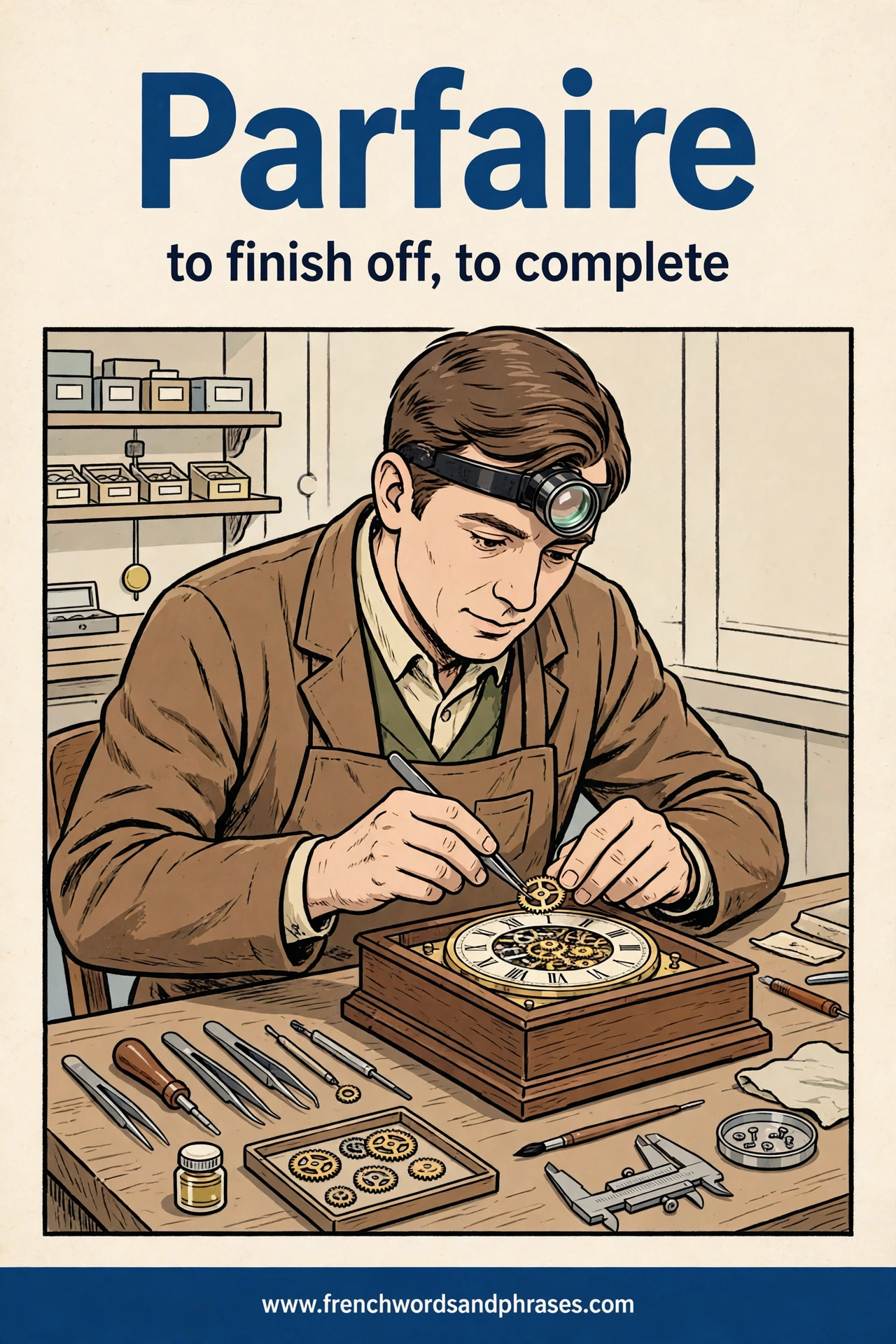
Parfaire means to finish off, to complete — to give a work, a training or a sum of money its last missing piece, exactly as faire does, but pushed to perfection.
A painter stepping back for the final touch, a young lawyer completing her training abroad, an accountant adding the last coins that make the round sum — parfaire is faire with its sleeves rolled up and its standards raised: to complete something so thoroughly that nothing is missing, not one brushstroke, not one centime.
In this guide, you’ll learn how to conjugate parfaire in all the major French tenses and moods. Explore complete conjugation tables, French examples, English translations, and practice quizzes.
Understanding the French Verb Parfaire
Parfaire is an irregular French verb ending in -aire, conjugated exactly like faire.
It means to finish off, to complete. Parfaire has three home territories: education (parfaire sa formation, parfaire son anglais), money (parfaire une somme, to add what is missing to reach the full amount), and craftsmanship (parfaire un ouvrage, to give a work its final polish). It always implies a gap being closed exactly — not improving in general, but supplying the precise thing that was lacking.
Verb classification: Irregular (-aire, like faire)
Auxiliary verb: Avoir
Past participle: parfait
Present participle: parfaisant
English equivalents: To finish off, to complete, to perfect; parfaire son éducation — to complete one’s education; parfaire sa formation — to complete one’s training; parfaire une somme — to make up the full amount; parfaire un ouvrage — to put the finishing touches to a work; parfaire ses connaissances — to round out one’s knowledge.
One important detail: parfaire is faire wearing a prefix, and it copies faire everywhere — je parfais, nous parfaisons, vous parfaites (never parfaisez), ils parfont, subjunctive que je parfasse, past participle parfait. That participle is identical to the adjective parfait, perfect — a happy accident, since parfaire means precisely to make perfect. Mike’s dictionary marks the verb D.: in real life only the present indicative, the infinitive and the past participle are in common use — parfaire sa formation, elle a parfait son éducation. The full paradigm in the tables is correct French, but formal; meet it in books, not at the bakery.
Experience the Word
Parfaire is the last-piece verb — the final coin in the sum, the final term abroad, the final touch of varnish.
Imagine a young violinist in Lyon. Ten years of scales, three competitions, one stubborn gap: her bow arm. She spends a summer in Vienna with an old master, working on that arm alone — elle parfait sa technique, nothing new, everything completed — and comes home, at last, whole.
She had not learned more. She had finished learning — parfait — what she had begun.
How to Conjugate Parfaire: Complete French Conjugation Guide
Let’s explore every major conjugation of parfaire, beginning with the indicative mood.
How to Conjugate Parfaire in the Indicative Mood
The indicative mood is used to express facts, observations, actions, and events.
How to Conjugate Parfaire in the Present Tense (Présent)
Used for actions happening now, habitual actions, and general truths.
| Subject | Conjugation |
|---|---|
| je | parfais |
| tu | parfais |
| il / elle | parfait |
| nous | parfaisons |
| vous | parfaites |
| ils / elles | parfont |
Le peintre parfait les derniers détails de son tableau.
The painter perfects the last details of his painting.
Complete the sentence:
Nous ______ notre formation à Lyon.
Reveal the answer
parfaisons
Nous parfaisons notre formation à Lyon.
We are completing our training in Lyon.
How to Conjugate Parfaire in the Passé Composé
Used for completed actions in the past. Parfaire takes the auxiliary verb avoir.
| Subject | Conjugation |
|---|---|
| j’ | ai parfait |
| tu | as parfait |
| il / elle | a parfait |
| nous | avons parfait |
| vous | avez parfait |
| ils / elles | ont parfait |
Elle a parfait son éducation à Paris.
She completed her education in Paris.
How to Conjugate Parfaire in the Imparfait (Imperfect Tense)
Used for habitual past actions, descriptions, and ongoing situations in the past.
| Subject | Conjugation |
|---|---|
| je | parfaisais |
| tu | parfaisais |
| il / elle | parfaisait |
| nous | parfaisions |
| vous | parfaisiez |
| ils / elles | parfaisaient |
Il parfaisait sa technique chaque matin au piano.
He perfected his technique every morning at the piano.
Choose the correct form:
You (vous) complete the sum.
Vous ______ la somme. (parfaites / parfaisez)
Reveal the answer
parfaites
Vous parfaites la somme.
Like faire: vous faites, so vous parfaites — never parfaisez.
How to Conjugate Parfaire in the Plus-que-parfait
Used to describe an action that had already been completed before another past event.
| Subject | Conjugation |
|---|---|
| j’ | avais parfait |
| tu | avais parfait |
| il / elle | avait parfait |
| nous | avions parfait |
| vous | aviez parfait |
| ils / elles | avaient parfait |
Elle avait parfait le plan avant de le présenter.
She had perfected the plan before presenting it.
How to Conjugate Parfaire in the Passé Simple
Primarily used in formal writing, literature, and historical narratives. It is rarely used in everyday conversation.
| Subject | Conjugation |
|---|---|
| je | parfis |
| tu | parfis |
| il / elle | parfit |
| nous | parfîmes |
| vous | parfîtes |
| ils / elles | parfirent |
Le maître parfit l’œuvre en quelques retouches.
The master finished off the work with a few touches.
How to Conjugate Parfaire in the Passé Antérieur
A literary tense used to express an action completed immediately before another past action, generally in the passé simple.
| Subject | Conjugation |
|---|---|
| j’ | eus parfait |
| tu | eus parfait |
| il / elle | eut parfait |
| nous | eûmes parfait |
| vous | eûtes parfait |
| ils / elles | eurent parfait |
Quand il eut parfait son discours, il se leva.
When he had perfected his speech, he stood up.
How to Conjugate Parfaire in the Future Tense (Futur Simple)
Used to describe actions that will take place in the future.
| Subject | Conjugation |
|---|---|
| je | parferai |
| tu | parferas |
| il / elle | parfera |
| nous | parferons |
| vous | parferez |
| ils / elles | parferont |
Ce voyage parfera votre connaissance de la langue.
This trip will complete your knowledge of the language.
How to Conjugate Parfaire in the Futur Antérieur (Future Perfect)
Used for an action that will have been completed before a particular point in the future.
| Subject | Conjugation |
|---|---|
| j’ | aurai parfait |
| tu | auras parfait |
| il / elle | aura parfait |
| nous | aurons parfait |
| vous | aurez parfait |
| ils / elles | auront parfait |
Quand vous aurez parfait la somme, le compte sera juste.
When you have made up the full amount, the account will balance.
How to Conjugate Parfaire in the Near Future (Futur Proche)
Used to describe something that is going to happen soon. Formed with aller + infinitive.
| Subject | Conjugation |
|---|---|
| je | vais parfaire |
| tu | vas parfaire |
| il / elle | va parfaire |
| nous | allons parfaire |
| vous | allez parfaire |
| ils / elles | vont parfaire |
Elle va parfaire sa formation à Lyon.
She is going to complete her training in Lyon.
How to Conjugate Parfaire in the Conditional Mood
The conditional mood expresses what would happen under certain circumstances. It is also frequently used to make polite requests or express wishes.
How to Conjugate Parfaire in the Present Conditional
| Subject | Conjugation |
|---|---|
| je | parferais |
| tu | parferais |
| il / elle | parferait |
| nous | parferions |
| vous | parferiez |
| ils / elles | parferaient |
Un séjour en France parferait ton français.
A stay in France would perfect your French.
How to Conjugate Parfaire in the Past Conditional
| Subject | Conjugation |
|---|---|
| j’ | aurais parfait |
| tu | aurais parfait |
| il / elle | aurait parfait |
| nous | aurions parfait |
| vous | auriez parfait |
| ils / elles | auraient parfait |
Ce stage aurait parfait sa formation.
This placement would have completed her training.
Parfaire in the Literary Past Conditional Form
This less common literary form uses the imperfect subjunctive of avoir.
| Subject | Conjugation |
|---|---|
| j’ | eusse parfait |
| tu | eusses parfait |
| il / elle | eût parfait |
| nous | eussions parfait |
| vous | eussiez parfait |
| ils / elles | eussent parfait |
Il eût parfait l’ouvrage, si le temps ne lui eût manqué.
He would have completed the work, if time had not failed him.
How to Conjugate Parfaire in the Subjunctive Mood
The subjunctive is used to express wishes, emotions, doubts, necessity, and uncertainty. It frequently follows expressions such as il faut que (it is necessary that) or bien que (although).
How to Conjugate Parfaire in the Present Subjunctive
| Subject | Conjugation |
|---|---|
| que je | parfasse |
| que tu | parfasses |
| qu’il / qu’elle | parfasse |
| que nous | parfassions |
| que vous | parfassiez |
| qu’ils / qu’elles | parfassent |
Il faut que tu parfasses la somme avant vendredi.
You must make up the full amount before Friday.
Complete the sentence using the subjunctive:
Il faut que vous ______ votre formation cette année.
Reveal the answer
parfassiez
Il faut que vous parfassiez votre formation cette année.
You must complete your training this year.
How to Conjugate Parfaire in the Imperfect Subjunctive
A literary tense, rarely encountered in modern spoken French.
| Subject | Conjugation |
|---|---|
| que je | parfisse |
| que tu | parfisses |
| qu’il / qu’elle | parfît |
| que nous | parfissions |
| que vous | parfissiez |
| qu’ils / qu’elles | parfissent |
Je ne croyais pas qu’il parfît son œuvre si vite.
I did not believe he would finish his work so quickly.
How to Conjugate Parfaire in the Pluperfect Subjunctive
A literary construction used to express an action completed before another past action.
| Subject | Conjugation |
|---|---|
| que j’ | eusse parfait |
| que tu | eusses parfait |
| qu’il / qu’elle | eût parfait |
| que nous | eussions parfait |
| que vous | eussiez parfait |
| qu’ils / qu’elles | eussent parfait |
On disait qu’elle eût parfait son éducation en Italie.
People said she had completed her education in Italy.
How to Conjugate Parfaire in the Past Subjunctive
| Subject | Conjugation |
|---|---|
| que j’ | aie parfait |
| que tu | aies parfait |
| qu’il / qu’elle | ait parfait |
| que nous | ayons parfait |
| que vous | ayez parfait |
| qu’ils / qu’elles | aient parfait |
Je suis ravi qu’elle ait parfait sa formation.
I am delighted she has completed her training.
How to Conjugate Parfaire in the Imperative
The imperative is used to give commands, instructions, invitations, or suggestions. Subject pronouns are omitted.
How to Conjugate Parfaire in the Present Imperative
| Person | Conjugation |
|---|---|
| (tu) | parfais |
| (nous) | parfaisons |
| (vous) | parfaites |
Parfais ton travail avant de partir !
Finish off your work before leaving!
How would you say Finish off your work (tu form)?
Reveal the answer
Parfais ton travail !
French Participles of Parfaire
Participles are verb forms that can be used in compound tenses and other grammatical constructions.
Present Participle of Parfaire
parfaisant
En parfaisant son style, elle a trouvé sa voix.
By perfecting her style, she found her voice.
Past Participle of Parfaire
parfait
Parfait par les retouches du maître, le tableau émut la salle.
Perfected by the master’s touches, the painting moved the room.
Parfaire in Everyday French: Real-Life Examples
Now that you know the conjugations, let’s see how parfaire appears in everyday French.
Nous parfaisons notre formation à Lyon.
We are completing our training in Lyon.
Elle a parfait son éducation à Paris.
She completed her education in Paris.
Il parfaisait sa technique chaque matin.
He perfected his technique every morning.
Ce voyage parfera ton français.
This trip will perfect your French.
Un séjour en France parferait ton français.
A stay in France would perfect your French.
Parfais ton travail avant de partir !
Finish off your work before leaving!
Beyond Translation: The Meaning of Parfaire
Parfaire is Latin perficere — to do thoroughly, to carry through to the end — and its past participle parfait broke away centuries ago to live as the adjective meaning perfect.
Every time you say parfait, you are quoting this verb.
The family resemblance is exact: what has been parfait — completed, finished off, made whole — is, by definition, parfait. English perfect as a verb (to perfect one’s technique) is its closest cousin.
How to Remember the French Verb Parfaire
Remember it this way: Parfaire is about faire with a prefix — the last coin that makes the round sum.
- Conjugated exactly like faire: je parfais, nous parfaisons, vous parfaites, ils parfont, que je parfasse.
- Past participle parfait — the same word as the adjective perfect.
- In real life it lives in the present, the infinitive and the participle: parfaire sa formation, elle a parfait son éducation.
The key idea is faire with a prefix — the last coin that makes the round sum.
Test Your Knowledge of Parfaire
Let’s see how much you’ve learned. Try answering these questions before revealing the answers.
Parfaire is conjugated exactly like which verb?
Reveal the answer
Faire — je parfais, nous parfaisons, vous parfaites, ils parfont, que je parfasse.
How do you say She completed her education in Paris in French?
Reveal the answer
Elle a parfait son éducation à Paris.
Translate: A stay in France would perfect your French.
Reveal the answer
Un séjour en France parferait ton français.
What is the past participle of parfaire?
Reveal the answer
Parfait — identical to the adjective parfait, perfect.
Complete the sentence:
Il faut que tu ______ la somme avant vendredi.
Reveal the answer
parfasses
Il faut que tu parfasses la somme avant vendredi.
You must make up the full amount before Friday.
Can You Use It?
How would you say this in French?
She completed her education between Paris and Vienna, and now nothing is missing from her playing.
Reveal the answer
Elle a parfait son éducation entre Paris et Vienne, et il ne manque plus rien à son jeu.
She completed her education between Paris and Vienna, and now nothing is missing from her playing.
LEARN FRENCH ONE WORD AT A TIME