How to Conjugate Paralyser in French
/pa.ʁa.li.ze/
Paralyser means to paralyze, to incapacitate — to strike a body, a city or a will so that it can no longer move or act.
A patient who cannot lift his hand, a capital frozen by a general strike, a climber whose legs stop answering in the cold — paralyser is the verb of movement stolen: whatever stops a body, a system or a country from acting at all.
In this guide, you’ll learn how to conjugate paralyser in all the major French tenses and moods. Explore complete conjugation tables, French examples, English translations, and practice quizzes.
Understanding the French Verb Paralyser
Paralyser is a regular French verb belonging to the first group of verbs, those ending in -er.
It means to paralyze, to incapacitate. It is commonly used in medicine for nerves and limbs that no longer respond, in the news for strikes, snow and breakdowns that freeze a whole network, and figuratively for fear, doubt or bureaucracy that stops a person from acting — the figurative uses are probably the ones a learner will meet most.
Verb classification: First group (-er)
Auxiliary verb: Avoir
Past participle: paralysé
Present participle: paralysant
English equivalents: To paralyze, to incapacitate, to bring to a standstill; paralyser un membre — to paralyze a limb; la peur le paralyse — fear paralyzes him; une grève paralyse les transports — a strike brings transport to a standstill; être paralysé de peur — to be paralyzed with fear.
One important detail: paralyser is a regular -er verb — je paralyse, nous paralysons, ils paralysent — and French uses it far beyond the hospital. A limb is paralysé, but so is a country during a strike (le pays est paralysé par la grève), an administration buried in forms, and a person rooted by fear: la peur le paralyse. The construction is simple: paralyser quelqu’un / quelque chose, and paralysé de or par for the cause.
Experience the Word
Paralyser is the verb of the full stop — not slowness, not weakness, but the complete loss of movement or action.
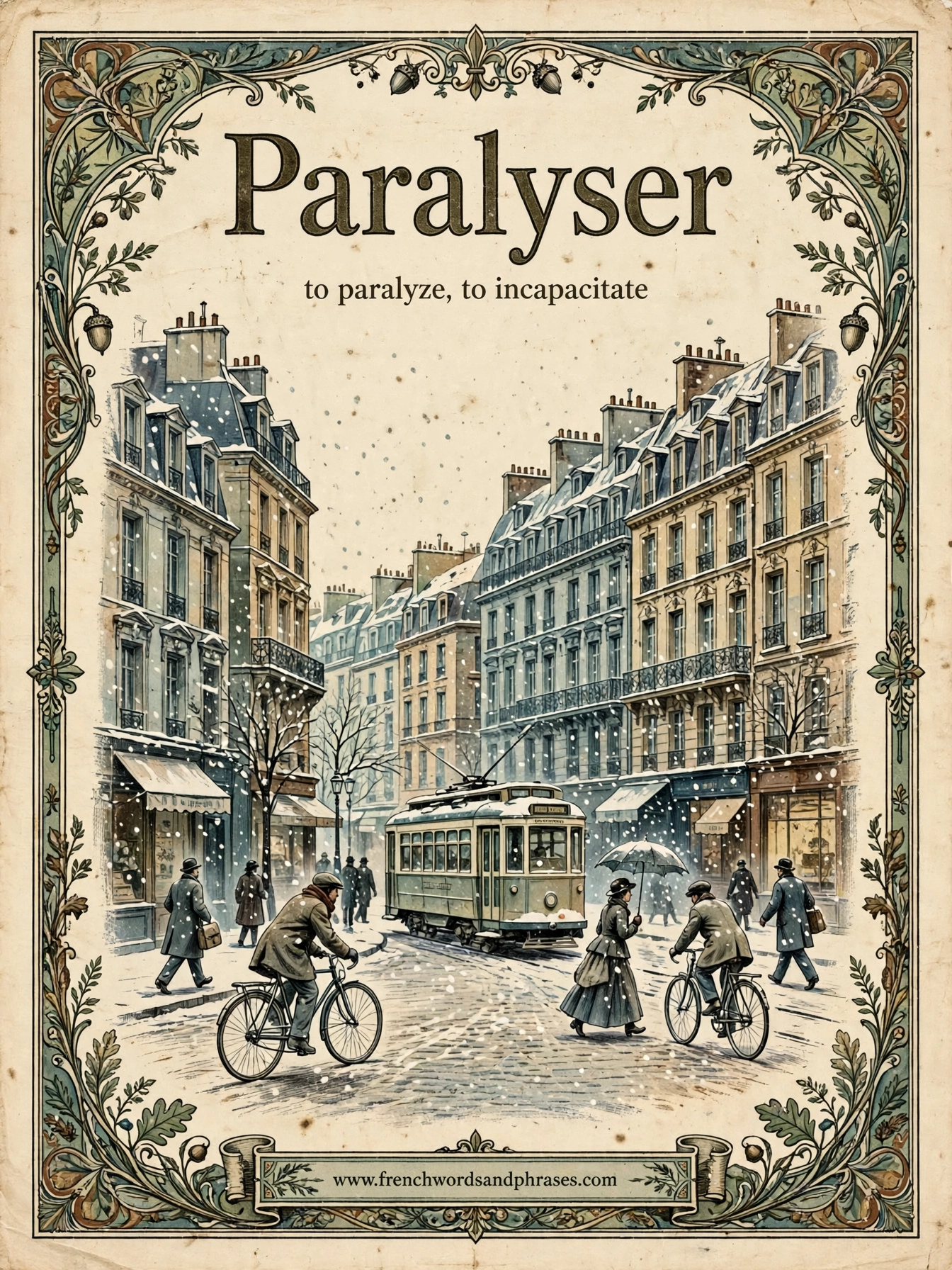
Imagine a December morning in Paris. Snow in the night, a strike at dawn, and by eight o’clock the whole city is still: no buses, no trains, no deliveries. The radio repeats one sentence — les transports sont paralysés — and a million people simply stay home.
The city has not been destroyed or defeated. It has been paralyzed — paralysée — held perfectly still by snow and strike.
How to Conjugate Paralyser: Complete French Conjugation Guide
Let’s explore every major conjugation of paralyser, beginning with the indicative mood.
How to Conjugate Paralyser in the Indicative Mood
The indicative mood is used to express facts, observations, actions, and events.
How to Conjugate Paralyser in the Present Tense (Présent)
Used for actions happening now, habitual actions, and general truths.
| Subject | Conjugation |
|---|---|
| je | paralyse |
| tu | paralyses |
| il / elle | paralyse |
| nous | paralysons |
| vous | paralysez |
| ils / elles | paralysent |
La peur paralyse le jeune orateur.
Fear paralyzes the young speaker.
Complete the sentence:
Nous craignons que la grève ______ le pays.
Reveal the answer
paralyse
Nous craignons que la grève paralyse le pays.
We fear the strike may paralyze the country.
How to Conjugate Paralyser in the Passé Composé
Used for completed actions in the past. Paralyser takes the auxiliary verb avoir.
| Subject | Conjugation |
|---|---|
| j’ | ai paralysé |
| tu | as paralysé |
| il / elle | a paralysé |
| nous | avons paralysé |
| vous | avez paralysé |
| ils / elles | ont paralysé |
La grève a paralysé les transports pendant trois jours.
The strike brought transport to a standstill for three days.
How to Conjugate Paralyser in the Imparfait (Imperfect Tense)
Used for habitual past actions, descriptions, and ongoing situations in the past.
| Subject | Conjugation |
|---|---|
| je | paralysais |
| tu | paralysais |
| il / elle | paralysait |
| nous | paralysions |
| vous | paralysiez |
| ils / elles | paralysaient |
Le froid paralysait ses doigts sur la corde.
The cold was numbing his fingers on the rope.
Choose the correct form:
The snow paralyzed the roads.
La neige ______ les routes. (a paralysé / est paralysé)
Reveal the answer
a paralysé
La neige a paralysé les routes.
Paralyser takes avoir.
How to Conjugate Paralyser in the Plus-que-parfait
Used to describe an action that had already been completed before another past event.
| Subject | Conjugation |
|---|---|
| j’ | avais paralysé |
| tu | avais paralysé |
| il / elle | avait paralysé |
| nous | avions paralysé |
| vous | aviez paralysé |
| ils / elles | avaient paralysé |
La maladie avait paralysé son bras gauche.
The illness had paralyzed his left arm.
How to Conjugate Paralyser in the Passé Simple
Primarily used in formal writing, literature, and historical narratives. It is rarely used in everyday conversation.
| Subject | Conjugation |
|---|---|
| je | paralysai |
| tu | paralysas |
| il / elle | paralysa |
| nous | paralysâmes |
| vous | paralysâtes |
| ils / elles | paralysèrent |
La nouvelle paralysa l’assemblée entière.
The news paralyzed the whole assembly.
How to Conjugate Paralyser in the Passé Antérieur
A literary tense used to express an action completed immediately before another past action, generally in the passé simple.
| Subject | Conjugation |
|---|---|
| j’ | eus paralysé |
| tu | eus paralysé |
| il / elle | eut paralysé |
| nous | eûmes paralysé |
| vous | eûtes paralysé |
| ils / elles | eurent paralysé |
Quand la neige eut paralysé les routes, le village s’endormit.
When the snow had paralyzed the roads, the village fell asleep.
How to Conjugate Paralyser in the Future Tense (Futur Simple)
Used to describe actions that will take place in the future.
| Subject | Conjugation |
|---|---|
| je | paralyserai |
| tu | paralyseras |
| il / elle | paralysera |
| nous | paralyserons |
| vous | paralyserez |
| ils / elles | paralyseront |
Cette panne paralysera tout le réseau demain.
This breakdown will paralyze the whole network tomorrow.
How to Conjugate Paralyser in the Futur Antérieur (Future Perfect)
Used for an action that will have been completed before a particular point in the future.
| Subject | Conjugation |
|---|---|
| j’ | aurai paralysé |
| tu | auras paralysé |
| il / elle | aura paralysé |
| nous | aurons paralysé |
| vous | aurez paralysé |
| ils / elles | auront paralysé |
À midi, la manifestation aura paralysé le centre-ville.
By noon, the demonstration will have brought the city centre to a standstill.
How to Conjugate Paralyser in the Near Future (Futur Proche)
Used to describe something that is going to happen soon. Formed with aller + infinitive.
| Subject | Conjugation |
|---|---|
| je | vais paralyser |
| tu | vas paralyser |
| il / elle | va paralyser |
| nous | allons paralyser |
| vous | allez paralyser |
| ils / elles | vont paralyser |
Attention, ce verglas va paralyser la circulation.
Careful, this black ice is going to paralyze traffic.
How to Conjugate Paralyser in the Conditional Mood
The conditional mood expresses what would happen under certain circumstances. It is also frequently used to make polite requests or express wishes.
How to Conjugate Paralyser in the Present Conditional
| Subject | Conjugation |
|---|---|
| je | paralyserais |
| tu | paralyserais |
| il / elle | paralyserait |
| nous | paralyserions |
| vous | paralyseriez |
| ils / elles | paralyseraient |
Une grève générale paralyserait le pays entier.
A general strike would paralyze the whole country.
How to Conjugate Paralyser in the Past Conditional
| Subject | Conjugation |
|---|---|
| j’ | aurais paralysé |
| tu | aurais paralysé |
| il / elle | aurait paralysé |
| nous | aurions paralysé |
| vous | auriez paralysé |
| ils / elles | auraient paralysé |
Le doute l’aurait paralysé s’il avait hésité une seconde de plus.
Doubt would have paralyzed him if he had hesitated one second longer.
Paralyser in the Literary Past Conditional Form
This less common literary form uses the imperfect subjunctive of avoir.
| Subject | Conjugation |
|---|---|
| j’ | eusse paralysé |
| tu | eusses paralysé |
| il / elle | eût paralysé |
| nous | eussions paralysé |
| vous | eussiez paralysé |
| ils / elles | eussent paralysé |
La terreur eût paralysé la ville sans le courage du maire.
Terror would have paralyzed the town without the mayor’s courage.
How to Conjugate Paralyser in the Subjunctive Mood
The subjunctive is used to express wishes, emotions, doubts, necessity, and uncertainty. It frequently follows expressions such as il faut que (it is necessary that) or bien que (although).
How to Conjugate Paralyser in the Present Subjunctive
| Subject | Conjugation |
|---|---|
| que je | paralyse |
| que tu | paralyses |
| qu’il / qu’elle | paralyse |
| que nous | paralysions |
| que vous | paralysiez |
| qu’ils / qu’elles | paralysent |
Je crains que la peur ne te paralyse sur scène.
I fear that fear may paralyze you on stage.
Complete the sentence using the subjunctive:
Il faut que rien ne ______ les secours.
Reveal the answer
paralyse
Il faut que rien ne paralyse les secours.
Nothing must paralyze the rescue services.
How to Conjugate Paralyser in the Imperfect Subjunctive
A literary tense, rarely encountered in modern spoken French.
| Subject | Conjugation |
|---|---|
| que je | paralysasse |
| que tu | paralysasses |
| qu’il / qu’elle | paralysât |
| que nous | paralysassions |
| que vous | paralysassiez |
| qu’ils / qu’elles | paralysassent |
On redoutait que la grève paralysât les hôpitaux.
People feared the strike might paralyze the hospitals.
How to Conjugate Paralyser in the Pluperfect Subjunctive
A literary construction used to express an action completed before another past action.
| Subject | Conjugation |
|---|---|
| que j’ | eusse paralysé |
| que tu | eusses paralysé |
| qu’il / qu’elle | eût paralysé |
| que nous | eussions paralysé |
| que vous | eussiez paralysé |
| qu’ils / qu’elles | eussent paralysé |
On racontait que la maladie eût paralysé le vieux roi.
People said the illness had paralyzed the old king.
How to Conjugate Paralyser in the Past Subjunctive
| Subject | Conjugation |
|---|---|
| que j’ | aie paralysé |
| que tu | aies paralysé |
| qu’il / qu’elle | ait paralysé |
| que nous | ayons paralysé |
| que vous | ayez paralysé |
| qu’ils / qu’elles | aient paralysé |
Je suis désolé que l’accident l’ait paralysé.
I am sorry the accident paralyzed him.
How to Conjugate Paralyser in the Imperative
The imperative is used to give commands, instructions, invitations, or suggestions. Subject pronouns are omitted.
How to Conjugate Paralyser in the Present Imperative
| Person | Conjugation |
|---|---|
| (tu) | paralyse |
| (nous) | paralysons |
| (vous) | paralysez |
Ne laisse pas la peur te paralyser, avance !
Do not let fear paralyze you, move forward!
How would you say Do not let fear paralyze you (tu form)?
Reveal the answer
Ne laisse pas la peur te paralyser !
French Participles of Paralyser
Participles are verb forms that can be used in compound tenses and other grammatical constructions.
Present Participle of Paralyser
paralysant
En paralysant les routes, la neige a isolé les villages.
By paralyzing the roads, the snow cut off the villages.
Past Participle of Paralyser
paralysé
Paralysé par la peur, il resta sans voix.
Paralyzed with fear, he remained speechless.
Paralyser in Everyday French: Real-Life Examples
Now that you know the conjugations, let’s see how paralyser appears in everyday French.
La peur le paralyse.
Fear paralyzes him.
La grève a paralysé les transports.
The strike brought transport to a standstill.
Le froid paralysait ses doigts.
The cold was numbing his fingers.
La neige paralysera les routes.
The snow will paralyze the roads.
Une grève générale paralyserait le pays.
A general strike would paralyze the country.
Ne te laisse pas paralyser par la peur !
Do not let yourself be paralyzed by fear!
Beyond Translation: The Meaning of Paralyser
English paralyze and French paralyser are the same Greek traveller — paralyein, to loosen at the side, to unstring.
French lets it stop far more than bodies.
A strike, a snowfall, a rumour, a form in triplicate — tout peut paralyser in French, and the news uses the verb so often for frozen cities that the medical sense almost comes second.
How to Remember the French Verb Paralyser
Remember it this way: Paralyser is about the frozen city — no buses, no trains, everything perfectly still.
- Three stages of the same picture: a limb that will not move, a city frozen by a strike, a person rooted by fear.
- The cause follows with de or par: paralysé de peur, paralysé par la grève.
- Regular -er: je paralyse, nous paralysons, past participle paralysé.
The key idea is the frozen city — no buses, no trains, everything perfectly still.
Test Your Knowledge of Paralyser
Let’s see how much you’ve learned. Try answering these questions before revealing the answers.
Name two things besides a body that paralyser can stop.
Reveal the answer
A city’s transport (la grève paralyse les transports) and a person’s will (la peur le paralyse).
How do you say Fear paralyzes him in French?
Reveal the answer
La peur le paralyse.
Translate: The strike brought transport to a standstill.
Reveal the answer
La grève a paralysé les transports.
What is the past participle of paralyser?
Reveal the answer
Paralysé.
Complete the sentence:
Je crains que la peur ne te ______ sur scène.
Reveal the answer
paralyse
Je crains que la peur ne te paralyse sur scène.
I fear that fear may paralyze you on stage.
Can You Use It?
How would you say this in French?
Fear sometimes paralyzes more surely than chains do.
Reveal the answer
La peur paralyse parfois plus sûrement que les chaînes.
Fear sometimes paralyzes more surely than chains do.
LEARN FRENCH ONE WORD AT A TIME