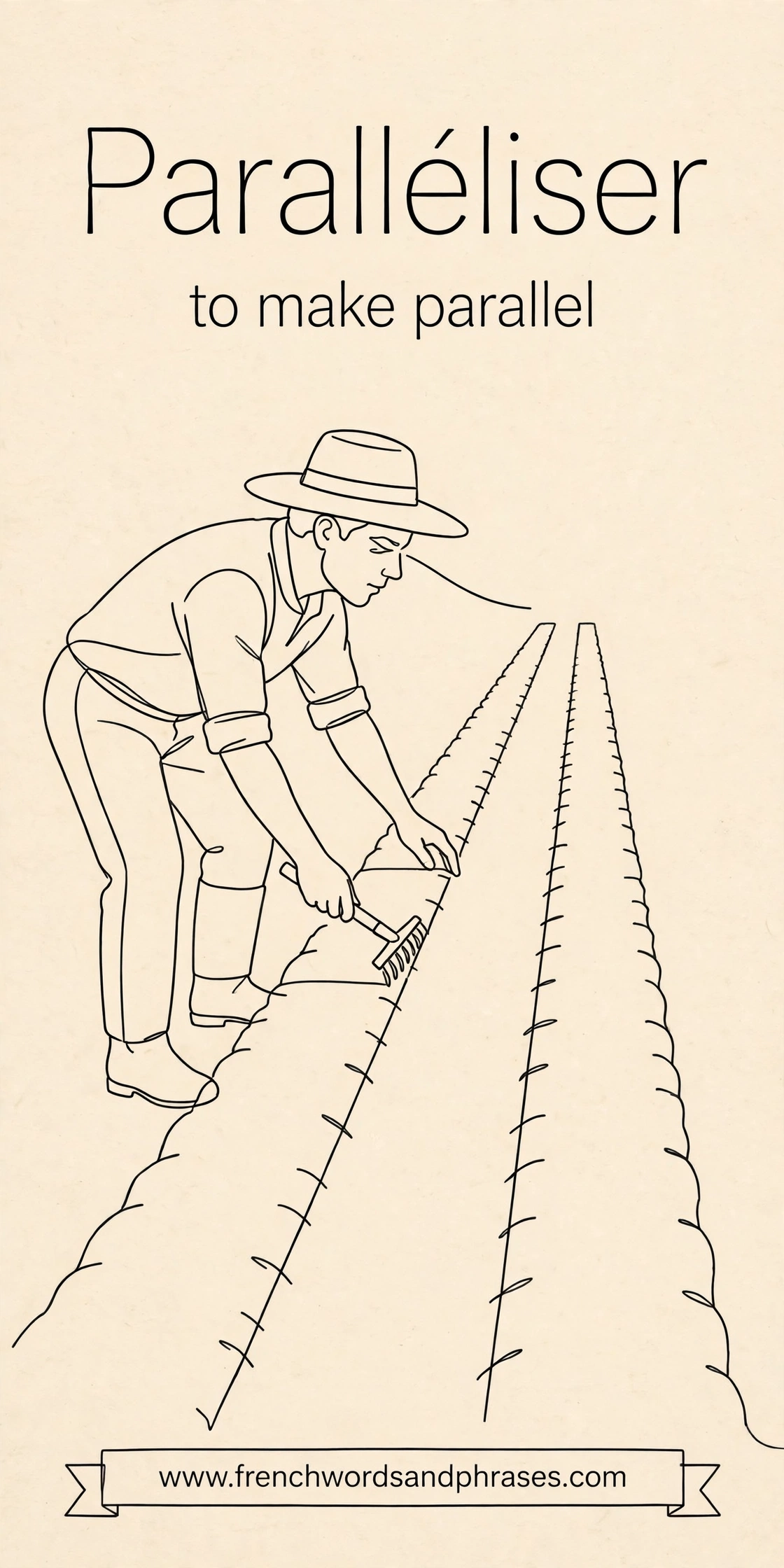
How to Conjugate Paralléliser in French
/pa.ʁa.le.li.ze/
Paralléliser means to make parallel — to set things side by side so that they run in the same direction, or at the same time.
Two railway lines running to the horizon, two roads that must never meet, two computer processors sharing one task — paralléliser is the verb of alignment: putting things side by side so they advance together without colliding.
In this guide, you’ll learn how to conjugate paralléliser in all the major French tenses and moods. Explore complete conjugation tables, French examples, English translations, and practice quizzes.
Understanding the French Verb Paralléliser
Paralléliser is a regular French verb belonging to the first group of verbs, those ending in -er.
It means to make parallel. It is a technical verb — geometry, engineering, electricity and, above all today, computing. In essays you will also meet the looser figurative sense of drawing a parallel between two situations, though mettre en parallèle is the more common phrase for comparing.
Verb classification: First group (-er)
Auxiliary verb: Avoir
Past participle: parallélisé
Present participle: parallélisant
English equivalents: To make parallel, to parallelize; paralléliser deux routes — to run two roads parallel; paralléliser un calcul — to parallelize a computation; mettre en parallèle — to place side by side, to compare; des lignes parallèles — parallel lines.
One important detail: paralléliser carries its geometry in its spelling — double l twice, then é: parallèle, paralléliser, je parallélise, nous parallélisons. The verb is regular, but its world has doubled: surveyors and engineers use it for roads, rails and circuits that must run side by side, and programmers now use it constantly for work split between processors — paralléliser un traitement, to make a program run tasks in parallel instead of one after another.
Experience the Word
Paralléliser is the verb of side-by-side order — things that advance together, in the same direction, never crossing.
Imagine a young engineer with a slow program. One processor does everything, step by step, while the others sit idle. She rewrites the code, parallélise les calculs, and suddenly four processors share the work — the same road, widened into four lanes running side by side.
Nothing about the journey has changed. It has been parallelized — parallélisé — and it arrives four times faster.
How to Conjugate Paralléliser: Complete French Conjugation Guide
Let’s explore every major conjugation of paralléliser, beginning with the indicative mood.
How to Conjugate Paralléliser in the Indicative Mood
The indicative mood is used to express facts, observations, actions, and events.
How to Conjugate Paralléliser in the Present Tense (Présent)
Used for actions happening now, habitual actions, and general truths.
| Subject | Conjugation |
|---|---|
| je | parallélise |
| tu | parallélises |
| il / elle | parallélise |
| nous | parallélisons |
| vous | parallélisez |
| ils / elles | parallélisent |
L’ingénieur parallélise les calculs pour gagner du temps.
The engineer parallelizes the computations to save time.
Complete the sentence:
Nous ______ les calculs sur quatre processeurs.
Reveal the answer
parallélisons
Nous parallélisons les calculs sur quatre processeurs.
We parallelize the computations across four processors.
How to Conjugate Paralléliser in the Passé Composé
Used for completed actions in the past. Paralléliser takes the auxiliary verb avoir.
| Subject | Conjugation |
|---|---|
| j’ | ai parallélisé |
| tu | as parallélisé |
| il / elle | a parallélisé |
| nous | avons parallélisé |
| vous | avez parallélisé |
| ils / elles | ont parallélisé |
Ils ont parallélisé les deux voies ferrées.
They laid the two railway tracks parallel to each other.
How to Conjugate Paralléliser in the Imparfait (Imperfect Tense)
Used for habitual past actions, descriptions, and ongoing situations in the past.
| Subject | Conjugation |
|---|---|
| je | parallélisais |
| tu | parallélisais |
| il / elle | parallélisait |
| nous | parallélisions |
| vous | parallélisiez |
| ils / elles | parallélisaient |
Le programme parallélisait mal les tâches longues.
The program parallelized the long tasks badly.
Choose the correct form:
She parallelized the program.
Elle ______ le programme. (a parallélisé / est parallélisé)
Reveal the answer
a parallélisé
Elle a parallélisé le programme.
Paralléliser takes avoir.
How to Conjugate Paralléliser in the Plus-que-parfait
Used to describe an action that had already been completed before another past event.
| Subject | Conjugation |
|---|---|
| j’ | avais parallélisé |
| tu | avais parallélisé |
| il / elle | avait parallélisé |
| nous | avions parallélisé |
| vous | aviez parallélisé |
| ils / elles | avaient parallélisé |
Elle avait parallélisé le traitement avant la mise en ligne.
She had parallelized the processing before the launch.
How to Conjugate Paralléliser in the Passé Simple
Primarily used in formal writing, literature, and historical narratives. It is rarely used in everyday conversation.
| Subject | Conjugation |
|---|---|
| je | parallélisai |
| tu | parallélisas |
| il / elle | parallélisa |
| nous | parallélisâmes |
| vous | parallélisâtes |
| ils / elles | parallélisèrent |
L’architecte parallélisa les deux allées du jardin.
The architect laid the two garden paths parallel to each other.
How to Conjugate Paralléliser in the Passé Antérieur
A literary tense used to express an action completed immediately before another past action, generally in the passé simple.
| Subject | Conjugation |
|---|---|
| j’ | eus parallélisé |
| tu | eus parallélisé |
| il / elle | eut parallélisé |
| nous | eûmes parallélisé |
| vous | eûtes parallélisé |
| ils / elles | eurent parallélisé |
Quand il eut parallélisé les circuits, le courant doubla.
When he had wired the circuits in parallel, the current doubled.
How to Conjugate Paralléliser in the Future Tense (Futur Simple)
Used to describe actions that will take place in the future.
| Subject | Conjugation |
|---|---|
| je | paralléliserai |
| tu | paralléliseras |
| il / elle | parallélisera |
| nous | paralléliserons |
| vous | paralléliserez |
| ils / elles | paralléliseront |
La prochaine version parallélisera toutes les recherches.
The next version will parallelize all the searches.
How to Conjugate Paralléliser in the Futur Antérieur (Future Perfect)
Used for an action that will have been completed before a particular point in the future.
| Subject | Conjugation |
|---|---|
| j’ | aurai parallélisé |
| tu | auras parallélisé |
| il / elle | aura parallélisé |
| nous | aurons parallélisé |
| vous | aurez parallélisé |
| ils / elles | auront parallélisé |
À la fin du mois, ils auront parallélisé le système entier.
By the end of the month, they will have parallelized the whole system.
How to Conjugate Paralléliser in the Near Future (Futur Proche)
Used to describe something that is going to happen soon. Formed with aller + infinitive.
| Subject | Conjugation |
|---|---|
| je | vais paralléliser |
| tu | vas paralléliser |
| il / elle | va paralléliser |
| nous | allons paralléliser |
| vous | allez paralléliser |
| ils / elles | vont paralléliser |
Je vais paralléliser ce programme ce soir.
I am going to parallelize this program tonight.
How to Conjugate Paralléliser in the Conditional Mood
The conditional mood expresses what would happen under certain circumstances. It is also frequently used to make polite requests or express wishes.
How to Conjugate Paralléliser in the Present Conditional
| Subject | Conjugation |
|---|---|
| je | paralléliserais |
| tu | paralléliserais |
| il / elle | paralléliserait |
| nous | paralléliserions |
| vous | paralléliseriez |
| ils / elles | paralléliseraient |
Avec plus de processeurs, on paralléliserait davantage.
With more processors, we would parallelize more.
How to Conjugate Paralléliser in the Past Conditional
| Subject | Conjugation |
|---|---|
| j’ | aurais parallélisé |
| tu | aurais parallélisé |
| il / elle | aurait parallélisé |
| nous | aurions parallélisé |
| vous | auriez parallélisé |
| ils / elles | auraient parallélisé |
Elle aurait parallélisé le calcul si le délai l’avait permis.
She would have parallelized the computation if the deadline had allowed it.
Paralléliser in the Literary Past Conditional Form
This less common literary form uses the imperfect subjunctive of avoir.
| Subject | Conjugation |
|---|---|
| j’ | eusse parallélisé |
| tu | eusses parallélisé |
| il / elle | eût parallélisé |
| nous | eussions parallélisé |
| vous | eussiez parallélisé |
| ils / elles | eussent parallélisé |
Le géomètre eût parallélisé les deux routes sur toute la plaine.
The surveyor would have run the two roads parallel across the whole plain.
How to Conjugate Paralléliser in the Subjunctive Mood
The subjunctive is used to express wishes, emotions, doubts, necessity, and uncertainty. It frequently follows expressions such as il faut que (it is necessary that) or bien que (although).
How to Conjugate Paralléliser in the Present Subjunctive
| Subject | Conjugation |
|---|---|
| que je | parallélise |
| que tu | parallélises |
| qu’il / qu’elle | parallélise |
| que nous | parallélisions |
| que vous | parallélisiez |
| qu’ils / qu’elles | parallélisent |
Il faut que le logiciel parallélise les tâches lourdes.
The software must parallelize the heavy tasks.
Complete the sentence using the subjunctive:
Il faut que vous ______ les deux circuits.
Reveal the answer
parallélisiez
Il faut que vous parallélisiez les deux circuits.
You must wire the two circuits in parallel.
How to Conjugate Paralléliser in the Imperfect Subjunctive
A literary tense, rarely encountered in modern spoken French.
| Subject | Conjugation |
|---|---|
| que je | parallélisasse |
| que tu | parallélisasses |
| qu’il / qu’elle | parallélisât |
| que nous | parallélisassions |
| que vous | parallélisassiez |
| qu’ils / qu’elles | parallélisassent |
On doutait qu’il parallélisât correctement les données.
People doubted he would parallelize the data correctly.
How to Conjugate Paralléliser in the Pluperfect Subjunctive
A literary construction used to express an action completed before another past action.
| Subject | Conjugation |
|---|---|
| que j’ | eusse parallélisé |
| que tu | eusses parallélisé |
| qu’il / qu’elle | eût parallélisé |
| que nous | eussions parallélisé |
| que vous | eussiez parallélisé |
| qu’ils / qu’elles | eussent parallélisé |
On admirait qu’ils eussent parallélisé tout le réseau.
People admired that they had parallelized the whole network.
How to Conjugate Paralléliser in the Past Subjunctive
| Subject | Conjugation |
|---|---|
| que j’ | aie parallélisé |
| que tu | aies parallélisé |
| qu’il / qu’elle | ait parallélisé |
| que nous | ayons parallélisé |
| que vous | ayez parallélisé |
| qu’ils / qu’elles | aient parallélisé |
Je suis content qu’elle ait parallélisé le programme.
I am glad she parallelized the program.
How to Conjugate Paralléliser in the Imperative
The imperative is used to give commands, instructions, invitations, or suggestions. Subject pronouns are omitted.
How to Conjugate Paralléliser in the Present Imperative
| Person | Conjugation |
|---|---|
| (tu) | parallélise |
| (nous) | parallélisons |
| (vous) | parallélisez |
Parallélisez les deux circuits avant de brancher !
Wire the two circuits in parallel before switching on!
How would you say Parallelize this computation (tu form)?
Reveal the answer
Parallélise ce calcul !
French Participles of Paralléliser
Participles are verb forms that can be used in compound tenses and other grammatical constructions.
Present Participle of Paralléliser
parallélisant
En parallélisant les calculs, on divise le temps par quatre.
By parallelizing the computations, you divide the time by four.
Past Participle of Paralléliser
parallélisé
Parallélisées avec soin, les voies ne se croisent jamais.
Carefully laid parallel, the tracks never cross.
Paralléliser in Everyday French: Real-Life Examples
Now that you know the conjugations, let’s see how paralléliser appears in everyday French.
L’ingénieur parallélise les calculs.
The engineer parallelizes the computations.
Ils ont parallélisé les deux voies.
They laid the two tracks parallel.
Le programme parallélisait mal les tâches.
The program parallelized the tasks badly.
La nouvelle version parallélisera les recherches.
The new version will parallelize the searches.
On paralléliserait davantage avec plus de processeurs.
We would parallelize more with more processors.
Parallélise ce calcul !
Parallelize this computation!
Beyond Translation: The Meaning of Paralléliser
The word descends from Greek parallēlos — ‘beside one another’ — and geometry gave it to the engineers, who gave it to the electricians, who gave it to the programmers.
Each age finds new things to run side by side.
Roads, rails, wires, and now streams of data: paralléliser is the story of a Greek picture of two lines becoming the everyday verb of the computer age.
How to Remember the French Verb Paralléliser
Remember it this way: Paralléliser is about railway lines to the horizon — and processors sharing one task.
- Double l twice, then é: parall-él-iser — spell it like the parallel lines it describes.
- Two homes: the surveyor’s field (roads and rails side by side) and the programmer’s screen (tasks at the same time).
- Regular -er: je parallélise, nous parallélisons, past participle parallélisé.
The key idea is railway lines to the horizon — and processors sharing one task.
Test Your Knowledge of Paralléliser
Let’s see how much you’ve learned. Try answering these questions before revealing the answers.
In computing, what does paralléliser un calcul mean?
Reveal the answer
To split the computation so that several processors work on it at the same time, in parallel.
How do you say The engineer parallelizes the computations in French?
Reveal the answer
L’ingénieur parallélise les calculs.
Translate: They laid the two railway tracks parallel.
Reveal the answer
Ils ont parallélisé les deux voies ferrées.
What is the past participle of paralléliser?
Reveal the answer
Parallélisé.
Complete the sentence:
Il faut que le logiciel ______ les tâches lourdes.
Reveal the answer
parallélise
Il faut que le logiciel parallélise les tâches lourdes.
The software must parallelize the heavy tasks.
Can You Use It?
How would you say this in French?
Running roads parallel is useless if nobody knows where they lead.
Reveal the answer
Paralléliser les routes ne sert à rien si personne ne sait où elles mènent.
Running roads parallel is useless if nobody knows where they lead.
LEARN FRENCH ONE WORD AT A TIME