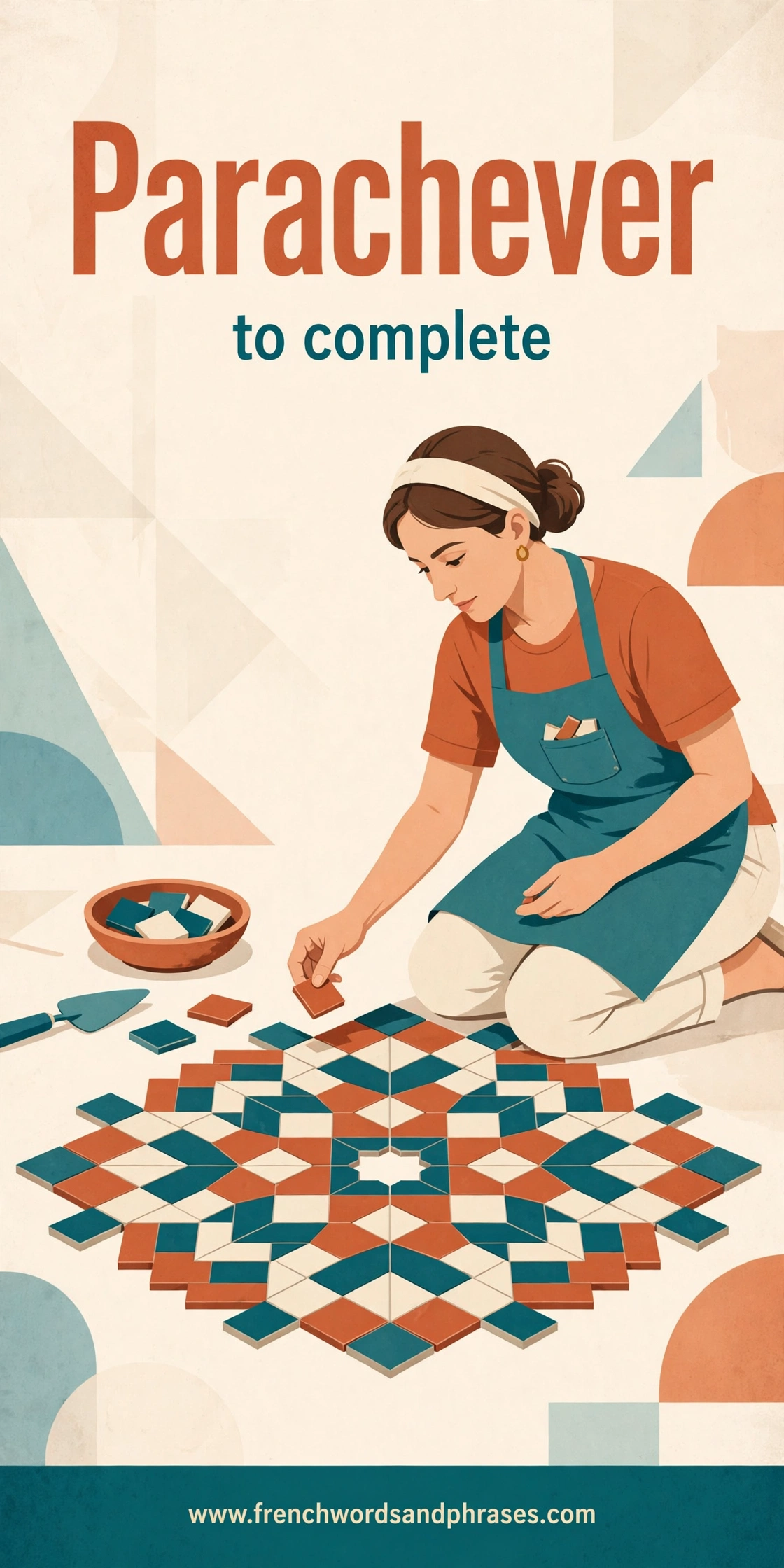
How to Conjugate Parachever in French
/pa.ʁa.ʃ(ə).ve/
Parachever means to complete — to finish a work entirely, down to its last detail, and leave nothing undone.
A cathedral receiving its final statue, a novelist writing the last page after ten years, a restorer touching the last corner of a fresco — parachever is the solemn verb of finishing completely: achever, with the thoroughness turned all the way up.
In this guide, you’ll learn how to conjugate parachever in all the major French tenses and moods. Explore complete conjugation tables, French examples, English translations, and practice quizzes.
Understanding the French Verb Parachever
Parachever is a regular French verb belonging to the first group of verbs, those ending in -er.
It means to complete. It is the formal, written cousin of achever and terminer: administrations parachevent reforms, builders parachevent constructions, and its noun le parachèvement appears in official French for the final completion of works. Where terminer simply ends something, parachever ends it completely, with nothing left over.
Verb classification: First group (-er)
Auxiliary verb: Avoir
Past participle: parachevé
Present participle: parachevant
English equivalents: To complete, to finish off entirely; parachever un ouvrage — to complete a work; parachever la construction — to finish the building completely; parachever sa formation — to complete one’s training; le parachèvement — completion, finishing.
One important detail: parachever is an acheter-type verb — the e of the stem opens to è wherever the next syllable is mute: je parachève, tu parachèves, il parachève, ils parachèvent, and all through the future and conditional: je parachèverai, je parachèverais. The plain e survives where the ending is sounded: nous parachevons, vous parachevez, je parachevais, en parachevant, and in the infinitive and participle, parachever, parachevé. The subjunctive splits along the same line: que je parachève, but que nous parachevions. The word itself is par- (thoroughly, all the way) plus achever (to finish): to finish through and through.
Experience the Word
Parachever is the verb of the very last touch — not stopping, not ending, but finishing so thoroughly that nothing remains to be done.
Imagine the restoration of a great fresco, ten years in. Scaffolding has come and gone; colours have returned square by square. One morning the restorer climbs up with a single small brush, retouches the last shadow in the last corner — et parachève l’œuvre — and the scaffold comes down for good.
The work is not merely stopped. It is completed — parachevée, finished in every corner, signed by its wholeness.
How to Conjugate Parachever: Complete French Conjugation Guide
Let’s explore every major conjugation of parachever, beginning with the indicative mood.
How to Conjugate Parachever in the Indicative Mood
The indicative mood is used to express facts, observations, actions, and events.
How to Conjugate Parachever in the Present Tense (Présent)
Used for actions happening now, habitual actions, and general truths.
| Subject | Conjugation |
|---|---|
| je | parachève |
| tu | parachèves |
| il / elle | parachève |
| nous | parachevons |
| vous | parachevez |
| ils / elles | parachèvent |
Il parachève son roman après trois ans de travail.
He is completing his novel after three years of work.
Complete the sentence:
Nous ______ le projet ce mois-ci.
Reveal the answer
parachevons
Nous parachevons le projet ce mois-ci.
We are completing the project this month — nous keeps the plain e.
How to Conjugate Parachever in the Passé Composé
Used for completed actions in the past. Parachever takes the auxiliary verb avoir.
| Subject | Conjugation |
|---|---|
| j’ | ai parachevé |
| tu | as parachevé |
| il / elle | a parachevé |
| nous | avons parachevé |
| vous | avez parachevé |
| ils / elles | ont parachevé |
Ils ont parachevé les travaux en décembre.
They completed the works in December.
How to Conjugate Parachever in the Imparfait (Imperfect Tense)
Used for habitual past actions, descriptions, and ongoing situations in the past.
| Subject | Conjugation |
|---|---|
| je | parachevais |
| tu | parachevais |
| il / elle | parachevait |
| nous | parachevions |
| vous | paracheviez |
| ils / elles | parachevaient |
Elle parachevait lentement sa thèse, page après page.
She was slowly completing her thesis, page after page.
Choose the correct form:
She will complete the restoration.
Elle ______ la restauration. (parachèvera / parachevera)
Reveal the answer
parachèvera
Elle parachèvera la restauration.
The whole future stem takes è, like acheter: je parachèverai.
How to Conjugate Parachever in the Plus-que-parfait
Used to describe an action that had already been completed before another past event.
| Subject | Conjugation |
|---|---|
| j’ | avais parachevé |
| tu | avais parachevé |
| il / elle | avait parachevé |
| nous | avions parachevé |
| vous | aviez parachevé |
| ils / elles | avaient parachevé |
L’architecte avait parachevé les plans avant sa mort.
The architect had completed the plans before his death.
How to Conjugate Parachever in the Passé Simple
Primarily used in formal writing, literature, and historical narratives. It is rarely used in everyday conversation.
| Subject | Conjugation |
|---|---|
| je | parachevai |
| tu | parachevas |
| il / elle | paracheva |
| nous | parachevâmes |
| vous | parachevâtes |
| ils / elles | parachevèrent |
Elle paracheva l’ouvrage en une seule nuit.
She completed the work in a single night.
How to Conjugate Parachever in the Passé Antérieur
A literary tense used to express an action completed immediately before another past action, generally in the passé simple.
| Subject | Conjugation |
|---|---|
| j’ | eus parachevé |
| tu | eus parachevé |
| il / elle | eut parachevé |
| nous | eûmes parachevé |
| vous | eûtes parachevé |
| ils / elles | eurent parachevé |
Quand il eut parachevé le bâtiment, la ville organisa une fête.
When he had completed the building, the town held a celebration.
How to Conjugate Parachever in the Future Tense (Futur Simple)
Used to describe actions that will take place in the future.
| Subject | Conjugation |
|---|---|
| je | parachèverai |
| tu | parachèveras |
| il / elle | parachèvera |
| nous | parachèverons |
| vous | parachèverez |
| ils / elles | parachèveront |
Elle parachèvera la restauration ce printemps.
She will complete the restoration this spring.
How to Conjugate Parachever in the Futur Antérieur (Future Perfect)
Used for an action that will have been completed before a particular point in the future.
| Subject | Conjugation |
|---|---|
| j’ | aurai parachevé |
| tu | auras parachevé |
| il / elle | aura parachevé |
| nous | aurons parachevé |
| vous | aurez parachevé |
| ils / elles | auront parachevé |
À la fin de l’année, nous aurons parachevé la réforme.
By the end of the year, we will have completed the reform.
How to Conjugate Parachever in the Near Future (Futur Proche)
Used to describe something that is going to happen soon. Formed with aller + infinitive.
| Subject | Conjugation |
|---|---|
| je | vais parachever |
| tu | vas parachever |
| il / elle | va parachever |
| nous | allons parachever |
| vous | allez parachever |
| ils / elles | vont parachever |
Je vais parachever ce rapport avant de partir.
I am going to complete this report before leaving.
How to Conjugate Parachever in the Conditional Mood
The conditional mood expresses what would happen under certain circumstances. It is also frequently used to make polite requests or express wishes.
How to Conjugate Parachever in the Present Conditional
| Subject | Conjugation |
|---|---|
| je | parachèverais |
| tu | parachèverais |
| il / elle | parachèverait |
| nous | parachèverions |
| vous | parachèveriez |
| ils / elles | parachèveraient |
Nous parachèverions le projet avec un mois de plus.
We would complete the project with one more month.
How to Conjugate Parachever in the Past Conditional
| Subject | Conjugation |
|---|---|
| j’ | aurais parachevé |
| tu | aurais parachevé |
| il / elle | aurait parachevé |
| nous | aurions parachevé |
| vous | auriez parachevé |
| ils / elles | auraient parachevé |
Tu aurais parachevé ton mémoire si tu avais eu plus de temps.
You would have completed your dissertation if you had had more time.
Parachever in the Literary Past Conditional Form
This less common literary form uses the imperfect subjunctive of avoir.
| Subject | Conjugation |
|---|---|
| j’ | eusse parachevé |
| tu | eusses parachevé |
| il / elle | eût parachevé |
| nous | eussions parachevé |
| vous | eussiez parachevé |
| ils / elles | eussent parachevé |
Il eût parachevé son œuvre sans la maladie.
He would have completed his work if not for illness.
How to Conjugate Parachever in the Subjunctive Mood
The subjunctive is used to express wishes, emotions, doubts, necessity, and uncertainty. It frequently follows expressions such as il faut que (it is necessary that) or bien que (although).
How to Conjugate Parachever in the Present Subjunctive
| Subject | Conjugation |
|---|---|
| que je | parachève |
| que tu | parachèves |
| qu’il / qu’elle | parachève |
| que nous | parachevions |
| que vous | paracheviez |
| qu’ils / qu’elles | parachèvent |
Il faut que tu parachèves ce chapitre ce soir.
You must complete this chapter this evening.
Complete the sentence using the subjunctive:
Il faut que nous ______ le projet avant juin.
Reveal the answer
parachevions
Il faut que nous parachevions le projet avant juin.
We must complete the project before June — the nous subjunctive keeps the plain e.
How to Conjugate Parachever in the Imperfect Subjunctive
A literary tense, rarely encountered in modern spoken French.
| Subject | Conjugation |
|---|---|
| que je | parachevasse |
| que tu | parachevasses |
| qu’il / qu’elle | parachevât |
| que nous | parachevassions |
| que vous | parachevassiez |
| qu’ils / qu’elles | parachevassent |
Il voulait qu’elle parachevât seule la dernière partie.
He wanted her to complete the last part on her own.
How to Conjugate Parachever in the Pluperfect Subjunctive
A literary construction used to express an action completed before another past action.
| Subject | Conjugation |
|---|---|
| que j’ | eusse parachevé |
| que tu | eusses parachevé |
| qu’il / qu’elle | eût parachevé |
| que nous | eussions parachevé |
| que vous | eussiez parachevé |
| qu’ils / qu’elles | eussent parachevé |
On admirait qu’ils eussent parachevé une œuvre si vaste.
People admired that they had completed so vast a work.
How to Conjugate Parachever in the Past Subjunctive
| Subject | Conjugation |
|---|---|
| que j’ | aie parachevé |
| que tu | aies parachevé |
| qu’il / qu’elle | ait parachevé |
| que nous | ayons parachevé |
| que vous | ayez parachevé |
| qu’ils / qu’elles | aient parachevé |
Je suis heureux que vous ayez parachevé la restauration.
I am happy that you completed the restoration.
How to Conjugate Parachever in the Imperative
The imperative is used to give commands, instructions, invitations, or suggestions. Subject pronouns are omitted.
How to Conjugate Parachever in the Present Imperative
| Person | Conjugation |
|---|---|
| (tu) | parachève |
| (nous) | parachevons |
| (vous) | parachevez |
Parachève ton travail avant de partir !
Complete your work before leaving!
How would you say Complete your work (tu form)?
Reveal the answer
Parachève ton travail !
French Participles of Parachever
Participles are verb forms that can be used in compound tenses and other grammatical constructions.
Present Participle of Parachever
parachevant
En parachevant le bâtiment, les ouvriers ont signé la dernière poutre.
While completing the building, the workers signed the last beam.
Past Participle of Parachever
parachevé
Parachevée en 1890, la tour domine encore la ville.
Completed in 1890, the tower still dominates the town.
Parachever in Everyday French: Real-Life Examples
Now that you know the conjugations, let’s see how parachever appears in everyday French.
Il parachève son roman.
He is completing his novel.
Ils ont parachevé les travaux.
They completed the works.
Elle parachevait sa thèse lentement.
She was slowly completing her thesis.
Elle parachèvera la restauration ce printemps.
She will complete the restoration this spring.
Nous parachèverions le projet avec un mois de plus.
We would complete the project with one more month.
Parachève ce chapitre ce soir !
Complete this chapter this evening!
Beyond Translation: The Meaning of Parachever
The word wears its meaning on its face: par-, thoroughly, through and through, welded to achever, to finish — itself built on chef, the head, the end.
To finish, and then finish the finishing.
Parachever is therefore the verb French reaches for when terminer feels too weak: reforms, cathedrals and life’s works are parachevés, ended so completely that their completeness is the point.
How to Remember the French Verb Parachever
Remember it this way: Parachever is about the restorer’s last brushstroke in the last corner.
- Par- (thoroughly) + achever (to finish): parachever is finishing through and through.
- Acheter-type spelling: je parachève with è, but nous parachevons with plain e.
- The future and conditional take è all the way: je parachèverai, nous parachèverions.
The key idea is the restorer’s last brushstroke in the last corner.
Test Your Knowledge of Parachever
Let’s see how much you’ve learned. Try answering these questions before revealing the answers.
Why does je parachève have a grave accent but nous parachevons none?
Reveal the answer
The acheter-type rule — the stem e opens to è before a mute syllable (je parachève) and stays plain where the ending is sounded (nous parachevons).
How do you say He is completing his novel in French?
Reveal the answer
Il parachève son roman.
Translate: They completed the works in December.
Reveal the answer
Ils ont parachevé les travaux en décembre.
What is the past participle of parachever?
Reveal the answer
Parachevé.
Complete the sentence:
Il faut que tu ______ ce chapitre ce soir.
Reveal the answer
parachèves
Il faut que tu parachèves ce chapitre ce soir.
You must complete this chapter this evening.
Can You Use It?
How would you say this in French?
She completes the restoration in spring, and the chapel finally recovers its colours of long ago.
Reveal the answer
Elle parachève la restauration au printemps, et la chapelle retrouve enfin ses couleurs d’autrefois.
She completes the restoration in spring, and the chapel finally recovers its colours of long ago.
LEARN FRENCH ONE WORD AT A TIME