How to Conjugate Palissader in French
/pa.li.sa.de/
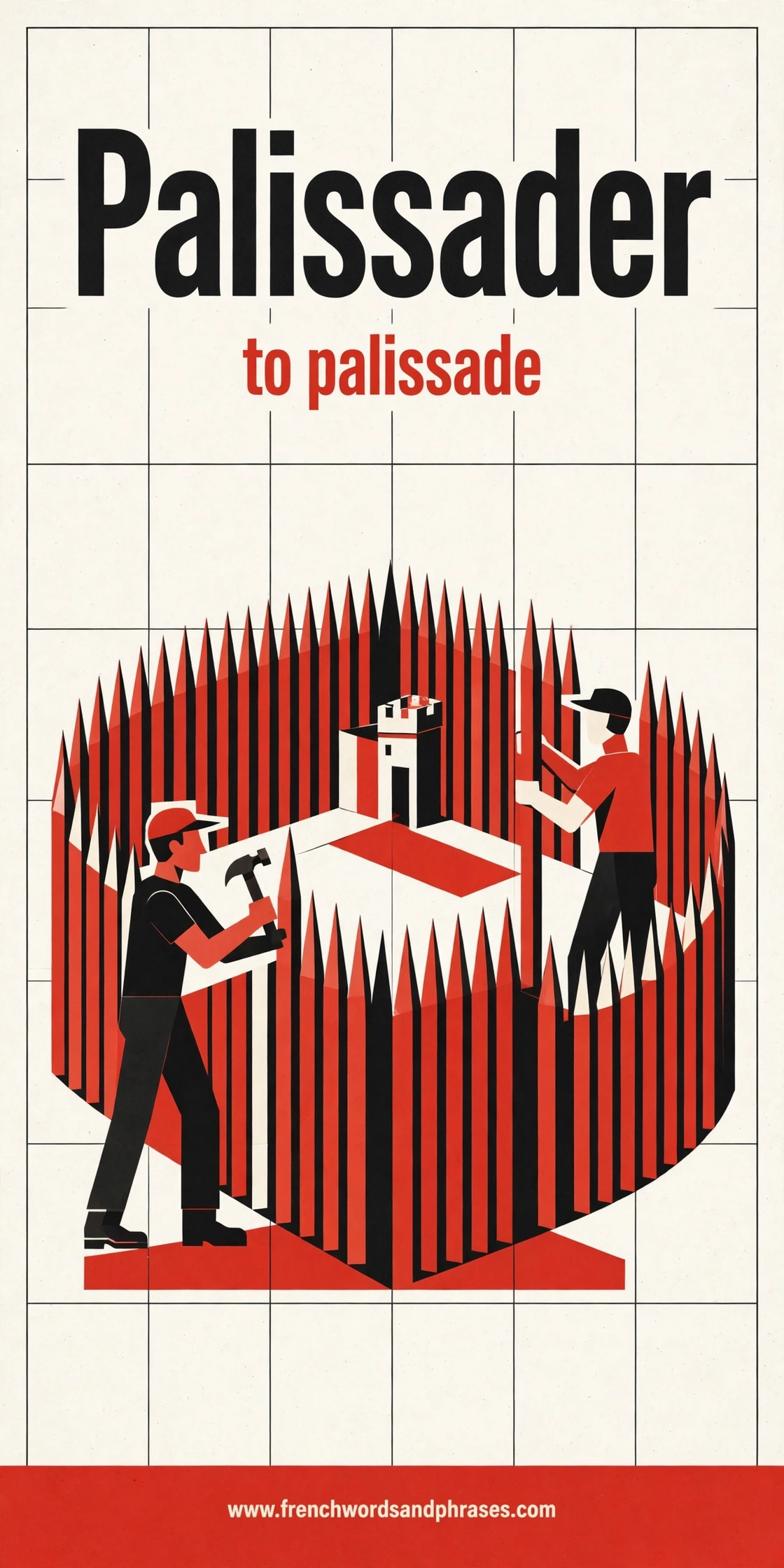
Palissader means to palissade — to fence a place in with a wall of upright stakes, the pointed wooden palings that guarded camps and frontier forts.
A frontier fort in the snow: soldiers sink sharpened logs side by side into the frozen earth until the camp stands inside a wooden wall of teeth. Palissader is their verb — to ring a place with a palisade, the oldest fence in the world, built wherever people needed a wall before they had stone.
In this guide, you’ll learn how to conjugate palissader in all the major French tenses and moods. Explore complete conjugation tables, French examples, English translations, and practice quizzes.
Understanding the French Verb Palissader
Palissader is a regular French verb belonging to the first group of verbs, those ending in -er.
It means to palissade. It is used for enclosing camps, forts, gardens and vineyards with a fence of upright stakes or palings, in historical and military writing above all. The reflexive se palissader exists too — to barricade oneself behind a palisade — but the plain verb, fencing a place in, is the dictionary’s entry and the commoner sight.
Verb classification: First group (-er)
Auxiliary verb: Avoir
Past participle: palissadé
Present participle: palissadant
English equivalents: To palissade, to fence with a palisade; palissader un camp — to palisade a camp; palissader un jardin — to fence a garden with palings; une palissade — a palisade, a fence of stakes; se palissader — to shut oneself in behind a palisade.
One important detail: palissader is the verb of une palissade, and the double s is the whole word — it never simplifies: je palissade, nous palissadons, past participle palissadé. English kept the noun as palisade with one s, which tempts learners to drop one in French; resist — French writes the fence with two. The verb is rare and mostly historical: armies, settlers and gardeners palissader what they fear to lose.
Experience the Word
Palissader is the verb of the wooden wall — a thousand sharpened stakes standing shoulder to shoulder against the wilderness.
Imagine a trading post on a frozen river in Canada, 1750. Before the snow deepens, every able man is felling pines, pointing the ends, sinking them in a trench: ils palissadent le fort, stake by stake, until the little wooden city has its wall and the wolves stay a rumour outside.
No stone, no mortar, no architect. The fort has been fenced — palissadé — with nothing but trees and urgency.
How to Conjugate Palissader: Complete French Conjugation Guide
Let’s explore every major conjugation of palissader, beginning with the indicative mood.
How to Conjugate Palissader in the Indicative Mood
The indicative mood is used to express facts, observations, actions, and events.
How to Conjugate Palissader in the Present Tense (Présent)
Used for actions happening now, habitual actions, and general truths.
| Subject | Conjugation |
|---|---|
| je | palissade |
| tu | palissades |
| il / elle | palissade |
| nous | palissadons |
| vous | palissadez |
| ils / elles | palissadent |
Les soldats palissadent le camp avant l’hiver.
The soldiers are palisading the camp before winter.
Complete the sentence:
Nous ______ le potager contre les cerfs.
Reveal the answer
palissadons
Nous palissadons le potager contre les cerfs.
We are palisading the vegetable garden against the deer.
How to Conjugate Palissader in the Passé Composé
Used for completed actions in the past. Palissader takes the auxiliary verb avoir.
| Subject | Conjugation |
|---|---|
| j’ | ai palissadé |
| tu | as palissadé |
| il / elle | a palissadé |
| nous | avons palissadé |
| vous | avez palissadé |
| ils / elles | ont palissadé |
Nous avons palissadé le jardin contre les cerfs.
We fenced the garden with a palisade against the deer.
How to Conjugate Palissader in the Imparfait (Imperfect Tense)
Used for habitual past actions, descriptions, and ongoing situations in the past.
| Subject | Conjugation |
|---|---|
| je | palissadais |
| tu | palissadais |
| il / elle | palissadait |
| nous | palissadions |
| vous | palissadiez |
| ils / elles | palissadaient |
Les colons palissadaient chaque fortin de la frontière.
The settlers used to palisade every small fort on the frontier.
Choose the correct form:
The settlers palisaded the village.
Les colons ______ le village. (ont palissadé / sont palissadés)
Reveal the answer
ont palissadé
Les colons ont palissadé le village.
Palissader takes avoir.
How to Conjugate Palissader in the Plus-que-parfait
Used to describe an action that had already been completed before another past event.
| Subject | Conjugation |
|---|---|
| j’ | avais palissadé |
| tu | avais palissadé |
| il / elle | avait palissadé |
| nous | avions palissadé |
| vous | aviez palissadé |
| ils / elles | avaient palissadé |
Ils avaient palissadé le village avant les premières neiges.
They had palisaded the village before the first snows.
How to Conjugate Palissader in the Passé Simple
Primarily used in formal writing, literature, and historical narratives. It is rarely used in everyday conversation.
| Subject | Conjugation |
|---|---|
| je | palissadai |
| tu | palissadas |
| il / elle | palissada |
| nous | palissadâmes |
| vous | palissadâtes |
| ils / elles | palissadèrent |
La garnison palissada l’enceinte en trois jours.
The garrison palisaded the enclosure in three days.
How to Conjugate Palissader in the Passé Antérieur
A literary tense used to express an action completed immediately before another past action, generally in the passé simple.
| Subject | Conjugation |
|---|---|
| j’ | eus palissadé |
| tu | eus palissadé |
| il / elle | eut palissadé |
| nous | eûmes palissadé |
| vous | eûtes palissadé |
| ils / elles | eurent palissadé |
Quand ils eurent palissadé le fort, les trappeurs revinrent.
When they had palisaded the fort, the trappers came back.
How to Conjugate Palissader in the Future Tense (Futur Simple)
Used to describe actions that will take place in the future.
| Subject | Conjugation |
|---|---|
| je | palissaderai |
| tu | palissaderas |
| il / elle | palissadera |
| nous | palissaderons |
| vous | palissaderez |
| ils / elles | palissaderont |
Demain, nous palissaderons le potager entier.
Tomorrow, we will palisade the whole vegetable garden.
How to Conjugate Palissader in the Futur Antérieur (Future Perfect)
Used for an action that will have been completed before a particular point in the future.
| Subject | Conjugation |
|---|---|
| j’ | aurai palissadé |
| tu | auras palissadé |
| il / elle | aura palissadé |
| nous | aurons palissadé |
| vous | aurez palissadé |
| ils / elles | auront palissadé |
À la fin du mois, ils auront palissadé tout le campement.
By the end of the month, they will have palisaded the whole encampment.
How to Conjugate Palissader in the Near Future (Futur Proche)
Used to describe something that is going to happen soon. Formed with aller + infinitive.
| Subject | Conjugation |
|---|---|
| je | vais palissader |
| tu | vas palissader |
| il / elle | va palissader |
| nous | allons palissader |
| vous | allez palissader |
| ils / elles | vont palissader |
On va palissader le chantier ce week-end.
We are going to fence the site with palings this weekend.
How to Conjugate Palissader in the Conditional Mood
The conditional mood expresses what would happen under certain circumstances. It is also frequently used to make polite requests or express wishes.
How to Conjugate Palissader in the Present Conditional
| Subject | Conjugation |
|---|---|
| je | palissaderais |
| tu | palissaderais |
| il / elle | palissaderait |
| nous | palissaderions |
| vous | palissaderiez |
| ils / elles | palissaderaient |
Avec plus de bois, on palissaderait aussi le verger.
With more wood, we would palisade the orchard too.
How to Conjugate Palissader in the Past Conditional
| Subject | Conjugation |
|---|---|
| j’ | aurais palissadé |
| tu | aurais palissadé |
| il / elle | aurait palissadé |
| nous | aurions palissadé |
| vous | auriez palissadé |
| ils / elles | auraient palissadé |
Ils auraient palissadé le fort plus tôt sans la pluie.
They would have palisaded the fort earlier but for the rain.
Palissader in the Literary Past Conditional Form
This less common literary form uses the imperfect subjunctive of avoir.
| Subject | Conjugation |
|---|---|
| j’ | eusse palissadé |
| tu | eusses palissadé |
| il / elle | eût palissadé |
| nous | eussions palissadé |
| vous | eussiez palissadé |
| ils / elles | eussent palissadé |
La garnison eût palissadé la redoute avant la nuit sans l’ordre contraire.
The garrison would have palisaded the redoubt before nightfall, but for the counter-order.
How to Conjugate Palissader in the Subjunctive Mood
The subjunctive is used to express wishes, emotions, doubts, necessity, and uncertainty. It frequently follows expressions such as il faut que (it is necessary that) or bien que (although).
How to Conjugate Palissader in the Present Subjunctive
| Subject | Conjugation |
|---|---|
| que je | palissade |
| que tu | palissades |
| qu’il / qu’elle | palissade |
| que nous | palissadions |
| que vous | palissadiez |
| qu’ils / qu’elles | palissadent |
Il faut que nous palissadions le camp avant la saison froide.
We must palisade the camp before the cold season.
Complete the sentence using the subjunctive:
Il faut que vous ______ l’enceinte entière.
Reveal the answer
palissadiez
Il faut que vous palissadiez l’enceinte entière.
You must palisade the whole enclosure.
How to Conjugate Palissader in the Imperfect Subjunctive
A literary tense, rarely encountered in modern spoken French.
| Subject | Conjugation |
|---|---|
| que je | palissadasse |
| que tu | palissadasses |
| qu’il / qu’elle | palissadât |
| que nous | palissadassions |
| que vous | palissadassiez |
| qu’ils / qu’elles | palissadassent |
Le commandant ordonna que l’on palissadât l’enceinte entière.
The commander ordered the whole enclosure to be palisaded.
How to Conjugate Palissader in the Pluperfect Subjunctive
A literary construction used to express an action completed before another past action.
| Subject | Conjugation |
|---|---|
| que j’ | eusse palissadé |
| que tu | eusses palissadé |
| qu’il / qu’elle | eût palissadé |
| que nous | eussions palissadé |
| que vous | eussiez palissadé |
| qu’ils / qu’elles | eussent palissadé |
On racontait qu’ils eussent palissadé trois forts en un été.
It was said they had palisaded three forts in one summer.
How to Conjugate Palissader in the Past Subjunctive
| Subject | Conjugation |
|---|---|
| que j’ | aie palissadé |
| que tu | aies palissadé |
| qu’il / qu’elle | ait palissadé |
| que nous | ayons palissadé |
| que vous | ayez palissadé |
| qu’ils / qu’elles | aient palissadé |
Je suis content que vous ayez palissadé le jardin à temps.
I am glad you fenced the garden with a palisade in time.
How to Conjugate Palissader in the Imperative
The imperative is used to give commands, instructions, invitations, or suggestions. Subject pronouns are omitted.
How to Conjugate Palissader in the Present Imperative
| Person | Conjugation |
|---|---|
| (tu) | palissade |
| (nous) | palissadons |
| (vous) | palissadez |
Palissadez l’enceinte avant la nuit, soldats !
Palisade the enclosure before nightfall, soldiers!
How would you say Palisade the camp (tu form)?
Reveal the answer
Palissade le camp !
French Participles of Palissader
Participles are verb forms that can be used in compound tenses and other grammatical constructions.
Present Participle of Palissader
palissadant
En palissadant le camp, les soldats chantaient pour se donner du cœur.
While palisading the camp, the soldiers sang to keep their spirits up.
Past Participle of Palissader
palissadé
Palissadé de troncs pointus, le fortin semblait hérissé.
Palisaded with sharpened trunks, the little fort seemed to bristle.
Palissader in Everyday French: Real-Life Examples
Now that you know the conjugations, let’s see how palissader appears in everyday French.
Les soldats palissadent le camp.
The soldiers are palisading the camp.
Nous avons palissadé le jardin.
We fenced the garden with a palisade.
Les colons palissadaient chaque fortin.
The settlers used to palisade every small fort.
Ils palissaderont le potager demain.
They will palisade the vegetable garden tomorrow.
On palissaderait aussi le verger avec plus de bois.
We would palisade the orchard too with more wood.
Palissadez l’enceinte avant la nuit !
Palisade the enclosure before nightfall!
Beyond Translation: The Meaning of Palissader
English palisade came straight from this French word — and the cliffs of New Jersey called the Palisades are named for the same fence of stakes they resemble.
The word family is all wood and defence.
Une palissade is the fence itself, un palis is a single stake, and palissader is the frontier verb of turning a stand of pine trees into a wall before winter — or before the enemy — arrives.
How to Remember the French Verb Palissader
Remember it this way: Palissader is about soldiers sinking sharpened logs to ring a frontier fort.
- Une palissade is a fence of pointed stakes; palissader is building one around something.
- Two s, always: palissade, palissader, palissadé — never let English palisade steal one.
- Regular -er: je palissade, nous palissadons, past participle palissadé.
The key idea is soldiers sinking sharpened logs to ring a frontier fort.
Test Your Knowledge of Palissader
Let’s see how much you’ve learned. Try answering these questions before revealing the answers.
What is une palissade?
Reveal the answer
A fence of upright pointed stakes — the wooden wall of camps and frontier forts; palissader is to enclose with one.
How do you say The soldiers are palisading the camp in French?
Reveal the answer
Les soldats palissadent le camp.
Translate: We fenced the garden with a palisade.
Reveal the answer
Nous avons palissadé le jardin.
What is the past participle of palissader?
Reveal the answer
Palissadé — with two s, like the noun palissade.
Complete the sentence:
Il faut que nous ______ le camp avant l’hiver.
Reveal the answer
palissadions
Il faut que nous palissadions le camp avant l’hiver.
We must palisade the camp before winter.
Can You Use It?
How would you say this in French?
Before the snows, the soldiers palisade the fort, and the forest becomes a wall.
Reveal the answer
Avant les neiges, les soldats palissadent le fort, et la forêt devient un mur.
Before the snows, the soldiers palisade the fort, and the forest becomes a wall.
LEARN FRENCH ONE WORD AT A TIME