How to Conjugate Palataliser in French
/pa.la.ta.li.ze/
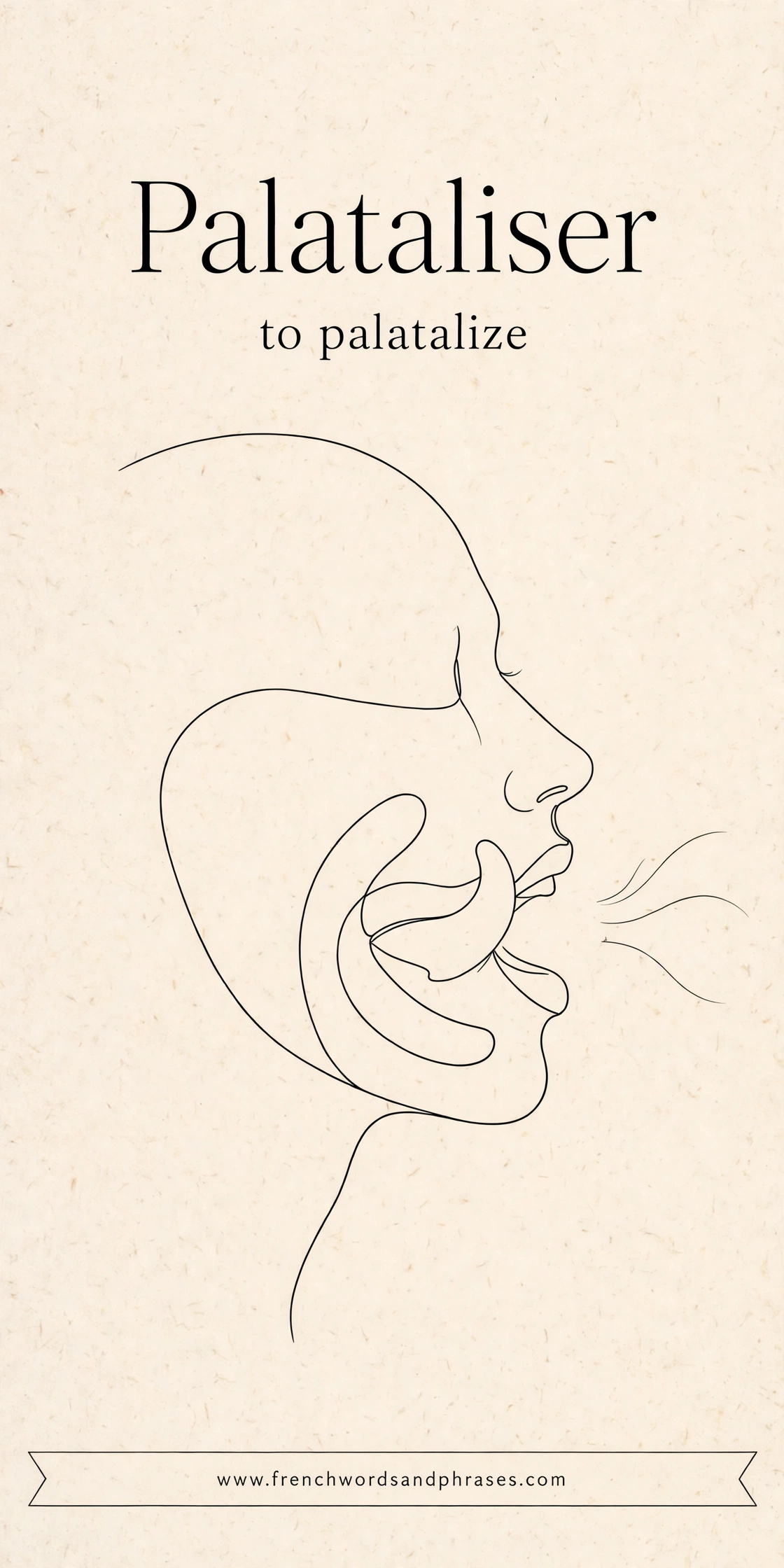
Palataliser means to palatalize — to draw a consonant towards the palate, so that a hard sound softens into the hushing, y-coloured sound of ch, j or gn.
Say the hard c of Latin cantare, then the soft ch of French chanter: somewhere on the road between the two, the tongue rose towards the palate and the sound melted. Palataliser is the phonetician’s verb for that melting — the moment a consonant slides forward in the mouth and comes out softer, wetter, more musical.
In this guide, you’ll learn how to conjugate palataliser in all the major French tenses and moods. Explore complete conjugation tables, French examples, English translations, and practice quizzes.
Understanding the French Verb Palataliser
Palataliser is a regular French verb belonging to the first group of verbs, those ending in -er.
It means to palatalize. It is used almost entirely in phonetics and the history of language, for the process by which consonants are pronounced with the tongue raised to the hard palate — the change that turned Latin c and g into French ch and j, Italian ci and gi, and that still colours consonants in Russian and Japanese. Outside the linguistics seminar it is rare, but it names one of the great engines of French sound.
Verb classification: First group (-er)
Auxiliary verb: Avoir
Past participle: palatalisé
Present participle: palatalisant
English equivalents: To palatalize; palataliser une consonne — to palatalize a consonant; le français a palatalisé le c latin — French palatalized the Latin c; une consonne palatalisée — a palatalized consonant; la palatalisation — palatalization, the sound change itself.
One important detail: palataliser is a linguist’s verb, and its spelling is as tidy as its science — perfectly regular, with the family all around it: le palais (the palate), palatal (palatal), la palatalisation (the process). The famous French examples are the Latin hard sounds that melted on their way north: cantare became chanter, caballus became cheval — in each case the tongue palatalised the consonant before a following a. Conjugation: je palatalise, nous palatalisons, past participle palatalisé.
Experience the Word
Palataliser is the verb of the melting consonant — the tongue rises, the sound softens, and a language changes its music.
Imagine a phonetics class in Lyon. The professor writes two words on the board — Latin CANTAT, French CHANTE — and draws an arrow between them. Between those two spellings lie a thousand years of tongues creeping forward in the mouth: le c s’est palatalisé, and a whole language learned to hush.
No law ordered it and nobody noticed it happening. The consonant simply softened — palatalisé — one mouth at a time.
How to Conjugate Palataliser: Complete French Conjugation Guide
Let’s explore every major conjugation of palataliser, beginning with the indicative mood.
How to Conjugate Palataliser in the Indicative Mood
The indicative mood is used to express facts, observations, actions, and events.
How to Conjugate Palataliser in the Present Tense (Présent)
Used for actions happening now, habitual actions, and general truths.
| Subject | Conjugation |
|---|---|
| je | palatalise |
| tu | palatalises |
| il / elle | palatalise |
| nous | palatalisons |
| vous | palatalisez |
| ils / elles | palatalisent |
Le français palatalise souvent les consonnes devant a.
French often palatalizes consonants before a.
Complete the sentence:
Nous ______ les consonnes dans cet exercice.
Reveal the answer
palatalisons
Nous palatalisons les consonnes dans cet exercice.
We are palatalizing the consonants in this exercise.
How to Conjugate Palataliser in the Passé Composé
Used for completed actions in the past. Palataliser takes the auxiliary verb avoir.
| Subject | Conjugation |
|---|---|
| j’ | ai palatalisé |
| tu | as palatalisé |
| il / elle | a palatalisé |
| nous | avons palatalisé |
| vous | avez palatalisé |
| ils / elles | ont palatalisé |
Le latin tardif a palatalisé le c de cantare.
Late Latin palatalized the c of cantare.
How to Conjugate Palataliser in the Imparfait (Imperfect Tense)
Used for habitual past actions, descriptions, and ongoing situations in the past.
| Subject | Conjugation |
|---|---|
| je | palatalisais |
| tu | palatalisais |
| il / elle | palatalisait |
| nous | palatalisions |
| vous | palatalisiez |
| ils / elles | palatalisaient |
Dans cette région, on palatalisait même les t.
In that region, people used to palatalize even the t sounds.
Choose the correct form:
Late Latin palatalized the c.
Le latin tardif ______ le c. (a palatalisé / est palatalisé)
Reveal the answer
a palatalisé
Le latin tardif a palatalisé le c.
Palataliser takes avoir.
How to Conjugate Palataliser in the Plus-que-parfait
Used to describe an action that had already been completed before another past event.
| Subject | Conjugation |
|---|---|
| j’ | avais palatalisé |
| tu | avais palatalisé |
| il / elle | avait palatalisé |
| nous | avions palatalisé |
| vous | aviez palatalisé |
| ils / elles | avaient palatalisé |
La langue avait palatalisé ces sons bien avant l’an mille.
The language had palatalized those sounds long before the year 1000.
How to Conjugate Palataliser in the Passé Simple
Primarily used in formal writing, literature, and historical narratives. It is rarely used in everyday conversation.
| Subject | Conjugation |
|---|---|
| je | palatalisai |
| tu | palatalisas |
| il / elle | palatalisa |
| nous | palatalisâmes |
| vous | palatalisâtes |
| ils / elles | palatalisèrent |
Au fil des siècles, le français palatalisa le g latin devant e.
Over the centuries, French palatalized the Latin g before e.
How to Conjugate Palataliser in the Passé Antérieur
A literary tense used to express an action completed immediately before another past action, generally in the passé simple.
| Subject | Conjugation |
|---|---|
| j’ | eus palatalisé |
| tu | eus palatalisé |
| il / elle | eut palatalisé |
| nous | eûmes palatalisé |
| vous | eûtes palatalisé |
| ils / elles | eurent palatalisé |
Quand la langue eut palatalisé le c, l’orthographe suivit.
When the language had palatalized the c, the spelling followed.
How to Conjugate Palataliser in the Future Tense (Futur Simple)
Used to describe actions that will take place in the future.
| Subject | Conjugation |
|---|---|
| je | palataliserai |
| tu | palataliseras |
| il / elle | palatalisera |
| nous | palataliserons |
| vous | palataliserez |
| ils / elles | palataliseront |
Ce dialecte palatalisera peut-être aussi les d un jour.
This dialect will perhaps palatalize the d sounds too one day.
How to Conjugate Palataliser in the Futur Antérieur (Future Perfect)
Used for an action that will have been completed before a particular point in the future.
| Subject | Conjugation |
|---|---|
| j’ | aurai palatalisé |
| tu | auras palatalisé |
| il / elle | aura palatalisé |
| nous | aurons palatalisé |
| vous | aurez palatalisé |
| ils / elles | auront palatalisé |
Dans deux siècles, la langue aura palatalisé d’autres sons.
In two centuries, the language will have palatalized other sounds.
How to Conjugate Palataliser in the Near Future (Futur Proche)
Used to describe something that is going to happen soon. Formed with aller + infinitive.
| Subject | Conjugation |
|---|---|
| je | vais palataliser |
| tu | vas palataliser |
| il / elle | va palataliser |
| nous | allons palataliser |
| vous | allez palataliser |
| ils / elles | vont palataliser |
Attention, les enfants vont palataliser ce son difficile.
Careful, the children are going to palatalize this difficult sound.
How to Conjugate Palataliser in the Conditional Mood
The conditional mood expresses what would happen under certain circumstances. It is also frequently used to make polite requests or express wishes.
How to Conjugate Palataliser in the Present Conditional
| Subject | Conjugation |
|---|---|
| je | palataliserais |
| tu | palataliserais |
| il / elle | palataliserait |
| nous | palataliserions |
| vous | palataliseriez |
| ils / elles | palataliseraient |
Devant un i, ce son se palataliserait naturellement.
Before an i, this sound would palatalize naturally.
How to Conjugate Palataliser in the Past Conditional
| Subject | Conjugation |
|---|---|
| j’ | aurais palatalisé |
| tu | aurais palatalisé |
| il / elle | aurait palatalisé |
| nous | aurions palatalisé |
| vous | auriez palatalisé |
| ils / elles | auraient palatalisé |
Sans l’influence du nord, le c ne se serait pas palatalisé ainsi.
Without the northern influence, the c would not have palatalized like that.
Palataliser in the Literary Past Conditional Form
This less common literary form uses the imperfect subjunctive of avoir.
| Subject | Conjugation |
|---|---|
| j’ | eusse palatalisé |
| tu | eusses palatalisé |
| il / elle | eût palatalisé |
| nous | eussions palatalisé |
| vous | eussiez palatalisé |
| ils / elles | eussent palatalisé |
La consonne se fût palatalisée devant la voyelle suivante.
The consonant would have palatalized before the following vowel.
How to Conjugate Palataliser in the Subjunctive Mood
The subjunctive is used to express wishes, emotions, doubts, necessity, and uncertainty. It frequently follows expressions such as il faut que (it is necessary that) or bien que (although).
How to Conjugate Palataliser in the Present Subjunctive
| Subject | Conjugation |
|---|---|
| que je | palatalise |
| que tu | palatalises |
| qu’il / qu’elle | palatalise |
| que nous | palatalisions |
| que vous | palatalisiez |
| qu’ils / qu’elles | palatalisent |
Il est possible que ce dialecte palatalise les k.
It is possible that this dialect palatalizes the k sounds.
Complete the sentence using the subjunctive:
Il est possible que vous ______ ce son.
Reveal the answer
palatalisiez
Il est possible que vous palatalisiez ce son.
It is possible that you palatalize this sound.
How to Conjugate Palataliser in the Imperfect Subjunctive
A literary tense, rarely encountered in modern spoken French.
| Subject | Conjugation |
|---|---|
| que je | palatalisasse |
| que tu | palatalisasses |
| qu’il / qu’elle | palatalisât |
| que nous | palatalisassions |
| que vous | palatalisassiez |
| qu’ils / qu’elles | palatalisassent |
On s’étonnait que la langue palatalisât si vite ces consonnes.
People were astonished that the language palatalized those consonants so quickly.
How to Conjugate Palataliser in the Pluperfect Subjunctive
A literary construction used to express an action completed before another past action.
| Subject | Conjugation |
|---|---|
| que j’ | eusse palatalisé |
| que tu | eusses palatalisé |
| qu’il / qu’elle | eût palatalisé |
| que nous | eussions palatalisé |
| que vous | eussiez palatalisé |
| qu’ils / qu’elles | eussent palatalisé |
Les grammairiens pensaient que le peuple eût palatalisé le son par paresse.
The grammarians thought the people had palatalized the sound out of laziness.
How to Conjugate Palataliser in the Past Subjunctive
| Subject | Conjugation |
|---|---|
| que j’ | aie palatalisé |
| que tu | aies palatalisé |
| qu’il / qu’elle | ait palatalisé |
| que nous | ayons palatalisé |
| que vous | ayez palatalisé |
| qu’ils / qu’elles | aient palatalisé |
Je suis content que l’exercice ait palatalisé ta manière de prononcer le ch.
I am glad the exercise palatalized the way you pronounce ch.
How to Conjugate Palataliser in the Imperative
The imperative is used to give commands, instructions, invitations, or suggestions. Subject pronouns are omitted.
How to Conjugate Palataliser in the Present Imperative
| Person | Conjugation |
|---|---|
| (tu) | palatalise |
| (nous) | palatalisons |
| (vous) | palatalisez |
Palatalise ce c, comme dans chanter !
Palatalize this c, as in chanter!
How would you say Palatalize this sound (tu form)?
Reveal the answer
Palatalise ce son !
French Participles of Palataliser
Participles are verb forms that can be used in compound tenses and other grammatical constructions.
Present Participle of Palataliser
palatalisant
En palatalisant le t, ce dialecte produit un son proche du tch.
By palatalizing the t, this dialect produces a sound close to tch.
Past Participle of Palataliser
palatalisé
Palatalisé par des siècles d’usage, le c latin est devenu ch.
Palatalized by centuries of use, the Latin c became ch.
Palataliser in Everyday French: Real-Life Examples
Now that you know the conjugations, let’s see how palataliser appears in everyday French.
Le français palatalise le c devant a.
French palatalizes the c before a.
Le latin tardif a palatalisé ce son.
Late Latin palatalized this sound.
On palatalisait même les t dans ce dialecte.
People used to palatalize even the t sounds in this dialect.
La langue palatalisera d’autres sons un jour.
The language will palatalize other sounds one day.
Devant un i, le son se palataliserait.
Before an i, the sound would palatalize.
Palatalise ce c, comme dans chanter !
Palatalize this c, as in chanter!
Beyond Translation: The Meaning of Palataliser
English palatalize is the same learned word, built on palate — in French le palais, which is also a palace, a happy accident: the roof of the mouth is the palace of speech.
Palatalisation built the French sound.
Without it there is no ch in chanter, no j in jardin — the whole hushing, singing surface of French is the scar left by consonants that palatalised a thousand years ago.
How to Remember the French Verb Palataliser
Remember it this way: Palataliser is about the tongue rising to the palate, melting cantare into chanter.
- Le palais is the palate: to palatalize is to pull a consonant up towards it.
- The classic story: Latin cantare, the c palatalised, French chanter.
- Regular -er: je palatalise, nous palatalisons, past participle palatalisé.
The key idea is the tongue rising to the palate, melting cantare into chanter.
Test Your Knowledge of Palataliser
Let’s see how much you’ve learned. Try answering these questions before revealing the answers.
What happens to a consonant when it is palatalized?
Reveal the answer
It is drawn towards the palate and softens — Latin hard c, palatalized, became the ch of chanter.
How do you say French palatalizes the c before a in French?
Reveal the answer
Le français palatalise le c devant a.
Translate: Late Latin palatalized this sound.
Reveal the answer
Le latin tardif a palatalisé ce son.
What is the past participle of palataliser?
Reveal the answer
Palatalisé.
Complete the sentence:
Il est possible que ce dialecte ______ les k.
Reveal the answer
palatalise
Il est possible que ce dialecte palatalise les k.
It is possible that this dialect palatalizes the k sounds.
Can You Use It?
How would you say this in French?
The c of cantare palatalized on the way, and French learned to sing.
Reveal the answer
Le c de cantare s’est palatalisé en route, et le français a appris à chanter.
The c of cantare palatalized on the way, and French learned to sing.
LEARN FRENCH ONE WORD AT A TIME