How to Conjugate Palanguer in French
/pa.lɑ̃.ɡe/
Palanguer means to bowse — to haul a heavy load tight and secure with a palan, the block and tackle of the docks.
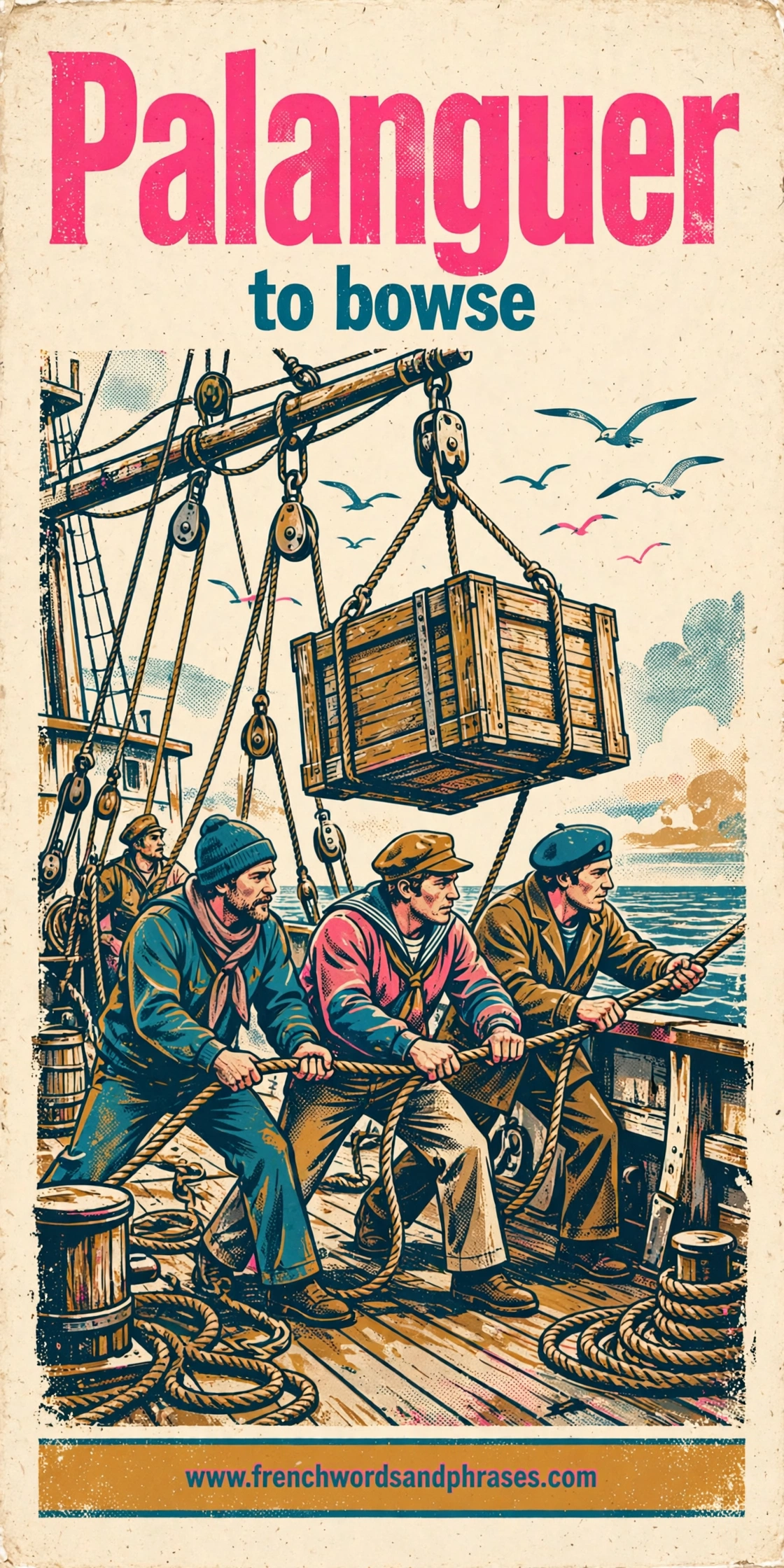
On a working quay, a crate of machinery hangs from a crane and four dockers lean on the ropes of a block and tackle, heaving together on the mate’s call. Palanguer is their verb: to bowse — to haul on a tackle until a heavy load sits tight, wedged and lashed, exactly where it must not move.
In this guide, you’ll learn how to conjugate palanguer in all the major French tenses and moods. Explore complete conjugation tables, French examples, English translations, and practice quizzes.
Understanding the French Verb Palanguer
Palanguer is a regular French verb belonging to the first group of verbs, those ending in -er.
It means to bowse. It is a specialist verb of sailors, dockers and movers of heavy loads — barrels, crates, guns on a ship’s deck — and most French speakers meet it only in maritime writing. The load is not merely lifted: it is hauled down and secured so that it cannot shift, which is why English bowse, itself an old sailors’ word, is the dictionary’s exact match.
Verb classification: First group (-er)
Auxiliary verb: Avoir
Past participle: palangué
Present participle: palanguant
English equivalents: To bowse, to haul with a block and tackle, to secure a load; palanguer une charge — to bowse a load tight; palanguer un tonneau — to haul a barrel fast with a tackle; un palan — a block and tackle, a hoist; palanguer au cabestan — to heave at the capstan.
One important detail: the dictionary also gives the variant spelling palanquer — same verb, said exactly the same way, the qu spelling simply making the hard g sound explicit. Under its commoner spelling, palanguer keeps a u after the g in every form so the g stays hard before e and i: nous palanguons, je palanguais, en palanguant — exactly like naviguer. The word belongs to the docks and the navy: it is built on un palan, a block and tackle, and to bowse is to haul a load tight and wedge it fast with that tackle.
Experience the Word
Palanguer is the verb of the tackle pulled bar-tight — a load not just lifted, but hauled fast so it can never move again.
Imagine a sailing ship loading casks of wine at Bordeaux. Each barrel swings over the hold on the crane, drops between the beams, and then the crew lean on the tackle together — palanguer ! — until the cask sits wedged among its neighbours, immovable in any sea.
The barrel is not resting there. It has been bowsed — palangué — tight enough to cross an ocean.
How to Conjugate Palanguer: Complete French Conjugation Guide
Let’s explore every major conjugation of palanguer, beginning with the indicative mood.
How to Conjugate Palanguer in the Indicative Mood
The indicative mood is used to express facts, observations, actions, and events.
How to Conjugate Palanguer in the Present Tense (Présent)
Used for actions happening now, habitual actions, and general truths.
| Subject | Conjugation |
|---|---|
| je | palangue |
| tu | palangues |
| il / elle | palangue |
| nous | palanguons |
| vous | palanguez |
| ils / elles | palanguent |
Les dockers palanguent les tonneaux dans la cale.
The dockers are bowsing the barrels tight in the hold.
Complete the sentence:
Nous ______ les tonneaux dans la cale.
Reveal the answer
palanguons
Nous palanguons les tonneaux dans la cale.
We are bowsing the barrels tight in the hold.
How to Conjugate Palanguer in the Passé Composé
Used for completed actions in the past. Palanguer takes the auxiliary verb avoir.
| Subject | Conjugation |
|---|---|
| j’ | ai palangué |
| tu | as palangué |
| il / elle | a palangué |
| nous | avons palangué |
| vous | avez palangué |
| ils / elles | ont palangué |
Nous avons palangué la charge contre le bastingage.
We bowsed the load fast against the rail.
How to Conjugate Palanguer in the Imparfait (Imperfect Tense)
Used for habitual past actions, descriptions, and ongoing situations in the past.
| Subject | Conjugation |
|---|---|
| je | palanguais |
| tu | palanguais |
| il / elle | palanguait |
| nous | palanguions |
| vous | palanguiez |
| ils / elles | palanguaient |
L’équipage palanguait les canons avant la tempête.
The crew used to bowse the guns fast before a storm.
Choose the correct form:
The crew bowsed the guns fast.
L’équipage ______ les canons. (a palangué / est palangué)
Reveal the answer
a palangué
L’équipage a palangué les canons.
Palanguer takes avoir.
How to Conjugate Palanguer in the Plus-que-parfait
Used to describe an action that had already been completed before another past event.
| Subject | Conjugation |
|---|---|
| j’ | avais palangué |
| tu | avais palangué |
| il / elle | avait palangué |
| nous | avions palangué |
| vous | aviez palangué |
| ils / elles | avaient palangué |
Ils avaient palangué les caisses avant le départ du navire.
They had bowsed the crates fast before the ship sailed.
How to Conjugate Palanguer in the Passé Simple
Primarily used in formal writing, literature, and historical narratives. It is rarely used in everyday conversation.
| Subject | Conjugation |
|---|---|
| je | palanguai |
| tu | palanguas |
| il / elle | palangua |
| nous | palanguâmes |
| vous | palanguâtes |
| ils / elles | palanguèrent |
Les marins palanguèrent les fûts en une heure.
The sailors bowsed the casks tight in an hour.
How to Conjugate Palanguer in the Passé Antérieur
A literary tense used to express an action completed immediately before another past action, generally in the passé simple.
| Subject | Conjugation |
|---|---|
| j’ | eus palangué |
| tu | eus palangué |
| il / elle | eut palangué |
| nous | eûmes palangué |
| vous | eûtes palangué |
| ils / elles | eurent palangué |
Dès qu’ils eurent palangué le dernier tonneau, le navire appareilla.
As soon as they had bowsed the last barrel fast, the ship set sail.
How to Conjugate Palanguer in the Future Tense (Futur Simple)
Used to describe actions that will take place in the future.
| Subject | Conjugation |
|---|---|
| je | palanguerai |
| tu | palangueras |
| il / elle | palanguera |
| nous | palanguerons |
| vous | palanguerez |
| ils / elles | palangueront |
Demain, nous palanguerons les machines sur le pont.
Tomorrow, we will bowse the machines fast on deck.
How to Conjugate Palanguer in the Futur Antérieur (Future Perfect)
Used for an action that will have been completed before a particular point in the future.
| Subject | Conjugation |
|---|---|
| j’ | aurai palangué |
| tu | auras palangué |
| il / elle | aura palangué |
| nous | aurons palangué |
| vous | aurez palangué |
| ils / elles | auront palangué |
À midi, ils auront palangué toute la cargaison.
By noon, they will have bowsed the whole cargo tight.
How to Conjugate Palanguer in the Near Future (Futur Proche)
Used to describe something that is going to happen soon. Formed with aller + infinitive.
| Subject | Conjugation |
|---|---|
| je | vais palanguer |
| tu | vas palanguer |
| il / elle | va palanguer |
| nous | allons palanguer |
| vous | allez palanguer |
| ils / elles | vont palanguer |
Attention, ils vont palanguer la caisse, écartez-vous !
Careful, they are going to bowse the crate fast, stand clear!
How to Conjugate Palanguer in the Conditional Mood
The conditional mood expresses what would happen under certain circumstances. It is also frequently used to make polite requests or express wishes.
How to Conjugate Palanguer in the Present Conditional
| Subject | Conjugation |
|---|---|
| je | palanguerais |
| tu | palanguerais |
| il / elle | palanguerait |
| nous | palanguerions |
| vous | palangueriez |
| ils / elles | palangueraient |
Avec un palan neuf, on palanguerait ces charges sans peine.
With a new tackle, we would bowse these loads fast without effort.
How to Conjugate Palanguer in the Past Conditional
| Subject | Conjugation |
|---|---|
| j’ | aurais palangué |
| tu | aurais palangué |
| il / elle | aurait palangué |
| nous | aurions palangué |
| vous | auriez palangué |
| ils / elles | auraient palangué |
Ils auraient palangué les tonneaux plus vite avec un cabestan.
They would have bowsed the barrels faster with a capstan.
Palanguer in the Literary Past Conditional Form
This less common literary form uses the imperfect subjunctive of avoir.
| Subject | Conjugation |
|---|---|
| j’ | eusse palangué |
| tu | eusses palangué |
| il / elle | eût palangué |
| nous | eussions palangué |
| vous | eussiez palangué |
| ils / elles | eussent palangué |
L’équipage eût palangué les canons avant la nuit sans la pluie.
The crew would have bowsed the guns fast before nightfall, but for the rain.
How to Conjugate Palanguer in the Subjunctive Mood
The subjunctive is used to express wishes, emotions, doubts, necessity, and uncertainty. It frequently follows expressions such as il faut que (it is necessary that) or bien que (although).
How to Conjugate Palanguer in the Present Subjunctive
| Subject | Conjugation |
|---|---|
| que je | palangue |
| que tu | palangues |
| qu’il / qu’elle | palangue |
| que nous | palanguions |
| que vous | palanguiez |
| qu’ils / qu’elles | palanguent |
Il faut que vous palanguiez solidement cette charge.
You must bowse this load fast, solidly.
Complete the sentence using the subjunctive:
Il faut que tu ______ cette caisse à fond.
Reveal the answer
palangues
Il faut que tu palangues cette caisse à fond.
You must bowse this crate right fast.
How to Conjugate Palanguer in the Imperfect Subjunctive
A literary tense, rarely encountered in modern spoken French.
| Subject | Conjugation |
|---|---|
| que je | palanguasse |
| que tu | palanguasses |
| qu’il / qu’elle | palanguât |
| que nous | palanguassions |
| que vous | palanguassiez |
| qu’ils / qu’elles | palanguassent |
Le capitaine exigeait que l’on palanguât les fûts avant la houle.
The captain demanded that the casks be bowsed fast before the swell.
How to Conjugate Palanguer in the Pluperfect Subjunctive
A literary construction used to express an action completed before another past action.
| Subject | Conjugation |
|---|---|
| que j’ | eusse palangué |
| que tu | eusses palangué |
| qu’il / qu’elle | eût palangué |
| que nous | eussions palangué |
| que vous | eussiez palangué |
| qu’ils / qu’elles | eussent palangué |
On vérifia qu’ils eussent palangué chaque caisse à fond.
They checked that the men had bowsed every crate fully fast.
How to Conjugate Palanguer in the Past Subjunctive
| Subject | Conjugation |
|---|---|
| que j’ | aie palangué |
| que tu | aies palangué |
| qu’il / qu’elle | ait palangué |
| que nous | ayons palangué |
| que vous | ayez palangué |
| qu’ils / qu’elles | aient palangué |
Je suis content que vous ayez palangué la cargaison à temps.
I am glad you bowsed the cargo fast in time.
How to Conjugate Palanguer in the Imperative
The imperative is used to give commands, instructions, invitations, or suggestions. Subject pronouns are omitted.
How to Conjugate Palanguer in the Present Imperative
| Person | Conjugation |
|---|---|
| (tu) | palangue |
| (nous) | palanguons |
| (vous) | palanguez |
Palanguons ce tonneau, les gars, et à fond !
Let us bowse this barrel fast, lads, and hard!
How would you say Bowse this barrel fast (tu form)?
Reveal the answer
Palangue ce tonneau à fond !
French Participles of Palanguer
Participles are verb forms that can be used in compound tenses and other grammatical constructions.
Present Participle of Palanguer
palanguant
En palanguant les charges, les dockers chantent pour garder le rythme.
While bowsing the loads fast, the dockers sing to keep the rhythm.
Past Participle of Palanguer
palangué
Palanguées contre le flanc du navire, les caisses n’ont pas bougé.
Bowsed fast against the ship’s side, the crates did not move.
Palanguer in Everyday French: Real-Life Examples
Now that you know the conjugations, let’s see how palanguer appears in everyday French.
Les dockers palanguent les tonneaux.
The dockers bowse the barrels tight.
Nous avons palangué la charge.
We bowsed the load fast.
L’équipage palanguait les canons avant la tempête.
The crew used to bowse the guns fast before a storm.
Ils palangueront toute la cargaison demain.
They will bowse the whole cargo tight tomorrow.
On palanguerait mieux avec un palan neuf.
We would bowse better with a new tackle.
Palanguons ce tonneau à fond !
Let us bowse this barrel right fast!
Beyond Translation: The Meaning of Palanguer
English bowse — also spelled bouse — is a genuine old sailors’ word for hauling a tackle taut, and it survives in the drinking phrase bowse from the same world of barrels.
French keeps the dockyard in the word itself.
Un palan is the block and tackle; palanguer is simply what you do with one — haul, wedge, lash — until a ton of cargo rides as still as furniture.
How to Remember the French Verb Palanguer
Remember it this way: Palanguer is about dockers heaving on a block and tackle until the barrel cannot move.
- Think of un palan, the block and tackle: palanguer is hauling a load bar-tight with it.
- Also spelled palanquer — the dictionary gives both; the sound never changes.
- The u protects the hard g everywhere: nous palanguons, je palanguais, en palanguant.
The key idea is dockers heaving on a block and tackle until the barrel cannot move.
Test Your Knowledge of Palanguer
Let’s see how much you’ve learned. Try answering these questions before revealing the answers.
What is un palan, and why does it explain palanguer?
Reveal the answer
A block and tackle — palanguer is to haul a load tight and fast with one, to bowse it.
How do you say The dockers bowse the barrels tight in French?
Reveal the answer
Les dockers palanguent les tonneaux.
Translate: We bowsed the load fast.
Reveal the answer
Nous avons palangué la charge.
What is the other spelling the dictionary gives for palanguer?
Reveal the answer
Palanquer — with qu, same verb and same sound.
Complete the sentence:
Il faut que vous ______ solidement cette charge.
Reveal the answer
palanguiez
Il faut que vous palanguiez solidement cette charge.
You must bowse this load fast, solidly.
Can You Use It?
How would you say this in French?
The dockers bowse the last barrel fast, and the ship can face the swell.
Reveal the answer
Les dockers palanguent le dernier tonneau, et le navire peut affronter la houle.
The dockers bowse the last barrel fast, and the ship can face the swell.
LEARN FRENCH ONE WORD AT A TIME