How to Conjugate Palabrer in French
/pa.la.bʁe/
Palabrer means to palaver — to talk at great length, round and round a subject, without ever quite reaching a decision.
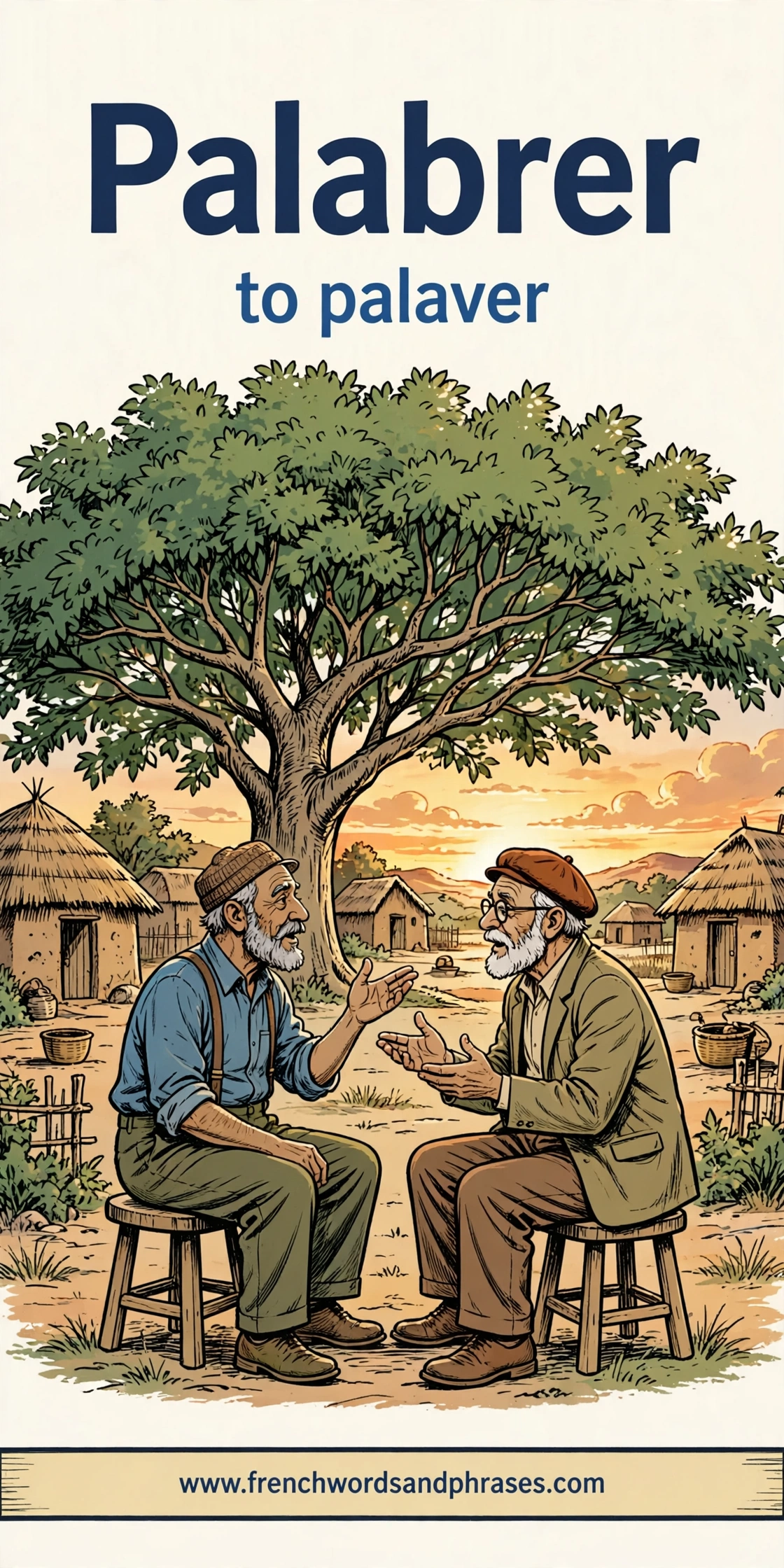
Under a great tree in a West African village, the elders sit in a circle and the talking begins — greetings, proverbs, old grievances, new proposals. Hours pass and nothing is rushed: palabrer is the verb of the long discussion, the endless negotiation, the meeting that talks its way slowly towards the truth.
In this guide, you’ll learn how to conjugate palabrer in all the major French tenses and moods. Explore complete conjugation tables, French examples, English translations, and practice quizzes.
Understanding the French Verb Palabrer
Palabrer is a regular French verb belonging to the first group of verbs, those ending in -er.
It means to palaver. It is commonly used for negotiations, village councils and committee meetings that go on and on, and in a lighter, everyday register for any long, rambling conversation that produces more words than decisions — closer to bavarder than to discuter, but with ceremony and endurance built in.
Verb classification: First group (-er)
Auxiliary verb: Avoir
Past participle: palabré
Present participle: palabrant
English equivalents: To palaver, to hold long discussions, to talk endlessly; palabrer pendant des heures — to palaver for hours; palabrer sur un prix — to haggle at length over a price; palabrer avant de décider — to talk and talk before deciding; les palabres — the palaver, the long drawn-out talks.
One important detail: palabrer belongs to the world of les palabres — the formal, unhurried palavers of West and Central Africa, where discussion under the palaver tree is how a community settles its affairs. In everyday French the verb has kept that flavour and added a smile: to palabrer is to talk long and inconclusively, and the tone is familiar, sometimes gently mocking — on a palabré pendant deux heures pour rien. The conjugation itself is perfectly regular: je palabre, nous palabrons, past participle palabré.
Experience the Word
Palabrer is the verb of talk as a journey — the destination matters, but nobody is allowed to hurry the road.
Imagine the shade of a mango tree at noon. Twelve elders, one question — a boundary between two fields — and the whole afternoon to settle it. Each man speaks in turn, nobody interrupts, the proverbs fly like slow birds: on palabre, and by sunset the boundary has moved and the friendship has not.
Nothing was signed or shouted. It was talked through — palabré — until the answer simply appeared.
How to Conjugate Palabrer: Complete French Conjugation Guide
Let’s explore every major conjugation of palabrer, beginning with the indicative mood.
How to Conjugate Palabrer in the Indicative Mood
The indicative mood is used to express facts, observations, actions, and events.
How to Conjugate Palabrer in the Present Tense (Présent)
Used for actions happening now, habitual actions, and general truths.
| Subject | Conjugation |
|---|---|
| je | palabre |
| tu | palabres |
| il / elle | palabre |
| nous | palabrons |
| vous | palabrez |
| ils / elles | palabrent |
Les anciens palabrent sous l’arbre depuis le matin.
The elders have been palavering under the tree since morning.
Complete the sentence:
Nous ______ sous l’arbre depuis le matin.
Reveal the answer
palabrons
Nous palabrons sous l’arbre depuis le matin.
We have been palavering under the tree since morning.
How to Conjugate Palabrer in the Passé Composé
Used for completed actions in the past. Palabrer takes the auxiliary verb avoir.
| Subject | Conjugation |
|---|---|
| j’ | ai palabré |
| tu | as palabré |
| il / elle | a palabré |
| nous | avons palabré |
| vous | avez palabré |
| ils / elles | ont palabré |
Nous avons palabré trois heures avant de signer l’accord.
We palavered for three hours before signing the agreement.
How to Conjugate Palabrer in the Imparfait (Imperfect Tense)
Used for habitual past actions, descriptions, and ongoing situations in the past.
| Subject | Conjugation |
|---|---|
| je | palabrais |
| tu | palabrais |
| il / elle | palabrait |
| nous | palabrions |
| vous | palabriez |
| ils / elles | palabraient |
Autrefois, on palabrait des jours entiers pour un mariage.
In the old days, people would palaver for whole days over a marriage.
Choose the correct form:
They palavered until nightfall.
Ils ______ jusqu’à la nuit. (ont palabré / sont palabrés)
Reveal the answer
ont palabré
Ils ont palabré jusqu’à la nuit.
Palabrer takes avoir.
How to Conjugate Palabrer in the Plus-que-parfait
Used to describe an action that had already been completed before another past event.
| Subject | Conjugation |
|---|---|
| j’ | avais palabré |
| tu | avais palabré |
| il / elle | avait palabré |
| nous | avions palabré |
| vous | aviez palabré |
| ils / elles | avaient palabré |
Ils avaient palabré toute la semaine sans trouver de solution.
They had palavered all week without finding a solution.
How to Conjugate Palabrer in the Passé Simple
Primarily used in formal writing, literature, and historical narratives. It is rarely used in everyday conversation.
| Subject | Conjugation |
|---|---|
| je | palabrai |
| tu | palabras |
| il / elle | palabra |
| nous | palabrâmes |
| vous | palabrâtes |
| ils / elles | palabrèrent |
Les chefs palabrèrent jusqu’à la tombée de la nuit.
The chiefs palavered until nightfall.
How to Conjugate Palabrer in the Passé Antérieur
A literary tense used to express an action completed immediately before another past action, generally in the passé simple.
| Subject | Conjugation |
|---|---|
| j’ | eus palabré |
| tu | eus palabré |
| il / elle | eut palabré |
| nous | eûmes palabré |
| vous | eûtes palabré |
| ils / elles | eurent palabré |
Quand ils eurent palabré assez longtemps, le doyen trancha.
When they had palavered long enough, the eldest man decided.
How to Conjugate Palabrer in the Future Tense (Futur Simple)
Used to describe actions that will take place in the future.
| Subject | Conjugation |
|---|---|
| je | palabrerai |
| tu | palabreras |
| il / elle | palabrera |
| nous | palabrerons |
| vous | palabrerez |
| ils / elles | palabreront |
Demain, les délégués palabreront encore sur le partage des terres.
Tomorrow, the delegates will palaver again over the sharing of the land.
How to Conjugate Palabrer in the Futur Antérieur (Future Perfect)
Used for an action that will have been completed before a particular point in the future.
| Subject | Conjugation |
|---|---|
| j’ | aurai palabré |
| tu | auras palabré |
| il / elle | aura palabré |
| nous | aurons palabré |
| vous | aurez palabré |
| ils / elles | auront palabré |
À la fin du mois, nous aurons palabré vingt fois sur ce dossier.
By the end of the month, we will have palavered twenty times over this file.
How to Conjugate Palabrer in the Near Future (Futur Proche)
Used to describe something that is going to happen soon. Formed with aller + infinitive.
| Subject | Conjugation |
|---|---|
| je | vais palabrer |
| tu | vas palabrer |
| il / elle | va palabrer |
| nous | allons palabrer |
| vous | allez palabrer |
| ils / elles | vont palabrer |
Installe-toi, on va palabrer un bon moment.
Sit down, we are going to palaver for a good while.
How to Conjugate Palabrer in the Conditional Mood
The conditional mood expresses what would happen under certain circumstances. It is also frequently used to make polite requests or express wishes.
How to Conjugate Palabrer in the Present Conditional
| Subject | Conjugation |
|---|---|
| je | palabrerais |
| tu | palabrerais |
| il / elle | palabrerait |
| nous | palabrerions |
| vous | palabreriez |
| ils / elles | palabreraient |
Sans ce vieux sage, ils palabreraient jusqu’à demain.
Without that old sage, they would palaver until tomorrow.
How to Conjugate Palabrer in the Past Conditional
| Subject | Conjugation |
|---|---|
| j’ | aurais palabré |
| tu | aurais palabré |
| il / elle | aurait palabré |
| nous | aurions palabré |
| vous | auriez palabré |
| ils / elles | auraient palabré |
Nous aurions palabré moins longtemps avec un bon président de séance.
We would have palavered for less time with a good chairman.
Palabrer in the Literary Past Conditional Form
This less common literary form uses the imperfect subjunctive of avoir.
| Subject | Conjugation |
|---|---|
| j’ | eusse palabré |
| tu | eusses palabré |
| il / elle | eût palabré |
| nous | eussions palabré |
| vous | eussiez palabré |
| ils / elles | eussent palabré |
Ils eussent palabré des jours sans l’arrivée du préfet.
They would have palavered for days without the prefect’s arrival.
How to Conjugate Palabrer in the Subjunctive Mood
The subjunctive is used to express wishes, emotions, doubts, necessity, and uncertainty. It frequently follows expressions such as il faut que (it is necessary that) or bien que (although).
How to Conjugate Palabrer in the Present Subjunctive
| Subject | Conjugation |
|---|---|
| que je | palabre |
| que tu | palabres |
| qu’il / qu’elle | palabre |
| que nous | palabrions |
| que vous | palabriez |
| qu’ils / qu’elles | palabrent |
Il faut que nous palabrions avant de prendre une décision.
We must palaver before taking a decision.
Complete the sentence using the subjunctive:
Il faut que vous ______ avant de signer.
Reveal the answer
palabriez
Il faut que vous palabriez avant de signer.
You must palaver before signing.
How to Conjugate Palabrer in the Imperfect Subjunctive
A literary tense, rarely encountered in modern spoken French.
| Subject | Conjugation |
|---|---|
| que je | palabrasse |
| que tu | palabrasses |
| qu’il / qu’elle | palabrât |
| que nous | palabrassions |
| que vous | palabrassiez |
| qu’ils / qu’elles | palabrassent |
Le chef voulait que l’on palabrât sous l’arbre, comme autrefois.
The chief wanted the palaver to take place under the tree, as in the old days.
How to Conjugate Palabrer in the Pluperfect Subjunctive
A literary construction used to express an action completed before another past action.
| Subject | Conjugation |
|---|---|
| que j’ | eusse palabré |
| que tu | eusses palabré |
| qu’il / qu’elle | eût palabré |
| que nous | eussions palabré |
| que vous | eussiez palabré |
| qu’ils / qu’elles | eussent palabré |
On racontait qu’ils eussent palabré toute la nuit avant l’accord.
People said they had palavered all night before the agreement.
How to Conjugate Palabrer in the Past Subjunctive
| Subject | Conjugation |
|---|---|
| que j’ | aie palabré |
| que tu | aies palabré |
| qu’il / qu’elle | ait palabré |
| que nous | ayons palabré |
| que vous | ayez palabré |
| qu’ils / qu’elles | aient palabré |
Je suis surpris que vous ayez palabré si longtemps pour si peu.
I am surprised you palavered so long for so little.
How to Conjugate Palabrer in the Imperative
The imperative is used to give commands, instructions, invitations, or suggestions. Subject pronouns are omitted.
How to Conjugate Palabrer in the Present Imperative
| Person | Conjugation |
|---|---|
| (tu) | palabre |
| (nous) | palabrons |
| (vous) | palabrez |
Palabrons calmement, la vérité viendra toute seule.
Let us palaver calmly, the truth will come by itself.
How would you say Palaver calmly first (tu form)?
Reveal the answer
Palabre calmement d’abord !
French Participles of Palabrer
Participles are verb forms that can be used in compound tenses and other grammatical constructions.
Present Participle of Palabrer
palabrant
En palabrant des heures, les anciens ont fini par s’entendre.
By palavering for hours, the elders ended up reaching an understanding.
Past Participle of Palabrer
palabré
Longuement palabré sous l’arbre, le différend s’est apaisé.
Palavered over at length under the tree, the dispute calmed down.
Palabrer in Everyday French: Real-Life Examples
Now that you know the conjugations, let’s see how palabrer appears in everyday French.
Les anciens palabrent sous l’arbre.
The elders palaver under the tree.
Nous avons palabré trois heures.
We palavered for three hours.
On palabrait des jours entiers autrefois.
People used to palaver for whole days.
Ils palabreront encore demain.
They will palaver again tomorrow.
Sans toi, ils palabreraient jusqu’à la nuit.
Without you, they would palaver until night.
Palabrons avant de décider !
Let us palaver before deciding!
Beyond Translation: The Meaning of Palabrer
English palaver is the very same word, borrowed from Portuguese palavra — a word, a speech — by way of the trading coasts of Africa.
In French, the word never lost its shade tree.
Les palabres are still real institutions in much of francophone Africa, and the verb carries both respect for that tradition and a wink at every committee that talks a subject to death.
How to Remember the French Verb Palabrer
Remember it this way: Palabrer is about the elders talking in a circle under the palaver tree.
- Picture the palaver tree: palabrer is talking in a circle, at length, until everyone agrees.
- Familiar and slightly teasing in everyday French: on a palabré pendant deux heures — we talked and talked.
- Regular -er: je palabre, nous palabrons, past participle palabré.
The key idea is the elders talking in a circle under the palaver tree.
Test Your Knowledge of Palabrer
Let’s see how much you’ve learned. Try answering these questions before revealing the answers.
Where does palabrer traditionally take place?
Reveal the answer
Under the palaver tree — les palabres are the long formal discussions of West and Central African village life.
How do you say We palavered for three hours in French?
Reveal the answer
Nous avons palabré trois heures.
Translate: The elders palaver under the tree.
Reveal the answer
Les anciens palabrent sous l’arbre.
What is the past participle of palabrer?
Reveal the answer
Palabré.
Complete the sentence:
Il faut que nous ______ avant de décider.
Reveal the answer
palabrions
Il faut que nous palabrions avant de décider.
We must palaver before deciding.
Can You Use It?
How would you say this in French?
Under the mango tree, they have been palavering since dawn, and the decision is ripening like a fruit.
Reveal the answer
Sous le manguier, on palabre depuis l’aube, et la décision mûrit comme un fruit.
Under the mango tree, they have been palavering since dawn, and the decision is ripening like a fruit.
LEARN FRENCH ONE WORD AT A TIME