How to Conjugate Paître in French
/pɛtʁ/
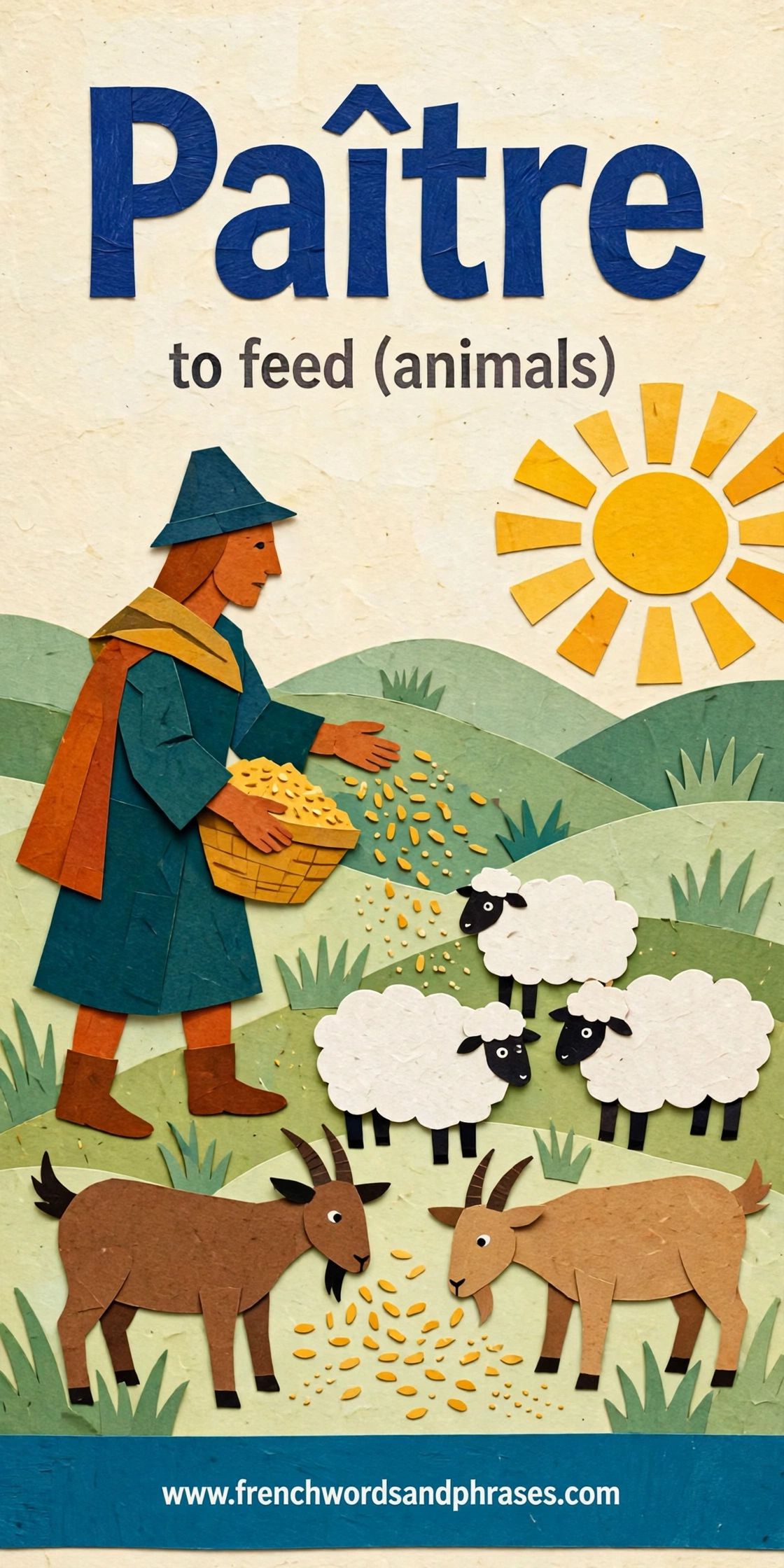
Paître means to feed (animals) — properly, it is the animals themselves who graze, cropping the grass of the meadow.
Hooves in wet grass, heads down, the slow music of tearing and chewing: paître is the literary verb of animals grazing — the cows, sheep and goats themselves do the paître-ing, and the shepherd’s part is faire paître, putting them out where the grass is good.
In this guide, you’ll learn how to conjugate paître in all the major French tenses and moods. Explore complete conjugation tables, French examples, English translations, and practice quizzes.
Understanding the French Verb Paître
Paître is an irregular French verb ending in -aître, conjugated like connaître — though modern French mostly uses it in the present tenses and the infinitive.
It means to feed (animals). It lives in literature, poetry and elevated prose for animals grazing — les troupeaux paissent — while everyday French says brouter or faire paître. Its one truly living everyday use is the rude idiom envoyer paître quelqu’un, to send someone packing, and its even ruder twin va te faire paître, get lost — literally, go and graze.
Verb classification: Irregular (-aître, like connaître)
Auxiliary verb: Avoir
Past participle: paît
Present participle: paissant
English equivalents: To graze, to feed (of animals); les vaches paissent l’herbe — the cows graze the grass; faire paître le troupeau — to put the flock out to graze; mener paître — to lead out to pasture; envoyer paître quelqu’un — to send someone packing (familiar); va te faire paître ! — get lost!
One important detail: paître is a semi-defective verb. It conjugates like connaître — note the circumflex on il paît and through the future (je paîtrai) — but modern French really only uses its present tenses and infinitive. The compound tenses are rare and bookish, and its past participle paît is invariable: les vaches ont paît. In real life the shepherd does not conjugate paître in the past — he says faire paître: le berger a fait paître ses moutons. And the dictionary’s gloss ‘to feed (animals)’ hides the direction: the animals paître (they graze); the human fait paître (puts them out to graze).
Experience the Word
Paître is the verb of heads down in the grass — grazing as the animals themselves live it, slow and total.
Imagine a high summer pasture in the Auvergne. Forty cows are scattered over the slope, each in her own world of grass and bells, paissant sans lever la tête — while the farmer, who a fait paître le troupeau at dawn, watches from the one patch of shade.
The herd asks for nothing more. They are grazing — paissant — and the meadow is doing all the work.
How to Conjugate Paître: Complete French Conjugation Guide
Let’s explore every major conjugation of paître, beginning with the indicative mood.
How to Conjugate Paître in the Indicative Mood
The indicative mood is used to express facts, observations, actions, and events.
How to Conjugate Paître in the Present Tense (Présent)
Used for actions happening now, habitual actions, and general truths.
| Subject | Conjugation |
|---|---|
| je | pais |
| tu | pais |
| il / elle | paît |
| nous | paissons |
| vous | paissez |
| ils / elles | paissent |
Les vaches paissent l’herbe tendre du pré.
The cows graze on the tender grass of the meadow.
Complete the sentence:
Les moutons ______ sur les hauteurs.
Reveal the answer
paissent
Les moutons paissent sur les hauteurs.
The sheep graze on the heights.
How to Conjugate Paître in the Passé Composé
Used for completed actions in the past. Paître takes the auxiliary verb avoir.
| Subject | Conjugation |
|---|---|
| j’ | ai paît |
| tu | as paît |
| il / elle | a paît |
| nous | avons paît |
| vous | avez paît |
| ils / elles | ont paît |
Le berger a fait paître ses moutons sur la colline.
The shepherd put his sheep out to graze on the hill.
How to Conjugate Paître in the Imparfait (Imperfect Tense)
Used for habitual past actions, descriptions, and ongoing situations in the past.
| Subject | Conjugation |
|---|---|
| je | paissais |
| tu | paissais |
| il / elle | paissait |
| nous | paissions |
| vous | paissiez |
| ils / elles | paissaient |
Les chèvres paissaient librement dans la garrigue.
The goats used to graze freely in the scrubland.
Choose the correct form:
The shepherd put his sheep out to graze.
Le berger ______ ses moutons. (a fait paître / a paît)
Reveal the answer
a fait paître
Le berger a fait paître ses moutons.
Humans faire paître; the animals do the grazing.
How to Conjugate Paître in the Plus-que-parfait
Used to describe an action that had already been completed before another past event.
| Subject | Conjugation |
|---|---|
| j’ | avais paît |
| tu | avais paît |
| il / elle | avait paît |
| nous | avions paît |
| vous | aviez paît |
| ils / elles | avaient paît |
Le berger avait fait paître le troupeau près de la source.
The shepherd had put the flock out to graze near the spring.
How to Conjugate Paître in the Passé Simple
Primarily used in formal writing, literature, and historical narratives. It is rarely used in everyday conversation.
| Subject | Conjugation |
|---|---|
| je | paîs |
| tu | paîs |
| il / elle | paît |
| nous | paîmes |
| vous | paîtes |
| ils / elles | paîrent |
Les bœufs paîrent l’herbe haute jusqu’au soir.
The oxen grazed on the tall grass until evening.
How to Conjugate Paître in the Passé Antérieur
A literary tense used to express an action completed immediately before another past action, generally in the passé simple.
| Subject | Conjugation |
|---|---|
| j’ | eus paît |
| tu | eus paît |
| il / elle | eut paît |
| nous | eûmes paît |
| vous | eûtes paît |
| ils / elles | eurent paît |
Quand les vaches eurent paît au bord du ruisseau, elles rentrèrent à l’étable.
When the cows had grazed by the stream, they went back to the byre.
How to Conjugate Paître in the Future Tense (Futur Simple)
Used to describe actions that will take place in the future.
| Subject | Conjugation |
|---|---|
| je | paîtrai |
| tu | paîtras |
| il / elle | paîtra |
| nous | paîtrons |
| vous | paîtrez |
| ils / elles | paîtront |
Demain, les moutons paîtront sur les hauteurs.
Tomorrow, the sheep will graze on the heights.
How to Conjugate Paître in the Futur Antérieur (Future Perfect)
Used for an action that will have been completed before a particular point in the future.
| Subject | Conjugation |
|---|---|
| j’ | aurai paît |
| tu | auras paît |
| il / elle | aura paît |
| nous | aurons paît |
| vous | aurez paît |
| ils / elles | auront paît |
À la nuit, le berger aura fait paître tout le troupeau.
By nightfall, the shepherd will have put the whole flock out to graze.
How to Conjugate Paître in the Near Future (Futur Proche)
Used to describe something that is going to happen soon. Formed with aller + infinitive.
| Subject | Conjugation |
|---|---|
| je | vais paître |
| tu | vas paître |
| il / elle | va paître |
| nous | allons paître |
| vous | allez paître |
| ils / elles | vont paître |
Le troupeau va paître dans le pré d’en bas.
The flock is going to graze in the lower meadow.
How to Conjugate Paître in the Conditional Mood
The conditional mood expresses what would happen under certain circumstances. It is also frequently used to make polite requests or express wishes.
How to Conjugate Paître in the Present Conditional
| Subject | Conjugation |
|---|---|
| je | paîtrais |
| tu | paîtrais |
| il / elle | paîtrait |
| nous | paîtrions |
| vous | paîtriez |
| ils / elles | paîtraient |
Sans la clôture, les vaches paîtraient chez le voisin.
Without the fence, the cows would graze at the neighbour’s.
How to Conjugate Paître in the Past Conditional
| Subject | Conjugation |
|---|---|
| j’ | aurais paît |
| tu | aurais paît |
| il / elle | aurait paît |
| nous | aurions paît |
| vous | auriez paît |
| ils / elles | auraient paît |
Le berger aurait fait paître ses chèvres plus tôt sans la pluie.
The shepherd would have put his goats out earlier if not for the rain.
Paître in the Literary Past Conditional Form
This less common literary form uses the imperfect subjunctive of avoir.
| Subject | Conjugation |
|---|---|
| j’ | eusse paît |
| tu | eusses paît |
| il / elle | eût paît |
| nous | eussions paît |
| vous | eussiez paît |
| ils / elles | eussent paît |
Les troupeaux eussent paît ces prairies sans la sécheresse.
The herds would have grazed these meadows without the drought.
How to Conjugate Paître in the Subjunctive Mood
The subjunctive is used to express wishes, emotions, doubts, necessity, and uncertainty. It frequently follows expressions such as il faut que (it is necessary that) or bien que (although).
How to Conjugate Paître in the Present Subjunctive
| Subject | Conjugation |
|---|---|
| que je | paisse |
| que tu | paisses |
| qu’il / qu’elle | paisse |
| que nous | paissions |
| que vous | paissiez |
| qu’ils / qu’elles | paissent |
Il faut que les brebis paissent loin de la route.
The ewes must graze far from the road.
Complete the sentence using the subjunctive:
Il faut que les brebis ______ loin de la route.
Reveal the answer
paissent
Il faut que les brebis paissent loin de la route.
The ewes must graze far from the road.
How to Conjugate Paître in the Imperfect Subjunctive
A literary tense, rarely encountered in modern spoken French.
| Subject | Conjugation |
|---|---|
| que je | paîsse |
| que tu | paîsses |
| qu’il / qu’elle | paît |
| que nous | paîssions |
| que vous | paîssiez |
| qu’ils / qu’elles | paîssent |
Le berger veillait à ce que les vaches paîssent en paix.
The shepherd saw to it that the cows grazed in peace.
How to Conjugate Paître in the Pluperfect Subjunctive
A literary construction used to express an action completed before another past action.
| Subject | Conjugation |
|---|---|
| que j’ | eusse paît |
| que tu | eusses paît |
| qu’il / qu’elle | eût paît |
| que nous | eussions paît |
| que vous | eussiez paît |
| qu’ils / qu’elles | eussent paît |
On racontait que les troupeaux eussent paît ces terres avant la guerre.
It was said that the herds had grazed these lands before the war.
How to Conjugate Paître in the Past Subjunctive
| Subject | Conjugation |
|---|---|
| que j’ | aie paît |
| que tu | aies paît |
| qu’il / qu’elle | ait paît |
| que nous | ayons paît |
| que vous | ayez paît |
| qu’ils / qu’elles | aient paît |
Je suis content que le berger ait fait paître les moutons de bonne heure.
I am glad the shepherd put the sheep out to graze early.
How to Conjugate Paître in the Imperative
The imperative is used to give commands, instructions, invitations, or suggestions. Subject pronouns are omitted.
How to Conjugate Paître in the Present Imperative
| Person | Conjugation |
|---|---|
| (tu) | pais |
| (nous) | paissons |
| (vous) | paissez |
Paissez, mes brebis, l’herbe est belle !
Graze, my ewes, the grass is fine!
How would you say Graze, my ewes (vous form)?
Reveal the answer
Paissez, mes brebis !
French Participles of Paître
Participles are verb forms that can be used in compound tenses and other grammatical constructions.
Present Participle of Paître
paissant
En paissant au bord du chemin, les chèvres attirent les enfants.
While grazing by the roadside, the goats attract the children.
Past Participle of Paître
paît
Paît par les troupeaux depuis des siècles, ce pré reste vert.
Grazed by herds for centuries, this meadow stays green.
Paître in Everyday French: Real-Life Examples
Now that you know the conjugations, let’s see how paître appears in everyday French.
Les vaches paissent l’herbe du pré.
The cows graze on the grass of the meadow.
Le berger a fait paître ses moutons.
The shepherd put his sheep out to graze.
Les chèvres paissaient dans la garrigue.
The goats used to graze in the scrubland.
Les moutons paîtront sur les hauteurs.
The sheep will graze on the heights.
Les vaches paîtraient chez le voisin sans la clôture.
The cows would graze at the neighbour’s without the fence.
Paissez, mes brebis !
Graze, my ewes!
Beyond Translation: The Meaning of Paître
Paître descends from the Latin pascere, to feed — the root of pacager, pâture and pasteur, the shepherd who became a pastor because his flock, too, had to be fed and led to grass.
Its rudest idiom is its most alive.
Envoyer paître quelqu’un — to send someone off to graze — is the standard French way to send someone packing, and va te faire paître ! dismisses a nuisance to the meadow for good. The verb of peaceful grazing is, in the imperative, gloriously impolite.
How to Remember the French Verb Paître
Remember it this way: Paître is about heads down in the Auvergne grass — and the rude envoyer paître.
- Direction matters: the animals paissent (they graze); the human fait paître (puts them out) — faire paître is the everyday frame.
- Semi-defective: present tenses and infinitive in real life; the past participle paît is invariable and rare.
- Its living idiom: envoyer paître quelqu’un — to send someone packing; va te faire paître ! — get lost!
The key idea is heads down in the Auvergne grass — and the rude envoyer paître.
Test Your Knowledge of Paître
Let’s see how much you’ve learned. Try answering these questions before revealing the answers.
How does a shepherd say he put his sheep out to graze?
Reveal the answer
With faire paître — le berger a fait paître ses moutons; the animals themselves paissent.
How do you say The cows graze on the grass of the meadow in French?
Reveal the answer
Les vaches paissent l’herbe du pré.
Translate: Go and graze! (the rude dismissal)
Reveal the answer
Va te faire paître !
What is the past participle of paître?
Reveal the answer
Paît — and it is invariable: les vaches ont paît.
Complete the sentence:
Il faut que les brebis ______ loin de la route.
Reveal the answer
paissent
Il faut que les brebis paissent loin de la route.
The ewes must graze far from the road.
Can You Use It?
How would you say this in French?
The cows graze in the evening light, and the whole meadow breathes slowly.
Reveal the answer
Les vaches paissent dans la lumière du soir, et le pré entier respire lentement.
The cows graze in the evening light, and the whole meadow breathes slowly.
LEARN FRENCH ONE WORD AT A TIME