How to Conjugate Pailleter in French
/paj.te/
Pailleter means to spangle, to flake — to scatter a surface with tiny shining scales, sequins or flakes of gold.
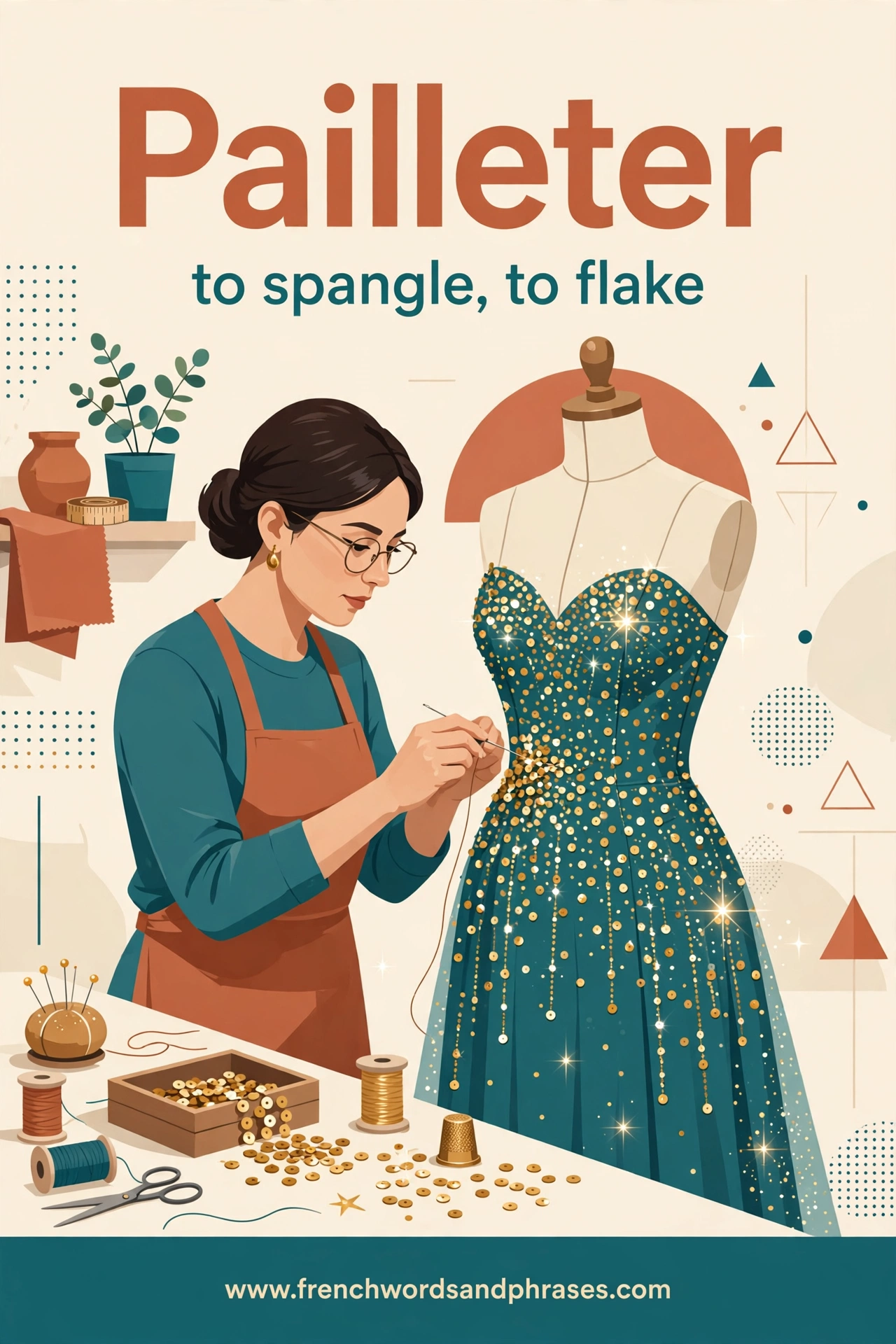
A costume workshop before opening night: a dress on a stand, a bowl of sequins, and a needle flashing in and out. Pailleter is the verb of that sparkle — covering cloth with spangles — and of the tiny flakes, of gold or mica, that catch the light wherever they fall.
In this guide, you’ll learn how to conjugate pailleter in all the major French tenses and moods. Explore complete conjugation tables, French examples, English translations, and practice quizzes.
Understanding the French Verb Pailleter
Pailleter is a regular French verb belonging to the first group of verbs, those ending in -er.
It means to spangle, to flake. Its home is the costume and fashion workshop — une robe pailletée is a sequinned dress — and anywhere tiny flakes shine: gold leaf (des paillettes d’or), mica in rock, soap flakes (du savon en paillettes). Intransitively, a surface that flakes or sparkles can pailleter, like paint peeling in scales or light dancing on water.
Verb classification: First group (-er)
Auxiliary verb: Avoir
Past participle: pailleté
Present participle: pailletant
English equivalents: To spangle, to flake; pailleter une robe — to spangle a dress; des paillettes — sequins, spangles; des paillettes d’or — gold flakes, gold leaf fragments; un savon en paillettes — soap flakes; pailleter de lumière — to fleck with light.
One important detail: pailleter conjugates like jeter — the t doubles wherever the next syllable is mute: je paillette, tu paillettes, elle paillette, ils paillettent, through the whole future and conditional (je pailletterai, je pailletterais), in the subjunctive singular and third plural (que je paillette, qu’ils paillettent) and in the tu imperative (paillette !). The single t stays where the ending is sounded: nous pailletons, vous pailletez, je pailletais, en pailletant, and in the infinitive and participle, pailleter, pailleté.
Experience the Word
Pailleter is the verb of a thousand tiny mirrors — each flake small, the effect unforgettable.
Imagine the dressmaker’s table the night before the premiere. Bowl by bowl, the sequins disappear under her needle — elle paillette le corsage, rang après rang — until the plain black dress stands up and turns into a galaxy when the actress moves.
One sequin is nothing. Ten thousand of them, pailletés, are a star entering the stage.
How to Conjugate Pailleter: Complete French Conjugation Guide
Let’s explore every major conjugation of pailleter, beginning with the indicative mood.
How to Conjugate Pailleter in the Indicative Mood
The indicative mood is used to express facts, observations, actions, and events.
How to Conjugate Pailleter in the Present Tense (Présent)
Used for actions happening now, habitual actions, and general truths.
| Subject | Conjugation |
|---|---|
| je | paillette |
| tu | paillettes |
| il / elle | paillette |
| nous | pailletons |
| vous | pailletez |
| ils / elles | paillettent |
La costumière paillette la robe de scène à la main.
The costume designer spangles the stage dress by hand.
Complete the sentence:
Nous ______ les manteaux des danseuses.
Reveal the answer
pailletons
Nous pailletons les manteaux des danseuses.
We spangle the dancers’ cloaks.
How to Conjugate Pailleter in the Passé Composé
Used for completed actions in the past. Pailleter takes the auxiliary verb avoir.
| Subject | Conjugation |
|---|---|
| j’ | ai pailleté |
| tu | as pailleté |
| il / elle | a pailleté |
| nous | avons pailleté |
| vous | avez pailleté |
| ils / elles | ont pailleté |
Elle a pailleté tout le corsage en une soirée.
She spangled the whole bodice in one evening.
How to Conjugate Pailleter in the Imparfait (Imperfect Tense)
Used for habitual past actions, descriptions, and ongoing situations in the past.
| Subject | Conjugation |
|---|---|
| je | pailletais |
| tu | pailletais |
| il / elle | pailletait |
| nous | pailletions |
| vous | pailletiez |
| ils / elles | pailletaient |
Les brodeuses pailletaient les manteaux des danseuses.
The embroiderers used to spangle the dancers’ cloaks.
Choose the correct form:
She spangled the whole bodice.
Elle ______ tout le corsage. (a pailleté / est pailletée)
Reveal the answer
a pailleté
Elle a pailleté tout le corsage.
Pailleter takes avoir.
How to Conjugate Pailleter in the Plus-que-parfait
Used to describe an action that had already been completed before another past event.
| Subject | Conjugation |
|---|---|
| j’ | avais pailleté |
| tu | avais pailleté |
| il / elle | avait pailleté |
| nous | avions pailleté |
| vous | aviez pailleté |
| ils / elles | avaient pailleté |
Il avait pailleté la nappe pour la fête.
He had spangled the tablecloth for the party.
How to Conjugate Pailleter in the Passé Simple
Primarily used in formal writing, literature, and historical narratives. It is rarely used in everyday conversation.
| Subject | Conjugation |
|---|---|
| je | pailletai |
| tu | pailletas |
| il / elle | pailleta |
| nous | pailletâmes |
| vous | pailletâtes |
| ils / elles | pailletèrent |
La fée pailleta la robe d’un geste de sa baguette.
The fairy spangled the dress with a wave of her wand.
How to Conjugate Pailleter in the Passé Antérieur
A literary tense used to express an action completed immediately before another past action, generally in the passé simple.
| Subject | Conjugation |
|---|---|
| j’ | eus pailleté |
| tu | eus pailleté |
| il / elle | eut pailleté |
| nous | eûmes pailleté |
| vous | eûtes pailleté |
| ils / elles | eurent pailleté |
Quand elle eut pailleté le voile, la robe fut prête.
When she had spangled the veil, the dress was ready.
How to Conjugate Pailleter in the Future Tense (Futur Simple)
Used to describe actions that will take place in the future.
| Subject | Conjugation |
|---|---|
| je | pailletterai |
| tu | pailletteras |
| il / elle | paillettera |
| nous | pailletterons |
| vous | pailletterez |
| ils / elles | pailletteront |
Je pailletterai le haut de la robe demain.
I will spangle the top of the dress tomorrow.
How to Conjugate Pailleter in the Futur Antérieur (Future Perfect)
Used for an action that will have been completed before a particular point in the future.
| Subject | Conjugation |
|---|---|
| j’ | aurai pailleté |
| tu | auras pailleté |
| il / elle | aura pailleté |
| nous | aurons pailleté |
| vous | aurez pailleté |
| ils / elles | auront pailleté |
À la fin de la semaine, elles auront pailleté tous les costumes.
By the end of the week, they will have spangled all the costumes.
How to Conjugate Pailleter in the Near Future (Futur Proche)
Used to describe something that is going to happen soon. Formed with aller + infinitive.
| Subject | Conjugation |
|---|---|
| je | vais pailleter |
| tu | vas pailleter |
| il / elle | va pailleter |
| nous | allons pailleter |
| vous | allez pailleter |
| ils / elles | vont pailleter |
Attention, la peinture va pailleter en séchant.
Careful, the paint is going to flake as it dries.
How to Conjugate Pailleter in the Conditional Mood
The conditional mood expresses what would happen under certain circumstances. It is also frequently used to make polite requests or express wishes.
How to Conjugate Pailleter in the Present Conditional
| Subject | Conjugation |
|---|---|
| je | pailletterais |
| tu | pailletterais |
| il / elle | pailletterait |
| nous | pailletterions |
| vous | pailletteriez |
| ils / elles | pailletteraient |
Avec plus de temps, je pailletterais aussi les manches.
With more time, I would spangle the sleeves too.
How to Conjugate Pailleter in the Past Conditional
| Subject | Conjugation |
|---|---|
| j’ | aurais pailleté |
| tu | aurais pailleté |
| il / elle | aurait pailleté |
| nous | aurions pailleté |
| vous | auriez pailleté |
| ils / elles | auraient pailleté |
Elle aurait pailleté le corsage sans la panne de machine.
She would have spangled the bodice without the machine breakdown.
Pailleter in the Literary Past Conditional Form
This less common literary form uses the imperfect subjunctive of avoir.
| Subject | Conjugation |
|---|---|
| j’ | eusse pailleté |
| tu | eusses pailleté |
| il / elle | eût pailleté |
| nous | eussions pailleté |
| vous | eussiez pailleté |
| ils / elles | eussent pailleté |
Elle eût pailleté la robe entière pour le bal.
She would have spangled the whole dress for the ball.
How to Conjugate Pailleter in the Subjunctive Mood
The subjunctive is used to express wishes, emotions, doubts, necessity, and uncertainty. It frequently follows expressions such as il faut que (it is necessary that) or bien que (although).
How to Conjugate Pailleter in the Present Subjunctive
| Subject | Conjugation |
|---|---|
| que je | paillette |
| que tu | paillettes |
| qu’il / qu’elle | paillette |
| que nous | pailletions |
| que vous | pailletiez |
| qu’ils / qu’elles | paillettent |
Il faut que tu paillettes le bord du voile.
You must spangle the edge of the veil.
Complete the sentence using the subjunctive:
Il faut que vous ______ les costumes avant vendredi.
Reveal the answer
pailletiez
Il faut que vous pailletiez les costumes avant vendredi.
You must spangle the costumes before Friday.
How to Conjugate Pailleter in the Imperfect Subjunctive
A literary tense, rarely encountered in modern spoken French.
| Subject | Conjugation |
|---|---|
| que je | pailletasse |
| que tu | pailletasses |
| qu’il / qu’elle | pailletât |
| que nous | pailletassions |
| que vous | pailletassiez |
| qu’ils / qu’elles | pailletassent |
On demandait que la brodeuse pailletât les épaules.
They asked the embroiderer to spangle the shoulders.
How to Conjugate Pailleter in the Pluperfect Subjunctive
A literary construction used to express an action completed before another past action.
| Subject | Conjugation |
|---|---|
| que j’ | eusse pailleté |
| que tu | eusses pailleté |
| qu’il / qu’elle | eût pailleté |
| que nous | eussions pailleté |
| que vous | eussiez pailleté |
| qu’ils / qu’elles | eussent pailleté |
On admirait qu’elle eût pailleté tout le manteau à la main.
People admired that she had spangled the whole cloak by hand.
How to Conjugate Pailleter in the Past Subjunctive
| Subject | Conjugation |
|---|---|
| que j’ | aie pailleté |
| que tu | aies pailleté |
| qu’il / qu’elle | ait pailleté |
| que nous | ayons pailleté |
| que vous | ayez pailleté |
| qu’ils / qu’elles | aient pailleté |
Je suis ravi que tu aies pailleté la robe à temps.
I am delighted you spangled the dress in time.
How to Conjugate Pailleter in the Imperative
The imperative is used to give commands, instructions, invitations, or suggestions. Subject pronouns are omitted.
How to Conjugate Pailleter in the Present Imperative
| Person | Conjugation |
|---|---|
| (tu) | paillette |
| (nous) | pailletons |
| (vous) | pailletez |
Paillette les manches aussi, ce sera plus joli !
Spangle the sleeves too, it will be prettier!
How would you say Spangle the sleeves too (tu form)?
Reveal the answer
Paillette les manches aussi !
French Participles of Pailleter
Participles are verb forms that can be used in compound tenses and other grammatical constructions.
Present Participle of Pailleter
pailletant
En pailletant la robe, elle chantonne doucement.
While spangling the dress, she hums softly.
Past Participle of Pailleter
pailleté
Pailletée d’or, la robe brillait sous les projecteurs.
Spangled with gold, the dress shone under the spotlights.
Pailleter in Everyday French: Real-Life Examples
Now that you know the conjugations, let’s see how pailleter appears in everyday French.
La costumière paillette la robe de scène.
The costume designer spangles the stage dress.
Elle a pailleté tout le corsage.
She spangled the whole bodice.
Les brodeuses pailletaient les manteaux.
The embroiderers used to spangle the cloaks.
Je pailletterai le haut de la robe demain.
I will spangle the top of the dress tomorrow.
Je pailletterais aussi les manches avec plus de temps.
I would spangle the sleeves too with more time.
Paillette les manches aussi !
Spangle the sleeves too!
Beyond Translation: The Meaning of Pailleter
A paillette is a little paille — a tiny scale or straw of shining matter — and French uses the word for sequins, for flakes of gold, for soap flakes and even for the glitter in nail varnish.
Pailleter is straw turned to starlight.
The same root that beds down cows in pailler here covers a dress in light: say une robe pailletée and every French listener sees the sparkle before you describe a single sequin.
How to Remember the French Verb Pailleter
Remember it this way: Pailleter is about the sequinned dress turning into a galaxy under the lights.
- Jeter-type doubling: je paillette with two t’s, but nous pailletons with one — the t doubles only before a mute syllable.
- The future doubles all the way: je pailletterai, je pailletterais.
- Une paillette is a sequin or a flake — des paillettes d’or are gold flakes, du savon en paillettes is soap flakes.
The key idea is the sequinned dress turning into a galaxy under the lights.
Test Your Knowledge of Pailleter
Let’s see how much you’ve learned. Try answering these questions before revealing the answers.
Why does je paillette have two t’s but nous pailletons only one?
Reveal the answer
The jeter rule — the consonant doubles before a mute syllable (je paillette, ils paillettent) and stays single where the ending is sounded (nous pailletons).
How do you say She spangled the whole bodice in French?
Reveal the answer
Elle a pailleté tout le corsage.
Translate: I will spangle the top of the dress tomorrow.
Reveal the answer
Je pailletterai le haut de la robe demain.
What is the past participle of pailleter?
Reveal the answer
Pailleté.
Complete the sentence:
Il faut que tu ______ le bord du voile.
Reveal the answer
paillettes
Il faut que tu paillettes le bord du voile.
You must spangle the edge of the veil.
Can You Use It?
How would you say this in French?
She spangles the dress all night, and by morning, the stage will have its star.
Reveal the answer
Elle paillette la robe toute la nuit, et au matin, la scène aura son étoile.
She spangles the dress all night, and by morning, the stage will have its star.
LEARN FRENCH ONE WORD AT A TIME