How to Conjugate Pacager in French
/pa.ka.ʒe/
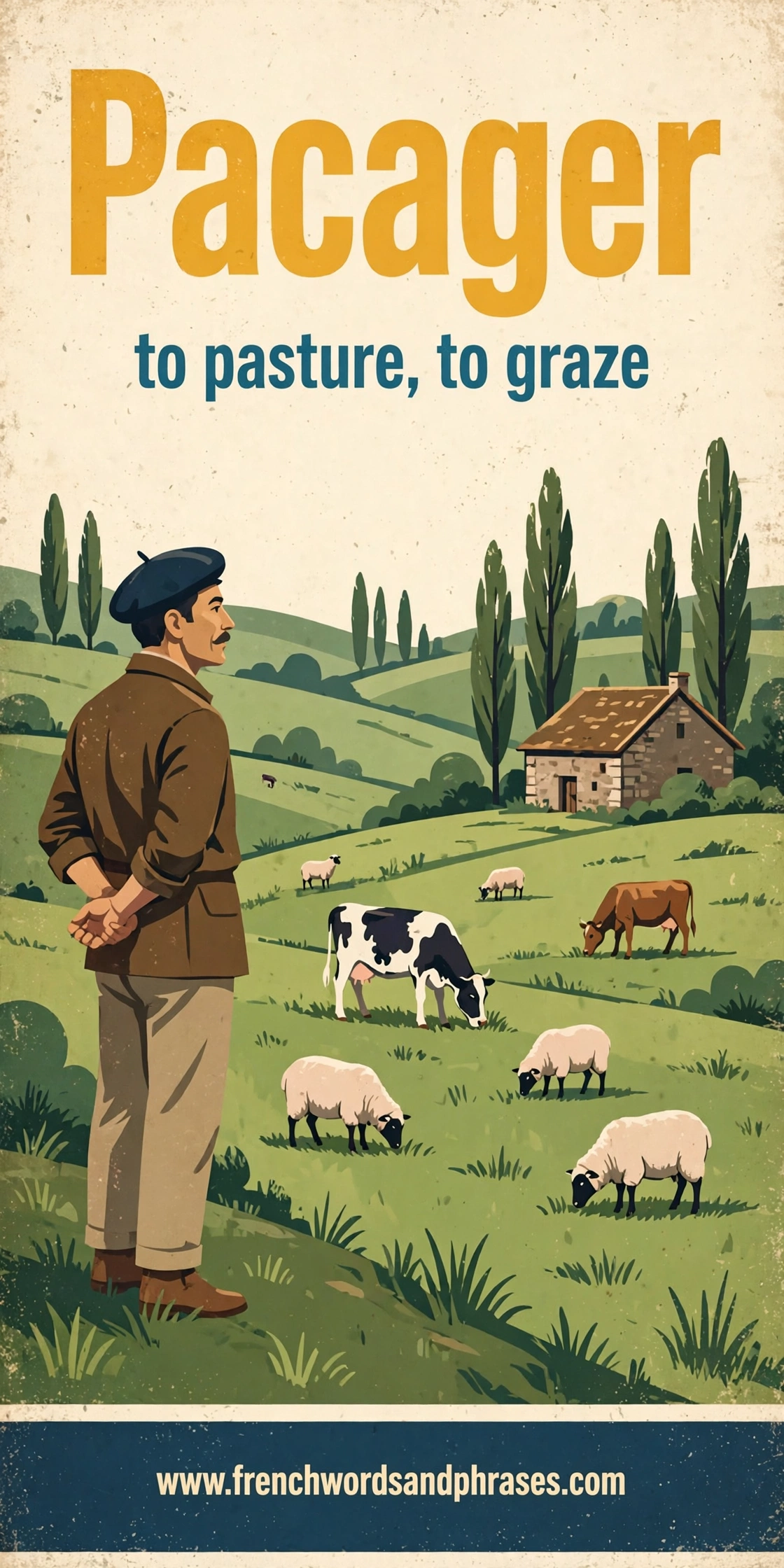
Pacager means to pasture, to graze — to lead the herd out onto the grass, or to be out there on the grass eating it.
Dawn on a small farm: the gate creaks open, the cows file out nose to tail, and the meadow fills with slow, contented munching. Pacager is the old farming verb for all of it — putting animals out to pasture, and the animals grazing once they are there.
In this guide, you’ll learn how to conjugate pacager in all the major French tenses and moods. Explore complete conjugation tables, French examples, English translations, and practice quizzes.
Understanding the French Verb Pacager
Pacager is a regular French verb belonging to the first group of verbs, those ending in -er.
It means to pasture, to graze. It is the traditional word of common land and village herds — le droit de pacage was the peasants’ right to graze animals on shared ground. Today it survives in farming, in law and in literature, where everyday speech more often says faire paître or laisser brouter.
Verb classification: First group (-er)
Auxiliary verb: Avoir
Past participle: pacagé
Present participle: pacageant
English equivalents: To pasture, to graze; pacager les vaches — to put the cows out to pasture; faire pacager un troupeau — to graze a flock; les moutons pacagent dans le pré — the sheep are grazing in the meadow; le droit de pacage — the right of common grazing.
One important detail: pacager is a -ger verb, so it keeps a protective e before the endings in a and o: nous pacageons, je pacageais, je pacageai, en pacageant — never *pacagons. Elsewhere the g stands alone: je pacage, tu pacages, ils pacagent. The verb works both ways: the farmer pacage ses vaches (puts them out), and the cows themselves pacagent (graze).
Experience the Word
Pacager is the verb of the open gate — the moment the herd leaves the yard and the whole meadow becomes a dining room.
Imagine a goatherd in the hills above a Provençal village. Every morning he opens the pen, and his goats spread over the thyme-scented slope, pacageant from tuft to tuft while their bells ring the hours better than any clock.
No hurry, no fences in their minds. They are grazing — pacageant — exactly as their ancestors did on this same hill.
How to Conjugate Pacager: Complete French Conjugation Guide
Let’s explore every major conjugation of pacager, beginning with the indicative mood.
How to Conjugate Pacager in the Indicative Mood
The indicative mood is used to express facts, observations, actions, and events.
How to Conjugate Pacager in the Present Tense (Présent)
Used for actions happening now, habitual actions, and general truths.
| Subject | Conjugation |
|---|---|
| je | pacage |
| tu | pacages |
| il / elle | pacage |
| nous | pacageons |
| vous | pacagez |
| ils / elles | pacagent |
Le fermier pacage ses vaches dans le pré derrière la grange.
The farmer pastures his cows in the meadow behind the barn.
Complete the sentence:
Nous ______ les chevaux dans le grand enclos.
Reveal the answer
pacageons
Nous pacageons les chevaux dans le grand enclos.
We pasture the horses in the big enclosure.
How to Conjugate Pacager in the Passé Composé
Used for completed actions in the past. Pacager takes the auxiliary verb avoir.
| Subject | Conjugation |
|---|---|
| j’ | ai pacagé |
| tu | as pacagé |
| il / elle | a pacagé |
| nous | avons pacagé |
| vous | avez pacagé |
| ils / elles | ont pacagé |
Ils ont pacagé le troupeau sur les terres communales.
They pastured the flock on the common lands.
How to Conjugate Pacager in the Imparfait (Imperfect Tense)
Used for habitual past actions, descriptions, and ongoing situations in the past.
| Subject | Conjugation |
|---|---|
| je | pacageais |
| tu | pacageais |
| il / elle | pacageait |
| nous | pacagions |
| vous | pacagiez |
| ils / elles | pacageaient |
Les moutons pacageaient paisiblement sur la colline.
The sheep were grazing peacefully on the hill.
Choose the correct form:
The sheep were grazing on the hill.
Les moutons ______ sur la colline. (pacageaient / pacagaient)
Reveal the answer
pacageaient
Les moutons pacageaient sur la colline.
A -ger verb keeps its e before a: pacageaient.
How to Conjugate Pacager in the Plus-que-parfait
Used to describe an action that had already been completed before another past event.
| Subject | Conjugation |
|---|---|
| j’ | avais pacagé |
| tu | avais pacagé |
| il / elle | avait pacagé |
| nous | avions pacagé |
| vous | aviez pacagé |
| ils / elles | avaient pacagé |
Le berger avait pacagé ses chèvres près de la rivière.
The goatherd had pastured his goats near the river.
How to Conjugate Pacager in the Passé Simple
Primarily used in formal writing, literature, and historical narratives. It is rarely used in everyday conversation.
| Subject | Conjugation |
|---|---|
| je | pacageai |
| tu | pacageas |
| il / elle | pacagea |
| nous | pacageâmes |
| vous | pacageâtes |
| ils / elles | pacageèrent |
Les vaches pacagèrent tout le jour dans la vallée.
The cows grazed all day long in the valley.
How to Conjugate Pacager in the Passé Antérieur
A literary tense used to express an action completed immediately before another past action, generally in the passé simple.
| Subject | Conjugation |
|---|---|
| j’ | eus pacagé |
| tu | eus pacagé |
| il / elle | eut pacagé |
| nous | eûmes pacagé |
| vous | eûtes pacagé |
| ils / elles | eurent pacagé |
Quand le fermier eut pacagé les bêtes, il ferma la barrière.
When the farmer had pastured the animals, he closed the gate.
How to Conjugate Pacager in the Future Tense (Futur Simple)
Used to describe actions that will take place in the future.
| Subject | Conjugation |
|---|---|
| je | pacagerai |
| tu | pacageras |
| il / elle | pacagera |
| nous | pacagerons |
| vous | pacagerez |
| ils / elles | pacageront |
Demain, nous pacagerons les chevaux dans le grand enclos.
Tomorrow, we will pasture the horses in the big enclosure.
How to Conjugate Pacager in the Futur Antérieur (Future Perfect)
Used for an action that will have been completed before a particular point in the future.
| Subject | Conjugation |
|---|---|
| j’ | aurai pacagé |
| tu | auras pacagé |
| il / elle | aura pacagé |
| nous | aurons pacagé |
| vous | aurez pacagé |
| ils / elles | auront pacagé |
À la tombée de la nuit, le berger aura pacagé tout le troupeau.
By nightfall, the shepherd will have pastured the whole flock.
How to Conjugate Pacager in the Near Future (Futur Proche)
Used to describe something that is going to happen soon. Formed with aller + infinitive.
| Subject | Conjugation |
|---|---|
| je | vais pacager |
| tu | vas pacager |
| il / elle | va pacager |
| nous | allons pacager |
| vous | allez pacager |
| ils / elles | vont pacager |
Le troupeau va pacager sur les hauteurs ce matin.
The flock is going to graze on the heights this morning.
How to Conjugate Pacager in the Conditional Mood
The conditional mood expresses what would happen under certain circumstances. It is also frequently used to make polite requests or express wishes.
How to Conjugate Pacager in the Present Conditional
| Subject | Conjugation |
|---|---|
| je | pacagerais |
| tu | pacagerais |
| il / elle | pacagerait |
| nous | pacagerions |
| vous | pacageriez |
| ils / elles | pacageraient |
Sans la sécheresse, les vaches pacageraient dans des prés verts.
Without the drought, the cows would graze in green meadows.
How to Conjugate Pacager in the Past Conditional
| Subject | Conjugation |
|---|---|
| j’ | aurais pacagé |
| tu | aurais pacagé |
| il / elle | aurait pacagé |
| nous | aurions pacagé |
| vous | auriez pacagé |
| ils / elles | auraient pacagé |
Il aurait pacagé les moutons plus tôt si la pluie avait cessé.
He would have pastured the sheep earlier if the rain had stopped.
Pacager in the Literary Past Conditional Form
This less common literary form uses the imperfect subjunctive of avoir.
| Subject | Conjugation |
|---|---|
| j’ | eusse pacagé |
| tu | eusses pacagé |
| il / elle | eût pacagé |
| nous | eussions pacagé |
| vous | eussiez pacagé |
| ils / elles | eussent pacagé |
Les troupeaux eussent pacagé ces terres sans la clôture nouvelle.
The herds would have grazed these lands without the new fence.
How to Conjugate Pacager in the Subjunctive Mood
The subjunctive is used to express wishes, emotions, doubts, necessity, and uncertainty. It frequently follows expressions such as il faut que (it is necessary that) or bien que (although).
How to Conjugate Pacager in the Present Subjunctive
| Subject | Conjugation |
|---|---|
| que je | pacage |
| que tu | pacages |
| qu’il / qu’elle | pacage |
| que nous | pacagions |
| que vous | pacagiez |
| qu’ils / qu’elles | pacagent |
Il faut que le berger pacage les chèvres avant midi.
The shepherd must pasture the goats before noon.
Complete the sentence using the subjunctive:
Il faut que tu ______ les vaches avant la pluie.
Reveal the answer
pacages
Il faut que tu pacages les vaches avant la pluie.
You must put the cows out to pasture before the rain.
How to Conjugate Pacager in the Imperfect Subjunctive
A literary tense, rarely encountered in modern spoken French.
| Subject | Conjugation |
|---|---|
| que je | pacagasse |
| que tu | pacagasses |
| qu’il / qu’elle | pacagât |
| que nous | pacagassions |
| que vous | pacagassiez |
| qu’ils / qu’elles | pacagassent |
Le fermier voulait que les vaches pacageassent loin de la route.
The farmer wanted the cows to graze far from the road.
How to Conjugate Pacager in the Pluperfect Subjunctive
A literary construction used to express an action completed before another past action.
| Subject | Conjugation |
|---|---|
| que j’ | eusse pacagé |
| que tu | eusses pacagé |
| qu’il / qu’elle | eût pacagé |
| que nous | eussions pacagé |
| que vous | eussiez pacagé |
| qu’ils / qu’elles | eussent pacagé |
On racontait que les bergers eussent pacagé leurs troupeaux jusqu’au sommet.
It was said that the shepherds had grazed their flocks right up to the summit.
How to Conjugate Pacager in the Past Subjunctive
| Subject | Conjugation |
|---|---|
| que j’ | aie pacagé |
| que tu | aies pacagé |
| qu’il / qu’elle | ait pacagé |
| que nous | ayons pacagé |
| que vous | ayez pacagé |
| qu’ils / qu’elles | aient pacagé |
Je suis content que tu aies pacagé les chevaux de bonne heure.
I am glad you pastured the horses early.
How to Conjugate Pacager in the Imperative
The imperative is used to give commands, instructions, invitations, or suggestions. Subject pronouns are omitted.
How to Conjugate Pacager in the Present Imperative
| Person | Conjugation |
|---|---|
| (tu) | pacage |
| (nous) | pacageons |
| (vous) | pacagez |
Pacageons les vaches avant l’orage !
Let us put the cows out to pasture before the storm!
How would you say Put the cows out to pasture (tu form)?
Reveal the answer
Pacage les vaches !
French Participles of Pacager
Participles are verb forms that can be used in compound tenses and other grammatical constructions.
Present Participle of Pacager
pacageant
En pacageant ses moutons près du village, le berger surveille la route.
While pasturing his sheep near the village, the shepherd watches the road.
Past Participle of Pacager
pacagé
Pacagées tout l’été sur l’alpage, les vaches donnent un lait riche.
Pastured all summer on the alpine pasture, the cows give rich milk.
Pacager in Everyday French: Real-Life Examples
Now that you know the conjugations, let’s see how pacager appears in everyday French.
Les vaches pacagent dans le pré.
The cows are grazing in the meadow.
Le berger a pacagé les moutons sur la colline.
The shepherd pastured the sheep on the hill.
Les chèvres pacageaient près de la rivière.
The goats used to graze near the river.
Nous pacagerons les chevaux demain matin.
We will pasture the horses tomorrow morning.
Les vaches pacageraient ici sans la clôture.
The cows would graze here without the fence.
Pacage les vaches avant la pluie !
Put the cows out to pasture before the rain!
Beyond Translation: The Meaning of Pacager
Behind pacager stands the Latin pascere, to feed — the same root that gives French paître, pâture (pasture) and pasteur, the shepherd who became the pastor.
Its noun, le pacage, is the pasture itself.
For centuries le droit de pacage — the right to graze your animals on the village common — was written into law and fought over like water or wood; the verb still carries that smell of shared grass and old rights.
How to Remember the French Verb Pacager
Remember it this way: Pacager is about the herd filing out of the gate into the morning meadow.
- A -ger verb: keep the e before a and o — nous pacageons, je pacageais, en pacageant.
- Two directions in one verb: the farmer pacage ses vaches, and the cows pacagent all by themselves.
- Regular endings otherwise: je pacage, nous pacageons, past participle pacagé.
The key idea is the herd filing out of the gate into the morning meadow.
Test Your Knowledge of Pacager
Let’s see how much you’ve learned. Try answering these questions before revealing the answers.
Why is it nous pacageons and not *nous pacagons?
Reveal the answer
The -ger rule — the e is kept before o to keep the g soft: nous pacageons, je pacageais.
How do you say The cows are grazing in the meadow in French?
Reveal the answer
Les vaches pacagent dans le pré.
Translate: The shepherd pastured the sheep on the hill.
Reveal the answer
Le berger a pacagé les moutons sur la colline.
What is the past participle of pacager?
Reveal the answer
Pacagé.
Complete the sentence:
Il faut que le berger ______ les chèvres avant midi.
Reveal the answer
pacage
Il faut que le berger pacage les chèvres avant midi.
The shepherd must pasture the goats before noon.
Can You Use It?
How would you say this in French?
At dawn, the shepherd opens the gate, and the whole flock grazes towards the light.
Reveal the answer
À l’aube, le berger ouvre la barrière, et tout le troupeau pacage vers la lumière.
At dawn, the shepherd opens the gate, and the whole flock grazes towards the light.
LEARN FRENCH ONE WORD AT A TIME