A French Word to Live By
How to Conjugate Saouler in French
/su.le/
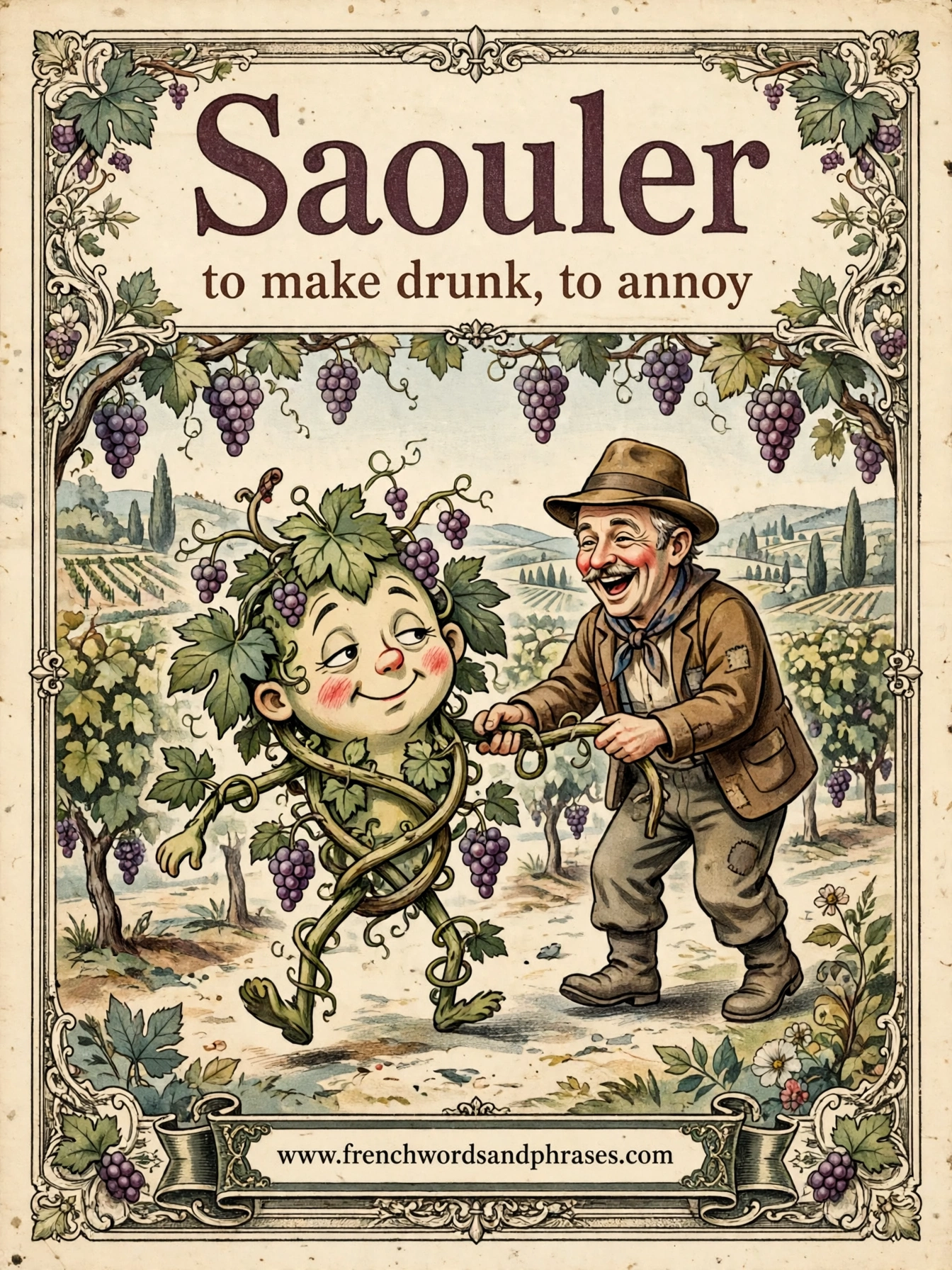
Saouler means to make drunk — and, in familiar French, to annoy someone beyond endurance: ça me saoule, I am fed up with it.
One glass too many at a wedding, a drill hammering through the wall at dawn, a colleague telling the same story for the tenth time — saouler is the verb of saturation: drink filling a person up, or boredom filling a person up, until there is no room left.
In this guide, you’ll learn how to conjugate saouler in all the major French tenses and moods. Explore complete conjugation tables, French examples, English translations, and practice quizzes.
Understanding the French Verb Saouler
Saouler is a regular French verb belonging to the first group of verbs, those ending in-er.
It means to make drunk, to annoy. It is commonly used at the table for wine and spirits doing their work, and far more often, in familiar speech, for anything that saturates and exasperates: noise, paperwork, delays, other people’s stories — saouler quelqu’un de chiffres, de discours, de questions. The reflexive se saouler means to get drunk.
Verb classification: First group (-er)
Auxiliary verb: Avoir
Past participle: saoulé
Present participle: saoulant
English equivalents: To make drunk, to get someone drunk; (familiar) to annoy, to bore stiff, to be a pain — ça me saoule, I am fed up with it; saouler quelqu’un de paroles — to talk someone’s ear off; tu me saoules ! — you are getting on my nerves!; also spelled soûler.
One important detail: saouler keeps a spelling secret — it is also written soûler, with a circumflex, and both spellings are correct; the a is silent either way, and the verb is pronounced as if it were written souler. The conjugation is a perfectly regular -er pattern: je saoule, nous saoulons, ils saoulent. The two senses split by register: making someone drunk is the literal, older sense; the everyday modern use is familiar and means to exasperate — ce bruit me saoule has nothing to do with alcohol, except in the metaphor: the noise fills you up like wine.
Experience the Word
Saouler is the verb of too much — too much wine in the glass, or too much noise in the day, until the mind is drunk on it.
Imagine a flat at seven in the morning. The neighbour’s drill starts, stops, starts again. By nine o’clock no wine has been drunk, yet the whole building is saoulé — fed up to the brim — and the word everyone uses is the drunkard’s word: ça me saoule.
Nothing was poured. Everyone is full — saoulé — of noise.
How to Conjugate Saouler: Complete French Conjugation Guide
Let’s explore every major conjugation of saouler, beginning with the indicative mood.
How to Conjugate Saouler in the Indicative Mood
The indicative mood is used to express facts, observations, actions, and events.
How to Conjugate Saouler in the Present Tense (Présent)
Used for actions happening now, habitual actions, and general truths.
| Subject | Conjugation |
|---|---|
| je | saoule |
| tu | saoules |
| il / elle | saoule |
| nous | saoulons |
| vous | saoulez |
| ils / elles | saoulent |
Example
Ce bruit de perceuse me saoule depuis ce matin.
This drill noise has been driving me mad since this morning.
Quick Quiz 1
Complete the sentence:
Ce bruit de perceuse nous ______.
Reveal the answer
saoule
Ce bruit de perceuse nous saoule.
This drill noise is driving us mad.
How to Conjugate Saouler in the Passé Composé
Used for completed actions in the past. Saouler takes the auxiliary verb avoir.
| Subject | Conjugation |
|---|---|
| j’ | ai saoulé |
| tu | as saoulé |
| il / elle | a saoulé |
| nous | avons saoulé |
| vous | avez saoulé |
| ils / elles | ont saoulé |
Example
Trois verres de vin l’ont saoulé complètement.
Three glasses of wine got him completely drunk.
How to Conjugate Saouler in the Imparfait (Imperfect Tense)
Used for habitual past actions, descriptions, and ongoing situations in the past.
| Subject | Conjugation |
|---|---|
| je | saoulais |
| tu | saoulais |
| il / elle | saoulait |
| nous | saoulions |
| vous | saouliez |
| ils / elles | saoulaient |
Example
Ses histoires sans fin nous saoulaient.
His endless stories used to bore us stiff.
Quick Quiz 2
Choose the correct form:
Three glasses got him drunk.
Trois verres ______. (l’ont saoulé / le sont saoulé)
Reveal the answer
l’ont saoulé
Trois verres l’ont saoulé.
Saouler takes avoir.
How to Conjugate Saouler in the Plus-que-parfait
Used to describe an action that had already been completed before another past event.
| Subject | Conjugation |
|---|---|
| j’ | avais saoulé |
| tu | avais saoulé |
| il / elle | avait saoulé |
| nous | avions saoulé |
| vous | aviez saoulé |
| ils / elles | avaient saoulé |
Example
Le vin chaud les avait saoulés avant le dessert.
The mulled wine had got them drunk before dessert.
How to Conjugate Saouler in the Passé Simple
Primarily used in formal writing, literature, and historical narratives. It is rarely used in everyday conversation.
| Subject | Conjugation |
|---|---|
| je | saoulai |
| tu | saoulas |
| il / elle | saoula |
| nous | saoulâmes |
| vous | saoulâtes |
| ils / elles | saoulèrent |
Example
La chaleur et le vin les saoulèrent dès le premier soir.
The heat and the wine made them drunk from the very first evening.
How to Conjugate Saouler in the Passé Antérieur
A literary tense used to express an action completed immediately before another past action, generally in the passé simple.
| Subject | Conjugation |
|---|---|
| j’ | eus saoulé |
| tu | eus saoulé |
| il / elle | eut saoulé |
| nous | eûmes saoulé |
| vous | eûtes saoulé |
| ils / elles | eurent saoulé |
Example
Quand le cidre les eut saoulés, ils se mirent à chanter.
When the cider had made them drunk, they started to sing.
How to Conjugate Saouler in the Future Tense (Futur Simple)
Used to describe actions that will take place in the future.
| Subject | Conjugation |
|---|---|
| je | saoulerai |
| tu | saouleras |
| il / elle | saoulera |
| nous | saoulerons |
| vous | saoulerez |
| ils / elles | saouleront |
Example
Ce travail répétitif te saoulera vite.
This repetitive work will soon get on your nerves.
How to Conjugate Saouler in the Futur Antérieur (Future Perfect)
Used for an action that will have been completed before a particular point in the future.
| Subject | Conjugation |
|---|---|
| j’ | aurai saoulé |
| tu | auras saoulé |
| il / elle | aura saoulé |
| nous | aurons saoulé |
| vous | aurez saoulé |
| ils / elles | auront saoulé |
Example
À la fin de la soirée, le vin les aura tous saoulés.
By the end of the evening, the wine will have made them all drunk.
How to Conjugate Saouler in the Near Future (Futur Proche)
Used to describe something that is going to happen soon. Formed with aller + infinitive.
| Subject | Conjugation |
|---|---|
| je | vais saouler |
| tu | vas saouler |
| il / elle | va saouler |
| nous | allons saouler |
| vous | allez saouler |
| ils / elles | vont saouler |
Example
Arrête, tu vas me saouler avec tes questions !
Stop, you are going to drive me mad with your questions!
How to Conjugate Saouler in the Conditional Mood
The conditional mood expresses what would happen under certain circumstances. It is also frequently used to make polite requests or express wishes.
How to Conjugate Saouler in the Present Conditional
| Subject | Conjugation |
|---|---|
| je | saoulerais |
| tu | saoulerais |
| il / elle | saoulerait |
| nous | saoulerions |
| vous | saouleriez |
| ils / elles | saouleraient |
Example
Rien que l’odeur de l’anis le saoulerait.
Just the smell of aniseed would make him drunk.
How to Conjugate Saouler in the Past Conditional
| Subject | Conjugation |
|---|---|
| j’ | aurais saoulé |
| tu | aurais saoulé |
| il / elle | aurait saoulé |
| nous | aurions saoulé |
| vous | auriez saoulé |
| ils / elles | auraient saoulé |
Example
Ce long voyage en car nous aurait saoulés.
That long coach journey would have driven us mad.
Saouler in the Literary Past Conditional Form
This less common literary form uses the imperfect subjunctive of avoir.
| Subject | Conjugation |
|---|---|
| j’ | eusse saoulé |
| tu | eusses saoulé |
| il / elle | eût saoulé |
| nous | eussions saoulé |
| vous | eussiez saoulé |
| ils / elles | eussent saoulé |
Example
Le vin les eût saoulés sans le repas.
The wine would have made them drunk without the meal.
How to Conjugate Saouler in the Subjunctive Mood
The subjunctive is used to express wishes, emotions, doubts, necessity, and uncertainty. It frequently follows expressions such as il faut que (it is necessary that) or bien que (although).
How to Conjugate Saouler in the Present Subjunctive
| Subject | Conjugation |
|---|---|
| que je | saoule |
| que tu | saoules |
| qu’il / qu’elle | saoule |
| que nous | saoulions |
| que vous | saouliez |
| qu’ils / qu’elles | saoulent |
Example
Je ne veux pas que ce vin te saoule.
I do not want this wine to make you drunk.
Quick Quiz 3
Complete the sentence using the subjunctive:
Je ne veux pas que ce discours vous ______.
Reveal the answer
saoule
Je ne veux pas que ce discours vous saoule.
I do not want this speech to bore you stiff.
How to Conjugate Saouler in the Imperfect Subjunctive
A literary tense, rarely encountered in modern spoken French.
| Subject | Conjugation |
|---|---|
| que je | saoulasse |
| que tu | saoulasses |
| qu’il / qu’elle | saoulât |
| que nous | saoulassions |
| que vous | saoulassiez |
| qu’ils / qu’elles | saoulassent |
Example
Elle craignait que la réunion ne saoulât tout le monde.
She feared the meeting would bore everyone stiff.
How to Conjugate Saouler in the Pluperfect Subjunctive
A literary construction used to express an action completed before another past action.
| Subject | Conjugation |
|---|---|
| que j’ | eusse saoulé |
| que tu | eusses saoulé |
| qu’il / qu’elle | eût saoulé |
| que nous | eussions saoulé |
| que vous | eussiez saoulé |
| qu’ils / qu’elles | eussent saoulé |
Example
On riait qu’un seul verre l’eût saoulé.
People laughed that a single glass had made him drunk.
How to Conjugate Saouler in the Past Subjunctive
| Subject | Conjugation |
|---|---|
| que j’ | aie saoulé |
| que tu | aies saoulé |
| qu’il / qu’elle | ait saoulé |
| que nous | ayons saoulé |
| que vous | ayez saoulé |
| qu’ils / qu’elles | aient saoulé |
Example
Je suis surpris que ce discours t’ait saoulé.
I am surprised that speech bored you stiff.
How to Conjugate Saouler in the Imperative
The imperative is used to give commands, instructions, invitations, or suggestions. Subject pronouns are omitted.
How to Conjugate Saouler in the Present Imperative
| Person | Conjugation |
|---|---|
| (tu) | saoule |
| (nous) | saoulons |
| (vous) | saoulez |
Example
Ne me saoule pas avec tes histoires !
Do not get on my nerves with your stories!
Quick Quiz 4
How would you say Do not get on my nerves (tu form)?
Reveal the answer
Ne me saoule pas !
French Participles of Saouler
Participles are verb forms that can be used in compound tenses and other grammatical constructions.
Present Participle of Saouler
saoulant
En nous saoulant de chiffres, il a endormi toute la salle.
By drowning us in figures, he sent the whole room to sleep.
Past Participle of Saouler
saoulé
Saoulé de chiffres, il a quitté la réunion avant la fin.
Drunk on figures, he left the meeting before the end.
Saouler in Everyday French: Real-Life Examples
Now that you know the conjugations, let’s see how saouler appears in everyday French.
Example 1 — Present
Ce bruit me saoule.
This noise is driving me mad.
Example 2 — Passé composé
Trois verres l’ont saoulé.
Three glasses got him drunk.
Example 3 — Imparfait
Ses histoires nous saoulaient.
His stories used to bore us stiff.
Example 4 — Future
Ce travail te saoulera vite.
This work will soon get on your nerves.
Example 5 — Conditional
L’odeur seule le saoulerait.
The smell alone would make him drunk.
Example 6 — Imperative
Ne me saoule pas !
Do not get on my nerves!
Beyond Translation: The Meaning of Saouler
English says I am fed up — full of food; French saouler says it with drink: saoul is an old word for full, satisfied, and drunk all at once.
To be saoulé is to be filled past the brim.
That is why the same verb serves the wine that fills a guest and the meeting that fills a worker: in both cases something pleasant, or bearable, in small doses has simply gone on too long. The noun is un saoulard, a drunkard — and the fed-up office worker borrows his word with a smile.
How to Remember the French Verb Saouler
Remember it this way: Saouler is about full to the brim — with wine, or with boredom.
- Two spellings, one sound: saouler or soûler — the a is silent, say it like souler.
- Ça me saoule ! is the everyday cry of the fed-up — no alcohol required.
- Regular -er throughout: je saoule, nous saoulons, past participle saoulé.
The key idea is full to the brim — with wine, or with boredom.
Test Your Knowledge of Saouler
Let’s see how much you’ve learned. Try answering these questions before revealing the answers.
Question 1
What does ça me saoule mean in everyday French?
Reveal the answer
I am fed up with it / it is driving me mad — the familiar, figurative sense of saouler.
Question 2
How do you say Three glasses got him drunk in French?
Reveal the answer
Trois verres de vin l’ont saoulé.
Question 3
Translate: Do not get on my nerves with your stories!
Reveal the answer
Ne me saoule pas avec tes histoires !
Question 4
What is the past participle of saouler?
Reveal the answer
Saoulé — agreeing: saoulée, saoulés, saoulées.
Question 5
Complete the sentence:
Je ne veux pas que ce vin te ______.
Reveal the answer
saoule
Je ne veux pas que ce vin te saoule.
I do not want this wine to make you drunk.
Your Final Challenge
Can You Use It?
How would you say this in French?
The wine makes the guests drunk, but it is the building noise that drives the whole neighbourhood mad.
Reveal the answer
Le vin saoule les invités, mais c’est le bruit des travaux qui saoule tout le quartier.
The wine makes the guests drunk, but it is the building noise that drives the whole neighbourhood mad.
A little French. A little curiosity. A richer everyday life.
LEARN FRENCH ONE WORD AT A TIME