A French Word to Live By
How to Conjugate Prendre in French
/pʁɑ̃dʁ/
Prendre means to take, grab, pick up, or have something.
Some words become part of everyday life because we use them in so many different situations. Prendre is one of those words. You take a train, have a coffee, take a photograph, make a decision, or take a moment to relax.
In this guide, you’ll learn how to conjugate prendre in all the major French tenses and moods. Explore complete conjugation tables, French examples, English translations, pronunciation links, and practice quizzes.
Understanding the French Verb Prendre
Prendre is an irregular French verb belonging to the third group of verbs, those that do not follow the regular conjugation patterns of the first and second groups.
It means to take, pick up, grab, or have. It is also used in many common French expressions, including prendre un café (to have a coffee), prendre le train (to take the train), and prendre une décision (to make a decision).
Verb classification: Third group (irregular -re)
Auxiliary verb: Avoir
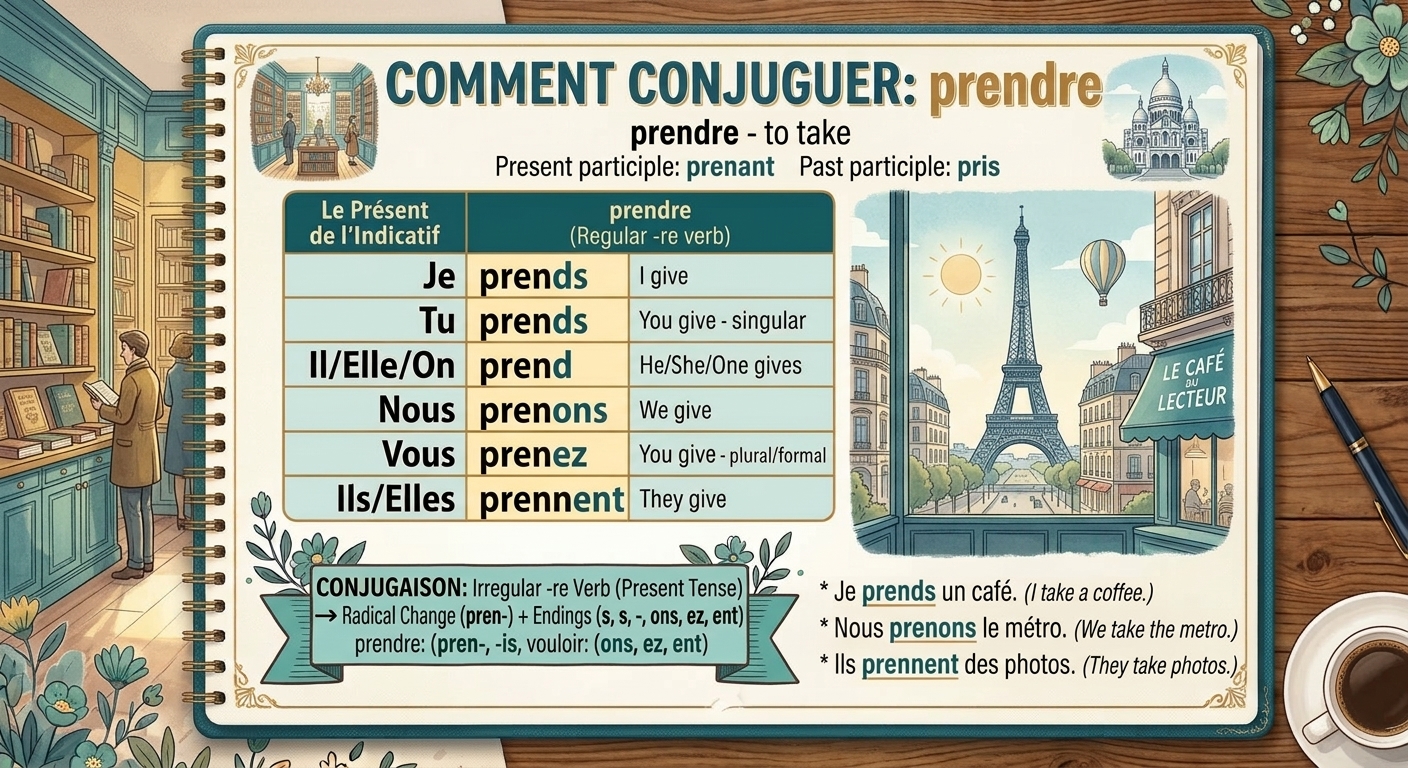
Past participle: pris
Present participle: prenant
English equivalents: To take, to pick up, to grab, to have.
Prendre has an irregular present-tense pattern. Notice how the stem changes:
– je prends, tu prends, il prend
– nous prenons, vous prenez
– ils prennent
The third-person plural form, prennent, is particularly important to remember.
Prendre is also the base verb for several related verbs, including apprendre (to learn), comprendre (to understand), and reprendre (to take again or resume). These related verbs follow similar conjugation patterns.
Experience the Word
Prendre is one of those wonderfully useful French verbs that seems to appear everywhere.
Imagine waking up in Paris and deciding to prendre un café at a neighborhood café. Later, you prenez le métro to explore the city, prenez des photos along the way, and perhaps prenez le temps to enjoy a quiet afternoon.
The same verb can describe taking an object, choosing transportation, enjoying a meal or drink, or making a decision.
It is a word worth learning well because you will encounter it constantly in everyday French.
How to Conjugate Prendre: Complete French Conjugation Guide
Let’s explore every major conjugation of prendre, beginning with the indicative mood.
How to Conjugate Prendre in the Indicative Mood
The indicative mood is used to express facts, observations, actions, and events.
How to Conjugate Prendre in the Present Tense (Présent)
Used for actions happening now, habitual actions, and general truths.
| Subject | Conjugation |
|---|---|
| je | prends |
| tu | prends |
| il / elle | prend |
| nous | prenons |
| vous | prenez |
| ils / elles | prennent |
Example
Je prends un café tous les matins.
I have a coffee every morning.
Quick Quiz 1
Complete the sentence:
Nous ______ le train pour aller à Paris.
Reveal the answer
prenons
Nous prenons le train pour aller à Paris.
We take the train to go to Paris.
How to Conjugate Prendre in the Passé Composé
Used for completed actions in the past. Prendre takes the auxiliary verb avoir.
| Subject | Conjugation |
|---|---|
| j’ | ai pris |
| tu | as pris |
| il / elle | a pris |
| nous | avons pris |
| vous | avez pris |
| ils / elles | ont pris |
Example
J’ai pris beaucoup de photos pendant mon voyage.
I took a lot of photographs during my trip.
How to Conjugate Prendre in the Imparfait (Imperfect Tense)
Used for habitual past actions, descriptions, and ongoing situations in the past.
| Subject | Conjugation |
|---|---|
| je | prenais |
| tu | prenais |
| il / elle | prenait |
| nous | prenions |
| vous | preniez |
| ils / elles | prenaient |
Example
Quand j’étais jeune, je prenais le bus pour aller à l’école.
When I was young, I used to take the bus to school.
Quick Quiz 2
Choose the correct form:
When we lived in Lyon, we used to take the metro every day.
Quand nous habitions à Lyon, nous ______ le métro tous les jours.
Reveal the answer
prenions
Quand nous habitions à Lyon, nous prenions le métro tous les jours.
How to Conjugate Prendre in the Plus-que-parfait
Used to describe an action that had already been completed before another past event.
| Subject | Conjugation |
|---|---|
| j’ | avais pris |
| tu | avais pris |
| il / elle | avait pris |
| nous | avions pris |
| vous | aviez pris |
| ils / elles | avaient pris |
Example
J’avais déjà pris mon petit-déjeuner avant de partir.
I had already eaten breakfast before leaving.
How to Conjugate Prendre in the Passé Simple
Primarily used in formal writing, literature, and historical narratives. It is rarely used in everyday conversation.
| Subject | Conjugation |
|---|---|
| je | pris |
| tu | pris |
| il / elle | prit |
| nous | prîmes |
| vous | prîtes |
| ils / elles | prirent |
Example
Le voyageur prit son sac et quitta la maison.
The traveler took his bag and left the house.
How to Conjugate Prendre in the Passé Antérieur
A literary tense used to express an action completed immediately before another past action, generally in the passé simple.
| Subject | Conjugation |
|---|---|
| j’ | eus pris |
| tu | eus pris |
| il / elle | eut pris |
| nous | eûmes pris |
| vous | eûtes pris |
| ils / elles | eurent pris |
Example
Dès qu’il eut pris sa décision, il annonça son départ.
As soon as he had made his decision, he announced his departure.
How to Conjugate Prendre in the Future Tense (Futur Simple)
Used to describe actions that will take place in the future.
| Subject | Conjugation |
|---|---|
| je | prendrai |
| tu | prendras |
| il / elle | prendra |
| nous | prendrons |
| vous | prendrez |
| ils / elles | prendront |
Example
Demain, je prendrai le train de huit heures.
Tomorrow, I will take the eight o’clock train.
How to Conjugate Prendre in the Futur Antérieur (Future Perfect)
Used for an action that will have been completed before a particular point in the future.
| Subject | Conjugation |
|---|---|
| j’ | aurai pris |
| tu | auras pris |
| il / elle | aura pris |
| nous | aurons pris |
| vous | aurez pris |
| ils / elles | auront pris |
Example
À midi, nous aurons déjà pris notre décision.
By noon, we will have already made our decision.
How to Conjugate Prendre in the Near Future (Futur Proche)
Used to describe something that is going to happen soon. Formed with aller + infinitive.
| Subject | Conjugation |
|---|---|
| je | vais prendre |
| tu | vas prendre |
| il / elle | va prendre |
| nous | allons prendre |
| vous | allez prendre |
| ils / elles | vont prendre |
Example
Je vais prendre une douche avant de sortir.
I’m going to take a shower before going out.
How to Conjugate Prendre in the Conditional Mood
The conditional mood expresses what would happen under certain circumstances. It is also frequently used to make polite requests or express wishes.
How to Conjugate Prendre in the Present Conditional
| Subject | Conjugation |
|---|---|
| je | prendrais |
| tu | prendrais |
| il / elle | prendrait |
| nous | prendrions |
| vous | prendriez |
| ils / elles | prendraient |
Example
Je prendrais bien un café, s’il vous plaît.
I would like a coffee, please.
How to Conjugate Prendre in the Past Conditional
| Subject | Conjugation |
|---|---|
| j’ | aurais pris |
| tu | aurais pris |
| il / elle | aurait pris |
| nous | aurions pris |
| vous | auriez pris |
| ils / elles | auraient pris |
Example
J’aurais pris le train si j’avais eu le temps.
I would have taken the train if I had had the time.
Prendre in the Literary Past Conditional Form
This less common literary form uses the imperfect subjunctive of avoir.
| Subject | Conjugation |
|---|---|
| j’ | eusse pris |
| tu | eusses pris |
| il / elle | eût pris |
| nous | eussions pris |
| vous | eussiez pris |
| ils / elles | eussent pris |
Example
Il eût pris une autre décision s’il avait connu la vérité.
He would have made another decision had he known the truth.
How to Conjugate Prendre in the Subjunctive Mood
The subjunctive is used to express wishes, emotions, doubts, necessity, and uncertainty. It frequently follows expressions such as il faut que (it is necessary that) or bien que (although).
How to Conjugate Prendre in the Present Subjunctive
| Subject | Conjugation |
|---|---|
| que je | prenne |
| que tu | prennes |
| qu’il / qu’elle | prenne |
| que nous | prenions |
| que vous | preniez |
| qu’ils / qu’elles | prennent |
Example
Il faut que je prenne une décision rapidement.
I need to make a decision quickly.
Quick Quiz 3
Complete the sentence using the subjunctive:
Il faut que nous ______ le temps de réfléchir.
Reveal the answer
prenions
Il faut que nous prenions le temps de réfléchir.
We need to take the time to think.
How to Conjugate Prendre in the Imperfect Subjunctive
A literary tense, rarely encountered in modern spoken French.
| Subject | Conjugation |
|---|---|
| que je | prisse |
| que tu | prisses |
| qu’il / qu’elle | prît |
| que nous | prissions |
| que vous | prissiez |
| qu’ils / qu’elles | prissent |
Example
Il souhaitait qu’elle prît le temps de réfléchir.
He wished that she would take the time to think.
How to Conjugate Prendre in the Pluperfect Subjunctive
A literary construction used to express an action completed before another past action.
| Subject | Conjugation |
|---|---|
| que j’ | eusse pris |
| que tu | eusses pris |
| qu’il / qu’elle | eût pris |
| que nous | eussions pris |
| que vous | eussiez pris |
| qu’ils / qu’elles | eussent pris |
Example
Elle regrettait que nous eussions pris cette décision sans elle.
She regretted that we had made that decision without her.
How to Conjugate Prendre in the Past Subjunctive
| Subject | Conjugation |
|---|---|
| que j’ | aie pris |
| que tu | aies pris |
| qu’il / qu’elle | ait pris |
| que nous | ayons pris |
| que vous | ayez pris |
| qu’ils / qu’elles | aient pris |
Example
Je suis heureux que tu aies pris le temps de venir.
I’m happy that you took the time to come.
How to Conjugate Prendre in the Imperative
The imperative is used to give commands, instructions, invitations, or suggestions. Subject pronouns are omitted.
How to Conjugate Prendre in the Present Imperative
| Person | Conjugation |
|---|---|
| (tu) | prends |
| (nous) | prenons |
| (vous) | prenez |
Example
Prends ton temps !
Take your time!
Quick Quiz 4
How would you say “Let’s take a break” in French?
Reveal the answer
Faisons une pause !
Another natural expression using prendre is Prenons une pause !, although faire une pause is more commonly used in everyday French.
French Participles of Prendre
Participles are verb forms that can be used in compound tenses and other grammatical constructions.
Present Participle of Prendre
prenant
En prenant le temps de réfléchir, tu feras le bon choix.
By taking the time to think, you will make the right choice.
Past Participle of Prendre
pris
prise
prises
The past participle of prendre is pris. Its feminine form is prise, and its plural forms are pris and prises.
Prendre uses avoir in compound tenses, so the past participle does not normally agree with the subject. It agrees with a preceding direct object when the rules of French past participle agreement require it.
Les photos que j’ai prises sont magnifiques.
The photographs that I took are beautiful.
Prendre in Everyday French: Real-Life Examples
Now that you know the conjugations, let’s see how prendre appears in everyday French.
Example 1 — Present
Je prends toujours un café après le déjeuner.
I always have a coffee after lunch.
Example 2 — Passé composé
Nous avons pris un taxi pour rentrer à l’hôtel.
We took a taxi to return to the hotel.
Example 3 — Imparfait
Elle prenait souvent le train pour aller travailler.
She often used to take the train to go to work.
Example 4 — Future
Ils prendront leurs vacances en juillet.
They will take their vacation in July.
Example 5 — Conditional
Je prendrais bien quelques jours de repos.
I would gladly take a few days off.
Example 6 — Subjunctive
Il faut que vous preniez une décision.
You need to make a decision.
Beyond Translation: The Meaning of Prendre
The English verb to take captures much of the meaning of prendre, but the French verb is used in many expressions that do not translate word for word.
Here are some common examples:
- prendre un café — to have a coffee
- prendre le train — to take the train
- prendre une décision — to make a decision
- prendre des photos — to take photographs
- prendre son temps — to take one’s time
- prendre soin de quelqu’un — to take care of someone
- prendre rendez-vous — to make an appointment
- prendre froid — to catch a chill
- prendre la parole — to take the floor or begin speaking
You will also encounter the reflexive form se prendre in expressions such as se prendre pour quelqu’un (to think oneself to be someone) and s’y prendre (to go about something or approach a task).
One particularly useful distinction is between prendre and apprendre. Prendre means to take, while apprendre means to learn. They share a similar conjugation pattern.
Learning these expressions will help you recognize prendre in many different everyday situations.
How to Remember the French Verb Prendre
Remember it this way: Prendre is what you do when you take something, choose something, or make use of something.
- You take the train: prendre le train.
- You have a coffee: prendre un café.
- You take your time: prendre son temps.
Pay particular attention to the irregular present-tense forms:
prends, prends, prend, prenons, prenez, prennent.
The key is to remember that the singular forms and the third-person plural are different from the nous and vous forms.
Once you become comfortable with this pattern, you will also recognize it in related verbs such as apprendre and comprendre.
Test Your Knowledge of Prendre
Let’s see how much you’ve learned. Try answering these questions before revealing the answers.
Question 1
What auxiliary verb is used with prendre in compound tenses?
Reveal the answer
Avoir
Question 2
How do you say “I will take” in French?
Reveal the answer
Je prendrai.
Question 3
Translate: “We have taken the train.”
Reveal the answer
Nous avons pris le train.
Question 4
What is the present participle of prendre?
Reveal the answer
Prenant.
Question 5
Complete the sentence:
Si j’avais le choix, je ______ le train.
Reveal the answer
prendrais
Si j’avais le choix, je prendrais le train.
If I had the choice, I would take the train.
Your Final Challenge
Can You Use It?
How would you say this in French?
“Tomorrow, I will take some photographs of the old town.”
Reveal the answer
Demain, je prendrai des photos de la vieille ville.
Tomorrow, I will take some photographs of the old town.
A little French. A little curiosity. A richer everyday life.
LEARN FRENCH ONE WORD AT A TIME