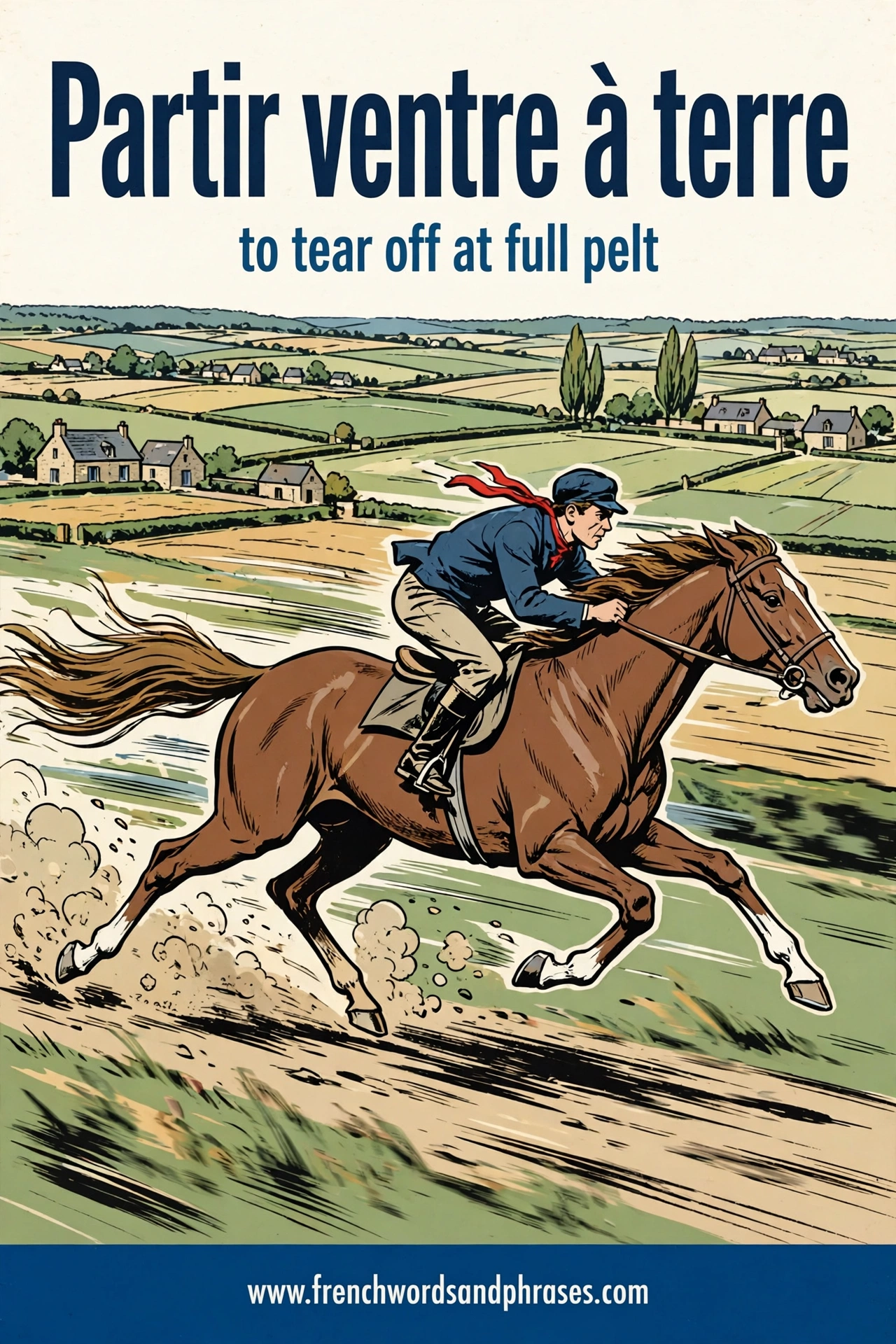
A French Word to Live By
Translate Partir ventre à terre to English
/paʁ.tiʁ vɑ̃tʁ a tɛʁ/
Partir ventre à terre means to tear off at full pelt — to gallop away as fast as possible, stretched out flat with speed.
The starting gate snaps open, the horse explodes out of it — neck stretched, legs a blur, belly skimming so low over the turf you would swear it brushes the grass. The commentator does not need a stopwatch to describe it: « Il est parti ventre à terre ! »
Let’s explore how partir ventre à terre works in French, beginning with the whole phrase on one card.
Understanding the French Phrase Partir ventre à terre
Partir ventre à terre is an idiomatic expression built from partir (to leave, to set off), le ventre (the belly) and à terre (to the ground). It comes straight from the horse world: a horse at the full gallop stretches its body so flat and low that its belly nearly grazes the ground.
It means to set off at maximum speed — to tear away flat out, whether on a horse, a bicycle, a motorbike or two running feet. The belly-to-the-ground picture is about total commitment to speed: nothing held back, nothing upright and dignified, just the body thrown forward at full stretch. French also uses ventre à terre behind other verbs of motion — arriver, courir, rentrer ventre à terre — always with the same meaning: at a dead gallop, as fast as physics allows.
Type: Idiomatic expression — speed (motion verb + body picture)
Answers the need: Saying someone set off absolutely flat out, at top speed
Register: Neutral to informal — colourful, at home in speech, sport and stories
Literal picture: Belly to the ground — a galloping horse stretched so low it nearly grazes the earth
One important usage detail: ventre à terre is a fixed adverbial block that rides behind verbs of motion — partir, arriver, courir, passer ventre à terre — and it never changes form: no agreement, no article, no plural. Partir is the classic partner because the phrase loves a departure, but any fast movement can carry it. Do not confuse it with ramper, crawling: ventre à terre is not slow and low, it is low because it is fast.
Experience the Word
Partir ventre à terre is speed you can see — the moment a body stops being dignified and becomes a projectile.
Imagine the last train home announced across the station, and one traveller who hears it from the far platform. Bag flying, coat flying, he crosses the concourse ventre à terre — not running so much as launched. Everyone who has ever caught that train recognises the posture: forward, flat, total.
The phrase keeps the horse inside every use. However modern the vehicle, partir ventre à terre still smells of turf, leather and a finish line.
How to Use Partir ventre à terre in French: Complete Guide
Let’s explore how partir ventre à terre works in French, beginning with the whole phrase on one card.
Partir ventre à terre at a Glance
The Whole Phrase on One Card
Real meaning, literal picture, English twin and register — partir ventre à terre in five lines.
| Point | Partir ventre à terre |
|---|---|
| What it really means | to set off at full speed — flat out, maximum velocity from the first stride |
| Word for word | to leave belly-to-ground |
| English equivalent | to tear off at full pelt / to gallop off flat out / to take off like a shot |
| Register | neutral to informal — colourful, sporty, storyteller-friendly |
| Use it for | horses, cyclists, runners, escaping children, last-minute dashes |
Example
Le chien a vu le facteur et il est parti ventre à terre.
The dog saw the postman and tore off at full pelt.
Word by Word: Building the Gallop
Three pieces — a departure, a belly, and the ground it nearly touches.
| Word | Literal meaning | Its job in the phrase |
|---|---|---|
| partir | to leave, to set off | the launch — the phrase loves the first explosive second of movement |
| ventre | belly, stomach | the body’s underside, stretched flat by speed |
| à terre | to the ground, earthwards | the direction of the stretch — so low the belly nearly grazes the ground |
Example
Le cheval est parti ventre à terre dès l’ouverture des portes.
The horse tore off at full pelt the moment the gates opened.
Quick Quiz 1
Does ventre à terre describe slow crawling or maximum speed?
Reveal the answer
Maximum speed — the belly is low because a galloping body stretches flat, not because it crawls.
Elle est rentrée ventre à terre pour attraper son train.
She raced home flat out to catch her train.
When You Say It: The Full-Pelt Moments
Ventre à terre appears at moments like these — wherever something launches.
| Situation | Example |
|---|---|
| The race start | les chevaux sont partis ventre à terre — the horses tore off at full pelt |
| The escape | le voleur est parti ventre à terre — the thief ran off as fast as he could |
| The last train | il a couru ventre à terre jusqu’au quai — he ran flat out to the platform |
| The excited child | les enfants partent ventre à terre vers la plage — the children tear off towards the beach |
Example
Au coup de feu, les coureurs sont partis ventre à terre.
At the starting gun, the runners took off at full pelt.
Make It Yours: The Verbs That Carry It
Ventre à terre never changes; only the verb of motion in front of it does.
| Form | French | In English |
|---|---|---|
| Setting off | partir ventre à terre | to tear off at full pelt |
| Arriving | arriver ventre à terre | to come charging in flat out |
| Running | courir ventre à terre | to run at full stretch |
| Passing | passer ventre à terre | to flash past at top speed |
| Coming back | rentrer ventre à terre | to race back home flat out |
Example
Le facteur est passé ventre à terre sur son vélo.
The postman flashed past at full speed on his bike.
Quick Quiz 2
Does ventre à terre change form for a female rider or a plural subject?
Reveal the answer
No — it is a fixed block: elles sont parties ventre à terre, with ventre à terre untouched.
Les cavalières sont parties ventre à terre.
The riders (women) tore off at full pelt.
Everyday Expressions: Building on the Gallop
Partir ventre à terre slots into these everyday frames — each one ready to use as it stands.
| Frame | In English |
|---|---|
| partir ventre à terre | to tear off at full pelt |
| à ventre à terre (after a verb) | flat out, at full stretch — the same block in mid-sentence |
| une course ventre à terre | a flat-out race, a headlong dash |
| ventre à terre, sans regarder derrière | flat out, without looking back — the full escape picture |
Example
Il a traversé la cour ventre à terre, sans regarder derrière lui.
He crossed the yard at full pelt, without looking back.
Close Cousins: The Other Speed Phrases
French hurries in several styles — ventre à terre is the horse’s; its cousins burn rubber and break necks.
| Expression | The difference |
|---|---|
| partir ventre à terre | to set off flat out — body stretched, full gallop, from the horse world |
| à toute vitesse | at full speed — the plain, neutral version, no picture |
| à fond la caisse | flat out, pedal to the metal — engines and bicycles, informal and modern |
| se casser le cou | to break your neck (hurrying) — speed with a warning attached |
| comme une flèche | like an arrow — straight-line speed, a clean visual cousin |
Example
Elle est partie comme une flèche, à fond la caisse, ventre à terre.
She took off like an arrow, flat out, at full pelt.
Quick Quiz 3
Which cousin belongs to engines — à fond la caisse or ventre à terre?
Reveal the answer
À fond la caisse — pedal to the metal; ventre à terre keeps the horse.
Sur l’autoroute déserte, il roulait à fond la caisse.
On the empty motorway, he was driving flat out.
Partir ventre à terre and Its Neighbours
The speed shelf around the phrase — hooves, wheels and finish lines.
| French | In English |
|---|---|
| le galop | the gallop — the gait that invented the phrase |
| un cavalier | a rider |
| la ligne d’arrivée | the finish line |
| un départ canon | a flying start (informal) |
| filer | to speed off, to shoot past (informal) |
| un ventre | a belly — the phrase’s unlikely hero |
Example
Au galop, ventre à terre, le cavalier a franchi la ligne d’arrivée.
At the gallop, flat out, the rider crossed the finish line.
Watch Out: The Traps Around Partir ventre à terre
The traps: a fixed block that refuses all decoration, and a posture that means speed, not surrender.
| Trap | The truth |
|---|---|
| no agreement, ever | ventre à terre never changes — not for women, not for plurals, not for vehicles |
| not crawling | the belly is near the ground from speed, not from creeping — ramper is the crawling verb |
| not ‘on the stomach’ | English ‘flat on his stomach’ sounds like lying down; the French phrase is the opposite — pure departure |
| needs a motion verb | the block rides behind partir, courir, arriver — it cannot stand alone as a complete sentence |
Example
Elle ne rampe pas, elle file ventre à terre.
She is not crawling, she is speeding off flat out.
Quick Quiz 4
True or false: ventre à terre can be used with arriver as well as partir.
Reveal the answer
True — any verb of fast motion can carry it: arriver, courir, passer, rentrer ventre à terre.
Le coursier est arrivé ventre à terre avec le paquet.
The courier arrived flat out with the parcel.
Partir ventre à terre in Everyday French: Real-Life Examples
Now that you know the word, let’s see how partir ventre à terre appears in everyday French.
Example 1 — The race
Les chevaux sont partis ventre à terre dès la première seconde.
The horses tore off at full pelt from the very first second.
Example 2 — The dog and the cat
Le chien a aperçu le chat et est parti ventre à terre.
The dog spotted the cat and took off at full pelt.
Example 3 — The last bus
Elle a couru ventre à terre pour attraper le dernier bus.
She ran flat out to catch the last bus.
Example 4 — The children
À la sonnerie, les élèves partent ventre à terre vers la cour.
At the bell, the pupils tear off towards the playground.
Example 5 — The cyclist
Le cycliste est passé ventre à terre devant le café.
The cyclist flashed past the café at full speed.
Example 6 — The escape
Le ballon a roulé, et le petit est parti ventre à terre derrière lui.
The ball rolled away, and the little boy tore off after it at full pelt.
Beyond Translation: The Meaning of Partir ventre à terre
English tears off ‘at full pelt’ — a phrase about skins and speed that nobody pictures anymore. French kept the photograph: a horse at the gallop, stretched so long and low that its belly grazes the turf, every muscle converted into forward.
Partir ventre à terre is what total commitment looks like at speed — nothing upright, nothing reserved, the whole body aimed.
That is why it suits escapes, races and last trains so well. Dignity travels upright. Urgency travels ventre à terre.
How to Remember the French Phrase Partir ventre à terre
Remember it this way: Partir ventre à terre is the galloping horse’s silhouette — stretched flat by speed, belly skimming the ground it is conquering.
- You picture the horse — at full gallop the body stretches so low the ventre nearly brushes the terre.
- You keep the block frozen — ventre à terre never agrees, never changes; only the motion verb moves.
- You launch it with partir — departures are its home: partir, arriver, courir ventre à terre.
The key idea is partir ventre à terre means to tear off at full pelt — to set off at maximum speed, belly to the ground.
Test Your Knowledge of Partir ventre à terre
Let’s see how much you’ve learned. Try answering these questions before revealing the answers.
Question 1
What does partir ventre à terre mean?
Reveal the answer
To tear off at full pelt — to set off at maximum speed, flat out from the first stride.
Question 2
What is the literal, word-for-word meaning?
Reveal the answer
To leave belly-to-ground — from a galloping horse stretched so low its belly nearly grazes the earth.
Question 3
How do you say ‘The riders tore off at full pelt’ (women riders)?
Reveal the answer
Les cavalières sont parties ventre à terre — ventre à terre never changes form, whatever the subject.
Question 4
Which other verbs can carry ventre à terre?
Reveal the answer
Any verb of fast motion — arriver, courir, passer, rentrer ventre à terre all work the same way.
Question 5
Complete the sentence:
Au signal, le chien est parti ventre à ______. (At the signal, the dog tore off at full pelt.)
Reveal the answer
terre
Au signal, le chien est parti ventre à terre.
At the signal, the dog tore off at full pelt.
Your Final Challenge
Can You Use It?
How would you say this in French?
“When the gate opened, the horse tore off at full pelt and never looked back.”
Reveal the answer
Quand la porte s’est ouverte, le cheval est parti ventre à terre sans jamais regarder derrière lui.
When the gate opened, the horse tore off at full pelt and never looked back.
A little French. A little curiosity. A richer everyday life.
LEARN FRENCH ONE WORD AT A TIME