A French Word to Live By
Translate S’entendre comme chien et chat to English
/sɑ̃.tɑ̃dʁ kɔm ʃjɛ̃ e ʃa/
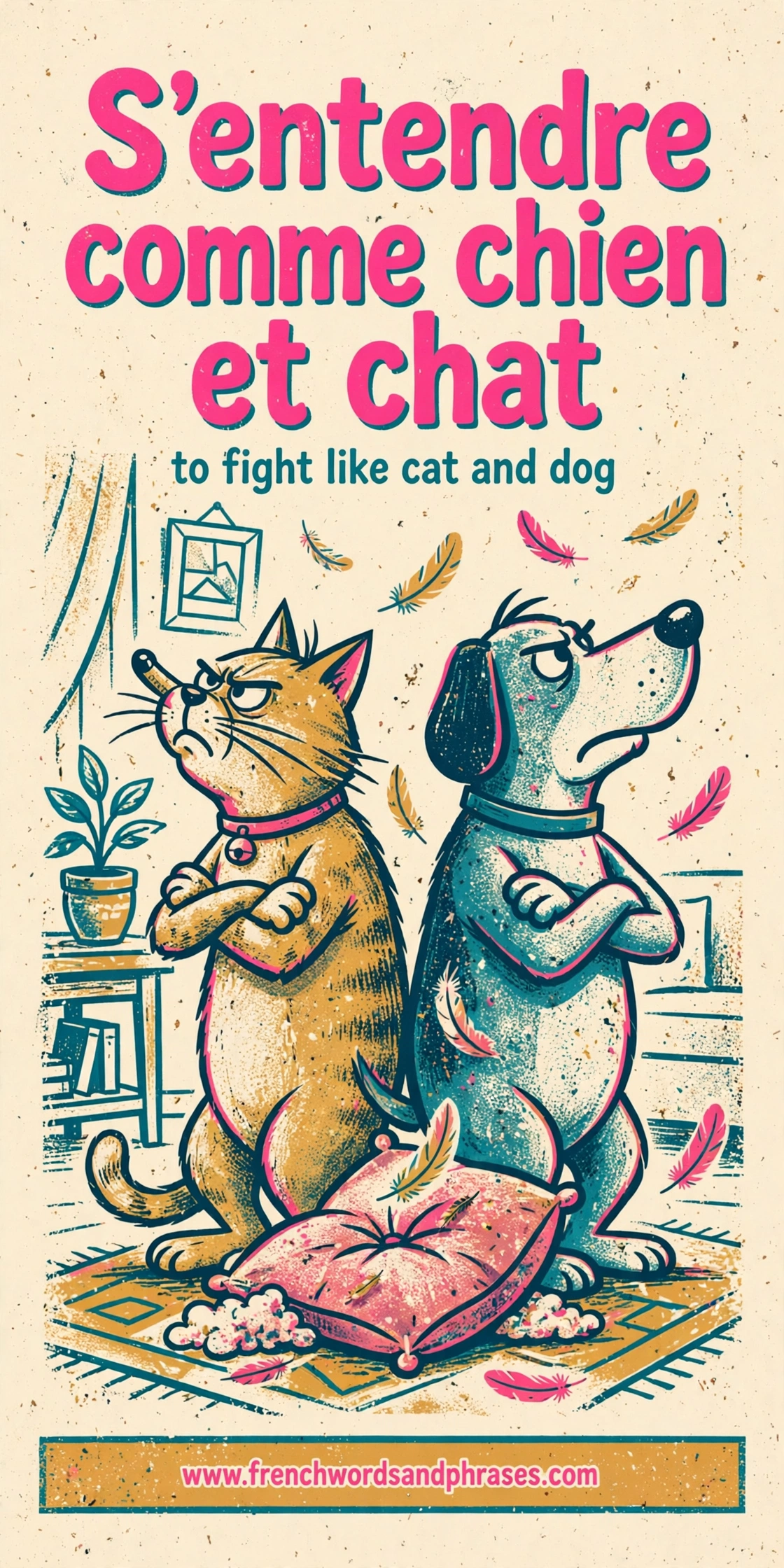
S’entendre comme chien et chat means to fight like cat and dog — to be constantly arguing and never getting along.
The two brothers share a bakery, a surname and approximately nothing else. By nine the flour is flying, by ten the customers are taking bets, by eleven they are laughing over coffee — and tomorrow the show starts again. Their mother shrugs the shrug of forty years: « Ils s’entendent comme chien et chat. »
Let’s explore how s’entendre comme chien et chat works in French, beginning with the whole phrase on one card.
Understanding the French Phrase S’entendre comme chien et chat
S’entendre comme chien et chat is an ironic comparison built from s’entendre — which normally means ‘to get along’ — and comme chien et chat, ‘like dog and cat’. The joke is in the wiring: French takes the verb of harmony and plugs it into the two most famously unharmonious animals in the house.
It means to be constantly at odds — arguing, bickering and sparking off each other, the way the proverbial dog and cat are supposed to do. Notice the irony: s’entendre on its own means to get along well, so the phrase literally claims two people ‘get along like cat and dog’, and every listener understands the reverse. It describes a relationship, not a single quarrel: colleagues, siblings, neighbours or nations who simply cannot share a room peacefully for long.
Type: Ironic comparison — relationships (reflexive verb + animal pair)
Answers the need: Saying two people are always arguing and can never get along
Register: Neutral to informal — humorous, safe almost everywhere
Literal picture: To ‘get along’ like dog and cat — the harmony verb wired to the feuding animals
One important usage detail: s’entendre is reflexive, so the pronouns do the work — ils s’entendent comme chien et chat, nous nous entendons comme chien et chat. Drop the animals and the verb flips back to its normal, happy meaning: ils s’entendent très bien, they get on very well. The animals are the entire joke, so they can never be left out — and the shorter form être comme chien et chat exists too, for simply being like cat and dog.
Experience the Word
S’entendre comme chien et chat is the family legend format: two people, one roof, and a lifetime subscription to small wars.
Imagine the old neighbours on either side of the garden fence, disputing the same hedge since 1987. They argue about the leaves, the shade, the fence itself — and when one falls ill, the other arrives with soup, grumbling all the way up the path. That is the secret truth inside the phrase: the feuding is permanent, and so, often, is the pair.
French built the joke into the grammar. The verb promises harmony; the animals deliver the opposite — and the listener gets both meanings in one sentence.
How to Use S’entendre comme chien et chat in French: Complete Guide
Let’s explore how s’entendre comme chien et chat works in French, beginning with the whole phrase on one card.
S’entendre comme chien et chat at a Glance
The Whole Phrase on One Card
Real meaning, literal picture, English twin and register — s’entendre comme chien et chat in five lines.
| Point | S’entendre comme chien et chat |
|---|---|
| What it really means | to fight like cat and dog — to be constantly arguing, never at peace |
| Word for word | to get along like dog and cat |
| English equivalent | to fight like cat and dog / to be at each other’s throats |
| Register | neutral to informal — humorous, affectionate more often than cruel |
| Use it for | siblings, colleagues, neighbours, couples in comedies — any permanently sparking pair |
Example
Les deux associés s’entendent comme chien et chat.
The two business partners fight like cat and dog.
Word by Word: Building the Feud
Three pieces — a harmony verb, a hinge, and the animal kingdom’s oldest rivalry.
| Word | Literal meaning | Its job in the phrase |
|---|---|---|
| s’entendre | to get along, to understand each other | the irony engine — the verb promises peace, the animals cancel it |
| comme | like, as | the comparison hinge that lets the animals in |
| chien et chat | dog and cat | the legendary feud — two animals, one house, no treaty |
Example
Mes enfants s’entendent comme chien et chat dès le réveil.
My children fight like cat and dog from the moment they wake up.
Quick Quiz 1
What does s’entendre mean without the animals — and why is that funny here?
Reveal the answer
To get along well — the phrase wires the harmony verb to the feuding animals, and the irony does the rest.
Sans les animaux, ils s’entendent à merveille.
Without the animals, they get along wonderfully.
When You Say It: The Sparking Pairs
The phrase is aimed at pairs like these — relationships with a permanent weather system.
| Situation | Example |
|---|---|
| The siblings | frère et sœur, ils s’entendent comme chien et chat — brother and sister, they fight like cat and dog |
| The colleagues | ces deux-là s’entendent comme chien et chat depuis des années — those two have been at odds for years |
| The neighbours | les voisins s’entendent comme chien et chat à cause de la haie — the neighbours feud over the hedge |
| The comedy couple | à l’écran, ils s’entendent comme chien et chat, et le public adore — on screen they fight like cat and dog, and the audience loves it |
Example
Depuis l’enfance, les jumeaux s’entendent comme chien et chat.
Since childhood, the twins have fought like cat and dog.
Make It Yours: Every Person in the Feud
The reflexive pronoun changes with the pair — the animals never do.
| Form | French | In English |
|---|---|---|
| They (men/mixed) | ils s’entendent comme chien et chat | they fight like cat and dog |
| They (women) | elles s’entendent comme chien et chat | they fight like cat and dog |
| We | nous nous entendons comme chien et chat | we are always arguing |
| In the past | ils se sont entendus comme chien et chat | they fought like cat and dog (with a wink at the reflexive past) |
| The short form | ils sont comme chien et chat | they are like cat and dog |
Example
Nous nous entendons comme chien et chat, mais on finit toujours par rire.
We fight like cat and dog, but we always end up laughing.
Quick Quiz 2
A colleague says « ils s’entendent très bien ». Are they fighting?
Reveal the answer
No — the opposite: without the animals, s’entendre keeps its true meaning: they get along very well.
Ils s’entendent très bien, eux, pas comme chien et chat.
They get along very well — not like cat and dog at all.
Everyday Expressions: Building on the Feud
S’entendre comme chien et chat slots into these everyday frames — each one ready to use as it stands.
| Frame | In English |
|---|---|
| s’entendre comme chien et chat | to fight like cat and dog |
| être comme chien et chat | to be like cat and dog (the short form) |
| une entente de chien et chat | a cat-and-dog understanding — peace, technically (joking) |
| chien et chat sous le même toit | cat and dog under one roof — the whole situation in a picture |
Example
Chien et chat sous le même toit depuis trente ans, et toujours là.
Cat and dog under one roof for thirty years, and still there.
Close Cousins: The Other Discord Phrases
French argues in several registers — the animals are the funniest; the cousins reach for throats, storms and divorce courts.
| Expression | The difference |
|---|---|
| s’entendre comme chien et chat | constant bickering between a pair — comic, often affectionate |
| être à couteaux tirés | to be at daggers drawn — real hostility, no comedy |
| se disputer comme des chiffonniers | to argue like ragpickers — noisy, vulgar quarrelling, stronger |
| ne pas pouvoir se voir | to be unable to stand each other — the cold, silent version (informal) |
| être en froid | to be on cold terms — the feud gone quiet, not loud |
Example
Ils ne sont pas à couteaux tirés, juste chien et chat, comme toujours.
They are not at daggers drawn, just cat and dog, as always.
Quick Quiz 3
Which cousin means a real, hostile stand-off — ‘at daggers drawn’?
Reveal the answer
Être à couteaux tirés — when the cat-and-dog comedy has stopped being funny.
Depuis l’héritage, les frères sont à couteaux tirés.
Since the inheritance, the brothers have been at daggers drawn.
S’entendre comme chien et chat and Its Neighbours
The relationship shelf around the phrase — harmony, friction and everything between.
| French | In English |
|---|---|
| s’entendre | to get along — the verb in its honest, animal-free form |
| se disputer | to argue, to quarrel |
| se réconcilier | to make up, to be reconciled — the feud’s favourite ending |
| une chamaillerie | a squabble, a bit of bickering (often children’s) |
| la paix | peace — the treaty’s name |
| un médiateur | a mediator — the referee every cat-and-dog pair eventually needs |
Example
Après chaque chamaillerie, ils se réconcilient autour d’un café.
After every squabble, they make up over a coffee.
Watch Out: The Traps Around S’entendre comme chien et chat
The traps: the verb that flips meaning, and the word order that never swaps.
| Trap | The truth |
|---|---|
| the flipping verb | s’entendre alone means getting along; the animals reverse it — never drop them and keep the feuding meaning |
| order is fixed | chien before chat, always: comme chien et chat — the dog leads the parade |
| a relationship, not a moment | one single argument is une dispute; the phrase describes the pair’s permanent climate |
| the reflexive is essential | ils s’entendent — without the se, entendre means ‘to hear’, and the sentence falls apart |
Example
Ils ont eu une dispute, mais en général ils s’entendent bien — pas comme chien et chat.
They had one argument, but generally they get along well — not like cat and dog.
Quick Quiz 4
True or false: « ils s’entendent comme chat et chien » is the correct order.
Reveal the answer
False — the dog always comes first: comme chien et chat.
Chien et chat, dans cet ordre, depuis toujours.
Dog and cat, in that order, since forever.
S’entendre comme chien et chat in Everyday French: Real-Life Examples
Now that you know the word, let’s see how s’entendre comme chien et chat appears in everyday French.
Example 1 — The brothers
Les deux frères s’entendent comme chien et chat, mais leur boulangerie est la meilleure du quartier.
The two brothers fight like cat and dog, but their bakery is the best in the neighbourhood.
Example 2 — The office pair
Au bureau, Martin et Léa s’entendent comme chien et chat.
At the office, Martin and Léa fight like cat and dog.
Example 3 — The neighbours
Nos voisins s’entendent comme chien et chat à cause d’une haie.
Our neighbours are like cat and dog over a hedge.
Example 4 — The twins
Les jumelles s’entendent comme chien et chat depuis la maternelle.
The twins have fought like cat and dog since nursery school.
Example 5 — The truce
Aujourd’hui, miracle : ils ne se sont pas entendus comme chien et chat.
Today, miracle: they did not fight like cat and dog.
Example 6 — The family verdict
Chez nous, on s’entend comme chien et chat, et on s’adore.
In our family, we fight like cat and dog, and we adore each other.
Beyond Translation: The Meaning of S’entendre comme chien et chat
English fights ‘like cat and dog’ too — the animals are international. But French adds a layer of pure mischief by choosing s’entendre, the verb of getting along, to carry the feud: the sentence literally announces harmony and delivers a war, and the listener’s brain enjoys the short-circuit.
It is the perfect idiom for the pairs who feud forever and separate never — the arguing is not the failure of the relationship; it is the relationship.
Ask any cat-and-dog couple of forty years. The sparks are not a problem to solve. They are the furniture.
How to Remember the French Phrase S’entendre comme chien et chat
Remember it this way: S’entendre comme chien et chat is the harmony verb with two saboteurs inside it — a dog, a cat, and a peace treaty that never gets signed.
- You hear the irony — s’entendre means to get along; the animals turn it upside down.
- You keep the parade order — chien first, chat second, always.
- You conjugate the pair — ils s’entendent comme chien et chat; the reflexive pronoun belongs to the couple.
The key idea is s’entendre comme chien et chat means to fight like cat and dog — to be constantly arguing.
Test Your Knowledge of S’entendre comme chien et chat
Let’s see how much you’ve learned. Try answering these questions before revealing the answers.
Question 1
What does s’entendre comme chien et chat mean?
Reveal the answer
To fight like cat and dog — to be constantly arguing and never getting along.
Question 2
What is the literal, word-for-word meaning?
Reveal the answer
To get along like dog and cat — s’entendre normally means to get along, which is exactly the joke.
Question 3
How do you say ‘They fight like cat and dog’ (two women)?
Reveal the answer
Elles s’entendent comme chien et chat — the reflexive pronoun matches the pair; the animals never change.
Question 4
What does s’entendre mean without the animals?
Reveal the answer
To get along well — ils s’entendent très bien is a compliment about a harmonious pair.
Question 5
Complete the sentence:
Les voisins s’entendent comme ______ et chat. (The neighbours fight like cat and dog.)
Reveal the answer
chien
Les voisins s’entendent comme chien et chat.
The neighbours fight like cat and dog.
Your Final Challenge
Can You Use It?
How would you say this in French?
“My two sons fight like cat and dog, but they defend each other against the whole world.”
Reveal the answer
Mes deux fils s’entendent comme chien et chat, mais ils se défendent l’un l’autre contre le monde entier.
My two sons fight like cat and dog, but they defend each other against the whole world.
A little French. A little curiosity. A richer everyday life.
LEARN FRENCH ONE WORD AT A TIME