A French Word to Live By
Translate Entre chien et loup to English
/ɑ̃tʁ ʃjɛ̃ e lu/
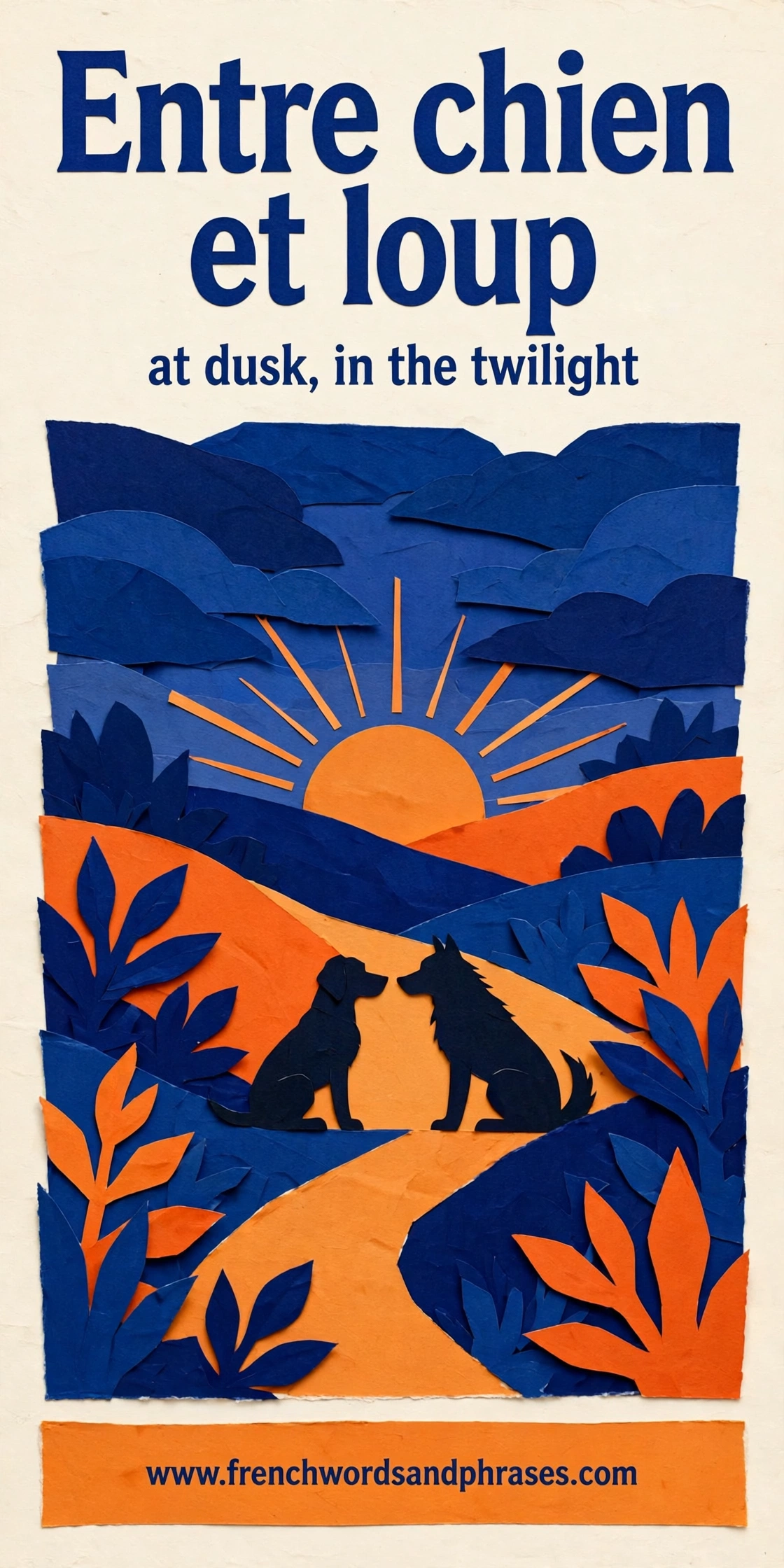
Entre chien et loup means at dusk — the twilight hour when the light is too dim to tell a dog from a wolf.
The path home crosses the last field just as the sun lets go of the sky. Shapes soften; the neighbour’s dog could be anything at all until it wags its tail. The French have kept a beautiful old name for this uncertain light: « entre chien et loup ».
Let’s explore how entre chien et loup works in French, beginning with the whole phrase on one card.
Understanding the French Phrase Entre chien et loup
Entre chien et loup is a French idiomatic expression built from entre (between), un chien (a dog) and un loup (a wolf). It is one of the oldest phrases in the language — already old in Latin, inter canem et lupum — naming the hour of failing light when friend and danger look exactly alike.
It means at dusk, in the twilight — the short hour between day and night when you can no longer distinguish a dog from a wolf. Nobody is walking animals: the two beasts stand for the familiar and the wild, and twilight is the moment the eye cannot separate them. French uses it for the time of day itself, and poetically for any moment of uncertainty between two states.
Type: Idiomatic expression — time of day (entre + two nouns)
Answers the need: Naming dusk with poetry — the uncertain light between day and night
Register: Neutral to literary — loved by writers, understood by everyone
Strength: Atmospheric — it paints the hour rather than clocking it
One important usage detail: the phrase behaves like an adverb of time — à l’heure entre chien et loup, rentrer entre chien et loup — and often appears with the noun heure understood. It names the fall of evening; for dawn’s first grey light, French prefers le petit matin or l’aube.
Experience the Word
Entre chien et loup is the day handing over to the night, and for a few minutes nobody is sure who is who.
Imagine a shepherd coming down from the hill in November, the flock ahead of him, the light draining out of the valley. Something moves by the hedge — his own dog, probably; a wolf, possibly. He walks a little faster, and the phrase walks with him, two thousand years old.
Modern streets have lamps, but the feeling survives. Every language keeps one phrase for the hour when the world goes ambiguous — this is France’s.
How to Use Entre chien et loup in French: Complete Guide
Let’s explore how entre chien et loup works in French, beginning with the whole phrase on one card.
Entre chien et loup at a Glance
The Whole Phrase on One Card
Real meaning, literal picture, English twin and register — entre chien et loup in five lines.
| Point | Entre chien et loup |
|---|---|
| What it really means | at dusk, in the twilight — the failing light between day and night |
| Word for word | between dog and wolf — too dark to tell the tame from the wild |
| English equivalent | at dusk / in the twilight / at nightfall |
| Register | neutral to literary — poetic, but everyone knows it |
| Use it for | evening walks, journeys home, scenes of uncertainty and mood |
Example
Nous sommes rentrés entre chien et loup.
We came home at dusk.
Word by Word: Building the Twilight
Four small pieces — take them one by one and the light begins to fail.
| Word | Literal meaning | Its job in the phrase |
|---|---|---|
| entre | between | the in-between word — the whole phrase lives in a gap |
| chien | dog | the familiar animal, the friend at your side |
| et | and | the hinge between the two silhouettes |
| loup | wolf | the wild animal, the danger in the same shape |
Example
Entre chien et loup, toutes les formes se ressemblent.
At dusk, all shapes look alike.
Quick Quiz 1
Why a dog and a wolf — what can’t you do at this hour?
Reveal the answer
Tell them apart — in the failing light, the tame animal and the wild one have the same silhouette.
Entre chien et loup, le berger rassemble ses bêtes.
At dusk, the shepherd gathers his animals.
When You Say It: The Dusk Moments
Entre chien et loup fires at moments like these — the light is going, and the day is not quite over.
| Situation | Example |
|---|---|
| Coming home | rentrer entre chien et loup — to come home at dusk |
| A walk | se promener entre chien et loup — to walk in the twilight |
| Setting the scene | c’était l’heure entre chien et loup — it was the hour of dusk |
| Driving | conduire entre chien et loup, les phares allumés — to drive at dusk, headlights on |
| Figurative uncertainty | entre chien et loup, on ne savait plus qui croire — in that twilight, we no longer knew whom to believe |
Example
Le village s’allume entre chien et loup.
The village lights up at dusk.
Make It Yours: The Twilight in Every Frame
The phrase is fixed — it slots into sentences as a block of time, usually after the verb or with heure.
| Form | French | In English |
|---|---|---|
| Basic use | entre chien et loup | at dusk |
| With the hour named | à l’heure entre chien et loup | at the hour of dusk |
| Coming home | il est rentré entre chien et loup | he came home at dusk |
| In a story | le soir tombait, entre chien et loup | evening was falling, in the twilight |
| Poetic plural scene | les toits, entre chien et loup, devenaient bleus | the rooftops, at dusk, were turning blue |
| Question | on part entre chien et loup ? | shall we leave at dusk? |
Example
À l’heure entre chien et loup, les enfants rentrent de l’école.
At dusk, the children come home from school.
Quick Quiz 2
Does entre chien et loup describe dawn or dusk?
Reveal the answer
Dusk — the fall of evening. Dawn has its own words: l’aube, le petit matin.
Le train part à l’aube et arrive entre chien et loup.
The train leaves at dawn and arrives at dusk.
Everyday Expressions: Building on the Twilight
Entre chien et loup slots into these everyday frames — each one ready to use as it stands.
| Frame | In English |
|---|---|
| entre chien et loup | at dusk, in the twilight |
| à l’heure entre chien et loup | at the dusk hour |
| rentrer entre chien et loup | to come home at dusk |
| le jour décline | the day is fading — a close, plainer frame |
| la tombée de la nuit | nightfall — the moment just after |
Example
Ils ferment la boutique à la tombée de la nuit, entre chien et loup.
They close the shop at nightfall, at dusk.
Close Cousins: The Other Hours of the Day
French names its hours carefully — entre chien et loup is the ambiguous one; its cousins are precise or differently lit.
| Expression | The difference |
|---|---|
| entre chien et loup | dusk as uncertainty — the poetic, animal-eyed name of twilight |
| au crépuscule | at twilight — the direct, slightly literary equivalent |
| à la tombée de la nuit | at nightfall — the moment the dark actually lands |
| au coucher du soleil | at sunset — the sun’s exit, earlier and more precise |
| à la nuit tombante | as night falls — a narrator’s frame, close in feel |
Example
Au coucher du soleil, tout est d’or ; entre chien et loup, tout devient bleu.
At sunset, everything is gold; at dusk, everything turns blue.
Quick Quiz 3
Which cousin simply means ‘at sunset’ — au crépuscule or au coucher du soleil?
Reveal the answer
Au coucher du soleil — the sun going down. Le crépuscule is the twilight itself, the light after.
Au coucher du soleil, les pêcheurs rentrent au port.
At sunset, the fishermen return to harbour.
Entre chien et loup and Its Neighbours
The day’s-end shelf around the phrase — from first star to full dark.
| French | In English |
|---|---|
| le crépuscule | twilight, dusk |
| la tombée de la nuit | nightfall |
| un loup | a wolf |
| un chien | a dog |
| l’obscurité | darkness |
| la première étoile | the first star |
Example
Entre chien et loup, la première étoile paraît dans le ciel.
At dusk, the first star appears in the sky.
Watch Out: The Traps Around Entre chien et loup
The traps: an hour that is not a meeting, a fixed order of animals, and a dawn that must not borrow it.
| Trap | The truth |
|---|---|
| no animals are meeting | nothing is happening between a real dog and a real wolf — the pair names a quality of light |
| the order is fixed | it is always chien before loup — entre loup et chien does not exist |
| evening only | the phrase belongs to the fall of day; dawn takes l’aube or le petit matin |
| no articles inside | say entre chien et loup, bare — not entre le chien et le loup |
Example
Entre chien et loup, sans articles, comme il faut.
At dusk, without articles, as it should be.
Quick Quiz 4
True or false: entre chien et loup can describe the grey light of early morning.
Reveal the answer
False — it is the evening’s phrase, inherited from Latin shepherds bringing the flock home.
Le matin a son aube ; le soir a son heure entre chien et loup.
Morning has its dawn; evening has its dusk hour.
Entre chien et loup in Everyday French: Real-Life Examples
Now that you know the word, let’s see how entre chien et loup appears in everyday French.
Example 1 — The walk home
Nous rentrons toujours entre chien et loup.
We always come home at dusk.
Example 2 — The village
Entre chien et loup, le village devient silencieux.
At dusk, the village falls silent.
Example 3 — The drive
Conduire entre chien et loup demande des phares.
Driving at dusk calls for headlights.
Example 4 — The story opening
C’était entre chien et loup quand il a frappé à la porte.
It was dusk when he knocked at the door.
Example 5 — The garden
Entre chien et loup, les fleurs du soir s’ouvrent.
At dusk, the evening flowers open.
Example 6 — The appointment
Retrouve-moi entre chien et loup, près du pont.
Meet me at dusk, near the bridge.
Beyond Translation: The Meaning of Entre chien et loup
English dusk is a colour and twilight is a dimming — both describe the light. French describes the eye: at this hour, you cannot tell your own dog from a wolf. The phrase keeps the shepherd’s ancient anxiety inside an everyday word for the time of day.
Entre chien et loup is not about the sky — it is about trust, and how little light it needs.
Writers reach for it whenever a story enters uncertain territory: it is the hour when identities blur, in the street and in the soul.
How to Remember the French Phrase Entre chien et loup
Remember it this way: Entre chien et loup is the shepherd’s hour — the light so dim that the dog at your side and the wolf in the hedge wear the same silhouette.
- You picture the two silhouettes — chien for the familiar, loup for the wild, and dusk making them twins.
- You keep the order and the bareness — entre chien et loup, dog first, no articles.
- You save it for evening — dawn belongs to l’aube; this phrase walks the flock home.
The key idea is entre chien et loup means at dusk — too dark to tell a dog from a wolf.
Test Your Knowledge of Entre chien et loup
Let’s see how much you’ve learned. Try answering these questions before revealing the answers.
Question 1
What does entre chien et loup mean?
Reveal the answer
At dusk, in the twilight — the failing light between day and night.
Question 2
Why a dog and a wolf?
Reveal the answer
Because you cannot tell them apart — in dim light the tame animal and the wild one share one silhouette.
Question 3
How do you say ‘we came home at dusk’?
Reveal the answer
Nous sommes rentrés entre chien et loup — the phrase slots in as a block of time.
Question 4
What is the difference between entre chien et loup and au coucher du soleil?
Reveal the answer
Au coucher du soleil is sunset itself, the sun’s exit; entre chien et loup is the ambiguous twilight that follows it.
Question 5
Complete the sentence:
Le berger rassemble ses bêtes entre ______ et loup. (The shepherd gathers his animals at dusk.)
Reveal the answer
chien
Le berger rassemble ses bêtes entre chien et loup.
The shepherd gathers his animals at dusk.
Your Final Challenge
Can You Use It?
How would you say this in French?
“We walked home at dusk, when you can no longer tell a dog from a wolf.”
Reveal the answer
Nous sommes rentrés à pied entre chien et loup, quand on ne distingue plus un chien d’un loup.
We walked home at dusk, when you can no longer tell a dog from a wolf.
A little French. A little curiosity. A richer everyday life.
LEARN FRENCH ONE WORD AT A TIME