A French Word to Live By
Translate Être à cheval sur les principes to English
/ɛtʁ a ʃə.val syʁ le pʁɛ̃.sip/
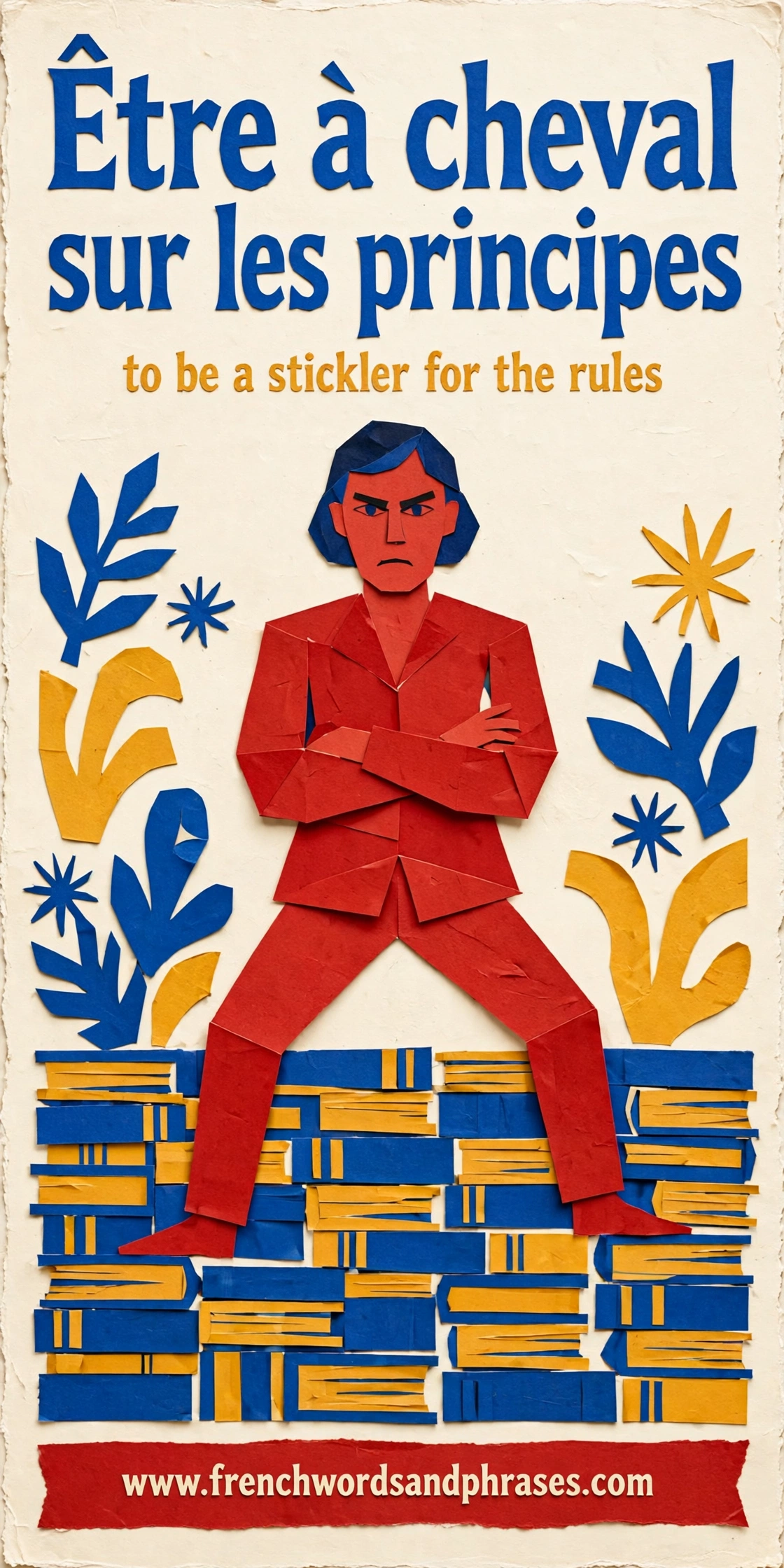
Être à cheval sur les principes means to be a stickler for the rules — strict and unbending about principles, manners or procedure.
At Madame Fabre’s table, the fish fork goes on the outside, the glasses stand in a diagonal line, and a grandson who reaches across for the bread is corrected before his hand arrives. Nobody is angry; nobody is surprised. Madame Fabre est à cheval sur les principes — she sits on the rules of the table the way a rider sits on a horse: firmly, upright, and with no intention of getting off.
Let’s explore how être à cheval sur les principes works in French, beginning with the whole phrase on one card.
Understanding the French Phrase Être à cheval sur les principes
Être à cheval sur les principes is an idiomatic expression built from à cheval — astride, as a rider sits on a horse — and les principes, the principles. To sit astride your principles is to guard them from horseback: mounted, elevated, and not budging an inch. The pattern is generous: whatever follows sur is the treasure being guarded — les règles, les horaires, l’orthographe, la politesse.
It means to be a stickler — strict and unbending about rules, principles or correct procedure. It is not necessarily an insult. Said of the accountant who never lets a cent escape, it is a compliment to her rigour; said of the uncle who corrects your fork, it is a tease. The stickler’s world has edges, and he patrols them. French even keeps the relaxed opposite on the same shelf: someone who is not à cheval sur anything is coulant — easy-going, happy to let the small things flow past.
Type: Idiomatic expression — être + à cheval sur + noun
Answers the need: Describing someone strict and unbending about rules or principles
Register: Neutral — safe in speech and writing; teasing at most
Strength: Medium — real strictness, but said with a smile as often as with a sigh
One important usage detail: the guarded treasure follows sur, and it changes freely — à cheval sur les horaires (a stickler for punctuality), sur l’orthographe (for spelling), sur la propreté (for cleanliness). The same à cheval sur also has a literal, geographical life: un village à cheval sur deux départements is a village straddling two counties. Context tells you whether the rider is guarding rules or a border.
Experience the Word
Être à cheval sur les principes puts the rulebook in a saddle — the stickler is not standing next to his principles, he is mounted on them, and the view from up there is excellent.
Imagine the village schoolmaster of 1950, ruler in hand, for whom a blot in a copybook is a small moral event. His pupils fear him all year and thank him for thirty years afterwards: every one of them can still spell, punctuate and lay a table. The phrase remembers him without cruelty — rigour, in French, is a fault people forgive in proportion to what it taught them.
Every office, every family, every orchestra keeps one rider on the rules. He is teased at lunch and telephoned in a crisis — because when things go wrong, everyone wants the person who never let the small things slide.
How to Use Être à cheval sur les principes in French: Complete Guide
Let’s explore how être à cheval sur les principes works in French, beginning with the whole phrase on one card.
Être à cheval sur les principes at a Glance
The Whole Phrase on One Card
Real meaning, literal picture, English twin and register — être à cheval sur les principes in five lines.
| Point | Être à cheval sur les principes |
|---|---|
| What it really means | to be a stickler for the rules — strict and unbending about principles and procedure |
| Word for word | to be on horseback on the principles |
| English equivalent | to be a stickler for the rules / to be strict about principles |
| Register | neutral — safe everywhere; admiring or teasing, rarely an attack |
| Use it for | strict teachers, meticulous accountants, punctuality hawks and table-manner grandmothers |
Example
Notre comptable est à cheval sur les principes : chaque centime doit être justifié.
Our accountant is a stickler for the rules: every cent must be accounted for.
Word by Word: The Rider and His Rules
Four pieces — a verb, a horseman’s posture, a preposition and the treasure being guarded.
| Word | Literal meaning | Its job in the phrase |
|---|---|---|
| être | to be | the verb that mounts the subject on the horse |
| à cheval | on horseback, astride | the posture of command — one leg each side, going nowhere |
| sur | on | the little word the whole guard-post stands on |
| les principes | the principles | the treasure — swappable for rules, timetables, spelling or manners |
Example
Il est à cheval sur les horaires : la réunion commence à neuf heures précises.
He is a stickler for punctuality: the meeting starts at nine o’clock sharp.
Quick Quiz 1
What does à cheval literally describe in the phrase?
Reveal the answer
A rider astride a horse — mounted on the principles and not budging an inch.
Elle est à cheval sur la politesse, même avec les vendeurs.
She is a stickler for politeness, even with shop assistants.
When You Say It: The Stickler Scenes
Être à cheval sur les principes is pronounced at scenes like these — wherever rigour is on patrol.
| Situation | Example |
|---|---|
| The strict teacher | elle est à cheval sur l’orthographe — she is a stickler for spelling |
| The punctual boss | il est à cheval sur les horaires — he is a stickler for punctuality |
| Grandmother’s table | elle est à cheval sur les bonnes manières — she is a stickler for good manners |
| The careful treasurer | il est à cheval sur les comptes — he is strict about the accounts |
| The relaxed opposite | lui, il n’est à cheval sur rien — him, he’s a stickler for nothing |
Example
Mon grand-père était à cheval sur la politesse : on ne mettait pas les coudes sur la table.
My grandfather was a stickler for politeness: elbows stayed off the table.
Make It Yours: Change the Treasure
The rider never changes — the treasure he guards changes freely after sur.
| Form | French | In English |
|---|---|---|
| The classic | être à cheval sur les principes | to be a stickler for principles |
| Punctuality | être à cheval sur les horaires | to be a stickler for punctuality |
| Spelling | être à cheval sur l’orthographe | to be a stickler for spelling |
| Very strict | être très à cheval sur les règles | to be very strict about the rules |
| The relaxed opposite | ne pas être à cheval sur grand-chose | not to be a stickler for much |
Example
Depuis l’école, elle est restée à cheval sur l’orthographe.
Since school, she has remained a stickler for spelling.
Quick Quiz 2
How do you say ‘he is a stickler for punctuality’ with the same pattern?
Reveal the answer
Il est à cheval sur les horaires — swap the treasure after sur and the rider guards the timetable instead.
Notre chef est à cheval sur les horaires.
Our boss is a stickler for punctuality.
Everyday Expressions: Rigour in Its Frames
The rider slots into these everyday frames — each one ready to use as it stands.
| Frame | In English |
|---|---|
| être à cheval sur les principes | to be a stickler for principles |
| être à cheval sur les règles | to be strict about the rules |
| être à cheval sur la propreté | to be a stickler for cleanliness |
| très à cheval sur… | very strict about… |
| pas du tout à cheval sur… | not at all strict about… — the easy-going version |
Example
Elle est très à cheval sur la propreté de la cuisine.
She is very strict about the cleanliness of the kitchen.
Close Cousins: The Rigour Shelf
French grades strictness from the shrug to the saddle — our rider sits near the firm end, with his dignity intact.
| Expression | The difference |
|---|---|
| être à cheval sur les principes | a stickler — mounted on the rules, teased or admired |
| être strict | to be strict — the plain adjective, no horse involved |
| être pointilleux | to be fussy about small details — the nitpicking cousin |
| tenir aux règles | to insist on the rules — the verb of the person who enforces them |
| être coulant | to be easy-going — the relaxed opposite, happy to let things flow |
Example
Il est strict, oui, mais jamais pointilleux pour le plaisir.
He is strict, yes, but never fussy for the fun of it.
Quick Quiz 3
Which cousin describes the relaxed opposite of our stickler — être coulant or être pointilleux?
Reveal the answer
Être coulant — easy-going, letting the small things flow past; pointilleux is the fussy detail-hunter.
Avec les enfants, il est plutôt coulant.
With the children, he’s rather easy-going.
Être à cheval sur les principes and Its Neighbours
The horse and the principle both work elsewhere in French — here is their other employment.
| French | In English |
|---|---|
| un cheval | a horse — the animal under the idiom |
| à cheval sur la frontière | straddling the border — the geographical twin of the phrase |
| de principe | as a matter of principle — un refus de principe, a refusal on principle |
| un principe | a principle — the rule of conduct being guarded |
| à cheval entre deux chaises | between two stools — sitting awkwardly between two positions |
Example
Ce village est à cheval sur deux départements.
This village straddles two counties.
Watch Out: The Traps Around Être à cheval sur les principes
The traps: a horse that is sometimes a map, and a tone that must stay a tease.
| Trap | The truth |
|---|---|
| the map trap | à cheval sur can be purely geographical — a village à cheval sur la frontière straddles a border and guards no rules at all |
| the riding trap | nobody is on a real horse: the posture is the meaning — astride, elevated, immovable |
| the tone trap | the phrase teases or admires; it is not the word for a tyrant — for real harshness French says dur, inflexible, autoritaire |
| the treasure trap | the noun after sur does the specifying — principes, horaires and orthographe produce three different sticklers |
Example
Leur maison est à cheval sur la frontière : la cuisine est en France, le jardin en Belgique.
Their house straddles the border: the kitchen is in France, the garden in Belgium.
Quick Quiz 4
True or false: in un pont à cheval sur la rivière, the bridge is being strict about the rules.
Reveal the answer
False — there à cheval sur is geographical: the bridge straddles the river. Only with principes, règles or horaires does the rider guard the rules.
Le pont est à cheval sur la rivière depuis 1890.
The bridge has straddled the river since 1890.
Être à cheval sur les principes in Everyday French: Real-Life Examples
Now that you know the word, let’s see how être à cheval sur les principes appears in everyday French.
Example 1 — The accountant
Notre comptable est à cheval sur les principes : elle vérifie chaque facture deux fois.
Our accountant is a stickler for the rules: she checks every invoice twice.
Example 2 — The timetable
Le directeur est à cheval sur les horaires ; la réunion commence à l’heure, toujours.
The director is a stickler for punctuality; the meeting starts on time, always.
Example 3 — Grandmother’s table
Ma grand-mère est très à cheval sur les bonnes manières à table.
My grandmother is very strict about good table manners.
Example 4 — The spelling hawk
Attention à tes fautes : le professeur est à cheval sur l’orthographe.
Watch your spelling mistakes: the teacher is a stickler for spelling.
Example 5 — The relaxed brother
Mon frère, lui, n’est à cheval sur rien : chez lui, on dîne quand on a faim.
My brother is a stickler for nothing: at his house, you eat when you’re hungry.
Example 6 — The compliment
On la taquine parce qu’elle est à cheval sur les règles, mais c’est elle qu’on appelle quand il y a un problème.
People tease her for being strict about the rules, but she’s the one they call when there’s a problem.
Beyond Translation: The Meaning of Être à cheval sur les principes
English’s stickler is armed with a stick — an old judge’s pointer, perhaps, or a fencer’s foil; the word has gone dusty and nobody pictures it. French keeps its picture alive and slightly comic: a grown adult, mounted on an invisible horse, patrolling the rulebook at a trot.
The image does the diplomacy: it lets you call someone rigid while handing them a certain equestrian dignity.
That balance — teasing without wounding — is why the phrase has survived every change of manners since the age when principles, and horses, were both ridden daily.
How to Remember the French Phrase Être à cheval sur les principes
Remember it this way: Être à cheval sur les principes is rigour in the saddle — a rider mounted on his rules, elevated, immovable, and quietly pleased with the view.
- You picture the rider — astride the principles like a horse, one leg each side, going nowhere on purpose.
- You swap the treasure — principes, horaires, orthographe: whatever follows sur is what the rider guards.
- You keep the map apart — à cheval sur la frontière is geography, not strictness.
The key idea is être à cheval sur les principes means to be a stickler for the rules — mounted on them and not budging.
Test Your Knowledge of Être à cheval sur les principes
Let’s see how much you’ve learned. Try answering these questions before revealing the answers.
Question 1
What does être à cheval sur les principes mean?
Reveal the answer
To be a stickler for the rules — strict and unbending about principles or procedure.
Question 2
What is the literal, word-for-word meaning?
Reveal the answer
To be on horseback on the principles — à cheval is the rider’s posture: astride and immovable.
Question 3
How do you say ‘She is a stickler for spelling’?
Reveal the answer
Elle est à cheval sur l’orthographe — the treasure after sur is what gets guarded.
Question 4
What is the relaxed opposite of the stickler?
Reveal the answer
Être coulant — easy-going, happy to let the small things flow past.
Question 5
Complete the sentence:
Le directeur est à cheval sur les ______ : la réunion commence à neuf heures précises. (The director is a stickler for punctuality: the meeting starts at nine o’clock sharp.)
Reveal the answer
horaires
Le directeur est à cheval sur les horaires : la réunion commence à neuf heures précises.
The director is a stickler for punctuality: the meeting starts at nine o’clock sharp.
Your Final Challenge
Can You Use It?
How would you say this in French?
“My grandmother is a stickler for table manners.”
Reveal the answer
Ma grand-mère est très à cheval sur les bonnes manières à table.
My grandmother is a stickler for table manners.
A little French. A little curiosity. A richer everyday life.
LEARN FRENCH ONE WORD AT A TIME