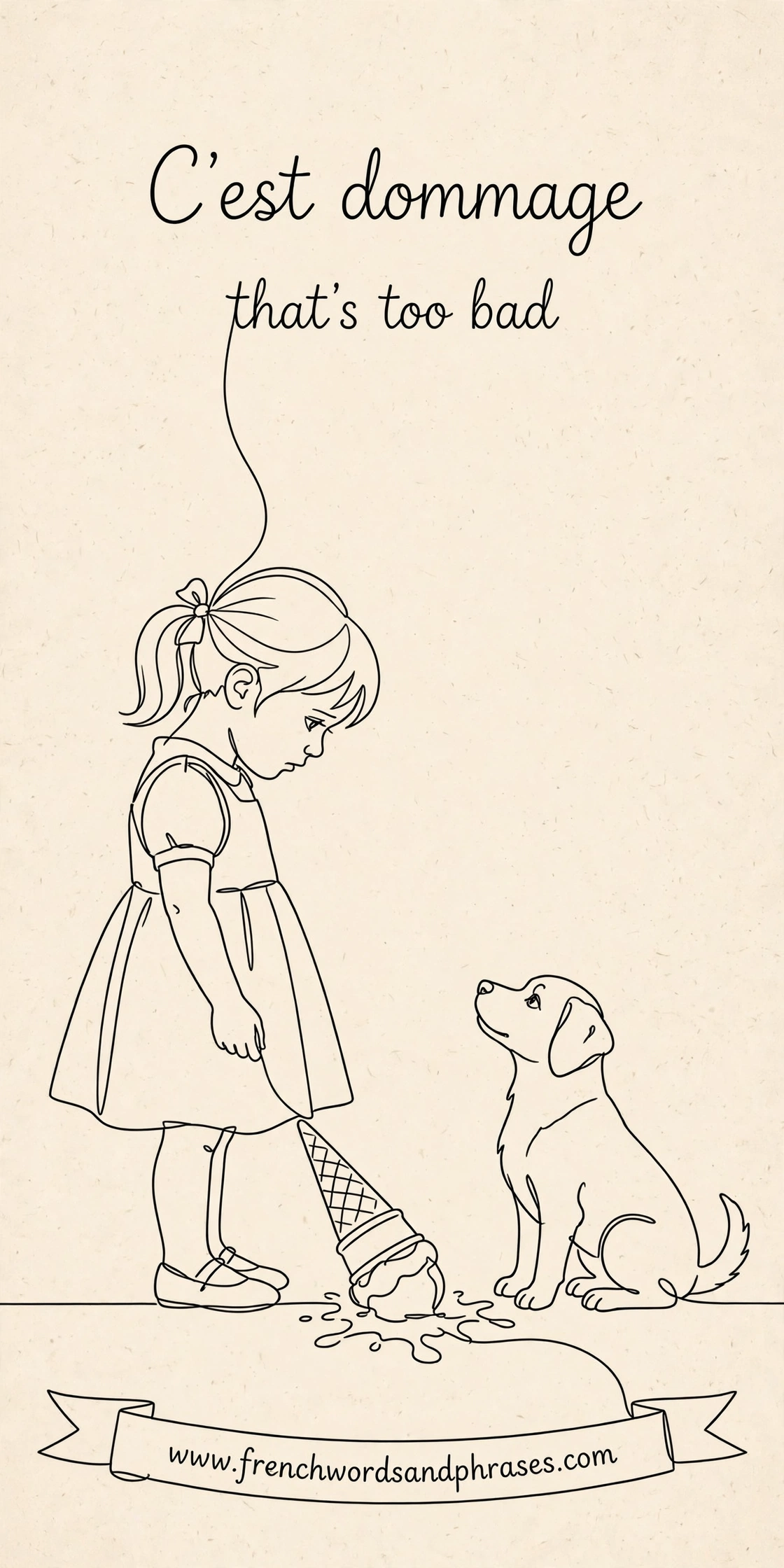
A French Word to Live By
Translate C’est dommage to English
/sɛ dɔ.maʒ/
C’est dommage means that’s too bad — what a pity, what a shame.
You arrive at the little bakery at six in the evening, dreaming of the last almond croissant you saw in the window this morning. The baker shakes her head: sold, an hour ago. You both look at the empty tray, and she says it for both of you: « C’est dommage ! »
Let’s explore how c’est dommage works in French, beginning with the whole phrase on one card.
Understanding the French Phrase C’est dommage
C’est dommage is a French everyday expression built from c’est (it is, that is) and dommage — a noun meaning damage, harm, and by extension a pity, a shame. What English splits into two words, too bad, French keeps inside one old word for harm done.
It means that’s a pity, what a shame, too bad — the standard French response to a small disappointment: a missed train, a rained-off picnic, a shop that has just closed. It is sympathy in two words, said by the person who suffers the disappointment and by everyone standing next to them.
Type: Everyday expression — reaction to disappointment (c’est + noun)
Answers the need: Saying ‘what a pity’ or ‘too bad’ about a disappointment
Register: Neutral — the all-purpose pity phrase, safe everywhere
Strength: Mild to warm — small disappointments; for tragedies French reaches for stronger words
One important usage detail: dommage also stands alone as an exclamation — « Dommage ! » — and grows with quel: « Quel dommage ! » is a stronger ‘what a real shame!’ The phrase also introduces regrets with que and the subjunctive: c’est dommage qu’il pleuve, it’s a pity it’s raining; c’est dommage que tu ne puisses pas venir.
Experience the Word
C’est dommage is the sound of a small door closing politely — nothing is broken, but the plan is gone.
Imagine the last train pulling out as you reach the platform, bag in hand, watching the red lights shrink. Nobody is at fault, nothing can be done, and the whole feeling fits in two words. French keeps this phrase oiled and ready because daily life produces the moment constantly: the sold-out screening, the closed museum, the friend who cannot come after all.
It is also a kindness word. Said to someone else, c’est dommage means: your disappointment is seen, and it counts.
How to Use C’est dommage in French: Complete Guide
Let’s explore how c’est dommage works in French, beginning with the whole phrase on one card.
C’est dommage at a Glance
The Whole Phrase on One Card
Real meaning, literal picture, English twin and register — c’est dommage in five lines.
| Point | C’est dommage |
|---|---|
| What it really means | that’s a pity, what a shame, too bad |
| Word for word | it is damage — harm done, in the old sense of the word dommage |
| English equivalent | that’s too bad / what a shame / what a pity |
| Register | neutral — safe everywhere, the standard reaction |
| Use it for | missed trains, closed shops, rained-off plans — everyday disappointments |
Example
Le musée est fermé le lundi, c’est dommage.
The museum is closed on Mondays, that’s a pity.
Word by Word: Building the Pity
Two pieces — a pointing word and an old word for harm.
| Word | Literal meaning | Its job in the phrase |
|---|---|---|
| c’est | it is, that is | points at the situation — the missed train, the rain, the news |
| dommage | damage, harm | the noun of harm done; softened by centuries of use into ‘a pity’ |
Example
C’est dommage, il ne reste plus de places.
It’s a pity, there are no seats left.
Quick Quiz 1
What does dommage mean outside this phrase?
Reveal the answer
Damage, harm — les dommages are the damages after an accident; in the phrase, the harm has shrunk to a disappointment.
L’assurance paie les dommages.
The insurance pays for the damage.
When You Say It: The Disappointment Moments
C’est dommage fires at moments like these — a plan meets a closed door.
| Situation | Example |
|---|---|
| Sold out | plus de billets ? c’est dommage — no tickets left? that’s too bad |
| Bad weather | il pleut le jour du pique-nique, c’est dommage — rain on picnic day, what a pity |
| A friend can’t come | tu ne peux pas venir ? c’est dommage — you can’t come? that’s a shame |
| Just missed | le train vient de partir, c’est dommage — the train has just left, too bad |
| Consoling someone | c’est dommage pour toi, tu méritais mieux — it’s a pity for you, you deserved better |
Example
C’est dommage que le concert soit annulé.
It’s a pity the concert is cancelled.
Make It Yours: The Pity in Every Size
Dommage scales from a murmur to a headline — and it can carry a whole clause behind it.
| Form | French | In English |
|---|---|---|
| Standard | c’est dommage | that’s too bad |
| Alone | dommage ! | too bad! / shame! |
| Stronger | quel dommage ! | what a shame! |
| Even warmer | c’est bien dommage | it’s a real pity |
| With a regret | c’est dommage que tu partes | it’s a pity you’re leaving |
| Past | c’était dommage | it was a pity |
Example
Quel dommage, cette robe te va si bien !
What a shame, that dress suits you so well!
Quick Quiz 2
Which form is the stronger exclamation — c’est dommage or quel dommage?
Reveal the answer
Quel dommage ! — quel turns the observation into an exclamation: what a shame!
Quel dommage, le spectacle est complet !
What a shame, the show is sold out!
Everyday Expressions: Building on the Pity
C’est dommage slots into these everyday frames — each one ready to use as it stands.
| Frame | In English |
|---|---|
| c’est dommage | that’s too bad |
| quel dommage ! | what a shame! |
| c’est dommage que + subjunctive | it’s a pity that… |
| dommage pour lui / pour elle | too bad for him / for her |
| c’est bien dommage | it’s a real pity |
Example
C’est bien dommage qu’elle ne soit pas là.
It’s a real pity she isn’t here.
Close Cousins: The Other Ways to Say Too Bad
French sighs in several registers — c’est dommage is the warm standard; its cousins shrug, resign or dramatise.
| Expression | The difference |
|---|---|
| c’est dommage | that’s a pity — warm, sympathetic, the standard |
| tant pis | oh well, never mind — resigned, the disappointment accepted and filed away |
| c’est triste | that’s sad — a heavier, more emotional judgement |
| malheureusement | unfortunately — the formal, written cousin |
| c’est bête | that’s silly / annoying — the disappointment with a pinch of irritation (everyday) |
Example
Tant pis, on reviendra demain.
Oh well, we’ll come back tomorrow.
Quick Quiz 3
The shop is closed and your friend shrugs: ‘never mind, tomorrow then.’ Which cousin fits — c’est dommage or tant pis?
Reveal the answer
Tant pis — it accepts the disappointment and moves on; c’est dommage lingers on the pity.
Tant pis, la boulangerie ouvre à sept heures demain.
Never mind, the bakery opens at seven tomorrow.
C’est dommage and Its Neighbours
The sympathy shelf around the phrase — regrets, sighs and consolations.
| French | In English |
|---|---|
| un regret | a regret |
| hélas | alas — literary, a touch theatrical |
| une déception | a disappointment |
| manquer de chance | to be unlucky, to have no luck |
| ce n’est pas de chance | that’s bad luck |
| la prochaine fois | next time — the consolation that follows |
Example
Ce n’est pas de chance, mais la prochaine fois sera la bonne.
That’s bad luck, but next time will be the one.
Watch Out: The Traps Around C’est dommage
The traps: a false friend called damage, and a subjunctive hiding behind que.
| Trap | The truth |
|---|---|
| the false friend | c’est dommage never means ‘it is damaged’ — a damaged thing is abîmé or endommagé |
| the subjunctive after que | c’est dommage que takes the subjunctive: c’est dommage qu’il pleuve, que tu partes — a classic exam trap |
| too small for tragedies | for real grief French says c’est terrible, c’est affreux — dommage is sized for everyday disappointments |
| word for word in English | ‘it is damage’ is not English — say that’s too bad, what a pity |
Example
La table est abîmée, et c’est bien dommage.
The table is damaged, and it’s a real pity.
Quick Quiz 4
True or false: c’est dommage can describe a broken object.
Reveal the answer
False — it pities a situation. A broken object is abîmé or endommagé; les dommages are damages in the legal and insurance sense.
Le vase est abîmé, quel dommage.
The vase is damaged, what a pity.
C’est dommage in Everyday French: Real-Life Examples
Now that you know the word, let’s see how c’est dommage appears in everyday French.
Example 1 — At the bakery
Plus de croissants ? C’est dommage.
No croissants left? That’s too bad.
Example 2 — Weather
Il pleut dimanche, c’est dommage pour le pique-nique.
It’s raining on Sunday, that’s a pity for the picnic.
Example 3 — A friend
Tu travailles ce soir ? C’est dommage, on t’attendait.
You’re working tonight? That’s a shame, we were expecting you.
Example 4 — Transport
Le dernier bus est passé, c’est dommage.
The last bus has gone, that’s too bad.
Example 5 — Stronger
Quel dommage, le feu d’artifice est annulé !
What a shame, the fireworks are cancelled!
Example 6 — Consolation
C’est dommage, mais on se rattrapera le week-end prochain.
It’s a pity, but we’ll make up for it next weekend.
Beyond Translation: The Meaning of C’est dommage
English says too bad — a quick shrug of two words. French reaches back to dommage, damage: somewhere under the polite little phrase is the old idea that a small harm has genuinely been done — to the plan, to the day, to you.
C’est dommage is sympathy with a memory: it treats every disappointment as a tiny injury worth naming.
That is why it is said so often, and to strangers as much as to friends. The baker says it about the croissant because in French, your small loss deserves its two words of mourning.
How to Remember the French Phrase C’est dommage
Remember it this way: C’est dommage is the baker shaking her head at the empty tray — a small harm has been done to your morning, and she names it kindly.
- You hear the old word inside — dommage is damage; the phrase calls a disappointment a small harm.
- You keep the family together — dommage ! alone, and quel dommage ! when the pity grows.
- You watch the que — c’est dommage que takes the subjunctive: qu’il pleuve, que tu partes.
The key idea is c’est dommage means that’s too bad — the standard French pity for everyday disappointments.
Test Your Knowledge of C’est dommage
Let’s see how much you’ve learned. Try answering these questions before revealing the answers.
Question 1
What does c’est dommage mean?
Reveal the answer
That’s too bad, what a pity — the standard response to an everyday disappointment.
Question 2
How do you make the phrase a stronger exclamation?
Reveal the answer
Quel dommage ! — what a shame! Quel turns it into an exclamation.
Question 3
What mood follows c’est dommage que?
Reveal the answer
The subjunctive — c’est dommage qu’il pleuve, c’est dommage que tu partes.
Question 4
What is the difference between c’est dommage and tant pis?
Reveal the answer
C’est dommage lingers on the pity; tant pis accepts and moves on — oh well, never mind.
Question 5
Complete the sentence:
Le concert est annulé, c’est vraiment ______. (The concert is cancelled, it’s a real pity.)
Reveal the answer
dommage
Le concert est annulé, c’est vraiment dommage.
The concert is cancelled, it’s a real pity.
Your Final Challenge
Can You Use It?
How would you say this in French?
“It’s a pity that the museum is closed today.”
Reveal the answer
C’est dommage que le musée soit fermé aujourd’hui.
It’s a pity that the museum is closed today.
A little French. A little curiosity. A richer everyday life.
LEARN FRENCH ONE WORD AT A TIME