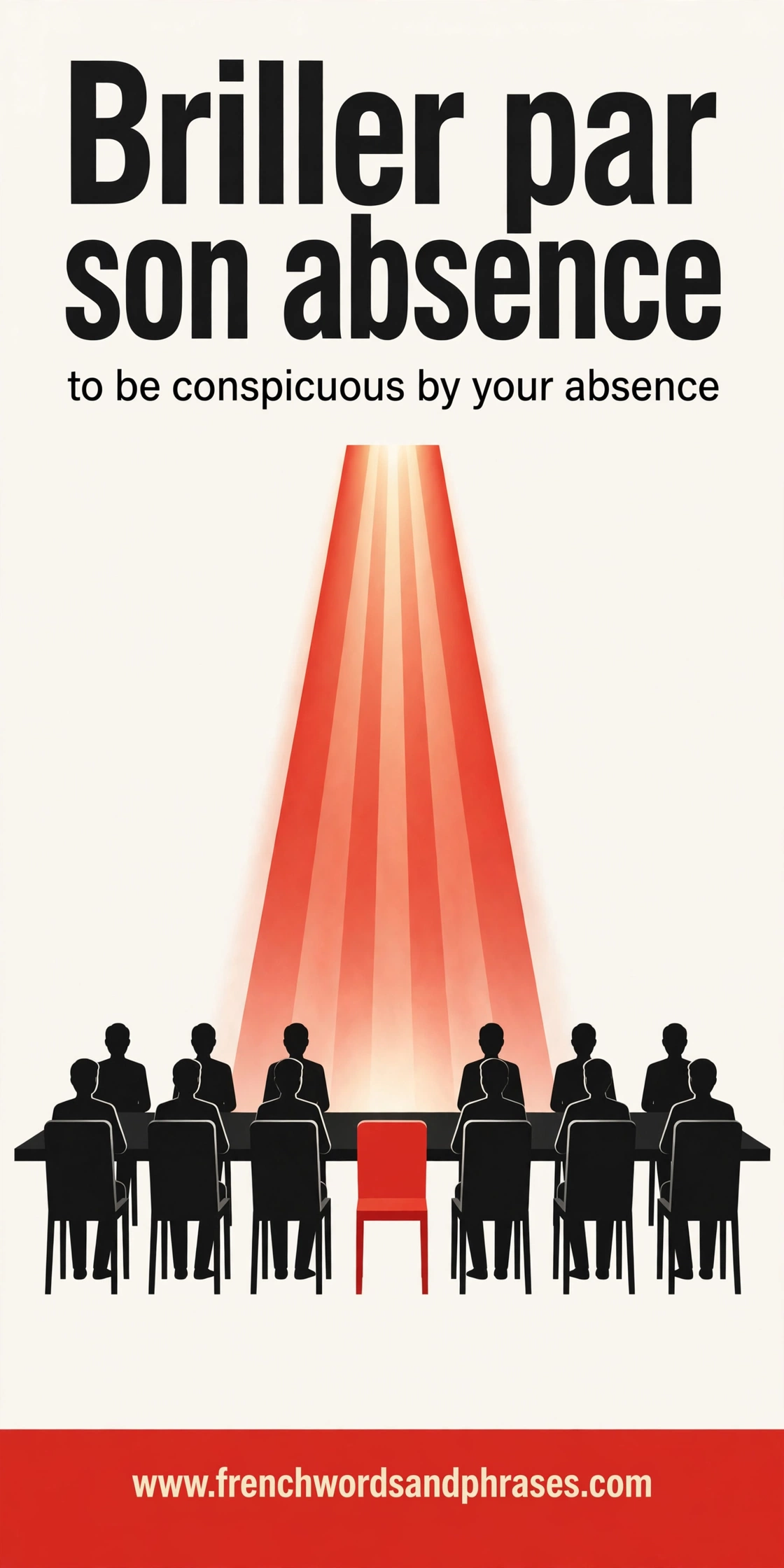
A French Word to Live By
Translate Briller par son absence to English
/bʁi.je paʁ sɔ̃.nap.sɑ̃s/
Briller par son absence means to be conspicuous by your absence — to be noticed precisely because you were not there.
The annual meeting had forty chairs, thirty-nine employees, and one empty seat in the front row — the seat of the deputy director, whose project was the only item on the agenda. Nobody mentioned his name for two hours. Nobody needed to. As the French say with a smile: il a brillé par son absence.
Let’s explore how briller par son absence works in French, beginning with the whole phrase on one card.
Understanding the French Phrase Briller par son absence
Briller par son absence is a French idiomatic expression built from briller (to shine) and absence. It is a deliberate paradox — a compliment turned inside out: the person shines, is noticed, stands out from the crowd, for the simple reason that they are not there at all.
It means to be conspicuous by your absence: someone who was expected — at a meeting, a ceremony, a family dinner — did not come, and their empty place drew more attention than most of the people who attended. The phrase is almost always ironic, sometimes affectionate (the beloved uncle who missed the wedding) and sometimes a polished public rebuke (the minister who skipped the debate).
Type: Idiomatic expression — absence (verb phrase with a possessive that agrees with the subject)
Answers the need: Noting, with a smile or a sting, that someone’s absence was the loudest presence
Register: Neutral to witty — at home in journalism, speeches and family teasing alike
Agreement: The possessive follows the missing person: il brille par son absence, elle par son absence, ils par leur absence
One important usage detail: the absence must be noticeable — the person was expected, invited, or needed. A stranger cannot briller par son absence at your dinner. The phrase also loves ceremonies and official occasions: weddings, funerals, summits and prize-givings are its natural habitat, because there the guest list is public and every empty chair has a name.
Experience the Word
Briller par son absence is the empty chair at the table that everyone keeps glancing at — presence measured by the size of the hole.
Imagine the village fête where the mayor always gives the first speech. This year: a deputy, a cough, an apology read from a card. The speech is forgotten by dessert; the absence is discussed until Christmas. That is the arithmetic of the phrase — some people are so woven into an occasion that removing them does not dim the event. It spotlights the gap.
The idea is old and Roman. Tacitus wrote that at a great funeral, the portraits of Brutus and Cassius outshone all the others — precisely because theirs were not shown.
How to Use Briller par son absence in French: Complete Guide
Let’s explore how briller par son absence works in French, beginning with the whole phrase on one card.
Briller par son absence at a Glance
The Whole Phrase on One Card
Real meaning, literal picture, English twin and register — briller par son absence in five lines.
| Point | Briller par son absence |
|---|---|
| What it really means | to be conspicuous by your absence — noticed because you were not there |
| Word for word | to shine by one’s absence |
| English equivalent | to be conspicuous by one’s absence |
| Register | neutral and witty — an ironic compliment that can tease or rebuke |
| Use it for | empty chairs at meetings, weddings, ceremonies and summits |
Example
Le ministre a brillé par son absence pendant tout le débat.
The minister was conspicuous by his absence throughout the whole debate.
Word by Word: Building the Paradox
Three small pieces — take them one by one and the empty chair starts to glow.
| Word | Literal meaning | Its job in the phrase |
|---|---|---|
| briller | to shine, to stand out | the spotlight — the missing person is the most visible one of all |
| par | by, through | the channel of the shining: not by talent or dress, but by absence itself |
| son absence | his/her absence | the star of the show — a non-arrival that everyone discusses |
Example
À la réunion de famille, mon frère a brillé par son absence.
At the family gathering, my brother was conspicuous by his absence.
Quick Quiz 1
Can a total stranger briller par son absence at your birthday?
Reveal the answer
No — the phrase needs an expectation. Only someone who was invited, expected or needed can shine by not arriving.
Tout le monde attendait le maire ; il a brillé par son absence.
Everyone was expecting the mayor; he was conspicuous by his absence.
When You Say It: The Empty-Chair Moments
Briller par son absence fires at moments like these — wherever a guest list meets an empty place.
| Situation | Example |
|---|---|
| At work | le directeur a brillé par son absence à la réunion — the director was conspicuous by his absence at the meeting |
| At a wedding | la tante a brillé par son absence, tout le monde l’a remarqué — the aunt was conspicuous by her absence, everyone noticed |
| In politics | plusieurs députés ont brillé par leur absence lors du vote — several deputies were conspicuous by their absence during the vote |
| Teasing a friend | alors, tu as brillé par ton absence hier soir ! — well, you were conspicuous by your absence last night! |
| In the press | la star a brillé par son absence sur le tapis rouge — the star was conspicuous by her absence on the red carpet |
Example
Tu as brillé par ton absence à l’entraînement, le coach a demandé après toi.
You were conspicuous by your absence at training, the coach asked after you.
Make It Yours: The Shining for Every Absentee
The possessive is the moving part — it follows whoever failed to arrive.
| Form | French | In English |
|---|---|---|
| He was absent | il a brillé par son absence | he was conspicuous by his absence |
| She was absent | elle a brillé par son absence | she was conspicuous by her absence |
| You were absent | tu as brillé par ton absence | you were conspicuous by your absence |
| They were absent | ils ont brillé par leur absence | they were conspicuous by their absence |
| We were absent | nous avons brillé par notre absence | we were conspicuous by our absence |
| Right now | il brille par son absence | he is conspicuous by his absence |
Example
Les deux témoins ont brillé par leur absence à la cérémonie.
The two witnesses were conspicuous by their absence at the ceremony.
Quick Quiz 2
Three deputies stayed away. Which form — par son absence or par leur absence?
Reveal the answer
Par leur absence — the possessive belongs to the absentees, and three absentees make it plural.
Ils ont brillé par leur absence.
They were conspicuous by their absence.
Everyday Expressions: Building on the Empty Chair
Briller par son absence slots into these everyday frames — each one ready to use as it stands.
| Frame | In English |
|---|---|
| briller par son absence | to be conspicuous by one’s absence |
| il/elle a brillé par son absence | he/she was conspicuous by his/her absence |
| briller par leur absence | to be conspicuous by their absence (several people) |
| tout le monde a remarqué son absence | everyone noticed his/her absence — the plain version, no shine |
| briller par son silence | to be conspicuous by one’s silence — the cousin, for people who attend but say nothing |
Example
Pendant la crise, le président a brillé par son silence.
During the crisis, the president was conspicuous by his silence.
Close Cousins: The Other Absences
French comments on absence in several tones — briller par son absence is the polished one; its cousins are plainer, kinder or ruder.
| Expression | The difference |
|---|---|
| briller par son absence | to shine by your absence — ironic, quotable, aimed at the expected guest |
| être aux abonnés absents | to be unreachable — the phone rings in an empty room; said when someone cannot be contacted at all |
| manquer à quelqu’un | to be missed by someone — the tender version: tu nous manques, we miss you |
| faire faux bond | to stand someone up — the absence as a broken promise, and a ruder verdict |
| être présent | to be present — the unglamorous opposite that nobody ever remarks on |
Example
Il ne nous a pas seulement manqué, il a brillé par son absence.
We didn’t just miss him, he was conspicuous by his absence.
Quick Quiz 3
Your friend promised to help you move house and simply never appeared. Which phrase carries the reproach — manquer à quelqu’un or faire faux bond?
Reveal the answer
Faire faux bond — to stand someone up. Manquer à quelqu’un is what you feel about people you love, not about people who owe you a sofa-carrying.
Il m’a fait faux bond le jour du déménagement.
He stood me up on moving day.
Briller par son absence and Its Neighbours
The ceremony shelf around the phrase — from guest lists to empty chairs.
| French | In English |
|---|---|
| une cérémonie | a ceremony |
| un invité | a guest |
| une chaise vide | an empty chair |
| remarquer | to notice |
| s’excuser | to send one’s apologies |
| être attendu | to be expected |
Example
Une chaise vide, et tout le monde a remarqué l’absence du maire.
One empty chair, and everyone noticed the mayor’s absence.
Watch Out: The Traps Around Briller par son absence
The traps: a compliment that is not one, a possessive that wanders, and shine that needs an audience.
| Trap | The truth |
|---|---|
| not a compliment | despite briller, the phrase almost never praises — it teases, laments or rebukes the absentee |
| the possessive follows the absentee | son, ton, leur, notre — the absence belongs to whoever stayed away, and must agree with them |
| an audience is required | if nobody expected the person and nobody noticed, there is no shining — just an absence |
| absence is not silence | for the person who came but said nothing, French switches the noun: briller par son silence |
Example
Personne ne l’attendait, alors personne n’a remarqué son absence.
Nobody was expecting him, so nobody noticed his absence.
Quick Quiz 4
True or false: briller par son absence is a compliment about how elegant someone looked at the party.
Reveal the answer
False — the person was not at the party at all. The shine is made entirely of other people’s noticing.
Elle n’était pas là, et c’est exactement pour ça qu’elle a brillé par son absence.
She wasn’t there, and that is exactly why she was conspicuous by her absence.
Briller par son absence in Everyday French: Real-Life Examples
Now that you know the word, let’s see how briller par son absence appears in everyday French.
Example 1 — At work
Le chef a brillé par son absence pendant la réunion de crise.
The boss was conspicuous by his absence during the crisis meeting.
Example 2 — At a wedding
L’oncle Henri a brillé par son absence, comme d’habitude.
Uncle Henri was conspicuous by his absence, as usual.
Example 3 — Teasing
Tu as brillé par ton absence hier, on a mangé ton dessert.
You were conspicuous by your absence yesterday, we ate your dessert.
Example 4 — In politics
Plusieurs ministres ont brillé par leur absence au sommet.
Several ministers were conspicuous by their absence at the summit.
Example 5 — At school
Le professeur a demandé pourquoi Karim avait brillé par son absence.
The teacher asked why Karim had been conspicuous by his absence.
Example 6 — The cousin form
Pendant tout le dîner, il a brillé par son silence.
Throughout the whole dinner, he was conspicuous by his silence.
Beyond Translation: The Meaning of Briller par son absence
English borrowed this one almost intact — conspicuous by one’s absence — because the paradox is too good to leave behind: a person can dominate a room they never entered.
French keeps the verb of light — briller — where English keeps the adjective of being seen.
That small difference is the whole wit of the phrase. To be seen is passive. To shine is something even an empty chair can do on your behalf.
How to Remember the French Phrase Briller par son absence
Remember it this way: Briller par son absence is the empty chair under a spotlight — the one seat in the room that everybody keeps looking at.
- You picture the empty chair — expected, named, and glowing with nobody in it.
- You aim the possessive at the absentee — son, ton, leur absence follows whoever stayed away.
- You remember Tacitus — Brutus and Cassius outshone a funeral precisely because their portraits were not shown.
The key idea is briller par son absence means to be conspicuous by your absence — to shine by not being there.
Test Your Knowledge of Briller par son absence
Let’s see how much you’ve learned. Try answering these questions before revealing the answers.
Question 1
What does briller par son absence mean?
Reveal the answer
To be conspicuous by your absence — to be noticed and discussed precisely because you did not come.
Question 2
What is the literal, word-for-word meaning?
Reveal the answer
To shine by one’s absence — briller is to shine, and the absence itself does the shining.
Question 3
How do you say ‘they were conspicuous by their absence’?
Reveal the answer
Ils ont brillé par leur absence — the possessive leur belongs to the absentees.
Question 4
What is the difference between briller par son absence and faire faux bond?
Reveal the answer
Faire faux bond is to stand someone up — a broken promise. Briller par son absence is the wider, wittier verdict on any noticed non-arrival.
Question 5
Complete the sentence:
La directrice a ______ par son absence à la cérémonie. (The director was conspicuous by her absence at the ceremony.)
Reveal the answer
brillé
La directrice a brillé par son absence à la cérémonie.
The director was conspicuous by her absence at the ceremony.
Your Final Challenge
Can You Use It?
How would you say this in French?
“The mayor was conspicuous by his absence.”
Reveal the answer
Le maire a brillé par son absence.
The mayor was conspicuous by his absence.
A little French. A little curiosity. A richer everyday life.
LEARN FRENCH ONE WORD AT A TIME