A French Word to Live By
Translate Bon vent to English
/bɔ̃ vɑ̃/
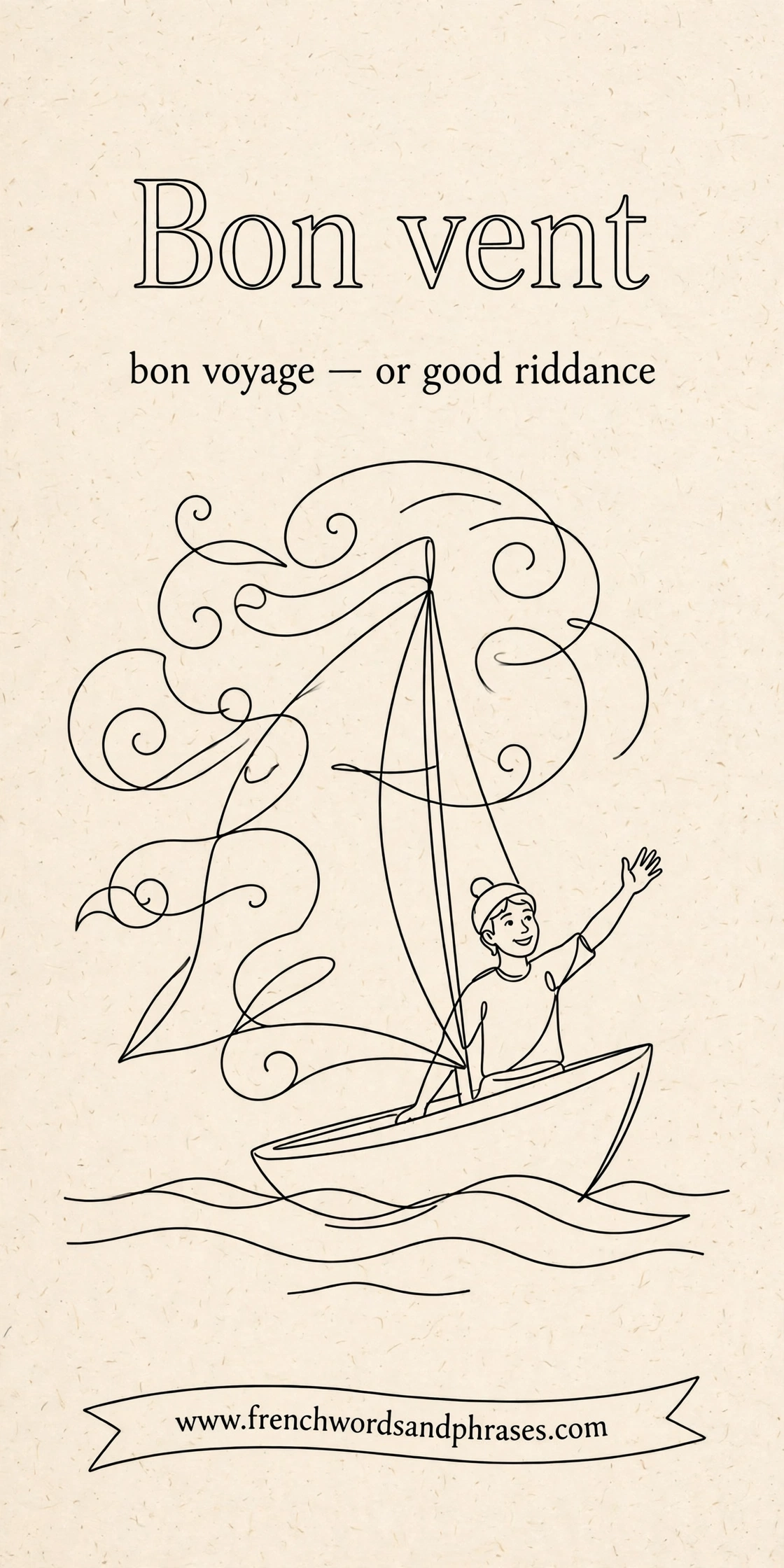
Bon vent means good wind — a sailor’s farewell: bon voyage, or ironically, good riddance.
On the quay at dawn, the ropes are cast off and the little boat slides away from the harbour wall. The old fisherman raises a hand and calls after it the oldest farewell on the coast: « Bon vent ! » Fair winds. Two words — and, said to the right person on the wrong day, they can mean entirely the opposite.
Let’s explore how bon vent works in French, beginning with the whole phrase on one card.
Understanding the French Phrase Bon vent
Bon vent is a French idiomatic exclamation built from bon (good) and vent (wind). It began as a sailor’s blessing — may your wind be good — and came ashore as a general farewell with two faces: the sincere wish for a good journey, and the ironic send-off for someone you are delighted to see leave.
Said warmly, bon vent ! means fair winds and a good journey — the harbour’s way of saying bon voyage. Said flatly, with a wave towards the door, it means good riddance: off you go, and the wind is welcome to keep you. The words never change; the smile — or the absence of one — decides which farewell you have just heard.
Type: Idiomatic exclamation — a farewell
Answers the need: Wishing someone a good journey — or waving a nuisance away
Register: Neutral words, two tones: warm sincerity or dry irony
Strength: As warm as a hug — or as cutting as a closing door
One important usage detail: context and tone do all the work. For the sincere version, French often pairs it up — bon vent et bonne route ! — or adds à bientôt, see you soon. The ironic version loves a flat allez in front: allez, bon vent ! Never write the ironic one in a formal farewell card unless you are very, very sure of your reader.
Experience the Word
Bon vent is the smallest farewell in French and the most double-edged — a blessing that can be folded into a dismissal without changing a single letter.
Imagine the apartment building’s front door closing behind the noisiest neighbour in its history, his van loaded, his music finally somebody else’s problem. From the third-floor window, Madame Berthe watches him go, raises her cup of tea like a harbourmaster, and murmurs: « Bon vent. » Every tenant in the building understands both meanings, and approves of each.
Sailors blessed departures because the sea was dangerous. The landsman’s irony survives because some departures are dangerous to nobody — and a relief to everybody.
How to Use Bon vent in French: Complete Guide
Let’s explore how bon vent works in French, beginning with the whole phrase on one card.
Bon vent at a Glance
The Whole Phrase on One Card
Real meaning, literal picture, English twin and register — bon vent in five lines.
| Point | Bon vent |
|---|---|
| What it really means | a farewell with two faces: a good journey wished — or a good riddance meant |
| Word for word | good wind — the sailor’s blessing for a departing boat |
| English equivalent | fair winds! / bon voyage! — or good riddance! |
| Register | neutral words; the tone and the smile decide the meaning |
| Use it for | harbour goodbyes, friends emigrating — and noisy neighbours moving out |
Example
Le bateau s’éloigne ; du quai, on crie : « Bon vent ! »
The boat moves away; from the quay, they shout: ‘Fair winds!’
Word by Word: Two Words, Two Faces
Two small pieces — the shortest farewell in this whole collection.
| Word | Literal meaning | Its job in the phrase |
|---|---|---|
| bon | good | the blessing — the same bon as in bon voyage and bonne route |
| vent | wind | the sailor’s engine — a good wind once meant a safe, fast journey home |
Example
Bon vent, et que la mer te soit douce.
Fair winds, and may the sea be gentle with you.
Quick Quiz 1
Where does bon vent come from?
Reveal the answer
From the quayside — it is a sailor’s blessing: may the wind be good for your voyage. The ironic landsman’s use came later.
Les marins se souhaitent bon vent avant de partir.
Sailors wish each other fair winds before setting off.
When You Say It: Departures Welcome and Otherwise
Bon vent fires at moments like these — the smile tells you which of its two faces is showing.
| Situation | Example |
|---|---|
| At the harbour | bon vent, capitaine ! — fair winds, captain! (sincere) |
| A friend emigrating | bon vent et bonne chance au Canada ! — good journey and good luck in Canada! (sincere) |
| The noisy neighbour leaving | les voisins bruyants déménagent — bon vent ! (ironic, behind the door) |
| The in-laws’ Sunday visit ends | bon vent, à dimanche prochain ! — off you go, see you next Sunday! (family joke) |
| A colleague’s last day | bon vent pour la suite ! — all the best for what comes next! (either, by tone) |
Example
Les voisins bruyants déménagent — bon vent, et ne revenez pas trop vite !
The noisy neighbours are moving out — good riddance, and don’t come back too soon!
Make It Yours: Tuning the Farewell
Small additions steer the phrase — towards warmth, or towards the door.
| Form | French | In English |
|---|---|---|
| The bare blessing | bon vent ! | fair winds! |
| Clearly sincere | bon vent et bonne route ! | fair winds and a safe journey! |
| With a return promised | bon vent, et à bientôt ! | good journey, and see you soon! |
| Clearly ironic | allez, bon vent ! | go on, off you go! |
| Ironic, complete | bon vent, et ne reviens pas ! | good riddance, and don’t come back! |
| For what comes next | bon vent pour la suite ! | all the best for the next chapter! |
Example
Bon vent, les amis, et à très bientôt !
Fair winds, friends, and see you very soon!
Quick Quiz 2
Which addition guarantees the sincere meaning — et à bientôt or et ne reviens pas?
Reveal the answer
Et à bientôt — ‘and see you soon’ promises a return, which no good riddance ever does.
Bon vent, et à bientôt, j’espère.
Good journey, and see you soon, I hope.
Everyday Expressions: The Farewell Shelf
Bon vent slots into these everyday frames — each one ready to use as it stands.
| Frame | In English |
|---|---|
| bon vent ! | fair winds! — or good riddance! |
| bonne route ! | safe journey! — the road traveller’s twin |
| bon voyage ! | the standard sincere farewell |
| au revoir | goodbye — the neutral everyday word |
| bon débarras ! | good riddance! — the blunt cousin, irony with no disguise |
Example
Bonne route pour les conducteurs, bon vent pour les marins !
Safe journey for the drivers, fair winds for the sailors!
Close Cousins: The Other Ways to Say Goodbye
French farewells run from the blessing to the broom — bon vent is the one that can face both ways.
| Expression | The difference |
|---|---|
| bon vent | the sailor’s farewell — sincere or ironic, tone decides |
| bon voyage | the standard good journey — always sincere |
| bonne route | safe travels — for the road, always sincere |
| bon débarras | good riddance — the blunt cousin, irony undisguised |
| allez, ouste ! | shoo, off with you — playful dismissal, for children and cats |
Example
Pour les amis, bon voyage ; pour les moustiques, bon débarras !
For friends, bon voyage; for mosquitoes, good riddance!
Quick Quiz 3
Which cousin is the blunt, undisguised ‘good riddance’?
Reveal the answer
Bon débarras — literally ‘good riddance/clearance’: no blessing costume, pure relief.
Il est enfin parti — bon débarras !
He’s finally gone — good riddance!
Bon vent and Its Neighbours
The harbour shelf around the phrase — wind, boats and departures.
| French | In English |
|---|---|
| le vent | the wind |
| un bateau | a boat |
| le port | the port, the harbour |
| un départ | a departure |
| la mer | the sea |
Example
Au port, chaque départ commence par un bon vent.
At the harbour, every departure begins with a fair-winds blessing.
Watch Out: The Traps Around Bon vent
The traps: a tone that flips the meaning, a farewell card that can backfire, and a wind that is only weather.
| Trap | The truth |
|---|---|
| the tone trap | the same two words bless a friend and dismiss a nuisance — if your face doesn’t say which, your listener will guess, sometimes wrong |
| the card trap | never write bon vent alone in a formal farewell card; add bonne route or à bientôt to lock in the sincere meaning |
| the weather trap | vent alone is just wind — bon vent is only a farewell as the whole, fixed phrase |
| the spelling trap | it is vent, the wind — not vents, and never ‘bon van’ |
Example
Dans sa carte, elle a écrit : bon vent et bonne route, chers amis !
In her card, she wrote: fair winds and a safe journey, dear friends!
Quick Quiz 4
True or false: bon vent always means ‘good riddance’.
Reveal the answer
False — its first and oldest meaning is the sincere sailor’s blessing; the irony is the landsman’s later joke.
Au port, bon vent est une bénédiction, pas une insulte.
At the harbour, bon vent is a blessing, not an insult.
Bon vent in Everyday French: Real-Life Examples
Now that you know the word, let’s see how bon vent appears in everyday French.
Example 1 — At the harbour
Le bateau quitte le port ; les pêcheurs crient : « Bon vent ! »
The boat leaves the harbour; the fishermen shout: ‘Fair winds!’
Example 2 — The friend emigrating
Elle part vivre au Canada : bon vent, et écris-nous vite !
She’s leaving to live in Canada: good journey, and write to us soon!
Example 3 — The noisy neighbours
Les voisins bruyants déménagent — bon vent, murmure tout l’immeuble.
The noisy neighbours are moving out — good riddance, murmurs the whole building.
Example 4 — The Sunday visit
Après le déjeuner, les beaux-parents repartent : bon vent, à dimanche !
After lunch, the in-laws head off: off you go, see you Sunday!
Example 5 — The farewell card
Pour sa retraite, ses collègues ont écrit : bon vent pour la suite !
For her retirement, her colleagues wrote: all the best for what comes next!
Example 6 — The garden chairs
La tempête a emporté les chaises du jardin : bon vent, les chaises !
The storm carried off the garden chairs: off you go, chairs!
Beyond Translation: The Meaning of Bon vent
English keeps the sailor’s blessing in its full ceremonial dress — ‘fair winds and following seas’ — and says it only in earnest. French shrank the blessing to two words and, in shrinking it, made room for a wink: the same wind that speeds a friend’s boat can be invited to keep a nuisance.
Bon vent is a harbour in the pocket: blessing and broom in a single breath.
Master its tone and you hold one of the most French instruments there is — a farewell whose meaning lives entirely in the smile that carries it.
How to Remember the French Phrase Bon vent
Remember it this way: Bon vent is the sailor’s blessing that learned to wink — good wind for friends, and the same wind, please, for nuisances.
- You stand on the quay — vent is the wind that once decided whether a voyage was safe.
- You let the tone steer — a smile makes it bon voyage; a flat wave makes it good riddance.
- You lock sincerity in with words — et bonne route, et à bientôt; the blunt cousin is bon débarras.
The key idea is bon vent means fair winds — a sincere bon voyage, or, by tone, good riddance.
Test Your Knowledge of Bon vent
Let’s see how much you’ve learned. Try answering these questions before revealing the answers.
Question 1
What does bon vent literally mean, and where does it come from?
Reveal the answer
‘Good wind’ — a sailor’s blessing shouted to a departing boat.
Question 2
What are the two meanings of bon vent today?
Reveal the answer
A sincere ‘bon voyage’ — and, said flatly, ‘good riddance’. Tone decides.
Question 3
How do you make the sincere meaning unmistakable?
Reveal the answer
Add a warm companion — bon vent et bonne route ! or bon vent, et à bientôt !
Question 4
Which cousin is the blunt ‘good riddance’ with no disguise?
Reveal the answer
Bon débarras — pure relief, no blessing costume.
Question 5
Complete the sentence:
Le bateau s’éloigne, et du quai on crie : « Bon ______ ! » (The boat moves away, and from the quay they shout: ‘Fair winds!’)
Reveal the answer
vent
Le bateau s’éloigne, et du quai on crie : « Bon vent ! »
The boat moves away, and from the quay they shout: ‘Fair winds!’
Your Final Challenge
Can You Use It?
How would you say this in French?
“The noisy neighbours are moving out — good riddance!”
Reveal the answer
Les voisins bruyants déménagent — bon vent !
The noisy neighbours are moving out — good riddance!
A little French. A little curiosity. A richer everyday life.
LEARN FRENCH ONE WORD AT A TIME