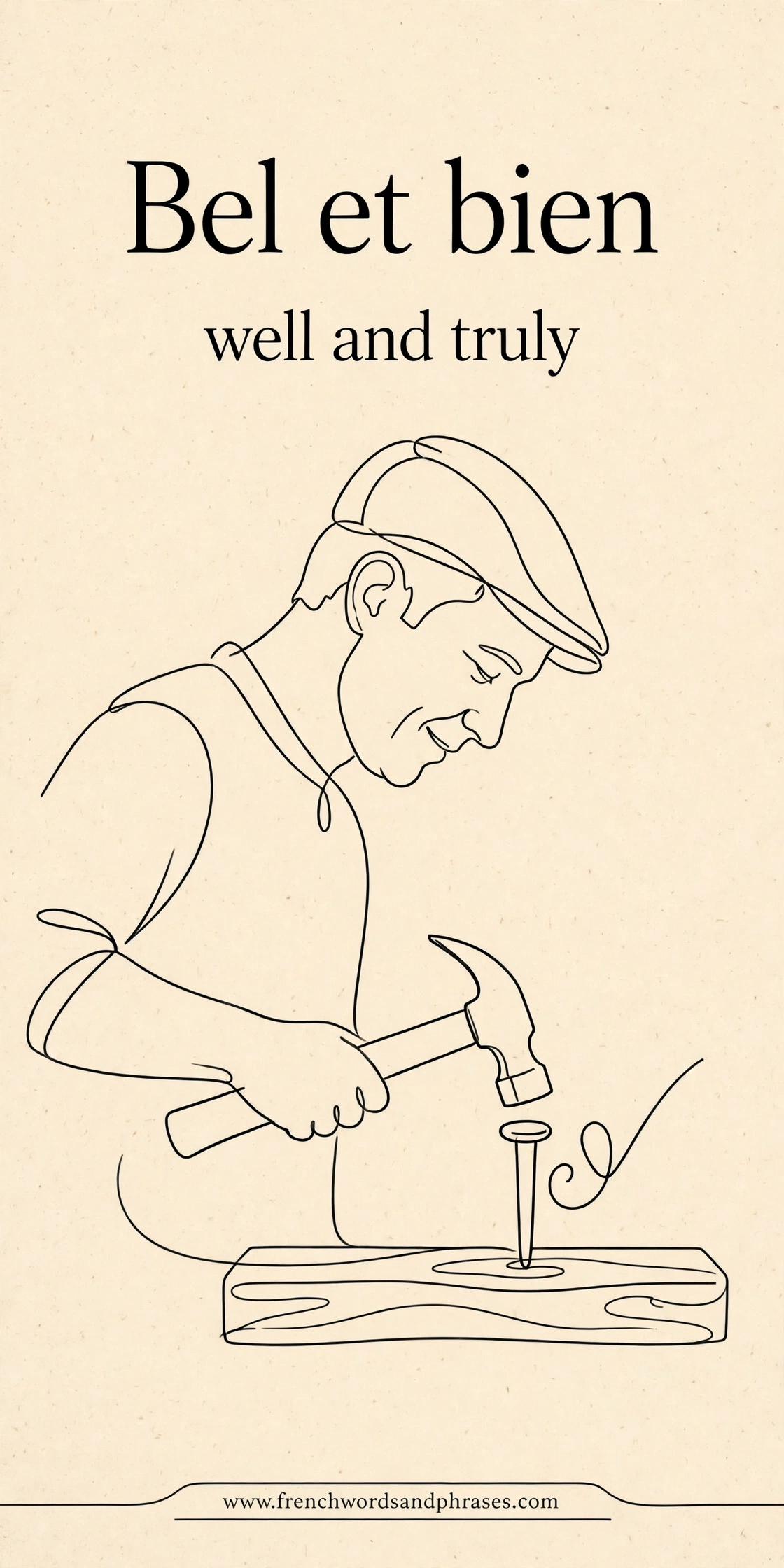
A French Word to Live By
Translate Bel et bien to English
/bɛ.le bjɛ̃/
Bel et bien means well and truly — really, definitely, beyond any doubt.
The rumour has been running around the office all morning: the old director is retiring. At noon he stands up, clears his throat and confirms it himself. No more doubt — « il part bel et bien à la retraite ». It really is happening.
Let’s explore how bel et bien works in French, beginning with the whole phrase on one card.
Understanding the French Phrase Bel et bien
Bel et bien is a French idiomatic adverbial phrase built from bel (the old form of beau, beautiful) and bien (well). The bel is a fossil: centuries ago it was the form beau took before a vowel, and it survives frozen inside this one expression, where the two approving words together mean really and truly.
It means really and truly — it stamps a fact as definite, usually after doubt, rumour or suspense. Il est bel et bien parti means he has well and truly gone. Nobody is talking about beauty: bel et bien is pure emphasis, a double seal pressed onto the truth.
Type: Idiomatic adverbial phrase — emphasis and confirmation
Answers the need: Confirming that something is really, definitely true
Register: Neutral, with a slightly old-fashioned flavour — safe in speech and writing
Strength: Maximum certainty — it closes the argument
One important usage detail: bel et bien never splits, and with a compound verb it slips between the auxiliary and the participle — il a bel et bien signé, she has well and truly signed. Before a plain verb or adjective it simply stands in front: elle est bel et bien là, c’est bel et bien fini.
Experience the Word
Bel et bien is the sound of a rumour becoming a fact — the moment the whispering stops and everyone nods.
Imagine the village that has talked for months about the old bakery closing. One Monday the shutters stay down and a sign appears in the window. The baker has bel et bien pris sa retraite — well and truly retired — and the talk turns, at last, into memory.
French loves to double-stamp its certainties. One approving word is an opinion; two together are a verdict.
How to Use Bel et bien in French: Complete Guide
Let’s explore how bel et bien works in French, beginning with the whole phrase on one card.
Bel et bien at a Glance
The Whole Phrase on One Card
Real meaning, literal picture, English twin and register — bel et bien in five lines.
| Point | Bel et bien |
|---|---|
| What it really means | really and truly — definitely, without any doubt |
| Word for word | beautiful and well — two old words of approval stamped together |
| English equivalent | well and truly / really and truly / definitely |
| Register | neutral, a touch old-fashioned — safe everywhere |
| Use it for | confirming rumours, ending doubt, stressing that something is genuinely so |
Example
Le magasin est bel et bien fermé.
The shop is well and truly closed.
Word by Word: Two Seals on the Truth
Three small pieces — take them one by one and the certainty builds itself.
| Word | Literal meaning | Its job in the phrase |
|---|---|---|
| bel | beautiful — the old form of beau | a fossil from Old French, kept only in fixed phrases like this one |
| et | and | the little link that presses the second seal beside the first |
| bien | well, truly | the word that does the real work — well and truly so |
Example
C’est bel et bien lui qui a téléphoné.
It really was him who phoned.
Quick Quiz 1
Is bel in bel et bien praising someone’s beauty?
Reveal the answer
No — bel is the old form of beau, frozen in the phrase; the whole expression means really and truly, and says nothing about looks.
Elle est bel et bien arrivée.
She has well and truly arrived.
When You Say It: The Doubt-Ending Moments
Bel et bien fires at moments like these — wherever a maybe turns into a yes.
| Situation | Example |
|---|---|
| Confirming news | il part bel et bien demain — he really is leaving tomorrow |
| Ending doubt | c’est bel et bien lui — it really is him |
| Insisting | je l’ai bel et bien vu de mes yeux — I definitely saw him with my own eyes |
| In writing | le projet est bel et bien terminé — the project is well and truly finished |
| Catching someone out | tu as bel et bien oublié ton parapluie — you really did forget your umbrella |
Example
Je te l’avais bel et bien dit !
I did tell you, didn’t I!
Make It Yours: The Stamp in Every Position
Bel et bien stays in one piece — only its seat in the sentence changes.
| Form | French | In English |
|---|---|---|
| With a compound verb | elle a bel et bien signé | she has well and truly signed |
| With être | il est bel et bien là | he really is there |
| Before an adjective | c’est bel et bien fini | it’s well and truly over |
| Denying a rumour | ce n’est pas une rumeur, c’est bel et bien vrai | it’s not a rumour, it’s really true |
| At full strength | bel et bien mort | well and truly dead |
| In a question | c’est bel et bien toi ? | is it really you? |
Example
Le train a bel et bien disparu dans le brouillard.
The train has well and truly vanished into the fog.
Quick Quiz 2
Where does bel et bien sit in il a signé (he has signed)?
Reveal the answer
Between the auxiliary and the participle — il a bel et bien signé. The stamp lands right before the action word.
Elle a bel et bien tout entendu.
She really did hear everything.
Everyday Expressions: Ready-Made Certainties
Bel et bien slots into these everyday frames — each one ready to use as it stands.
| Frame | In English |
|---|---|
| c’est bel et bien vrai | it’s really true |
| bel et bien décidé | well and truly decided |
| il a bel et bien disparu | he has well and truly vanished |
| bel et bien terminé | completely finished |
| je te l’avais bel et bien dit | I did tell you so |
Example
Les vacances sont bel et bien terminées.
The holidays are well and truly over.
Close Cousins: The Other Ways to Insist
French has a shelf of certainty words — bel et bien is the one with the old-fashioned double seal.
| Expression | The difference |
|---|---|
| vraiment | really — the everyday word, no ceremony |
| bel et bien | really and truly — the same insistence with an old double stamp |
| pour de bon | for good, for real — stresses permanence: c’est fini pour de bon |
| en effet | indeed — confirms politely, often in writing |
| bel et bon | rare and different: genuinely good, not a certainty stamp |
Example
Cette fois, c’est fini pour de bon, et il est bel et bien parti.
This time it’s over for good, and he really has left.
Quick Quiz 3
Which cousin means ‘for good, permanently’ — pour de bon or en effet?
Reveal the answer
Pour de bon — it is the one that says forever. En effet simply confirms, like ‘indeed’.
Il a quitté le village pour de bon.
He has left the village for good.
Bel et bien and Its Neighbours
The certainty shelf around the phrase — from a plain ‘well’ to a formal ‘assuredly’.
| French | In English |
|---|---|
| bien | well |
| beau / bel | beautiful — bel is its old form before a vowel |
| sans aucun doute | without any doubt |
| certainement | certainly |
| assurément | assuredly — formal |
Example
Sans aucun doute, elle a bel et bien gagné.
Without any doubt, she really did win.
Watch Out: The Traps Around Bel et bien
The traps: a beauty that isn’t there, a phrase that must not be split, and a near-twin that means something else.
| Trap | The truth |
|---|---|
| the beauty trap | bel here is not about looks — the phrase never describes anyone as beautiful |
| the splitting trap | bel and bien are never separated and never change form — no belle, no bonne |
| the position trap | with avoir or être + participle, it goes between them: il a bel et bien vu |
| the twin trap | bel et bon exists but is rare and means genuinely good — not ‘really and truly’ |
Example
Elle a bel et bien lu la lettre, ne dis pas le contraire.
She really did read the letter, don’t say otherwise.
Quick Quiz 4
True or false: bel et bien describes someone who is beautiful and good.
Reveal the answer
False — it is an emphasis phrase meaning really and truly; the bel is a fossil of beau and praises nobody’s looks.
Le pont est bel et bien fermé.
The bridge is well and truly closed.
Bel et bien in Everyday French: Real-Life Examples
Now that you know the word, let’s see how bel et bien appears in everyday French.
Example 1 — The retirement
Il part bel et bien à la retraite le mois prochain.
He really is retiring next month.
Example 2 — At the door
C’est bel et bien lui, je reconnais sa voix.
It really is him, I recognise his voice.
Example 3 — The lost keys
Je les ai bel et bien cherchées partout, ces clés.
I really did look everywhere for those keys.
Example 4 — In the newspaper
Le pont est bel et bien fermé pour travaux.
The bridge is well and truly closed for repairs.
Example 5 — Told you so
Je te l’avais bel et bien dit !
I did tell you so!
Example 6 — The exam
Elle a bel et bien réussi son examen.
She really did pass her exam.
Beyond Translation: The Meaning of Bel et bien
English keeps the exact twin of this phrase: ‘well and truly’. Both languages, asked to swear that something is so, reach for two approving words instead of one — as if a single ‘really’ were a promise and the double word a signature.
Bel et bien is a fact with two wax seals on it.
That is why it ends arguments so well. After bel et bien, there is nothing left to doubt — only the fact, standing there, stamped twice.
How to Remember the French Phrase Bel et bien
Remember it this way: Bel et bien is the truth with two wax seals pressed onto it — an old ‘beautiful’ and a solid ‘well’, side by side.
- You picture two seals — bel and bien, two approving words doing one job: certainty.
- You remember bel is a fossil — the old form of beau, kept only in fixed phrases.
- You park it between the helper verb and the participle — il a bel et bien signé.
The key idea is bel et bien means well and truly — really, definitely, beyond doubt.
Test Your Knowledge of Bel et bien
Let’s see how much you’ve learned. Try answering these questions before revealing the answers.
Question 1
What does bel et bien mean?
Reveal the answer
Well and truly — really, definitely, beyond any doubt.
Question 2
What is bel, the first word of the phrase?
Reveal the answer
The old form of beau (beautiful), fossilised in fixed phrases — it praises nobody’s looks here.
Question 3
How do you say ‘She has really signed’?
Reveal the answer
Elle a bel et bien signé — the phrase sits between the auxiliary and the participle.
Question 4
What is the difference between bel et bien and pour de bon?
Reveal the answer
Pour de bon means for good, permanently; bel et bien insists that something is really true.
Question 5
Complete the sentence:
Le magasin est ______ fermé, je te dis. (The shop is well and truly closed, I tell you.)
Reveal the answer
bel et bien
Le magasin est bel et bien fermé, je te dis.
The shop is well and truly closed, I tell you.
Your Final Challenge
Can You Use It?
How would you say this in French?
“He really is leaving tomorrow.”
Reveal the answer
Il part bel et bien demain.
He really is leaving tomorrow.
A little French. A little curiosity. A richer everyday life.
LEARN FRENCH ONE WORD AT A TIME