A French Word to Live By
How to Conjugate Donner in French
/dɔ.ne/
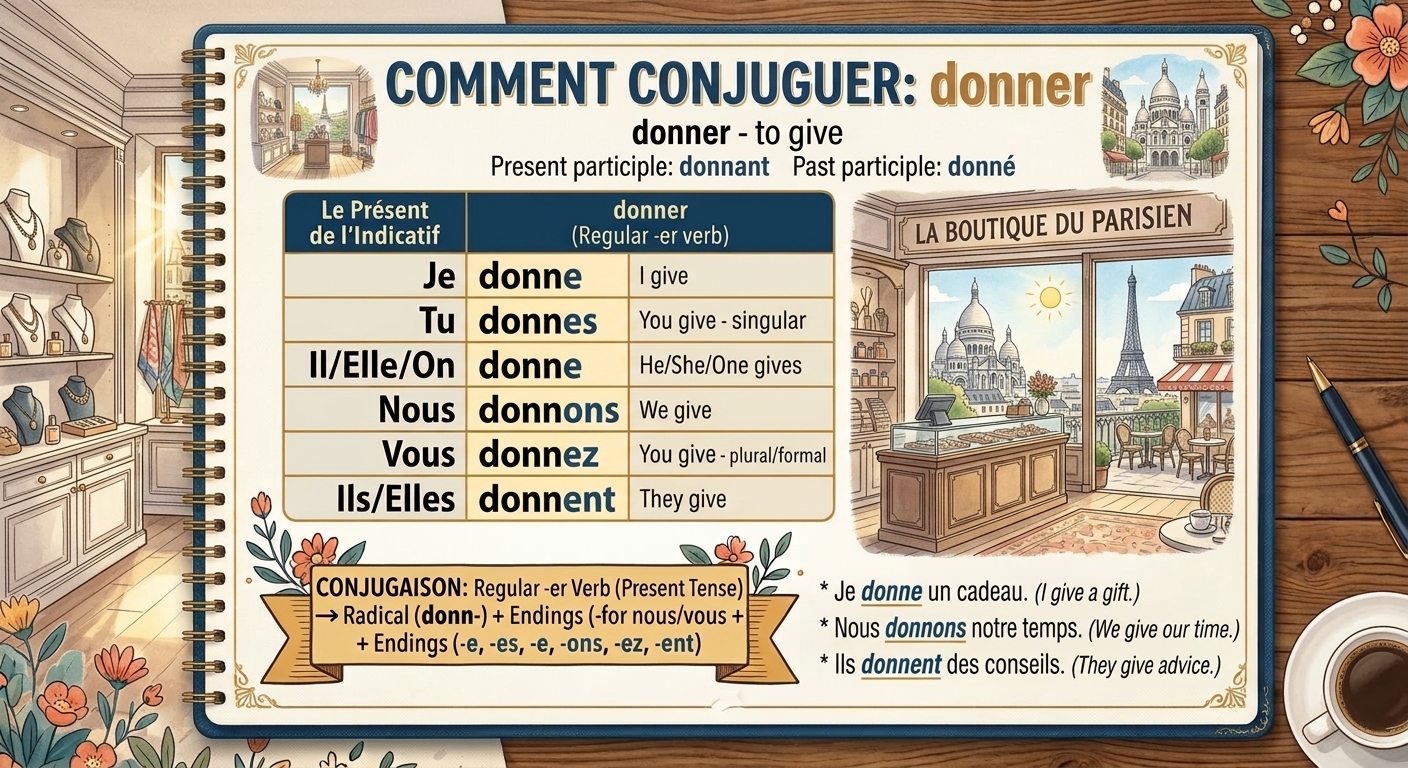
Donner means to give, provide, or hand something to someone.
Giving is one of the simplest ways we connect with others. We give our time, share what we have, offer help, and sometimes give someone a reason to smile. In French, the verb donner is used in all kinds of everyday situations.
In this guide, you’ll learn how to conjugate donner in all the major French tenses and moods. Explore complete conjugation tables, French examples, English translations, pronunciation links, and practice quizzes.
Understanding the French Verb Donner
Donner is a regular French verb belonging to the first group of verbs, those ending in -er.
It means to give, provide, hand over, or offer something to someone. It is one of the most frequently used verbs in everyday French.
Verb classification: First group (-er)
Auxiliary verb: Avoir
Past participle: donné
Present participle: donnant
English equivalents: To give, to provide, to hand over, to offer.
Donner follows the regular -er conjugation pattern. Remove the infinitive ending -er and add the appropriate endings for each tense.
One useful grammatical detail: donner commonly takes a direct object for the thing being given and an indirect object for the person receiving it.
For example: Je donne un livre à Marie. — I give a book to Marie.
Experience the Word
Donner is a versatile verb that appears in countless everyday situations. You can give someone a gift, give advice, give an answer, or give someone a hand.
Imagine offering a friend a cup of coffee, giving directions to a visitor, or sharing a little of your time with someone who needs help.
In French, donner goes far beyond handing someone an object. It is also used in many familiar expressions, such as donner son avis (to give one’s opinion) and donner rendez-vous (to arrange to meet someone).
It is a small word with a remarkably wide range of uses.
How to Conjugate Donner: Complete French Conjugation Guide
Let’s explore every major conjugation of donner, beginning with the indicative mood.
How to Conjugate Donner in the Indicative Mood
The indicative mood is used to express facts, observations, actions, and events.
How to Conjugate Donner in the Present Tense (Présent)
Used for actions happening now, habitual actions, and general truths.
| Subject | Conjugation |
|---|---|
| je | donne |
| tu | donnes |
| il / elle | donne |
| nous | donnons |
| vous | donnez |
| ils / elles | donnent |
Example
Je donne un cadeau à mon ami.
I give a gift to my friend.
Quick Quiz 1
Complete the sentence:
Nous ______ des conseils à nos enfants.
Reveal the answer
donnons
Nous donnons des conseils à nos enfants.
We give advice to our children.
How to Conjugate Donner in the Passé Composé
Used for completed actions in the past. Donner takes the auxiliary verb avoir.
| Subject | Conjugation |
|---|---|
| j’ | ai donné |
| tu | as donné |
| il / elle | a donné |
| nous | avons donné |
| vous | avez donné |
| ils / elles | ont donné |
Example
J’ai donné mon vieux vélo à mon voisin.
I gave my old bicycle to my neighbor.
How to Conjugate Donner in the Imparfait (Imperfect Tense)
Used for habitual past actions, descriptions, and ongoing situations in the past.
| Subject | Conjugation |
|---|---|
| je | donnais |
| tu | donnais |
| il / elle | donnait |
| nous | donnions |
| vous | donniez |
| ils / elles | donnaient |
Example
Quand j’étais petit, mon grand-père me donnait des bonbons.
When I was little, my grandfather used to give me candy.
Quick Quiz 2
Choose the correct form:
When we were students, our teacher gave us a lot of homework.
Quand nous étions étudiants, notre professeur nous ______ beaucoup de devoirs.
Reveal the answer
donnait
Quand nous étions étudiants, notre professeur nous donnait beaucoup de devoirs.
How to Conjugate Donner in the Plus-que-parfait
Used to describe an action that had already been completed before another past event.
| Subject | Conjugation |
|---|---|
| j’ | avais donné |
| tu | avais donné |
| il / elle | avait donné |
| nous | avions donné |
| vous | aviez donné |
| ils / elles | avaient donné |
Example
J’avais déjà donné mon adresse avant de partir.
I had already given my address before leaving.
How to Conjugate Donner in the Passé Simple
Primarily used in formal writing, literature, and historical narratives. It is rarely used in everyday conversation.
| Subject | Conjugation |
|---|---|
| je | donnai |
| tu | donnas |
| il / elle | donna |
| nous | donnâmes |
| vous | donnâtes |
| ils / elles | donnèrent |
Example
Le roi donna un ordre à ses soldats.
The king gave an order to his soldiers.
How to Conjugate Donner in the Passé Antérieur
A literary tense used to express an action completed immediately before another past action, generally in the passé simple.
| Subject | Conjugation |
|---|---|
| j’ | eus donné |
| tu | eus donné |
| il / elle | eut donné |
| nous | eûmes donné |
| vous | eûtes donné |
| ils / elles | eurent donné |
Example
Dès qu’il eut donné son accord, le projet commença.
As soon as he had given his approval, the project began.
How to Conjugate Donner in the Future Tense (Futur Simple)
Used to describe actions that will take place in the future.
| Subject | Conjugation |
|---|---|
| je | donnerai |
| tu | donneras |
| il / elle | donnera |
| nous | donnerons |
| vous | donnerez |
| ils / elles | donneront |
Example
Demain, je donnerai une réponse définitive.
Tomorrow, I will give a final answer.
How to Conjugate Donner in the Futur Antérieur (Future Perfect)
Used for an action that will have been completed before a particular point in the future.
| Subject | Conjugation |
|---|---|
| j’ | aurai donné |
| tu | auras donné |
| il / elle | aura donné |
| nous | aurons donné |
| vous | aurez donné |
| ils / elles | auront donné |
Example
À la fin de la journée, nous aurons donné tous les cadeaux.
By the end of the day, we will have given all the gifts.
How to Conjugate Donner in the Near Future (Futur Proche)
Used to describe something that is going to happen soon. Formed with aller + infinitive.
| Subject | Conjugation |
|---|---|
| je | vais donner |
| tu | vas donner |
| il / elle | va donner |
| nous | allons donner |
| vous | allez donner |
| ils / elles | vont donner |
Example
Je vais donner un coup de main à mon frère.
I’m going to give my brother a hand.
How to Conjugate Donner in the Conditional Mood
The conditional mood expresses what would happen under certain circumstances. It is also frequently used to make polite requests or express wishes.
How to Conjugate Donner in the Present Conditional
| Subject | Conjugation |
|---|---|
| je | donnerais |
| tu | donnerais |
| il / elle | donnerait |
| nous | donnerions |
| vous | donneriez |
| ils / elles | donneraient |
Example
Je donnerais volontiers de mon temps pour aider.
I would gladly give some of my time to help.
How to Conjugate Donner in the Past Conditional
| Subject | Conjugation |
|---|---|
| j’ | aurais donné |
| tu | aurais donné |
| il / elle | aurait donné |
| nous | aurions donné |
| vous | auriez donné |
| ils / elles | auraient donné |
Example
J’aurais donné davantage si j’avais eu plus d’argent.
I would have given more if I had had more money.
Donner in the Literary Past Conditional Form
This less common literary form uses the imperfect subjunctive of avoir.
| Subject | Conjugation |
|---|---|
| j’ | eusse donné |
| tu | eusses donné |
| il / elle | eût donné |
| nous | eussions donné |
| vous | eussiez donné |
| ils / elles | eussent donné |
Example
Il eût donné davantage s’il en avait eu les moyens.
He would have given more had he had the means.
How to Conjugate Donner in the Subjunctive Mood
The subjunctive is used to express wishes, emotions, doubts, necessity, and uncertainty. It frequently follows expressions such as il faut que (it is necessary that) or bien que (although).
How to Conjugate Donner in the Present Subjunctive
| Subject | Conjugation |
|---|---|
| que je | donne |
| que tu | donnes |
| qu’il / qu’elle | donne |
| que nous | donnions |
| que vous | donniez |
| qu’ils / qu’elles | donnent |
Example
Il faut que je donne une réponse aujourd’hui.
I need to give an answer today.
Quick Quiz 3
Complete the sentence using the subjunctive:
Il faut que vous ______ votre avis.
Reveal the answer
donnions is not correct here. The subject is vous, so the correct form is donniez.
Il faut que vous donniez votre avis.
You need to give your opinion.
How to Conjugate Donner in the Imperfect Subjunctive
A literary tense, rarely encountered in modern spoken French.
| Subject | Conjugation |
|---|---|
| que je | donnasse |
| que tu | donnasses |
| qu’il / qu’elle | donnât |
| que nous | donnassions |
| que vous | donnassiez |
| qu’ils / qu’elles | donnassent |
Example
Il souhaitait qu’elle donnât une réponse favorable.
He wished that she would give a favorable answer.
How to Conjugate Donner in the Pluperfect Subjunctive
A literary construction used to express an action completed before another past action.
| Subject | Conjugation |
|---|---|
| que j’ | eusse donné |
| que tu | eusses donné |
| qu’il / qu’elle | eût donné |
| que nous | eussions donné |
| que vous | eussiez donné |
| qu’ils / qu’elles | eussent donné |
Example
Elle regrettait que nous eussions donné notre accord si rapidement.
She regretted that we had given our approval so quickly.
How to Conjugate Donner in the Past Subjunctive
| Subject | Conjugation |
|---|---|
| que j’ | aie donné |
| que tu | aies donné |
| qu’il / qu’elle | ait donné |
| que nous | ayons donné |
| que vous | ayez donné |
| qu’ils / qu’elles | aient donné |
Example
Je suis heureux que tu aies donné ton aide.
I’m happy that you gave your help.
How to Conjugate Donner in the Imperative
The imperative is used to give commands, instructions, invitations, or suggestions. Subject pronouns are omitted.
How to Conjugate Donner in the Present Imperative
| Person | Conjugation |
|---|---|
| (tu) | donne |
| (nous) | donnons |
| (vous) | donnez |
Example
Donne-moi ton avis !
Give me your opinion!
Quick Quiz 4
How would you say “Give me a moment” in French?
Reveal the answer
Donne-moi un instant !
French Participles of Donner
Participles are verb forms that can be used in compound tenses and other grammatical constructions.
Present Participle of Donner
donnant
En donnant de son temps, elle aide les autres.
By giving her time, she helps others.
Past Participle of Donner
donné
donnés
donnée
données
The past participle is normally donné. Because donner takes avoir in compound tenses, it does not usually agree with the subject. It agrees with a preceding direct object when the rules of French past participle agreement require it.
Les fleurs que j’ai données étaient magnifiques.
The flowers that I gave were beautiful.
Donner in Everyday French: Real-Life Examples
Now that you know the conjugations, let’s see how donner appears in everyday French.
Example 1 — Present
Je donne toujours un pourboire au serveur.
I always give the waiter a tip.
Example 2 — Passé composé
Elle m’a donné un excellent conseil.
She gave me some excellent advice.
Example 3 — Imparfait
Mon père me donnait souvent des livres.
My father often used to give me books.
Example 4 — Future
Nous donnerons une fête samedi soir.
We will throw a party on Saturday evening.
Example 5 — Conditional
Je donnerais n’importe quoi pour revoir mes amis.
I would give anything to see my friends again.
Example 6 — Subjunctive
Il est important que tu donnes ton avis.
It is important that you give your opinion.
Beyond Translation: The Meaning of Donner
The English verb to give covers much of the meaning of donner, but the French verb is also used in many expressions that do not translate word for word.
Here are a few common examples:
- donner son avis — to give one’s opinion
- donner un conseil — to give advice
- donner rendez-vous — to arrange to meet someone
- donner un coup de main — to give someone a hand
- donner envie de — to make someone want to do something
- donner naissance à — to give birth to or give rise to
You will also encounter the reflexive form se donner in expressions such as se donner du mal (to make a great effort) and se donner rendez-vous (to arrange to meet one another).
Learning these expressions will help you understand how French speakers use donner naturally in everyday conversation.
How to Remember the French Verb Donner
Remember it this way: Donner is the action of giving something to someone, whether it is an object, an idea, a little help, or your time.
- You give a present to a friend: donner un cadeau.
- You give someone advice: donner un conseil.
- You give someone a hand: donner un coup de main.
The key idea is giving or providing something. Once you remember that meaning, you will recognize donner in a wide variety of French expressions.
Test Your Knowledge of Donner
Let’s see how much you’ve learned. Try answering these questions before revealing the answers.
Question 1
What auxiliary verb is used with donner in compound tenses?
Reveal the answer
Avoir
Question 2
How do you say “I will give” in French?
Reveal the answer
Je donnerai.
Question 3
Translate: “We have given a gift.”
Reveal the answer
Nous avons donné un cadeau.
Question 4
What is the present participle of donner?
Reveal the answer
Donnant.
Question 5
Complete the sentence:
Si j’avais plus de temps, je te ______ un coup de main.
Reveal the answer
donnerais
Si j’avais plus de temps, je te donnerais un coup de main.
If I had more time, I would give you a hand.
Your Final Challenge
Can You Use It?
How would you say this in French?
“Tomorrow, I will give my friend a book.”
Reveal the answer
Demain, je donnerai un livre à mon ami.
Tomorrow, I will give my friend a book.
A little French. A little curiosity. A richer everyday life.
LEARN FRENCH ONE WORD AT A TIME