A French Word to Live By
Translate Avoir le melon to English
/a.vwaʁ lə mə.lɔ̃/
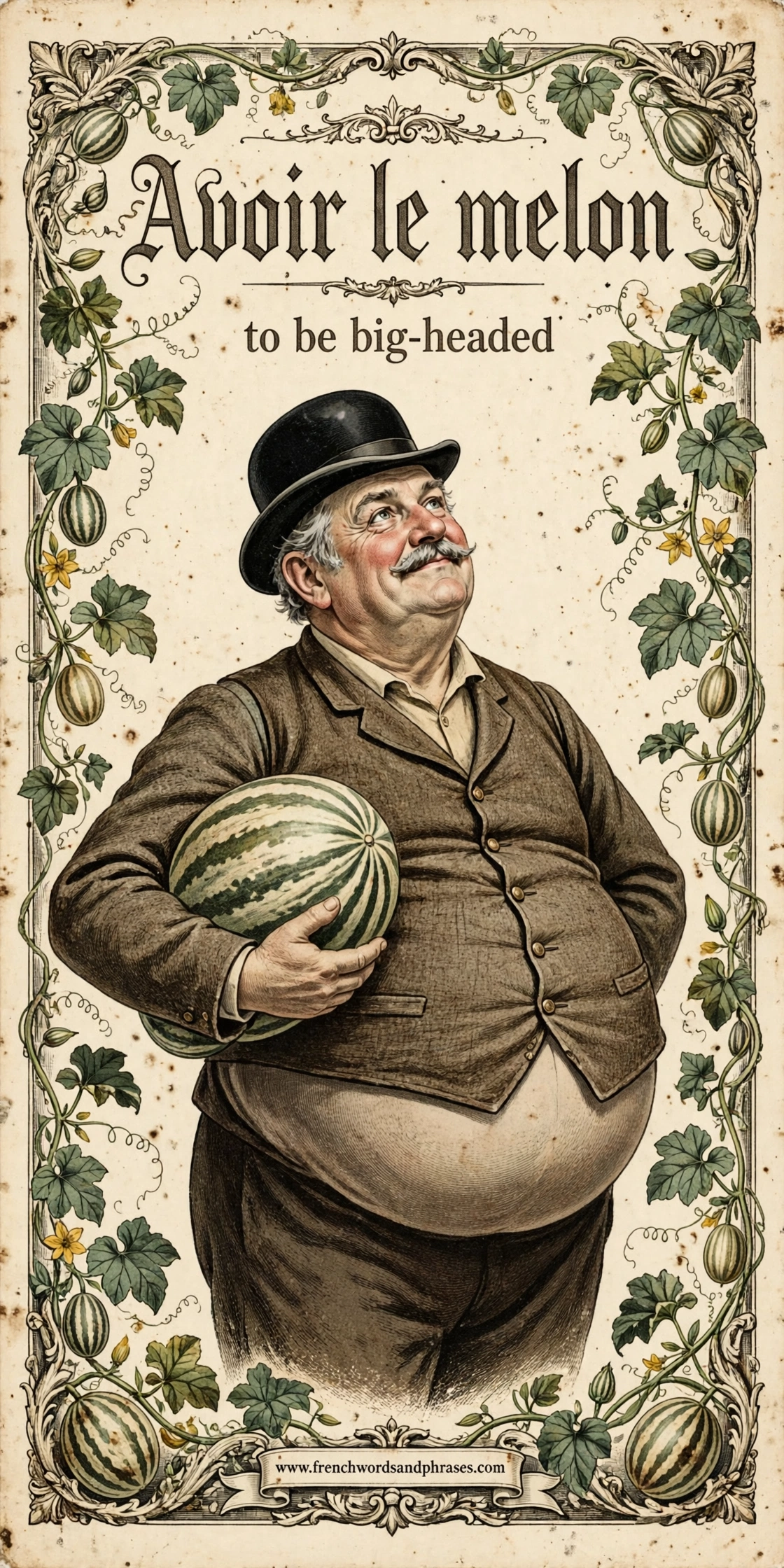
Avoir le melon means to be big-headed — so pleased with yourself that your head swells like a melon.
Since his photograph appeared in the local paper, your neighbour has changed. He takes the long way past the café terrace, sunglasses on, waiting to be recognised. His brother watches him pass, shakes his head and gives the diagnosis the whole street is thinking: « Depuis son prix, il a le melon. »
Let’s explore how avoir le melon works in French, beginning with the whole phrase on one card.
Understanding the French Phrase Avoir le melon
Avoir le melon is a French idiomatic expression built from avoir (to have) and le melon (the melon). The picture is pure cartoon: success goes to the head, the head swells, and soon it is the size and shape of a melon.
It means to be big-headed — full of yourself, swollen with pride, usually after some success or compliment has gone to your head. It is informal and mocking, the phrase friends and family use to bring a celebrity of the household back down to size. The melon is never a compliment: nobody announces their own melon except as a joke against themselves.
Type: Idiomatic expression — character (avoir + food picture)
Answers the need: Mocking someone who has become too pleased with themselves
Register: Informal — teasing among friends and family; not for formal writing
Strength: Mocking but mild — a deflation, delivered with a grin
One important usage detail: the melon usually arrives with a cause attached — depuis sa promotion, il a le melon; depuis qu’il passe à la télé, elle a le melon. Success first, swelling second. The verb grossir also joins in: son melon grossit, his melon is growing — the family’s running commentary on a rising ego.
Experience the Word
Avoir le melon is the ego drawn as fruit — round, smooth, and far too big for the neck carrying it.
Imagine the village footballer who scores one goal on regional television. By Sunday he is signing autographs at the bakery. By Monday his grandmother, unimpressed since 1962, looks him up and down and pronounces the cure: il a le melon, celui-là. The whole café laughs, and the melon shrinks a size.
French keeps a fruit for every fault. The melon is pride’s: sweet inside, perhaps, but mostly size.
How to Use Avoir le melon in French: Complete Guide
Let’s explore how avoir le melon works in French, beginning with the whole phrase on one card.
Avoir le melon at a Glance
The Whole Phrase on One Card
Real meaning, literal picture, English twin and register — avoir le melon in five lines.
| Point | Avoir le melon |
|---|---|
| What it really means | to be big-headed, full of yourself |
| Word for word | to have the melon |
| English equivalent | to be big-headed / to have a swollen head / too big for your boots |
| Register | informal — teasing, mocking, among people who know each other |
| Use it for | the colleague promoted once, the cousin on television, any ego after success |
Example
Depuis son émission, il a le melon, il ne dit plus bonjour.
Since his show, he is big-headed, he doesn’t say hello any more.
Word by Word: Building the Swollen Head
Three small pieces — take them one by one and the head starts to swell.
| Word | Literal meaning | Its job in the phrase |
|---|---|---|
| avoir | to have | the verb of states — you ‘have’ this unfortunate condition |
| le | the | the definite article — one particular, well-known melon |
| melon | melon | the fruit standing in for the head — big, round and full of itself |
Example
Regarde-le passer, il a le melon, celui-là.
Look at him go by — big-headed, that one.
Quick Quiz 1
What has swollen in avoir le melon — the head or the heart?
Reveal the answer
The head — the melon replaces the head, inflated by pride and success.
Une seule victoire et il a déjà le melon.
One single victory and he is already big-headed.
When You Say It: The Big-Head Moments
Avoir le melon fires at moments like these — wherever success has visibly gone to someone’s head.
| Situation | Example |
|---|---|
| After a promotion | depuis sa promotion, elle a le melon — since her promotion, she is big-headed |
| About a local celebrity | il passe à la télé une fois et il a le melon — he is on TV once and he is big-headed |
| Teasing a friend | doucement, tu vas attraper le melon — careful, you’ll get big-headed |
| In the family | son melon grossit de jour en jour — his big head is growing day by day |
| As a warning | reste simple, ne prends pas le melon — stay down to earth, don’t get big-headed |
Example
Trois articles dans le journal, et la voilà avec le melon.
Three articles in the paper, and there she is, big-headed.
Make It Yours: The Melon for Every Person
Avoir conjugates as usual; the melon itself can even grow with grossir for comic effect.
| Form | French | In English |
|---|---|---|
| He is big-headed | il a le melon | he is big-headed |
| She is big-headed | elle a le melon | she is big-headed |
| He got big-headed | il a pris le melon | he got big-headed |
| It’s growing | son melon grossit | his swollen head is growing |
| Don’t get big-headed | ne prends pas le melon | don’t get big-headed |
| Question | il a le melon, non ? | he’s big-headed, isn’t he? |
Example
Depuis le prix, son melon grossit à vue d’œil.
Since the prize, his big head is growing visibly.
Quick Quiz 2
Can you pay someone a compliment with il a le melon?
Reveal the answer
No — the melon is always mockery. The compliment version is about confidence: il a confiance en lui.
Il a le melon, ce n’est pas un compliment.
He is big-headed, that’s no compliment.
Everyday Expressions: Building on the Melon
Avoir le melon slots into these everyday frames — each one ready to use as it stands.
| Frame | In English |
|---|---|
| avoir le melon | to be big-headed |
| prendre le melon | to get big-headed — the swelling in progress |
| depuis X, il a le melon | since X, he is big-headed — success first, melon second |
| son melon grossit | his big head is growing — the family’s running joke |
| faire dégonfler le melon de quelqu’un | to take someone down a peg — literally, to deflate their melon |
Example
Sa grand-mère a vite fait dégonfler son melon.
His grandmother quickly took him down a peg.
Close Cousins: The Other Big Heads
French has a whole shelf of pride phrases — the melon is the fruity one; its cousins are anatomical, animal and theatrical.
| Expression | The difference |
|---|---|
| avoir le melon | to be big-headed — informal, fruity, mocking |
| avoir la grosse tête | to be big-headed — the closest twin, with the head itself named |
| se prendre pour quelqu’un | to think you are somebody — pride as mistaken identity |
| avoir les chevilles qui enflent | to get big-headed — the ankles swell instead; same joke, lower down |
| être imbu de soi-même | to be full of yourself — the formal, literary version, no fruit involved |
Example
Entre le melon et les chevilles qui enflent, il ne passe plus les portes.
Between the melon and the swelling ankles, he can’t get through doors any more.
Quick Quiz 3
Which cousin swells the ankles instead of the head?
Reveal the answer
Avoir les chevilles qui enflent — the swelling ankles: pride measured at the other end of the leg.
Attention, tes chevilles enflent.
Careful, your ankles are swelling.
Avoir le melon and Its Neighbours
The pride shelf around the phrase — the success, the swelling and the cure.
| French | In English |
|---|---|
| la réussite | success — the usual cause of the melon |
| être fier de soi | to be proud of yourself — the healthy amount |
| la modestie | modesty — the melon’s opposite |
| se vanter | to boast, to brag |
| prendre la grosse tête | to get big-headed — the twin picture |
| rester simple | to stay down to earth — the family’s advice |
Example
La réussite, oui, mais il faut rester simple et ne pas prendre le melon.
Success, yes, but stay down to earth and don’t get big-headed.
Watch Out: The Traps Around Avoir le melon
The traps: a hat hiding in the same word, a fruit bowl that means nothing, and pride that is sometimes healthy.
| Trap | The truth |
|---|---|
| melon is also a hat | un melon is also a bowler hat — un chapeau melon; in the phrase, it is the fruit that replaces the head |
| a real melon means nothing | acheter un melon is shopping; the phrase needs avoir and a person whose ego is showing |
| not all pride is melon | être fier de son travail is healthy pride; the melon starts when the pride shows off |
| never a self-compliment | je ai le melon about yourself only works as a joke — as a boast, it proves the melon is real |
Example
Chapeau melon sur la tête et melon dans la tête, il était complet.
A bowler hat on his head and a melon in his head, he was complete.
Quick Quiz 4
True or false: un melon can be something you wear.
Reveal the answer
True — un chapeau melon is a bowler hat. In avoir le melon, though, the melon is the fruit standing in for a swollen head.
Il portait un melon et, depuis peu, il avait le melon.
He wore a bowler hat and, lately, he had a big head too.
Avoir le melon in Everyday French: Real-Life Examples
Now that you know the word, let’s see how avoir le melon appears in everyday French.
Example 1 — After the prize
Depuis son prix, il a le melon, il ne salue plus personne.
Since his prize, he is big-headed, he doesn’t greet anyone any more.
Example 2 — The promoted colleague
Une promotion, et la voilà avec le melon.
One promotion, and there she is with a big head.
Example 3 — The warning
Reste simple, ne prends pas le melon.
Stay down to earth, don’t get big-headed.
Example 4 — The grandmother’s cure
Son melon grossissait, sa grand-mère l’a fait dégonfler.
His big head was growing, his grandmother deflated it.
Example 5 — On television once
Il est passé une fois à la télé et il a le melon.
He was on TV once and he is big-headed.
Example 6 — Owning the joke
Je sais, j’ai un peu le melon depuis l’article.
I know, I’ve got a bit big-headed since the article.
Beyond Translation: The Meaning of Avoir le melon
English swells the head directly — big-headed, swollen-headed, too big for your boots. French goes to the fruit stall and picks the roundest, smoothest, most self-satisfied object there. A melon is all surface and size, with the seeds of sense rattling somewhere small inside.
To avoir le melon is to carry your success where everyone can see it — on top, at fruit scale.
And the cure is built into the picture: what has swollen can be deflated, usually by a grandmother, in one sentence.
How to Remember the French Phrase Avoir le melon
Remember it this way: Avoir le melon is pride at the fruit stall — success goes to the head, the head swells, and the family reaches for the roundest comparison in the market.
- You picture the fruit — round, smooth and far too big: the head replaced by a melon.
- You attach the cause — the melon follows success: depuis sa promotion, depuis son prix.
- You keep it mocking — it is the family’s deflation tool, never a compliment and never formal.
The key idea is avoir le melon means to be big-headed — your head swollen like a melon with pride.
Test Your Knowledge of Avoir le melon
Let’s see how much you’ve learned. Try answering these questions before revealing the answers.
Question 1
What does avoir le melon mean?
Reveal the answer
To be big-headed — full of yourself, usually after success has gone to your head.
Question 2
What usually causes the melon?
Reveal the answer
Success — a prize, a promotion, a moment of fame: depuis son prix, il a le melon.
Question 3
How do you say ‘he got big-headed’?
Reveal the answer
Il a pris le melon — prendre marks the swelling in progress.
Question 4
What is the closest twin phrase with the head itself named?
Reveal the answer
Avoir la grosse tête — to have the big head; the melon is the same joke told with fruit.
Question 5
Complete the sentence:
Depuis sa promotion, elle a le ______. (Since her promotion, she is big-headed.)
Reveal the answer
melon
Depuis sa promotion, elle a le melon.
Since her promotion, she is big-headed.
Your Final Challenge
Can You Use It?
How would you say this in French?
“Since his prize, he has become big-headed.”
Reveal the answer
Depuis son prix, il a le melon.
Since his prize, he has become big-headed.
A little French. A little curiosity. A richer everyday life.
LEARN FRENCH ONE WORD AT A TIME