A French Word to Live By
How to Conjugate Affaisser in French
/a.fɛ.se/
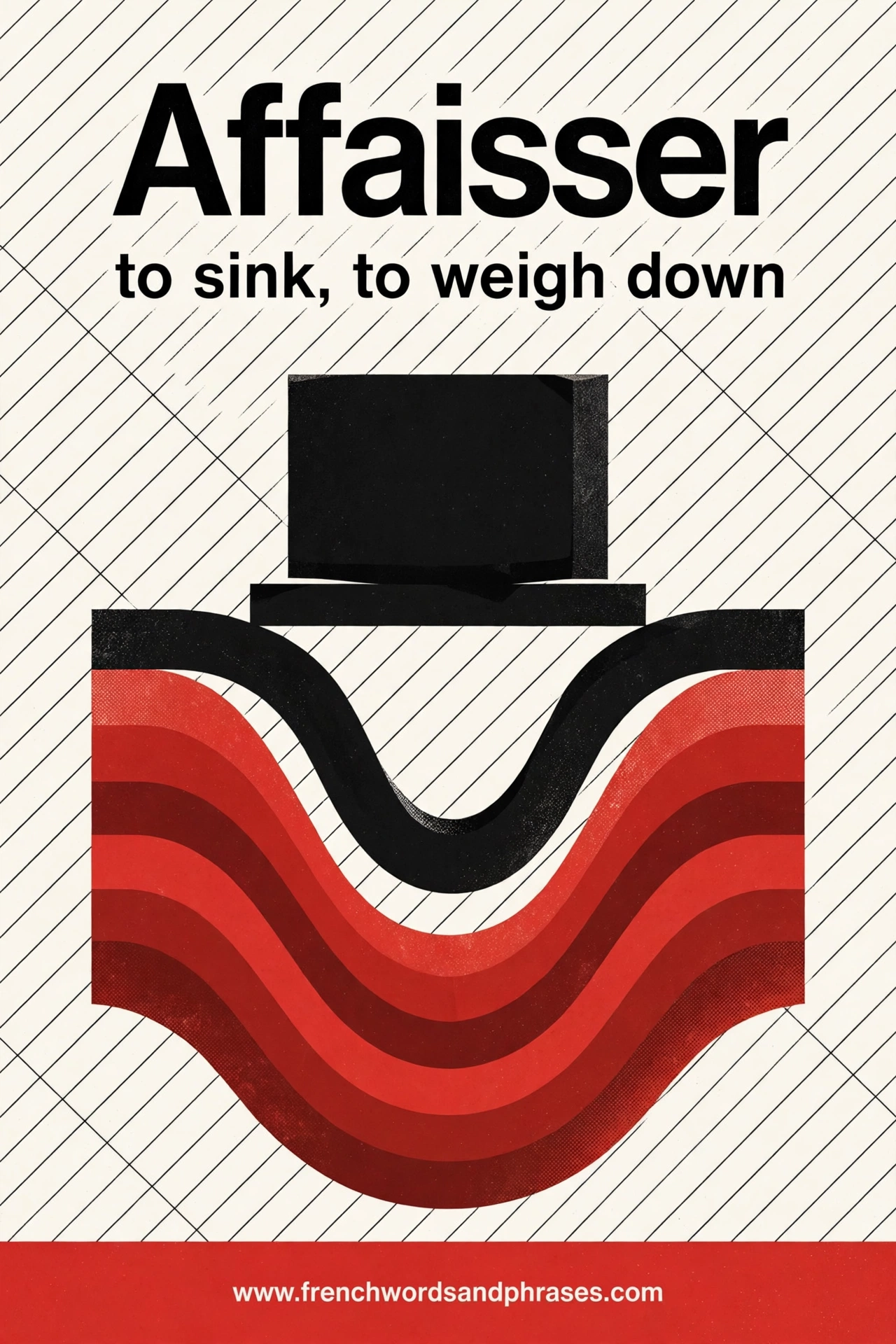
Affaisser means to sink, to weigh down — to press something downwards until it sags, settles or gives under the load.
A roof bending under wet snow, a road settling over an old cellar, shoulders rounding under years of work — affaisser is the verb of weight winning slowly: something pressing down, and something else giving way beneath it.
In this guide, you’ll learn how to conjugate affaisser in all the major French tenses and moods. Explore complete conjugation tables, French examples, English translations, and practice quizzes.
Understanding the French Verb Affaisser
Affaisser is a regular French verb belonging to the first group of verbs, those ending in-er.
It means to sink, to weigh down. It belongs to builders, farmers and doctors: roofs, roads and ground subside under weight, loads bow branches and backs, and age rounds shoulders. The sagging is always slow and gravitational — affaisser is never a sudden blow, always a long pressure.
Verb classification: First group (-er)
Auxiliary verb: Avoir
Past participle: affaissé
Present participle: affaissant
English equivalents: To sink, to weigh down, to cause to sag; affaisser un toit — to make a roof sag; la neige affaisse les branches — the snow weighs the branches down; affaisser le sol — to make the ground subside; les épaules affaissées par l’âge — shoulders bowed by age.
One important detail: affaisser is a regular -er verb with a double s in every form — j’affaisse, nous affaissons, affaissé — and no stem change. Its trap is its reflexive twin: plain affaisser needs a weight doing the pressing — la neige affaisse le toit — while s’affaisser is what the roof itself does when it sags or collapses. Name the load, use the plain verb; watch the thing give way, use the reflexive.
Experience the Word
Affaisser is the verb of slow defeat by weight — nothing breaks with a crack; everything simply settles a little lower than it was built to be.
Imagine a mountain barn after three days of snow. The roof, built by a grandfather for ordinary winters, bows a finger’s width lower every night — la neige affaisse le toit, beam by patient beam, until the farmer climbs up with a shovel at dawn.
The roof has not fallen. It has been weighed down — affaissé — and the difference is a whole winter of warning.
How to Conjugate Affaisser: Complete French Conjugation Guide
Let’s explore every major conjugation of affaisser, beginning with the indicative mood.
How to Conjugate Affaisser in the Indicative Mood
The indicative mood is used to express facts, observations, actions, and events.
How to Conjugate Affaisser in the Present Tense (Présent)
Used for actions happening now, habitual actions, and general truths.
| Subject | Conjugation |
|---|---|
| je | affaisse |
| tu | affaisses |
| il / elle | affaisse |
| nous | affaissons |
| vous | affaissez |
| ils / elles | affaissent |
Example
La neige affaisse les branches du vieux pommier.
The snow weighs down the branches of the old apple tree.
Quick Quiz 1
Complete the sentence:
La neige ______ les branches du vieux pommier.
Reveal the answer
affaisse
La neige affaisse les branches du vieux pommier.
The snow weighs down the branches of the old apple tree.
How to Conjugate Affaisser in the Passé Composé
Used for completed actions in the past. Affaisser takes the auxiliary verb avoir.
| Subject | Conjugation |
|---|---|
| j’ | ai affaissé |
| tu | as affaissé |
| il / elle | a affaissé |
| nous | avons affaissé |
| vous | avez affaissé |
| ils / elles | ont affaissé |
Example
Le poids des ans a affaissé ses épaules.
The weight of the years has bowed his shoulders.
How to Conjugate Affaisser in the Imparfait (Imperfect Tense)
Used for habitual past actions, descriptions, and ongoing situations in the past.
| Subject | Conjugation |
|---|---|
| je | affaissais |
| tu | affaissais |
| il / elle | affaissait |
| nous | affaissions |
| vous | affaissiez |
| ils / elles | affaissaient |
Example
Chaque hiver, la neige affaissait le toit de la grange.
Every winter, the snow weighed down the barn roof.
Quick Quiz 2
Choose the correct form:
The weight of the years has bowed his shoulders.
Le poids des ans ______ ses épaules. (a affaissé / est affaissé)
Reveal the answer
a affaissé
Le poids des ans a affaissé ses épaules.
Plain affaisser is transitive and takes avoir: a affaissé.
How to Conjugate Affaisser in the Plus-que-parfait
Used to describe an action that had already been completed before another past event.
| Subject | Conjugation |
|---|---|
| j’ | avais affaissé |
| tu | avais affaissé |
| il / elle | avait affaissé |
| nous | avions affaissé |
| vous | aviez affaissé |
| ils / elles | avaient affaissé |
Example
Les pluies avaient affaissé le chemin en plusieurs endroits.
The rains had made the path subside in several places.
How to Conjugate Affaisser in the Passé Simple
Primarily used in formal writing, literature, and historical narratives. It is rarely used in everyday conversation.
| Subject | Conjugation |
|---|---|
| je | affaissai |
| tu | affaissas |
| il / elle | affaissa |
| nous | affaissâmes |
| vous | affaissâtes |
| ils / elles | affaissèrent |
Example
La charge affaissa lentement le plancher usé.
The load slowly made the worn floor sag.
How to Conjugate Affaisser in the Passé Antérieur
A literary tense used to express an action completed immediately before another past action, generally in the passé simple.
| Subject | Conjugation |
|---|---|
| j’ | eus affaissé |
| tu | eus affaissé |
| il / elle | eut affaissé |
| nous | eûmes affaissé |
| vous | eûtes affaissé |
| ils / elles | eurent affaissé |
Example
Quand la neige eut affaissé la serre, le jardinier la dégagea.
When the snow had weighed down the greenhouse, the gardener cleared it.
How to Conjugate Affaisser in the Future Tense (Futur Simple)
Used to describe actions that will take place in the future.
| Subject | Conjugation |
|---|---|
| je | affaisserai |
| tu | affaisseras |
| il / elle | affaissera |
| nous | affaisserons |
| vous | affaisserez |
| ils / elles | affaisseront |
Example
Ce poids affaissera la poutre si tu ne la renforces pas.
This weight will make the beam sag if you do not reinforce it.
How to Conjugate Affaisser in the Futur Antérieur (Future Perfect)
Used for an action that will have been completed before a particular point in the future.
| Subject | Conjugation |
|---|---|
| j’ | aurai affaissé |
| tu | auras affaissé |
| il / elle | aura affaissé |
| nous | aurons affaissé |
| vous | aurez affaissé |
| ils / elles | auront affaissé |
Example
À la fonte, la neige aura affaissé plusieurs toits.
By the thaw, the snow will have weighed down several roofs.
How to Conjugate Affaisser in the Near Future (Futur Proche)
Used to describe something that is going to happen soon. Formed with aller + infinitive.
| Subject | Conjugation |
|---|---|
| je | vais affaisser |
| tu | vas affaisser |
| il / elle | va affaisser |
| nous | allons affaisser |
| vous | allez affaisser |
| ils / elles | vont affaisser |
Example
Attention, ce chargement va affaisser la remorque.
Careful, this load is going to weigh down the trailer.
How to Conjugate Affaisser in the Conditional Mood
The conditional mood expresses what would happen under certain circumstances. It is also frequently used to make polite requests or express wishes.
How to Conjugate Affaisser in the Present Conditional
| Subject | Conjugation |
|---|---|
| je | affaisserais |
| tu | affaisserais |
| il / elle | affaisserait |
| nous | affaisserions |
| vous | affaisseriez |
| ils / elles | affaisseraient |
Example
Un tel poids affaisserait même une poutre neuve.
Such a weight would make even a new beam sag.
How to Conjugate Affaisser in the Past Conditional
| Subject | Conjugation |
|---|---|
| j’ | aurais affaissé |
| tu | aurais affaissé |
| il / elle | aurait affaissé |
| nous | aurions affaissé |
| vous | auriez affaissé |
| ils / elles | auraient affaissé |
Example
Sans les étais, la neige aurait affaissé tout le toit.
Without the props, the snow would have brought the whole roof down.
Affaisser in the Literary Past Conditional Form
This less common literary form uses the imperfect subjunctive of avoir.
| Subject | Conjugation |
|---|---|
| j’ | eusse affaissé |
| tu | eusses affaissé |
| il / elle | eût affaissé |
| nous | eussions affaissé |
| vous | eussiez affaissé |
| ils / elles | eussent affaissé |
Example
La charge eût affaissé le plancher sans les renforts.
The load would have made the floor sag without the reinforcements.
How to Conjugate Affaisser in the Subjunctive Mood
The subjunctive is used to express wishes, emotions, doubts, necessity, and uncertainty. It frequently follows expressions such as il faut que (it is necessary that) or bien que (although).
How to Conjugate Affaisser in the Present Subjunctive
| Subject | Conjugation |
|---|---|
| que je | affaisse |
| que tu | affaisses |
| qu’il / qu’elle | affaisse |
| que nous | affaissions |
| que vous | affaissiez |
| qu’ils / qu’elles | affaissent |
Example
Je crains que cette neige n’affaisse les branches.
I fear this snow may weigh the branches down.
Quick Quiz 3
Complete the sentence using the subjunctive:
Je crains que cette neige n’______ les branches.
Reveal the answer
affaisse
Je crains que cette neige n’affaisse les branches.
I fear this snow may weigh the branches down.
How to Conjugate Affaisser in the Imperfect Subjunctive
A literary tense, rarely encountered in modern spoken French.
| Subject | Conjugation |
|---|---|
| que je | affaissasse |
| que tu | affaissasses |
| qu’il / qu’elle | affaissât |
| que nous | affaissassions |
| que vous | affaissassiez |
| qu’ils / qu’elles | affaissassent |
Example
Il fallait étayer le plafond pour que le poids ne l’affaissât pas.
The ceiling had to be propped so the weight would not make it sag.
How to Conjugate Affaisser in the Pluperfect Subjunctive
A literary construction used to express an action completed before another past action.
| Subject | Conjugation |
|---|---|
| que j’ | eusse affaissé |
| que tu | eusses affaissé |
| qu’il / qu’elle | eût affaissé |
| que nous | eussions affaissé |
| que vous | eussiez affaissé |
| qu’ils / qu’elles | eussent affaissé |
Example
On disait que les ans eussent affaissé ses épaules.
People said the years had bowed his shoulders.
How to Conjugate Affaisser in the Past Subjunctive
| Subject | Conjugation |
|---|---|
| que j’ | aie affaissé |
| que tu | aies affaissé |
| qu’il / qu’elle | ait affaissé |
| que nous | ayons affaissé |
| que vous | ayez affaissé |
| qu’ils / qu’elles | aient affaissé |
Example
C’est étonnant que la neige ait affaissé ce toit neuf.
It is surprising that the snow weighed down this new roof.
How to Conjugate Affaisser in the Imperative
The imperative is used to give commands, instructions, invitations, or suggestions. Subject pronouns are omitted.
How to Conjugate Affaisser in the Present Imperative
| Person | Conjugation |
|---|---|
| (tu) | affaisse |
| (nous) | affaissons |
| (vous) | affaissez |
Example
N’affaisse pas cette étagère avec tous ces livres !
Do not weigh down that shelf with all those books!
Quick Quiz 4
How would you say Do not weigh down that shelf (tu form)?
Reveal the answer
N’affaisse pas cette étagère !
French Participles of Affaisser
Participles are verb forms that can be used in compound tenses and other grammatical constructions.
Present Participle of Affaisser
affaissant
En affaissant le sol, les eaux ont fissuré la route.
By making the ground subside, the waters cracked the road.
Past Participle of Affaisser
affaissé
Affaissé par la neige, le toit demandait réparation.
Weighed down by the snow, the roof needed repair.
Affaisser in Everyday French: Real-Life Examples
Now that you know the conjugations, let’s see how affaisser appears in everyday French.
Example 1 — Present
La neige affaisse les branches du pommier.
The snow weighs down the branches of the apple tree.
Example 2 — Passé composé
Le poids des ans a affaissé ses épaules.
The weight of the years has bowed his shoulders.
Example 3 — Imparfait
La neige affaissait le toit de la grange.
The snow used to weigh down the barn roof.
Example 4 — Future
Ce poids affaissera la poutre.
This weight will make the beam sag.
Example 5 — Conditional
Un tel poids affaisserait même une poutre neuve.
Such a weight would make even a new beam sag.
Example 6 — Imperative
N’affaisse pas cette étagère avec ces livres !
Do not weigh down that shelf with those books!
Beyond Translation: The Meaning of Affaisser
French builds affaisser on the old word fais, a bundle or load — the same root that gives un fardeau, a burden, its travelling companion in spirit.
To affaisser is to put the load on and watch the level drop.
Builders use its noun, l’affaissement, for subsidence — the ground itself settling — and doctors borrow it for a posture that has slowly surrendered to gravity.
How to Remember the French Verb Affaisser
Remember it this way: Affaisser is about the barn roof bowing under three days of snow.
- Double s everywhere, no stem change: j’affaisse, nous affaissons, affaissé.
- Plain affaisser needs a weight as subject: la neige affaisse le toit.
- The roof itself s’affaisse — that is the reflexive twin’s job.
The key idea is the barn roof bowing under three days of snow.
Test Your Knowledge of Affaisser
Let’s see how much you’ve learned. Try answering these questions before revealing the answers.
Question 1
What is the difference between affaisser and s’affaisser?
Reveal the answer
Affaisser names the weight that presses down — la neige affaisse le toit; s’affaisser is the thing sagging under it.
Question 2
How do you say The snow weighs down the branches in French?
Reveal the answer
La neige affaisse les branches.
Question 3
Translate: The weight of the years has bowed his shoulders.
Reveal the answer
Le poids des ans a affaissé ses épaules.
Question 4
What is the past participle of affaisser?
Reveal the answer
Affaissé — affaissée, affaissés, affaissées.
Question 5
Complete the sentence:
Je crains que cette neige n’______ les branches.
Reveal the answer
affaisse
Je crains que cette neige n’affaisse les branches.
I fear this snow may weigh the branches down.
Your Final Challenge
Can You Use It?
How would you say this in French?
The snow weighs down the barn roof, and the farmer climbs up at dawn with his shovel.
Reveal the answer
La neige affaisse le toit de la grange, et le fermier monte à l’aube avec sa pelle.
The snow weighs down the barn roof, and the farmer climbs up at dawn with his shovel.
A little French. A little curiosity. A richer everyday life.
LEARN FRENCH ONE WORD AT A TIME