A French Word to Live By
How to Conjugate Adultérer in French
/a.dyl.te.ʁe/
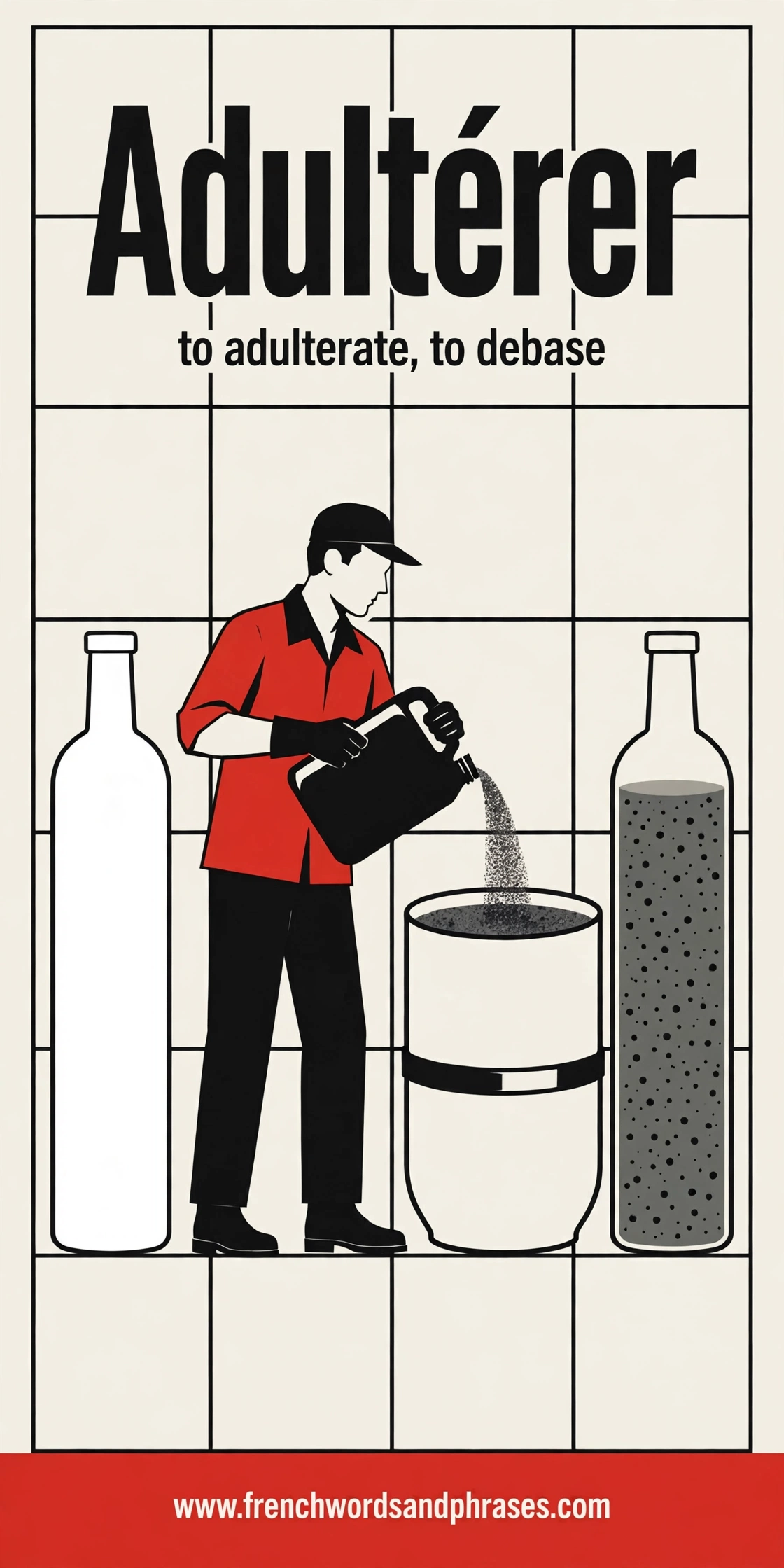
Adultérer means to adulterate, to debase — to corrupt something pure by mixing in something cheaper, weaker or false.
Wine stretched with water, olive oil cut with something greener and meaner, a text quietly rewritten by another hand — adultérer is the verb of purity betrayed: something genuine, diluted or falsified from within.
In this guide, you’ll learn how to conjugate adultérer in all the major French tenses and moods. Explore complete conjugation tables, French examples, English translations, and practice quizzes.
Understanding the French Verb Adultérer
Adultérer is a regular French verb belonging to the first group of verbs, those ending in-er.
It means to adulterate, to debase. It belongs to the worlds of food fraud, wine, oils and precious metals, and by extension to anything pure that gets falsified — texts, doctrines, traditions. It is a formal, serious word: the thing adultéré has been corrupted, not merely spoiled.
Verb classification: First group (-er)
Auxiliary verb: Avoir
Past participle: adultéré
Present participle: adultérant
English equivalents: To adulterate, to debase; adultérer le vin — to water down wine, to adulterate wine; adultérer une huile — to cut an oil with a cheaper one; adultérer un texte — to corrupt a text; adultérer la monnaie — to debase the coinage.
One important detail: adultérer is a céder-type verb — the é of the stem opens to è wherever the next syllable is mute: j’adultère, tu adultères, il adultère, ils adultèrent, and all through the future and conditional: j’adultèrerai, j’adultèrerais. The é survives wherever the ending is sounded: nous adultérons, vous adultérez, j’adultérais, en adultérant, and in the infinitive and participle, adultérer, adultéré. The subjunctive splits along the same line: que j’adultère, but que nous adultérions.
Experience the Word
Adultérer is the verb of the quiet fraud — nothing is removed in the open; something inferior is slipped in, and the pure thing is never quite itself again.
Imagine a wine merchant at dawn, alone in his cellar. One barrel of his best vintage, one bucket of thin wine from the plain — un peu d’eau, un peu de vin ordinaire — il adultère le vin, and by market time the fraud is invisible and the profit is real.
Nothing looks different in the glass. But the wine has been adulterated — adultéré — and purity, once mixed away, does not come back.
How to Conjugate Adultérer: Complete French Conjugation Guide
Let’s explore every major conjugation of adultérer, beginning with the indicative mood.
How to Conjugate Adultérer in the Indicative Mood
The indicative mood is used to express facts, observations, actions, and events.
How to Conjugate Adultérer in the Present Tense (Présent)
Used for actions happening now, habitual actions, and general truths.
| Subject | Conjugation |
|---|---|
| je | adultère |
| tu | adultères |
| il / elle | adultère |
| nous | adultérons |
| vous | adultérez |
| ils / elles | adultèrent |
Example
Certains marchands adultèrent le vin avec de l’eau.
Some merchants adulterate the wine with water.
Quick Quiz 1
Complete the sentence:
Certains marchands ______ le vin avec de l’eau.
Reveal the answer
adultèrent
Certains marchands adultèrent le vin avec de l’eau.
Some merchants adulterate the wine with water.
How to Conjugate Adultérer in the Passé Composé
Used for completed actions in the past. Adultérer takes the auxiliary verb avoir.
| Subject | Conjugation |
|---|---|
| j’ | ai adultéré |
| tu | as adultéré |
| il / elle | a adultéré |
| nous | avons adultéré |
| vous | avez adultéré |
| ils / elles | ont adultéré |
Example
Il a adultéré l’huile d’olive avec une huile bon marché.
He adulterated the olive oil with a cheap oil.
How to Conjugate Adultérer in the Imparfait (Imperfect Tense)
Used for habitual past actions, descriptions, and ongoing situations in the past.
| Subject | Conjugation |
|---|---|
| je | adultérais |
| tu | adultérais |
| il / elle | adultérait |
| nous | adultérions |
| vous | adultériez |
| ils / elles | adultéraient |
Example
Autrefois, on adultérait la monnaie avec du plomb.
In the old days, coinage was debased with lead.
Quick Quiz 2
Choose the correct form:
I adulterate (present).
J’______ le vin. (adultére / adultère)
Reveal the answer
adultère
J’adultère le vin.
The stem é opens to è before a mute ending: j’adultère.
How to Conjugate Adultérer in the Plus-que-parfait
Used to describe an action that had already been completed before another past event.
| Subject | Conjugation |
|---|---|
| j’ | avais adultéré |
| tu | avais adultéré |
| il / elle | avait adultéré |
| nous | avions adultéré |
| vous | aviez adultéré |
| ils / elles | avaient adultéré |
Example
Le faussaire avait adultéré le texte original.
The forger had corrupted the original text.
How to Conjugate Adultérer in the Passé Simple
Primarily used in formal writing, literature, and historical narratives. It is rarely used in everyday conversation.
| Subject | Conjugation |
|---|---|
| je | adultérai |
| tu | adultéras |
| il / elle | adultéra |
| nous | adultérâmes |
| vous | adultérâtes |
| ils / elles | adultérèrent |
Example
Le marchand adultéra le vin avant la foire.
The merchant adulterated the wine before the fair.
How to Conjugate Adultérer in the Passé Antérieur
A literary tense used to express an action completed immediately before another past action, generally in the passé simple.
| Subject | Conjugation |
|---|---|
| j’ | eus adultéré |
| tu | eus adultéré |
| il / elle | eut adultéré |
| nous | eûmes adultéré |
| vous | eûtes adultéré |
| ils / elles | eurent adultéré |
Example
Quand il eut adultéré l’huile, il ferma l’atelier.
When he had adulterated the oil, he closed the workshop.
How to Conjugate Adultérer in the Future Tense (Futur Simple)
Used to describe actions that will take place in the future.
| Subject | Conjugation |
|---|---|
| je | adultèrerai |
| tu | adultèreras |
| il / elle | adultèrera |
| nous | adultèrerons |
| vous | adultèrerez |
| ils / elles | adultèreront |
Example
Personne n’adultèrera ce produit sous ma surveillance.
No one will adulterate this product under my watch.
How to Conjugate Adultérer in the Futur Antérieur (Future Perfect)
Used for an action that will have been completed before a particular point in the future.
| Subject | Conjugation |
|---|---|
| j’ | aurai adultéré |
| tu | auras adultéré |
| il / elle | aura adultéré |
| nous | aurons adultéré |
| vous | aurez adultéré |
| ils / elles | auront adultéré |
Example
À l’aube, ils auront adultéré tout le stock.
By dawn, they will have adulterated the whole stock.
How to Conjugate Adultérer in the Near Future (Futur Proche)
Used to describe something that is going to happen soon. Formed with aller + infinitive.
| Subject | Conjugation |
|---|---|
| je | vais adultérer |
| tu | vas adultérer |
| il / elle | va adultérer |
| nous | allons adultérer |
| vous | allez adultérer |
| ils / elles | vont adultérer |
Example
Tu ne vas pas adultérer ce miel avec du sucre !
You are not going to adulterate this honey with sugar!
How to Conjugate Adultérer in the Conditional Mood
The conditional mood expresses what would happen under certain circumstances. It is also frequently used to make polite requests or express wishes.
How to Conjugate Adultérer in the Present Conditional
| Subject | Conjugation |
|---|---|
| je | adultèrerais |
| tu | adultèrerais |
| il / elle | adultèrerait |
| nous | adultèrerions |
| vous | adultèreriez |
| ils / elles | adultèreraient |
Example
Sans les contrôles, beaucoup adultèreraient leurs produits.
Without inspections, many would adulterate their products.
How to Conjugate Adultérer in the Past Conditional
| Subject | Conjugation |
|---|---|
| j’ | aurais adultéré |
| tu | aurais adultéré |
| il / elle | aurait adultéré |
| nous | aurions adultéré |
| vous | auriez adultéré |
| ils / elles | auraient adultéré |
Example
Elle n’aurait jamais adultéré un vin de cette qualité.
She would never have adulterated a wine of this quality.
Adultérer in the Literary Past Conditional Form
This less common literary form uses the imperfect subjunctive of avoir.
| Subject | Conjugation |
|---|---|
| j’ | eusse adultéré |
| tu | eusses adultéré |
| il / elle | eût adultéré |
| nous | eussions adultéré |
| vous | eussiez adultéré |
| ils / elles | eussent adultéré |
Example
Il eût adultéré la monnaie du royaume pour payer ses dettes.
He would have debased the kingdom’s coinage to pay his debts.
How to Conjugate Adultérer in the Subjunctive Mood
The subjunctive is used to express wishes, emotions, doubts, necessity, and uncertainty. It frequently follows expressions such as il faut que (it is necessary that) or bien que (although).
How to Conjugate Adultérer in the Present Subjunctive
| Subject | Conjugation |
|---|---|
| que je | adultère |
| que tu | adultères |
| qu’il / qu’elle | adultère |
| que nous | adultérions |
| que vous | adultériez |
| qu’ils / qu’elles | adultèrent |
Example
Il ne faut pas que ce laboratoire adultère les échantillons.
This laboratory must not tamper with the samples.
Quick Quiz 3
Complete the sentence using the subjunctive:
Il ne faut pas que ce laboratoire ______ les échantillons.
Reveal the answer
adultère
Il ne faut pas que ce laboratoire adultère les échantillons.
This laboratory must not tamper with the samples.
How to Conjugate Adultérer in the Imperfect Subjunctive
A literary tense, rarely encountered in modern spoken French.
| Subject | Conjugation |
|---|---|
| que je | adultérasse |
| que tu | adultérasses |
| qu’il / qu’elle | adultérât |
| que nous | adultérassions |
| que vous | adultérassiez |
| qu’ils / qu’elles | adultérassent |
Example
Le règlement interdisait qu’on adultérât les denrées.
The regulations forbade adulterating foodstuffs.
How to Conjugate Adultérer in the Pluperfect Subjunctive
A literary construction used to express an action completed before another past action.
| Subject | Conjugation |
|---|---|
| que j’ | eusse adultéré |
| que tu | eusses adultéré |
| qu’il / qu’elle | eût adultéré |
| que nous | eussions adultéré |
| que vous | eussiez adultéré |
| qu’ils / qu’elles | eussent adultéré |
Example
On prouva qu’il eût adultéré l’huile pendant des années.
It was proved that he had adulterated the oil for years.
How to Conjugate Adultérer in the Past Subjunctive
| Subject | Conjugation |
|---|---|
| que j’ | aie adultéré |
| que tu | aies adultéré |
| qu’il / qu’elle | ait adultéré |
| que nous | ayons adultéré |
| que vous | ayez adultéré |
| qu’ils / qu’elles | aient adultéré |
Example
Je regrette qu’ils aient adultéré ce beau produit.
I regret that they adulterated that fine product.
How to Conjugate Adultérer in the Imperative
The imperative is used to give commands, instructions, invitations, or suggestions. Subject pronouns are omitted.
How to Conjugate Adultérer in the Present Imperative
| Person | Conjugation |
|---|---|
| (tu) | adultère |
| (nous) | adultérons |
| (vous) | adultérez |
Example
N’adultère jamais ton vin, ta réputation en dépend.
Never adulterate your wine, your reputation depends on it.
Quick Quiz 4
How would you say Never adulterate your wine (tu form)?
Reveal the answer
N’adultère jamais ton vin !
French Participles of Adultérer
Participles are verb forms that can be used in compound tenses and other grammatical constructions.
Present Participle of Adultérer
adultérant
En adultérant le vin, il risquait la prison.
By adulterating the wine, he risked prison.
Past Participle of Adultérer
adultéré
Adultérée par des mains étrangères, la lettre perdit son sens.
Corrupted by foreign hands, the letter lost its meaning.
Adultérer in Everyday French: Real-Life Examples
Now that you know the conjugations, let’s see how adultérer appears in everyday French.
Example 1 — Present
Certains marchands adultèrent le vin.
Some merchants adulterate the wine.
Example 2 — Passé composé
Il a adultéré l’huile d’olive.
He adulterated the olive oil.
Example 3 — Imparfait
On adultérait la monnaie avec du plomb.
Coinage was debased with lead.
Example 4 — Future
Personne n’adultèrera ce produit.
No one will adulterate this product.
Example 5 — Conditional
Beaucoup adultèreraient leurs produits sans contrôles.
Many would adulterate their products without inspections.
Example 6 — Imperative
N’adultère jamais ton vin !
Never adulterate your wine!
Beyond Translation: The Meaning of Adultérer
French adultérer shares its Latin root, adulterare, to corrupt or falsify, with English adulterate — and with adultère, adultery.
The family resemblance is the meaning.
In the Latin imagination, both are the same crime: something that should have stayed pure and faithful — a wine, a text, a marriage — corrupted by a foreign mixture. French still uses the verb with that moral weight behind the commercial one.
How to Remember the French Verb Adultérer
Remember it this way: Adultérer is about wine stretched with water, purity mixed away.
- Céder-type stem change: j’adultère with è, but nous adultérons with é.
- The future and conditional take è all the way through: j’adultèrerai.
- It means corrupting something pure by mixing — wine, oil, coinage, texts.
The key idea is wine stretched with water, purity mixed away.
Test Your Knowledge of Adultérer
Let’s see how much you’ve learned. Try answering these questions before revealing the answers.
Question 1
What happens to the é of adultérer in je adultère?
Reveal the answer
It opens to è — j’adultère, tu adultères, ils adultèrent — wherever the next syllable is mute.
Question 2
How do you say Some merchants adulterate the wine in French?
Reveal the answer
Certains marchands adultèrent le vin.
Question 3
Translate: No one will adulterate this product.
Reveal the answer
Personne n’adultèrera ce produit.
Question 4
What is the past participle of adultérer?
Reveal the answer
Adultéré — adultérée, adultérés, adultérées; the participle keeps é.
Question 5
Complete the sentence:
Il ne faut pas que ce laboratoire ______ les échantillons.
Reveal the answer
adultère
Il ne faut pas que ce laboratoire adultère les échantillons.
This laboratory must not tamper with the samples.
Your Final Challenge
Can You Use It?
How would you say this in French?
Whoever adulterates wine adulterates trust as well, and trust cannot be remade.
Reveal the answer
Qui adultère le vin adultère aussi la confiance, et la confiance ne se refait pas.
Whoever adulterates wine adulterates trust as well, and trust cannot be remade.
A little French. A little curiosity. A richer everyday life.
LEARN FRENCH ONE WORD AT A TIME