A French Word to Live By
How to Conjugate Admonester in French
/ad.mɔ.nɛs.te/
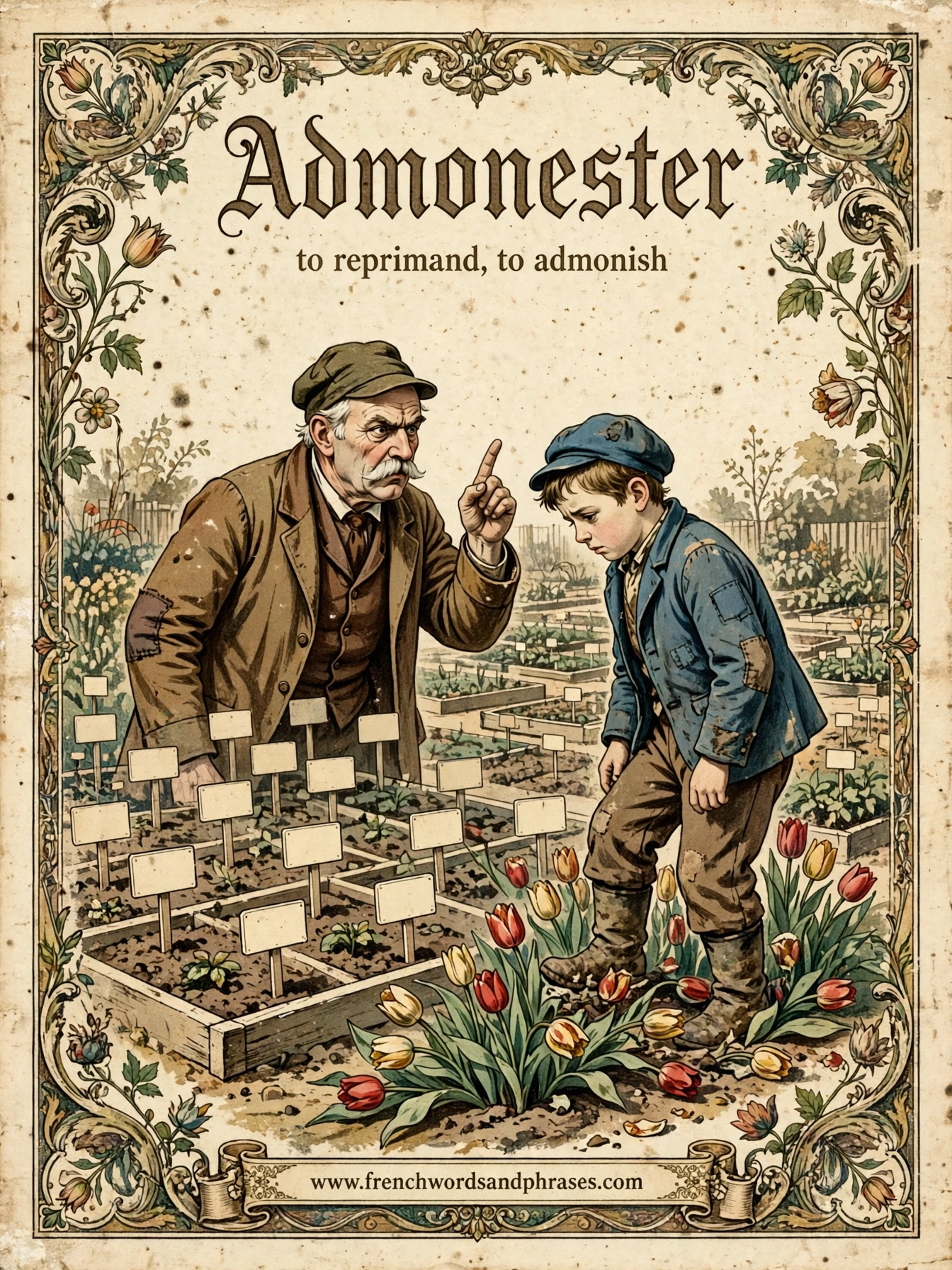
Admonester means to reprimand, to admonish — to scold someone formally and solemnly, with the full weight of an office behind the words.
A judge leaning forward to warn a witness, a bishop addressing his flock from the pulpit, a headmaster summoning a pupil to his study — admonester is the reprimand dressed in its Sunday clothes: no shouting, just authority, gravity and a warning for the future.
In this guide, you’ll learn how to conjugate admonester in all the major French tenses and moods. Explore complete conjugation tables, French examples, English translations, and practice quizzes.
Understanding the French Verb Admonester
Admonester is a regular French verb belonging to the first group of verbs, those ending in-er.
It means to reprimand, to admonish. It is commonly used in courts, churches, schools and parliaments, wherever the reprimand comes from an institution rather than a temper. Because it is so solemn, French also uses it with a smile for any pompous telling-off: se faire admonester par sa grand-mère — to be given a grave little lecture by one’s grandmother.
Verb classification: First group (-er)
Auxiliary verb: Avoir
Past participle: admonesté
Present participle: admonestant
English equivalents: To reprimand, to admonish, to rebuke solemnly; admonester un élève — to reprimand a pupil; admonester quelqu’un en public — to rebuke someone publicly; une admonestation — a formal reprimand, a warning.
One important detail: admonester is a regular -er verb (j’admoneste, nous admonestons, admonesté), and everything about it is register. It stands at the top of the scolding ladder: a parent gronde a child, a boss réprimande an employee, but a judge, a bishop or a head of state admoneste — slowly, publicly, and for the record. The noun une admonestation is the written warning itself, the kind that goes into a file.
Experience the Word
Admonester is the telling-off as ceremony — quiet voice, straight back, and every word meant to be remembered.
Imagine a courtroom in Lyon. The witness has arrived late for the third time. The judge removes her glasses, looks over the file and admoneste l’homme — two sentences only, level and cold, about respect for the court. No voice is raised; the man studies his shoes, and the whole room understands.
Nothing was shouted and nothing was forgiven. He was admonished — admonesté — and the record will remember it.
How to Conjugate Admonester: Complete French Conjugation Guide
Let’s explore every major conjugation of admonester, beginning with the indicative mood.
How to Conjugate Admonester in the Indicative Mood
The indicative mood is used to express facts, observations, actions, and events.
How to Conjugate Admonester in the Present Tense (Présent)
Used for actions happening now, habitual actions, and general truths.
| Subject | Conjugation |
|---|---|
| je | admoneste |
| tu | admonestes |
| il / elle | admoneste |
| nous | admonestons |
| vous | admonestez |
| ils / elles | admonestent |
Example
Le directeur admoneste l’élève devant ses parents.
The headmaster reprimands the pupil in front of his parents.
Quick Quiz 1
Complete the sentence:
Nous ______ les élèves bruyants après la récréation.
Reveal the answer
admonestons
Nous admonestons les élèves bruyants après la récréation.
We reprimand the noisy pupils after break.
How to Conjugate Admonester in the Passé Composé
Used for completed actions in the past. Admonester takes the auxiliary verb avoir.
| Subject | Conjugation |
|---|---|
| j’ | ai admonesté |
| tu | as admonesté |
| il / elle | a admonesté |
| nous | avons admonesté |
| vous | avez admonesté |
| ils / elles | ont admonesté |
Example
Le juge a admonesté le témoin pour son retard.
The judge admonished the witness for being late.
How to Conjugate Admonester in the Imparfait (Imperfect Tense)
Used for habitual past actions, descriptions, and ongoing situations in the past.
| Subject | Conjugation |
|---|---|
| je | admonestais |
| tu | admonestais |
| il / elle | admonestait |
| nous | admonestions |
| vous | admonestiez |
| ils / elles | admonestaient |
Example
Le père admonestait son fils à chaque mauvaise note.
The father used to reprimand his son for every bad mark.
Quick Quiz 2
Choose the correct form:
The bishop admonished the faithful.
L’évêque ______ les fidèles. (a admonesté / est admonesté)
Reveal the answer
a admonesté
L’évêque a admonesté les fidèles.
Admonester takes avoir.
How to Conjugate Admonester in the Plus-que-parfait
Used to describe an action that had already been completed before another past event.
| Subject | Conjugation |
|---|---|
| j’ | avais admonesté |
| tu | avais admonesté |
| il / elle | avait admonesté |
| nous | avions admonesté |
| vous | aviez admonesté |
| ils / elles | avaient admonesté |
Example
Elle avait admonesté l’employé à plusieurs reprises.
She had reprimanded the employee several times.
How to Conjugate Admonester in the Passé Simple
Primarily used in formal writing, literature, and historical narratives. It is rarely used in everyday conversation.
| Subject | Conjugation |
|---|---|
| je | admonestai |
| tu | admonestas |
| il / elle | admonesta |
| nous | admonestâmes |
| vous | admonestâtes |
| ils / elles | admonestèrent |
Example
L’évêque admonesta les fidèles du haut de la chaire.
The bishop admonished the faithful from the pulpit.
How to Conjugate Admonester in the Passé Antérieur
A literary tense used to express an action completed immediately before another past action, generally in the passé simple.
| Subject | Conjugation |
|---|---|
| j’ | eus admonesté |
| tu | eus admonesté |
| il / elle | eut admonesté |
| nous | eûmes admonesté |
| vous | eûtes admonesté |
| ils / elles | eurent admonesté |
Example
Quand il eut admonesté le soldat, il le renvoya à son poste.
When he had reprimanded the soldier, he sent him back to his post.
How to Conjugate Admonester in the Future Tense (Futur Simple)
Used to describe actions that will take place in the future.
| Subject | Conjugation |
|---|---|
| je | admonesterai |
| tu | admonesteras |
| il / elle | admonestera |
| nous | admonesterons |
| vous | admonesterez |
| ils / elles | admonesteront |
Example
Le président admonestera publiquement les ministres négligents.
The president will publicly rebuke the negligent ministers.
How to Conjugate Admonester in the Futur Antérieur (Future Perfect)
Used for an action that will have been completed before a particular point in the future.
| Subject | Conjugation |
|---|---|
| j’ | aurai admonesté |
| tu | auras admonesté |
| il / elle | aura admonesté |
| nous | aurons admonesté |
| vous | aurez admonesté |
| ils / elles | auront admonesté |
Example
À la fin de la séance, le juge aura admonesté les deux avocats.
By the end of the session, the judge will have admonished both lawyers.
How to Conjugate Admonester in the Near Future (Futur Proche)
Used to describe something that is going to happen soon. Formed with aller + infinitive.
| Subject | Conjugation |
|---|---|
| je | vais admonester |
| tu | vas admonester |
| il / elle | va admonester |
| nous | allons admonester |
| vous | allez admonester |
| ils / elles | vont admonester |
Example
Le professeur va admonester les élèves bruyants.
The teacher is going to reprimand the noisy pupils.
How to Conjugate Admonester in the Conditional Mood
The conditional mood expresses what would happen under certain circumstances. It is also frequently used to make polite requests or express wishes.
How to Conjugate Admonester in the Present Conditional
| Subject | Conjugation |
|---|---|
| je | admonesterais |
| tu | admonesterais |
| il / elle | admonesterait |
| nous | admonesterions |
| vous | admonesteriez |
| ils / elles | admonesteraient |
Example
Sans témoins, il admonesterait son fils plus durement.
Without witnesses, he would reprimand his son more harshly.
How to Conjugate Admonester in the Past Conditional
| Subject | Conjugation |
|---|---|
| j’ | aurais admonesté |
| tu | aurais admonesté |
| il / elle | aurait admonesté |
| nous | aurions admonesté |
| vous | auriez admonesté |
| ils / elles | auraient admonesté |
Example
Elle aurait admonesté l’équipe si le projet avait échoué.
She would have reprimanded the team if the project had failed.
Admonester in the Literary Past Conditional Form
This less common literary form uses the imperfect subjunctive of avoir.
| Subject | Conjugation |
|---|---|
| j’ | eusse admonesté |
| tu | eusses admonesté |
| il / elle | eût admonesté |
| nous | eussions admonesté |
| vous | eussiez admonesté |
| ils / elles | eussent admonesté |
Example
Le roi eût admonesté ses conseillers en plein conseil.
The king would have admonished his counsellors in full council.
How to Conjugate Admonester in the Subjunctive Mood
The subjunctive is used to express wishes, emotions, doubts, necessity, and uncertainty. It frequently follows expressions such as il faut que (it is necessary that) or bien que (although).
How to Conjugate Admonester in the Present Subjunctive
| Subject | Conjugation |
|---|---|
| que je | admoneste |
| que tu | admonestes |
| qu’il / qu’elle | admoneste |
| que nous | admonestions |
| que vous | admonestiez |
| qu’ils / qu’elles | admonestent |
Example
Il faut que le maître admoneste cet enfant avec calme.
The teacher must reprimand this child calmly.
Quick Quiz 3
Complete the sentence using the subjunctive:
Il faut que vous ______ cet employé devant témoins.
Reveal the answer
admonestiez
Il faut que vous admonestiez cet employé devant témoins.
You must reprimand this employee in front of witnesses.
How to Conjugate Admonester in the Imperfect Subjunctive
A literary tense, rarely encountered in modern spoken French.
| Subject | Conjugation |
|---|---|
| que je | admonestasse |
| que tu | admonestasses |
| qu’il / qu’elle | admonestât |
| que nous | admonestassions |
| que vous | admonestassiez |
| qu’ils / qu’elles | admonestassent |
Example
On craignait que le juge admonestât le témoin trop sévèrement.
People feared the judge might admonish the witness too severely.
How to Conjugate Admonester in the Pluperfect Subjunctive
A literary construction used to express an action completed before another past action.
| Subject | Conjugation |
|---|---|
| que j’ | eusse admonesté |
| que tu | eusses admonesté |
| qu’il / qu’elle | eût admonesté |
| que nous | eussions admonesté |
| que vous | eussiez admonesté |
| qu’ils / qu’elles | eussent admonesté |
Example
On disait qu’il eût admonesté son adjoint devant tous.
People said he had reprimanded his deputy in front of everyone.
How to Conjugate Admonester in the Past Subjunctive
| Subject | Conjugation |
|---|---|
| que j’ | aie admonesté |
| que tu | aies admonesté |
| qu’il / qu’elle | ait admonesté |
| que nous | ayons admonesté |
| que vous | ayez admonesté |
| qu’ils / qu’elles | aient admonesté |
Example
Je regrette qu’elle ait admonesté le vieil homme pour si peu.
I regret that she reprimanded the old man for so little.
How to Conjugate Admonester in the Imperative
The imperative is used to give commands, instructions, invitations, or suggestions. Subject pronouns are omitted.
How to Conjugate Admonester in the Present Imperative
| Person | Conjugation |
|---|---|
| (tu) | admoneste |
| (nous) | admonestons |
| (vous) | admonestez |
Example
Admonestez-le fermement, mais sans crier !
Reprimand him firmly, but without shouting!
Quick Quiz 4
How would you say Reprimand him firmly (tu form)?
Reveal the answer
Admoneste-le fermement !
French Participles of Admonester
Participles are verb forms that can be used in compound tenses and other grammatical constructions.
Present Participle of Admonester
admonestant
En admonestant l’élève, le directeur a gardé un ton mesuré.
While reprimanding the pupil, the headmaster kept a measured tone.
Past Participle of Admonester
admonesté
Admonesté par le juge, le témoin a baissé les yeux.
Admonished by the judge, the witness lowered his eyes.
Admonester in Everyday French: Real-Life Examples
Now that you know the conjugations, let’s see how admonester appears in everyday French.
Example 1 — Present
Le directeur admoneste l’élève devant ses parents.
The headmaster reprimands the pupil in front of his parents.
Example 2 — Passé composé
Le juge a admonesté le témoin pour son retard.
The judge admonished the witness for being late.
Example 3 — Imparfait
Le père admonestait son fils à chaque mauvaise note.
The father used to reprimand his son for every bad mark.
Example 4 — Future
Le président admonestera les ministres négligents.
The president will rebuke the negligent ministers.
Example 5 — Conditional
Sans témoins, il admonesterait son fils plus durement.
Without witnesses, he would reprimand his son more harshly.
Example 6 — Imperative
Admonestez-le fermement, mais sans crier !
Reprimand him firmly, but without shouting!
Beyond Translation: The Meaning of Admonester
English admonish is the exact twin — same Latin root (admonere, to remind, to warn) and the same raised eyebrow.
Both languages keep it for the formal warning.
An admonestation is never a family quarrel: it is the scolding that gets written down, the one with a date, a signature and consequences — which is precisely why French smiles when a grandmother delivers one over the Sunday roast.
How to Remember the French Verb Admonester
Remember it this way: Admonester is about the judge’s two quiet sentences — a scolding with a seal on it.
- Top of the scolding ladder: gronder at home, réprimander at work, admonester in court, church and parliament.
- Regular -er: j’admoneste, nous admonestons, past participle admonesté.
- The noun is une admonestation — the formal warning that goes into the file.
The key idea is the judge’s two quiet sentences — a scolding with a seal on it.
Test Your Knowledge of Admonester
Let’s see how much you’ve learned. Try answering these questions before revealing the answers.
Question 1
How does admonester differ from gronder, to scold?
Reveal the answer
Admonester is formal and institutional — judges, bishops and headmasters admonish; gronder is the everyday family scolding.
Question 2
How do you say The judge admonished the witness for being late in French?
Reveal the answer
Le juge a admonesté le témoin pour son retard.
Question 3
Translate: The headmaster reprimands the pupil in front of his parents.
Reveal the answer
Le directeur admoneste l’élève devant ses parents.
Question 4
What is the past participle of admonester?
Reveal the answer
Admonesté.
Question 5
Complete the sentence:
Il faut que le maître ______ cet enfant avec calme.
Reveal the answer
admoneste
Il faut que le maître admoneste cet enfant avec calme.
The teacher must reprimand this child calmly.
Your Final Challenge
Can You Use It?
How would you say this in French?
The judge admonished him in two sentences, and those two sentences will weigh more than a fine.
Reveal the answer
Le juge l’a admonesté en deux phrases, et ces deux phrases pèseront plus lourd qu’une amende.
The judge admonished him in two sentences, and those two sentences will weigh more than a fine.
A little French. A little curiosity. A richer everyday life.
LEARN FRENCH ONE WORD AT A TIME