A French Word to Live By
How to Conjugate Additionner in French
/a.di.sjɔ.ne/
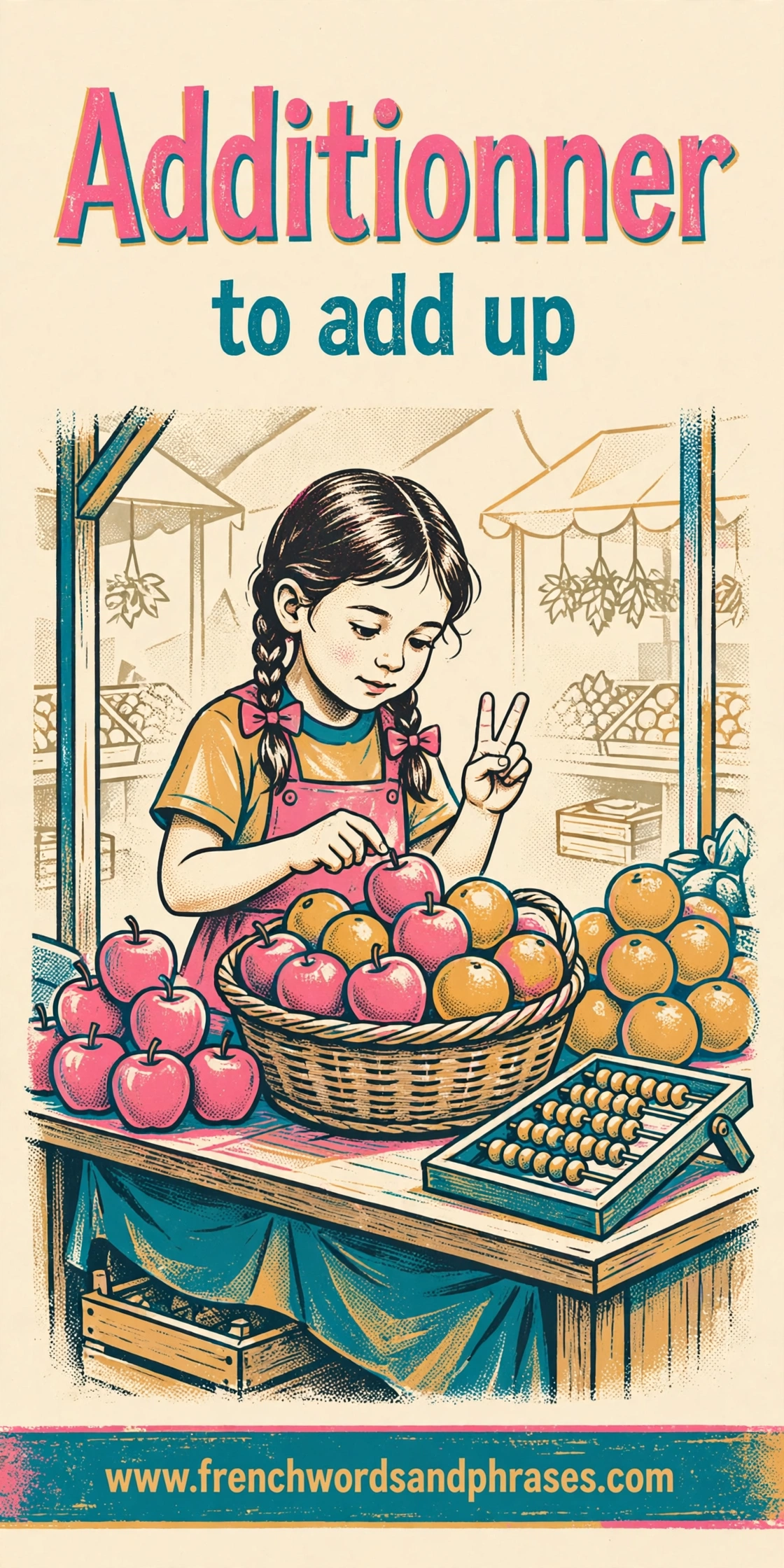
Additionner means to add up — to put figures together in a column and arrive at a total, the way a cashier, a bookkeeper or a voter-counting official does.
A market stall at closing time: the stallholder runs a pencil down the day’s column of figures, murmuring as he goes — additionner is the verb of the careful total, numbers gathered one by one until they become a single sum.
In this guide, you’ll learn how to conjugate additionner in all the major French tenses and moods. Explore complete conjugation tables, French examples, English translations, and practice quizzes.
Understanding the French Verb Additionner
Additionner is a regular French verb belonging to the first group of verbs, those ending in-er.
It means to add up. It is commonly used in shops, accounts and kitchens for totalling prices, receipts and expenses, in elections for adding up votes, and in any office where a column of numbers must become one trustworthy total.
Verb classification: First group (-er)
Auxiliary verb: Avoir
Past participle: additionné
Present participle: additionnant
English equivalents: To add up, to total; additionner des chiffres — to add up figures; additionner les voix — to add up the votes; additionner les frais — to total the costs; une addition — an addition sum, and also the restaurant bill; faire l’addition — to do the sum.
One important detail: additionner keeps the double n of une addition everywhere: j’additionne, nous additionnons, ils additionnent, past participle additionné — a perfectly regular -er verb. Its everyday stage is the end of a meal: l’addition is the bill, and additionner les notes is what friends do when they split it. For the schoolroom operation itself, French also says simply ajouter or faire une addition; additionner is the verb of totalling real columns of real figures.
Experience the Word
Additionner is the verb of the column — patient, exact, and finished only when the last figure has joined the total.
Imagine election night in a small town hall. Two officials read out the ballots while a third additionne les voix on a paper pad, column after column, until the whole village’s evening becomes one line of figures under his pencil.
Nothing has been decided by the pencil. But everything has been counted — additionné — and the total can speak.
How to Conjugate Additionner: Complete French Conjugation Guide
Let’s explore every major conjugation of additionner, beginning with the indicative mood.
How to Conjugate Additionner in the Indicative Mood
The indicative mood is used to express facts, observations, actions, and events.
How to Conjugate Additionner in the Present Tense (Présent)
Used for actions happening now, habitual actions, and general truths.
| Subject | Conjugation |
|---|---|
| je | additionne |
| tu | additionnes |
| il / elle | additionne |
| nous | additionnons |
| vous | additionnez |
| ils / elles | additionnent |
Example
Le caissier additionne les articles un par un.
The cashier adds up the items one by one.
Quick Quiz 1
Complete the sentence:
Nous ______ les voix avant le résultat.
Reveal the answer
additionnons
Nous additionnons les voix avant le résultat.
We add up the votes before the result.
How to Conjugate Additionner in the Passé Composé
Used for completed actions in the past. Additionner takes the auxiliary verb avoir.
| Subject | Conjugation |
|---|---|
| j’ | ai additionné |
| tu | as additionné |
| il / elle | a additionné |
| nous | avons additionné |
| vous | avez additionné |
| ils / elles | ont additionné |
Example
Elle a additionné tous les chiffres de la colonne.
She added up all the figures in the column.
How to Conjugate Additionner in the Imparfait (Imperfect Tense)
Used for habitual past actions, descriptions, and ongoing situations in the past.
| Subject | Conjugation |
|---|---|
| je | additionnais |
| tu | additionnais |
| il / elle | additionnait |
| nous | additionnions |
| vous | additionniez |
| ils / elles | additionnaient |
Example
Chaque soir, le marchand additionnait ses recettes.
Every evening, the shopkeeper used to add up his takings.
Quick Quiz 2
Choose the correct form:
He added up the costs.
Il ______ les frais. (a additionné / est additionné)
Reveal the answer
a additionné
Il a additionné les frais.
Additionner takes avoir.
How to Conjugate Additionner in the Plus-que-parfait
Used to describe an action that had already been completed before another past event.
| Subject | Conjugation |
|---|---|
| j’ | avais additionné |
| tu | avais additionné |
| il / elle | avait additionné |
| nous | avions additionné |
| vous | aviez additionné |
| ils / elles | avaient additionné |
Example
Ils avaient additionné les voix avant d’annoncer le résultat.
They had added up the votes before announcing the result.
How to Conjugate Additionner in the Passé Simple
Primarily used in formal writing, literature, and historical narratives. It is rarely used in everyday conversation.
| Subject | Conjugation |
|---|---|
| je | additionnai |
| tu | additionnas |
| il / elle | additionna |
| nous | additionnâmes |
| vous | additionnâtes |
| ils / elles | additionnèrent |
Example
Le comptable additionna les sommes en silence.
The accountant added up the sums in silence.
How to Conjugate Additionner in the Passé Antérieur
A literary tense used to express an action completed immediately before another past action, generally in the passé simple.
| Subject | Conjugation |
|---|---|
| j’ | eus additionné |
| tu | eus additionné |
| il / elle | eut additionné |
| nous | eûmes additionné |
| vous | eûtes additionné |
| ils / elles | eurent additionné |
Example
Quand il eut additionné les frais, il pâlit.
When he had totalled the costs, he went pale.
How to Conjugate Additionner in the Future Tense (Futur Simple)
Used to describe actions that will take place in the future.
| Subject | Conjugation |
|---|---|
| je | additionnerai |
| tu | additionneras |
| il / elle | additionnera |
| nous | additionnerons |
| vous | additionnerez |
| ils / elles | additionneront |
Example
La machine additionnera les montants automatiquement.
The machine will add up the amounts automatically.
How to Conjugate Additionner in the Futur Antérieur (Future Perfect)
Used for an action that will have been completed before a particular point in the future.
| Subject | Conjugation |
|---|---|
| j’ | aurai additionné |
| tu | auras additionné |
| il / elle | aura additionné |
| nous | aurons additionné |
| vous | aurez additionné |
| ils / elles | auront additionné |
Example
À la fin du repas, tu auras additionné toutes les dépenses.
By the end of the meal, you will have added up all the expenses.
How to Conjugate Additionner in the Near Future (Futur Proche)
Used to describe something that is going to happen soon. Formed with aller + infinitive.
| Subject | Conjugation |
|---|---|
| je | vais additionner |
| tu | vas additionner |
| il / elle | va additionner |
| nous | allons additionner |
| vous | allez additionner |
| ils / elles | vont additionner |
Example
Je vais additionner les notes pour partager l’addition.
I am going to add up the bills so we can split the total.
How to Conjugate Additionner in the Conditional Mood
The conditional mood expresses what would happen under certain circumstances. It is also frequently used to make polite requests or express wishes.
How to Conjugate Additionner in the Present Conditional
| Subject | Conjugation |
|---|---|
| je | additionnerais |
| tu | additionnerais |
| il / elle | additionnerait |
| nous | additionnerions |
| vous | additionneriez |
| ils / elles | additionneraient |
Example
Sans calculatrice, j’additionnerais plus lentement.
Without a calculator, I would add up more slowly.
How to Conjugate Additionner in the Past Conditional
| Subject | Conjugation |
|---|---|
| j’ | aurais additionné |
| tu | aurais additionné |
| il / elle | aurait additionné |
| nous | aurions additionné |
| vous | auriez additionné |
| ils / elles | auraient additionné |
Example
Elle aurait additionné les deux colonnes si elle avait eu le temps.
She would have added up the two columns if she had had the time.
Additionner in the Literary Past Conditional Form
This less common literary form uses the imperfect subjunctive of avoir.
| Subject | Conjugation |
|---|---|
| j’ | eusse additionné |
| tu | eusses additionné |
| il / elle | eût additionné |
| nous | eussions additionné |
| vous | eussiez additionné |
| ils / elles | eussent additionné |
Example
Le trésorier eût additionné les écus avant la nuit.
The treasurer would have added up the crowns before nightfall.
How to Conjugate Additionner in the Subjunctive Mood
The subjunctive is used to express wishes, emotions, doubts, necessity, and uncertainty. It frequently follows expressions such as il faut que (it is necessary that) or bien que (although).
How to Conjugate Additionner in the Present Subjunctive
| Subject | Conjugation |
|---|---|
| que je | additionne |
| que tu | additionnes |
| qu’il / qu’elle | additionne |
| que nous | additionnions |
| que vous | additionniez |
| qu’ils / qu’elles | additionnent |
Example
Il faut que tu additionnes ces chiffres sans erreur.
You must add up these figures without a mistake.
Quick Quiz 3
Complete the sentence using the subjunctive:
Il faut que vous ______ les factures du mois.
Reveal the answer
additionniez
Il faut que vous additionniez les factures du mois.
You must add up the month’s invoices.
How to Conjugate Additionner in the Imperfect Subjunctive
A literary tense, rarely encountered in modern spoken French.
| Subject | Conjugation |
|---|---|
| que je | additionnasse |
| que tu | additionnasses |
| qu’il / qu’elle | additionnât |
| que nous | additionnassions |
| que vous | additionnassiez |
| qu’ils / qu’elles | additionnassent |
Example
Je voulais qu’il additionnât les recettes du jour.
I wanted him to add up the day’s takings.
How to Conjugate Additionner in the Pluperfect Subjunctive
A literary construction used to express an action completed before another past action.
| Subject | Conjugation |
|---|---|
| que j’ | eusse additionné |
| que tu | eusses additionné |
| qu’il / qu’elle | eût additionné |
| que nous | eussions additionné |
| que vous | eussiez additionné |
| qu’ils / qu’elles | eussent additionné |
Example
On vérifia qu’elle eût additionné toutes les factures.
They checked that she had added up all the invoices.
How to Conjugate Additionner in the Past Subjunctive
| Subject | Conjugation |
|---|---|
| que j’ | aie additionné |
| que tu | aies additionné |
| qu’il / qu’elle | ait additionné |
| que nous | ayons additionné |
| que vous | ayez additionné |
| ils / elles | aient additionné |
Example
Je doute qu’elle ait additionné les bons montants.
I doubt she added up the right amounts.
How to Conjugate Additionner in the Imperative
The imperative is used to give commands, instructions, invitations, or suggestions. Subject pronouns are omitted.
How to Conjugate Additionner in the Present Imperative
| Person | Conjugation |
|---|---|
| (tu) | additionne |
| (nous) | additionnons |
| (vous) | additionnez |
Example
Additionne les deux colonnes et compare les totaux !
Add up the two columns and compare the totals!
Quick Quiz 4
How would you say Add up the figures (tu form)?
Reveal the answer
Additionne les chiffres !
French Participles of Additionner
Participles are verb forms that can be used in compound tenses and other grammatical constructions.
Present Participle of Additionner
additionnant
En additionnant les voix, on découvre une égalité parfaite.
By adding up the votes, we find a perfect tie.
Past Participle of Additionner
additionné
Additionnés, ces petits montants forment une belle somme.
Added up, these small amounts make a handsome sum.
Additionner in Everyday French: Real-Life Examples
Now that you know the conjugations, let’s see how additionner appears in everyday French.
Example 1 — Present
Le caissier additionne les articles.
The cashier adds up the items.
Example 2 — Passé composé
Elle a additionné tous les chiffres.
She added up all the figures.
Example 3 — Imparfait
Le marchand additionnait ses recettes chaque soir.
The shopkeeper used to add up his takings every evening.
Example 4 — Future
La machine additionnera les montants.
The machine will add up the amounts.
Example 5 — Conditional
Sans calculatrice, j’additionnerais plus lentement.
Without a calculator, I would add up more slowly.
Example 6 — Imperative
Additionne les deux colonnes !
Add up the two columns!
Beyond Translation: The Meaning of Additionner
English add up is the plain twin of additionner, but the French noun hides a surprise: l’addition is not only the schoolroom sum — it is also the bill at the end of a restaurant meal.
So the verb lives at the end of dinner.
When friends additionnent les notes to share the cost fairly, they are doing arithmetic and friendship at once — and the waiter who brings l’addition is bringing both a sum and a bill in a single word.
How to Remember the French Verb Additionner
Remember it this way: Additionner is about the pencil running down the column at closing time.
- Double n from une addition: j’additionne, nous additionnons, additionné.
- Its stage is the column of figures: additionner les prix, les voix, les frais.
- Remember the restaurant: l’addition is the bill you are totalling.
The key idea is the pencil running down the column at closing time.
Test Your Knowledge of Additionner
Let’s see how much you’ve learned. Try answering these questions before revealing the answers.
Question 1
How do you say She added up all the figures in French?
Reveal the answer
Elle a additionné tous les chiffres.
Question 2
What is l’addition at the end of a restaurant meal?
Reveal the answer
The bill — the total of everything the table has ordered.
Question 3
Translate: Add up the two columns!
Reveal the answer
Additionne les deux colonnes !
Question 4
What is the past participle of additionner?
Reveal the answer
Additionné.
Question 5
Complete the sentence:
Il faut que tu ______ ces chiffres sans erreur.
Reveal the answer
additionnes
Il faut que tu additionnes ces chiffres sans erreur.
You must add up these figures without a mistake.
Your Final Challenge
Can You Use It?
How would you say this in French?
The shopkeeper adds up his takings by lamplight, and the day becomes a single figure.
Reveal the answer
Le marchand additionne ses recettes à la lueur de la lampe, et la journée devient un chiffre.
The shopkeeper adds up his takings by lamplight, and the day becomes a single figure.
A little French. A little curiosity. A richer everyday life.
LEARN FRENCH ONE WORD AT A TIME