A French Word to Live By
How to Conjugate Acquiescer in French
/a.kjɛ.se/
Acquiescer means to acquiesce, to agree — to give assent, often quietly, sometimes without enthusiasm.
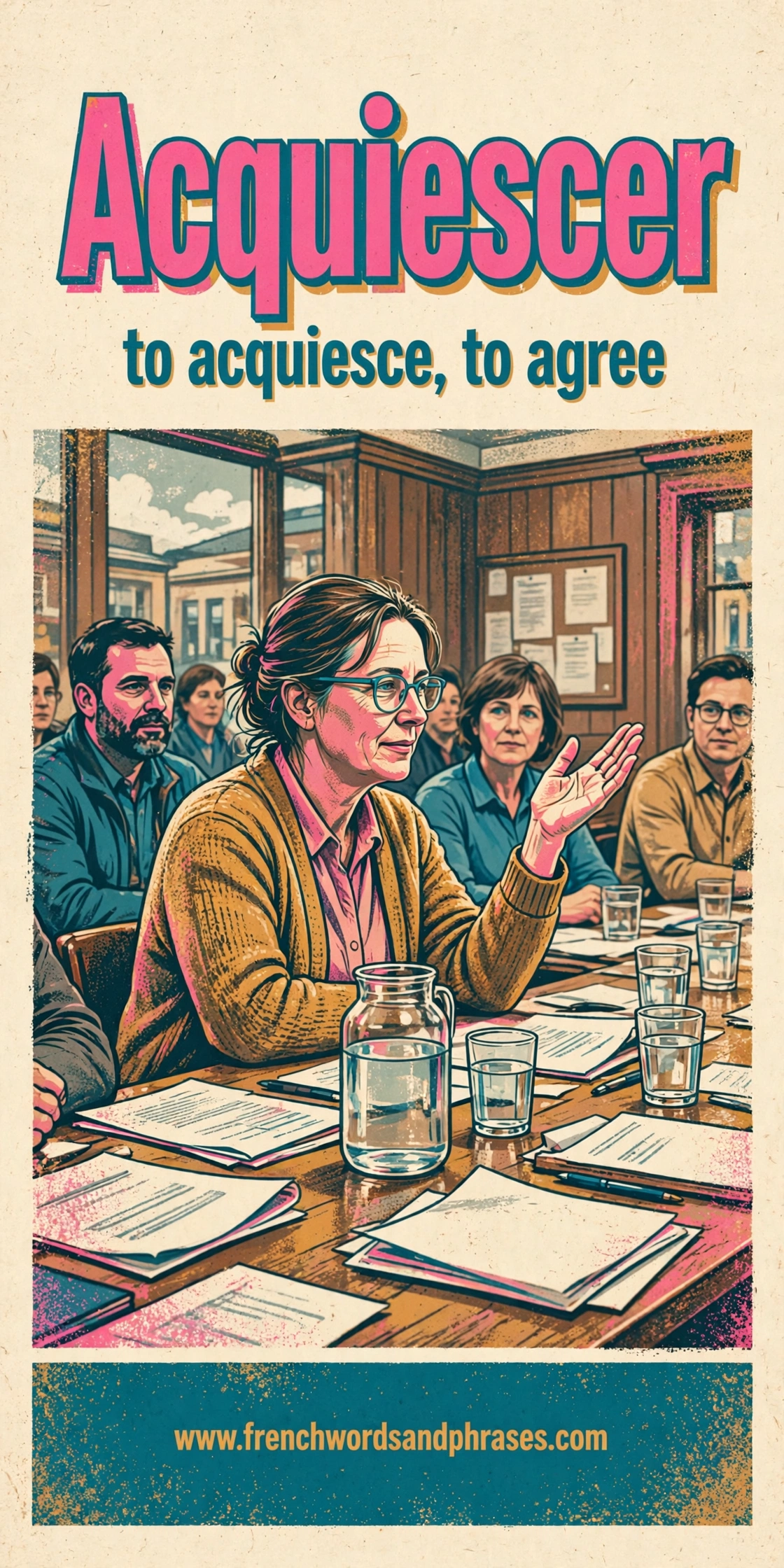
A committee chairman proposes, the room is silent, and one by one the heads go down in a small nod — acquiescer is the formal verb of giving assent: agreeing to a request, a proposal, a judgement, frequently with no more than a sign of the head and not always with a whole heart.
In this guide, you’ll learn how to conjugate acquiescer in all the major French tenses and moods. Explore complete conjugation tables, French examples, English translations, and practice quizzes.
Understanding the French Verb Acquiescer
Acquiescer is a regular French verb belonging to the first group of verbs, those ending in-er.
It means to acquiesce, to agree. Acquiescer sits a step above accepter in formality and a step below approuver in warmth: it records assent given, often after deliberation, and it can carry a shade of resignation — one acquiesces to what one cannot change. It is common in legal and administrative French and in reported speech: le ministre a acquiescé.
Verb classification: First group (-er)
Auxiliary verb: Avoir
Past participle: acquiescé
Present participle: acquiesçant
English equivalents: To acquiesce, to agree, to assent; acquiescer à une demande — to agree to a request; acquiescer à une proposition — to assent to a proposal; acquiescer d’un signe de tête — to nod assent; acquiescer en silence — to acquiesce in silence; acquiescer à un jugement — to accept a judgement.
One important detail: acquiescer is a -cer verb, so the c becomes ç before a and o: nous acquiesçons, and in the imperfect j’acquiesçais, nous acquiescions — the ç keeps the soft s-sound. The agreement itself is governed by à: acquiescer à une demande, à une proposition. And its most famous gesture needs no preposition at all: acquiescer d’un signe de tête, to nod one’s assent. The tone is formal — this is the verb of minutes, courts and committees, not of the café.
Experience the Word
Acquiescer is agreement at its quietest — a nod in a silent room that changes what happens next.
Imagine a family council around a lawyer’s desk. The will is read, the proposal is made, and the eldest brother looks at the floor for a long moment. Then, without a word, il acquiesce d’un signe de tête — and the notary picks up his pen, because the nod was the decision.
He has not applauded or even spoken. He has acquiesced — acquiescé — and the matter is settled.
How to Conjugate Acquiescer: Complete French Conjugation Guide
Let’s explore every major conjugation of acquiescer, beginning with the indicative mood.
How to Conjugate Acquiescer in the Indicative Mood
The indicative mood is used to express facts, observations, actions, and events.
How to Conjugate Acquiescer in the Present Tense (Présent)
Used for actions happening now, habitual actions, and general truths.
| Subject | Conjugation |
|---|---|
| je | acquiesce |
| tu | acquiesces |
| il / elle | acquiesce |
| nous | acquiesçons |
| vous | acquiescez |
| ils / elles | acquiescent |
Example
Le directeur acquiesce à toutes les demandes du service.
The director agrees to all the department’s requests.
Quick Quiz 1
Complete the sentence:
Nous ______ à votre proposition.
Reveal the answer
acquiesçons
Nous acquiesçons à votre proposition.
We assent to your proposal.
How to Conjugate Acquiescer in the Passé Composé
Used for completed actions in the past. Acquiescer takes the auxiliary verb avoir.
| Subject | Conjugation |
|---|---|
| j’ | ai acquiescé |
| tu | as acquiescé |
| il / elle | a acquiescé |
| nous | avons acquiescé |
| vous | avez acquiescé |
| ils / elles | ont acquiescé |
Example
Elle a acquiescé d’un signe de tête, sans un mot.
She nodded her assent, without a word.
How to Conjugate Acquiescer in the Imparfait (Imperfect Tense)
Used for habitual past actions, descriptions, and ongoing situations in the past.
| Subject | Conjugation |
|---|---|
| je | acquiesçais |
| tu | acquiesçais |
| il / elle | acquiesçait |
| nous | acquiescions |
| vous | acquiesciez |
| ils / elles | acquiesçaient |
Example
Le ministre acquiesçait rarement aux demandes des syndicats.
The minister rarely agreed to the unions’ demands.
Quick Quiz 2
Choose the correct form:
The minister agreed to the request.
Le ministre ______ à la demande. (a acquiescé / est acquiescé)
Reveal the answer
a acquiescé
Le ministre a acquiescé à la demande.
Acquiescer takes avoir.
How to Conjugate Acquiescer in the Plus-que-parfait
Used to describe an action that had already been completed before another past event.
| Subject | Conjugation |
|---|---|
| j’ | avais acquiescé |
| tu | avais acquiescé |
| il / elle | avait acquiescé |
| nous | avions acquiescé |
| vous | aviez acquiescé |
| ils / elles | avaient acquiescé |
Example
Nous avions acquiescé à la proposition avant même le vote.
We had assented to the proposal even before the vote.
How to Conjugate Acquiescer in the Passé Simple
Primarily used in formal writing, literature, and historical narratives. It is rarely used in everyday conversation.
| Subject | Conjugation |
|---|---|
| je | acquiesçai |
| tu | acquiesças |
| il / elle | acquiesça |
| nous | acquiesçâmes |
| vous | acquiesçâtes |
| ils / elles | acquiesçèrent |
Example
Le conseil acquiesça à la demande du maire.
The council agreed to the mayor’s request.
How to Conjugate Acquiescer in the Passé Antérieur
A literary tense used to express an action completed immediately before another past action, generally in the passé simple.
| Subject | Conjugation |
|---|---|
| j’ | eus acquiescé |
| tu | eus acquiescé |
| il / elle | eut acquiescé |
| nous | eûmes acquiescé |
| vous | eûtes acquiescé |
| ils / elles | eurent acquiescé |
Example
Quand le juge eut acquiescé, l’audience reprit.
When the judge had given his assent, the hearing resumed.
How to Conjugate Acquiescer in the Future Tense (Futur Simple)
Used to describe actions that will take place in the future.
| Subject | Conjugation |
|---|---|
| je | acquiescerai |
| tu | acquiesceras |
| il / elle | acquiescera |
| nous | acquiescerons |
| vous | acquiescerez |
| ils / elles | acquiesceront |
Example
Le comité acquiescera à votre proposition, je crois.
The committee will agree to your proposal, I believe.
How to Conjugate Acquiescer in the Futur Antérieur (Future Perfect)
Used for an action that will have been completed before a particular point in the future.
| Subject | Conjugation |
|---|---|
| j’ | aurai acquiescé |
| tu | auras acquiescé |
| il / elle | aura acquiescé |
| nous | aurons acquiescé |
| vous | aurez acquiescé |
| ils / elles | auront acquiescé |
Example
À la fin de la réunion, ils auront acquiescé à tout le plan.
By the end of the meeting, they will have assented to the whole plan.
How to Conjugate Acquiescer in the Near Future (Futur Proche)
Used to describe something that is going to happen soon. Formed with aller + infinitive.
| Subject | Conjugation |
|---|---|
| je | vais acquiescer |
| tu | vas acquiescer |
| il / elle | va acquiescer |
| nous | allons acquiescer |
| vous | allez acquiescer |
| ils / elles | vont acquiescer |
Example
Il va acquiescer, regarde, il hoche déjà la tête.
He is going to acquiesce, look, he is already nodding.
How to Conjugate Acquiescer in the Conditional Mood
The conditional mood expresses what would happen under certain circumstances. It is also frequently used to make polite requests or express wishes.
How to Conjugate Acquiescer in the Present Conditional
| Subject | Conjugation |
|---|---|
| je | acquiescerais |
| tu | acquiescerais |
| il / elle | acquiescerait |
| nous | acquiescerions |
| vous | acquiesceriez |
| ils / elles | acquiesceraient |
Example
Le président acquiescerait à un délai, mais pas à un refus.
The president would agree to a delay, but not to a refusal.
How to Conjugate Acquiescer in the Past Conditional
| Subject | Conjugation |
|---|---|
| j’ | aurais acquiescé |
| tu | aurais acquiescé |
| il / elle | aurait acquiescé |
| nous | aurions acquiescé |
| vous | auriez acquiescé |
| ils / elles | auraient acquiescé |
Example
Elle aurait acquiescé si la demande avait été raisonnable.
She would have agreed if the request had been reasonable.
Acquiescer in the Literary Past Conditional Form
This less common literary form uses the imperfect subjunctive of avoir.
| Subject | Conjugation |
|---|---|
| j’ | eusse acquiescé |
| tu | eusses acquiescé |
| il / elle | eût acquiescé |
| nous | eussions acquiescé |
| vous | eussiez acquiescé |
| ils / elles | eussent acquiescé |
Example
Le roi eût acquiescé à la requête sans l’avis de ses conseillers.
The king would have granted the request without his counsellors’ advice.
How to Conjugate Acquiescer in the Subjunctive Mood
The subjunctive is used to express wishes, emotions, doubts, necessity, and uncertainty. It frequently follows expressions such as il faut que (it is necessary that) or bien que (although).
How to Conjugate Acquiescer in the Present Subjunctive
| Subject | Conjugation |
|---|---|
| que je | acquiesce |
| que tu | acquiesces |
| qu’il / qu’elle | acquiesce |
| que nous | acquiescions |
| que vous | acquiesciez |
| qu’ils / qu’elles | acquiescent |
Example
Il est rare que le directeur acquiesce aussi vite.
It is rare for the director to agree so quickly.
Quick Quiz 3
Complete the sentence using the subjunctive:
Il est rare que vous ______ sans discuter.
Reveal the answer
acquiesciez
Il est rare que vous acquiesciez sans discuter.
It is rare for you to agree without arguing.
How to Conjugate Acquiescer in the Imperfect Subjunctive
A literary tense, rarely encountered in modern spoken French.
| Subject | Conjugation |
|---|---|
| que je | acquiescasse |
| que tu | acquiescasses |
| qu’il / qu’elle | acquiescât |
| que nous | acquiescassions |
| que vous | acquiescassiez |
| qu’ils / qu’elles | acquiescassent |
Example
On doutait qu’elle acquiesçât à une telle condition.
People doubted she would assent to such a condition.
How to Conjugate Acquiescer in the Pluperfect Subjunctive
A literary construction used to express an action completed before another past action.
| Subject | Conjugation |
|---|---|
| que j’ | eusse acquiescé |
| que tu | eusses acquiescé |
| qu’il / qu’elle | eût acquiescé |
| que nous | eussions acquiescé |
| que vous | eussiez acquiescé |
| qu’ils / qu’elles | eussent acquiescé |
Example
On racontait qu’ils eussent acquiescé en silence au jugement.
People said they had acquiesced in silence to the judgement.
How to Conjugate Acquiescer in the Past Subjunctive
| Subject | Conjugation |
|---|---|
| que j’ | aie acquiescé |
| que tu | aies acquiescé |
| qu’il / qu’elle | ait acquiescé |
| que nous | ayons acquiescé |
| que vous | ayez acquiescé |
| qu’ils / qu’elles | aient acquiescé |
Example
Je suis surpris qu’il ait acquiescé sans discuter.
I am surprised he agreed without arguing.
How to Conjugate Acquiescer in the Imperative
The imperative is used to give commands, instructions, invitations, or suggestions. Subject pronouns are omitted.
How to Conjugate Acquiescer in the Present Imperative
| Person | Conjugation |
|---|---|
| (tu) | acquiesce |
| (nous) | acquiesçons |
| (vous) | acquiescez |
Example
Acquiescez à cette demande, elle est juste !
Agree to this request, it is a fair one!
Quick Quiz 4
How would you say Agree to her request (tu form)?
Reveal the answer
Acquiesce à sa demande !
French Participles of Acquiescer
Participles are verb forms that can be used in compound tenses and other grammatical constructions.
Present Participle of Acquiescer
acquiesçant
En acquiesçant à tout, il évite les conflits mais perd son autorité.
By agreeing to everything, he avoids conflict but loses his authority.
Past Participle of Acquiescer
acquiescé
Acquiescé en silence, le plan fut adopté sans débat.
Assented to in silence, the plan was adopted without debate.
Acquiescer in Everyday French: Real-Life Examples
Now that you know the conjugations, let’s see how acquiescer appears in everyday French.
Example 1 — Present
Le directeur acquiesce à la demande.
The director agrees to the request.
Example 2 — Passé composé
Elle a acquiescé d’un signe de tête.
She nodded her assent.
Example 3 — Imparfait
Nous acquiesçions à toutes ses propositions.
We used to agree to all his proposals.
Example 4 — Future
Le comité acquiescera demain.
The committee will give its assent tomorrow.
Example 5 — Conditional
Il acquiescerait à un délai, pas à un refus.
He would agree to a delay, not to a refusal.
Example 6 — Imperative
Acquiesce à sa demande, elle est raisonnable !
Agree to her request, it is reasonable!
Beyond Translation: The Meaning of Acquiescer
English acquiesce and French acquiescer are the same Latin word twice over — acquiescere, to rest quiet, to find peace in something.
Assent as a kind of rest.
The root explains the flavour: to acquiesce is to stop resisting and let the matter lie. French keeps the verb formal and written, where English keeps it faintly reluctant — in both languages, nobody acquiesces to a birthday present.
How to Remember the French Verb Acquiescer
Remember it this way: Acquiescer is about the silent nod around the lawyer’s desk that settles everything.
- A -cer verb: c becomes ç before a and o — nous acquiesçons, j’acquiesçais.
- The thing agreed to takes à: acquiescer à une demande, à une proposition.
- Its signature gesture: acquiescer d’un signe de tête — to nod assent, no words needed.
The key idea is the silent nod around the lawyer’s desk that settles everything.
Test Your Knowledge of Acquiescer
Let’s see how much you’ve learned. Try answering these questions before revealing the answers.
Question 1
Why is it nous acquiesçons and not nous acquiescons?
Reveal the answer
The -cer rule — c becomes ç before a and o to keep the soft s-sound: acquiesçons, acquiesçais.
Question 2
How do you say She nodded her assent in French?
Reveal the answer
Elle a acquiescé d’un signe de tête.
Question 3
Translate: The council agreed to the mayor’s request.
Reveal the answer
Le conseil a acquiescé à la demande du maire.
Question 4
What is the past participle of acquiescer?
Reveal the answer
Acquiescé.
Question 5
Complete the sentence:
Il est rare que le directeur ______ aussi vite.
Reveal the answer
acquiesce
Il est rare que le directeur acquiesce aussi vite.
It is rare for the director to agree so quickly.
Your Final Challenge
Can You Use It?
How would you say this in French?
The old man listens to the proposal, is silent a moment, then nods his assent.
Reveal the answer
Le vieil homme écoute la proposition, se tait un instant, puis acquiesce d’un signe de tête.
The old man listens to the proposal, is silent a moment, then nods his assent.
A little French. A little curiosity. A richer everyday life.
LEARN FRENCH ONE WORD AT A TIME