A French Word to Live By
How to Conjugate Achopper in French
/a.ʃɔ.pe/
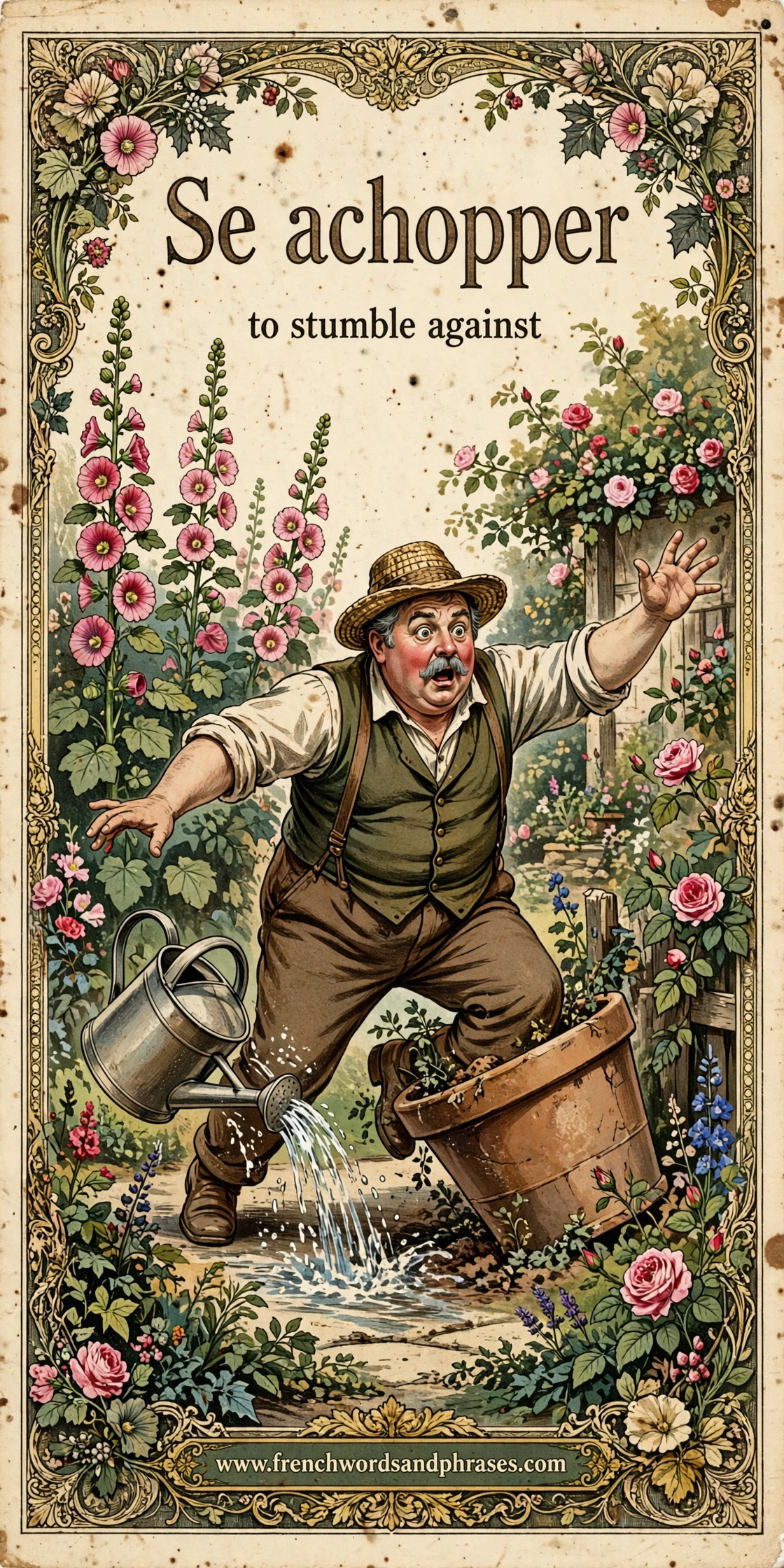
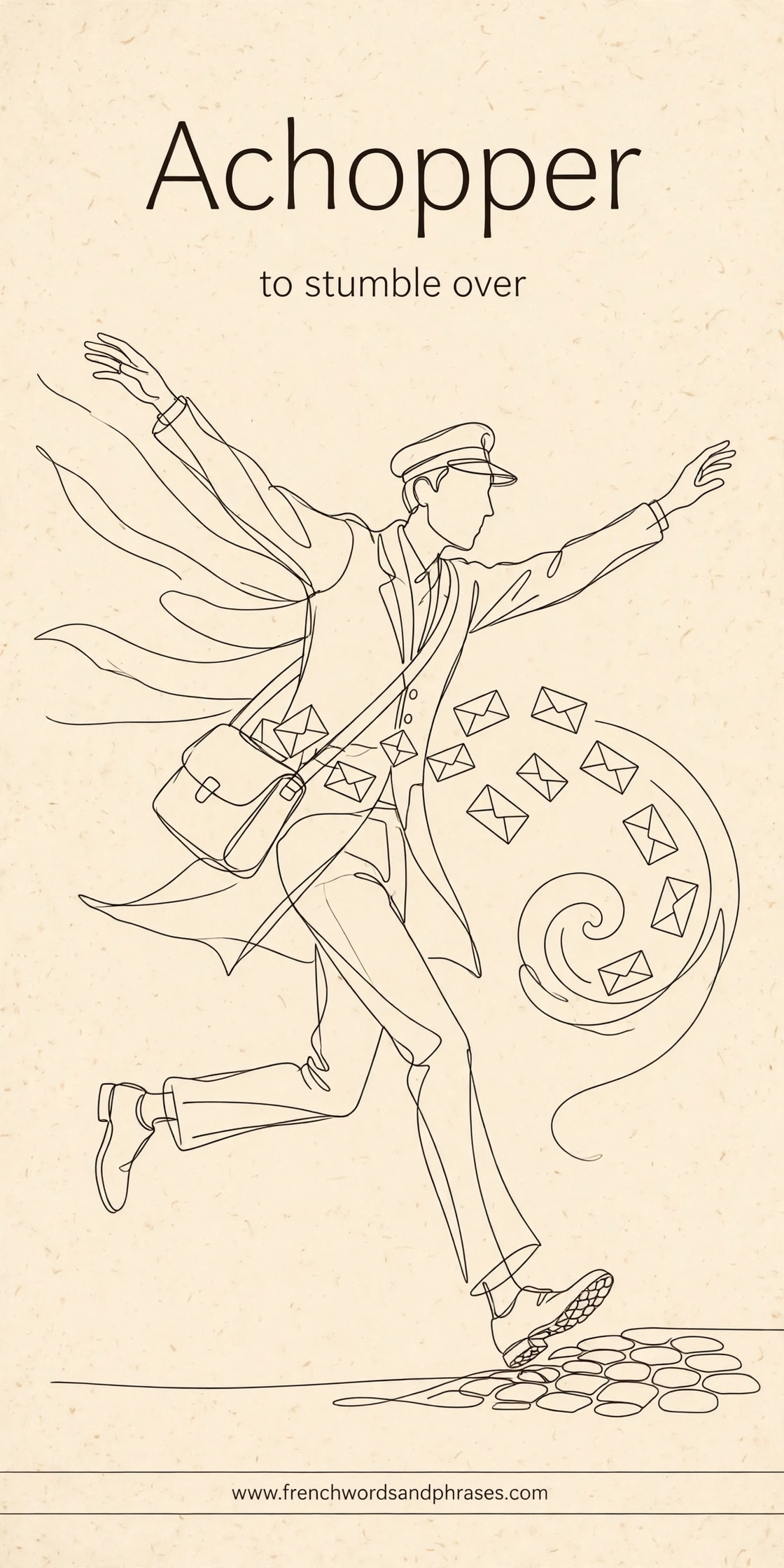
Achopper means to stumble over — to catch your foot, or your argument, on the obstacle in your path.
A walker on a stony path catches his toe on a loose rock; a negotiator’s plan catches on one stubborn clause. Achopper is the slightly old-fashioned verb of the stumble — physical on the path, figurative at the negotiating table — and it almost always arrives with sur, naming the thing stumbled on.
In this guide, you’ll learn how to conjugate achopper in all the major French tenses and moods. Explore complete conjugation tables, French examples, English translations, and practice quizzes.
Understanding the French Verb Achopper
Achopper is a regular French verb belonging to the first group of verbs, those ending in-er.
It means to stumble over. Achopper is literary and a little old-fashioned; the everyday verb for tripping is trébucher. Achopper survives best in its figurative sense — a project, a negotiation or an argument that achoppe sur something has hit the one point it cannot get past: les négociations achoppent sur la question des salaires.
Verb classification: First group (-er)
Auxiliary verb: Avoir
Past participle: achoppé
Present participle: achoppant
English equivalents: To stumble over, to trip on, to come up against; achopper sur une pierre — to stumble over a stone; achopper sur une difficulté — to come up against a difficulty; achopper sur un mot — to stumble over a word; achopper sur un détail — to get stuck on a detail.
One important detail: achopper is conjugated like a perfectly regular -er verb — j’achoppe, nous achoppons, ils achoppent, past participle achoppé — but it is never used bare. The obstacle is named with sur: il a achoppé sur une racine, he stumbled over a root. Watch the double p, inherited from the old French word for a stump or block of wood: the foot catches, and the spelling keeps both p’s in every form.
Experience the Word
Achopper is the verb of the caught toe and the blocked plan — everything was moving until one hard little obstacle said no.
Imagine a hiker descending a mountain path at dusk, tired and thinking of dinner. His boot catches on a root — il achoppe sur une racine — and for one long second the whole valley tilts. He stays upright, heart hammering, and walks the rest of the way watching the ground.
Nothing broke, nothing fell. He just stumbled — achoppé — on the one root he did not see.
How to Conjugate Achopper: Complete French Conjugation Guide
Let’s explore every major conjugation of achopper, beginning with the indicative mood.
How to Conjugate Achopper in the Indicative Mood
The indicative mood is used to express facts, observations, actions, and events.
How to Conjugate Achopper in the Present Tense (Présent)
Used for actions happening now, habitual actions, and general truths.
| Subject | Conjugation |
|---|---|
| je | achoppe |
| tu | achoppes |
| il / elle | achoppe |
| nous | achoppons |
| vous | achoppez |
| ils / elles | achoppent |
Example
Le marcheur achoppe sur les pierres du chemin.
The walker stumbles over the stones of the path.
Quick Quiz 1
Complete the sentence:
Nous ______ sur les pierres du chemin.
Reveal the answer
achoppons
Nous achoppons sur les pierres du chemin.
We stumble over the stones of the path.
How to Conjugate Achopper in the Passé Composé
Used for completed actions in the past. Achopper takes the auxiliary verb avoir.
| Subject | Conjugation |
|---|---|
| j’ | ai achoppé |
| tu | as achoppé |
| il / elle | a achoppé |
| nous | avons achoppé |
| vous | avez achoppé |
| ils / elles | ont achoppé |
Example
Elle a achoppé sur une racine et a failli tomber.
She stumbled over a root and nearly fell.
How to Conjugate Achopper in the Imparfait (Imperfect Tense)
Used for habitual past actions, descriptions, and ongoing situations in the past.
| Subject | Conjugation |
|---|---|
| je | achoppais |
| tu | achoppais |
| il / elle | achoppait |
| nous | achoppions |
| vous | achoppiez |
| ils / elles | achoppaient |
Example
Dans le noir, nous achoppions sur chaque marche.
In the dark, we kept stumbling over every step.
Quick Quiz 2
Choose the correct form:
She stumbled over a root.
Elle ______ sur une racine. (a achoppé / est achoppée)
Reveal the answer
a achoppé
Elle a achoppé sur une racine.
Achopper takes avoir.
How to Conjugate Achopper in the Plus-que-parfait
Used to describe an action that had already been completed before another past event.
| Subject | Conjugation |
|---|---|
| j’ | avais achoppé |
| tu | avais achoppé |
| il / elle | avait achoppé |
| nous | avions achoppé |
| vous | aviez achoppé |
| ils / elles | avaient achoppé |
Example
Il avait achoppé sur un mot dès la première phrase.
He had stumbled over a word in the very first sentence.
How to Conjugate Achopper in the Passé Simple
Primarily used in formal writing, literature, and historical narratives. It is rarely used in everyday conversation.
| Subject | Conjugation |
|---|---|
| je | achoppai |
| tu | achoppas |
| il / elle | achoppa |
| nous | achoppâmes |
| vous | achoppâtes |
| ils / elles | achoppèrent |
Example
Le cheval achoppa sur une pierre et boita un moment.
The horse stumbled over a stone and limped for a while.
How to Conjugate Achopper in the Passé Antérieur
A literary tense used to express an action completed immediately before another past action, generally in the passé simple.
| Subject | Conjugation |
|---|---|
| j’ | eus achoppé |
| tu | eus achoppé |
| il / elle | eut achoppé |
| nous | eûmes achoppé |
| vous | eûtes achoppé |
| ils / elles | eurent achoppé |
Example
Dès qu’il eut achoppé sur ce détail, la discussion s’arrêta.
As soon as he had stumbled on that detail, the discussion stopped.
How to Conjugate Achopper in the Future Tense (Futur Simple)
Used to describe actions that will take place in the future.
| Subject | Conjugation |
|---|---|
| je | achopperai |
| tu | achopperas |
| il / elle | achoppera |
| nous | achopperons |
| vous | achopperez |
| ils / elles | achopperont |
Example
Sans lampe, tu achopperas sur le seuil.
Without a lamp, you will stumble over the doorstep.
How to Conjugate Achopper in the Futur Antérieur (Future Perfect)
Used for an action that will have been completed before a particular point in the future.
| Subject | Conjugation |
|---|---|
| j’ | aurai achoppé |
| tu | auras achoppé |
| il / elle | aura achoppé |
| nous | aurons achoppé |
| vous | aurez achoppé |
| ils / elles | auront achoppé |
Example
Le projet aura achoppé sur le budget avant même de commencer.
The project will have come up against the budget before even starting.
How to Conjugate Achopper in the Near Future (Futur Proche)
Used to describe something that is going to happen soon. Formed with aller + infinitive.
| Subject | Conjugation |
|---|---|
| je | vais achopper |
| tu | vas achopper |
| il / elle | va achopper |
| nous | allons achopper |
| vous | allez achopper |
| ils / elles | vont achopper |
Example
Attention, tu vas achopper sur ce fil !
Careful, you are going to trip over that wire!
How to Conjugate Achopper in the Conditional Mood
The conditional mood expresses what would happen under certain circumstances. It is also frequently used to make polite requests or express wishes.
How to Conjugate Achopper in the Present Conditional
| Subject | Conjugation |
|---|---|
| je | achopperais |
| tu | achopperais |
| il / elle | achopperait |
| nous | achopperions |
| vous | achopperiez |
| ils / elles | achopperaient |
Example
Avec de meilleures chaussures, il achopperait moins souvent.
With better shoes, he would stumble less often.
How to Conjugate Achopper in the Past Conditional
| Subject | Conjugation |
|---|---|
| j’ | aurais achoppé |
| tu | aurais achoppé |
| il / elle | aurait achoppé |
| nous | aurions achoppé |
| vous | auriez achoppé |
| ils / elles | auraient achoppé |
Example
Elle aurait achoppé sur la dernière marche sans la rampe.
She would have stumbled on the last step without the handrail.
Achopper in the Literary Past Conditional Form
This less common literary form uses the imperfect subjunctive of avoir.
| Subject | Conjugation |
|---|---|
| j’ | eusse achoppé |
| tu | eusses achoppé |
| il / elle | eût achoppé |
| nous | eussions achoppé |
| vous | eussiez achoppé |
| ils / elles | eussent achoppé |
Example
Il eût achoppé sur cette clause sans l’aide de son avocat.
He would have come up against that clause without his lawyer’s help.
How to Conjugate Achopper in the Subjunctive Mood
The subjunctive is used to express wishes, emotions, doubts, necessity, and uncertainty. It frequently follows expressions such as il faut que (it is necessary that) or bien que (although).
How to Conjugate Achopper in the Present Subjunctive
| Subject | Conjugation |
|---|---|
| que je | achoppe |
| que tu | achoppes |
| qu’il / qu’elle | achoppe |
| que nous | achoppions |
| que vous | achoppiez |
| qu’ils / qu’elles | achoppent |
Example
Je crains qu’elle achoppe sur les mots difficiles.
I fear she may stumble over the difficult words.
Quick Quiz 3
Complete the sentence using the subjunctive:
Je crains que tu ______ sur le seuil.
Reveal the answer
achoppes
Je crains que tu achoppes sur le seuil.
I fear you may stumble over the doorstep.
How to Conjugate Achopper in the Imperfect Subjunctive
A literary tense, rarely encountered in modern spoken French.
| Subject | Conjugation |
|---|---|
| que je | achoppasse |
| que tu | achoppasses |
| qu’il / qu’elle | achoppât |
| que nous | achoppassions |
| que vous | achoppassiez |
| qu’ils / qu’elles | achoppassent |
Example
Il marchait lentement de peur qu’il achoppât sur une racine.
He walked slowly for fear of stumbling over a root.
How to Conjugate Achopper in the Pluperfect Subjunctive
A literary construction used to express an action completed before another past action.
| Subject | Conjugation |
|---|---|
| que j’ | eusse achoppé |
| que tu | eusses achoppé |
| qu’il / qu’elle | eût achoppé |
| que nous | eussions achoppé |
| que vous | eussiez achoppé |
| qu’ils / qu’elles | eussent achoppé |
Example
On racontait qu’ils eussent achoppé sur la question d’argent.
People said they had come up against the money question.
How to Conjugate Achopper in the Past Subjunctive
| Subject | Conjugation |
|---|---|
| que j’ | aie achoppé |
| que tu | aies achoppé |
| qu’il / qu’elle | ait achoppé |
| que nous | ayons achoppé |
| que vous | ayez achoppé |
| qu’ils / qu’elles | aient achoppé |
Example
Je suis surpris qu’il ait achoppé sur un mot si simple.
I am surprised he stumbled over such a simple word.
How to Conjugate Achopper in the Imperative
The imperative is used to give commands, instructions, invitations, or suggestions. Subject pronouns are omitted.
How to Conjugate Achopper in the Present Imperative
| Person | Conjugation |
|---|---|
| (tu) | achoppe |
| (nous) | achoppons |
| (vous) | achoppez |
Example
N’achoppe pas sur le seuil, lève les pieds !
Do not stumble over the doorstep, lift your feet!
Quick Quiz 4
How would you say Do not stumble on the step (tu form)?
Reveal the answer
N’achoppe pas sur la marche !
French Participles of Achopper
Participles are verb forms that can be used in compound tenses and other grammatical constructions.
Present Participle of Achopper
achoppant
En achoppant sur une pierre, il s’est tordu la cheville.
Stumbling over a stone, he twisted his ankle.
Past Participle of Achopper
achoppé
Achoppé sur un détail technique, le projet attend toujours.
Stuck on a technical detail, the project is still waiting.
Achopper in Everyday French: Real-Life Examples
Now that you know the conjugations, let’s see how achopper appears in everyday French.
Example 1 — Present
Les enfants achoppent sur les racines.
The children stumble over the roots.
Example 2 — Passé composé
Il a achoppé sur une pierre.
He stumbled over a stone.
Example 3 — Imparfait
Nous achoppions sur les marches dans le noir.
We kept stumbling over the steps in the dark.
Example 4 — Future
Tu achopperas sur ce fil si tu ne fais pas attention.
You will trip over that wire if you are not careful.
Example 5 — Conditional
Elle achopperait moins avec une lampe.
She would stumble less with a lamp.
Example 6 — Imperative
Achoppez sur rien, marchez lentement !
Stumble over nothing, walk slowly!
Beyond Translation: The Meaning of Achopper
French achopper grew out of the old word choppe, a block or stump of wood — the thing a foot catches on in the dark.
The obstacle became the verb.
That is why the figurative use feels so physical: when talks achoppent sur un point, you can almost hear the toe strike the stone. English speakers reach for the same image with to stumble over and to trip up on.
How to Remember the French Verb Achopper
Remember it this way: Achopper is about the toe catching on the root — and the plan catching on the clause.
- Always with sur: achopper sur une pierre, sur une difficulté — the obstacle is named.
- Double p in every form: j’achoppe, nous achoppons, achoppé.
- Literary cousin of trébucher: for real feet and, above all, for blocked plans and talks.
The key idea is the toe catching on the root — and the plan catching on the clause.
Test Your Knowledge of Achopper
Let’s see how much you’ve learned. Try answering these questions before revealing the answers.
Question 1
Which preposition always follows achopper, and why?
Reveal the answer
Sur — it names the obstacle: il achoppe sur une racine, the talks achoppent sur un point.
Question 2
How do you say He stumbled over a stone in French?
Reveal the answer
Il a achoppé sur une pierre.
Question 3
Translate: The negotiations keep coming up against the wages question.
Reveal the answer
Les négociations achoppent sur la question des salaires.
Question 4
What is the past participle of achopper?
Reveal the answer
Achoppé.
Question 5
Complete the sentence:
Je crains qu’elle ______ sur les mots difficiles.
Reveal the answer
achoppe
Je crains qu’elle achoppe sur les mots difficiles.
I fear she may stumble over the difficult words.
Your Final Challenge
Can You Use It?
How would you say this in French?
The path descends into shadow, and even the careful walker stumbles over a root.
Reveal the answer
Le sentier descend dans l’ombre, et même le marcheur prudent achoppe sur une racine.
The path descends into shadow, and even the careful walker stumbles over a root.
A little French. A little curiosity. A richer everyday life.
LEARN FRENCH ONE WORD AT A TIME